
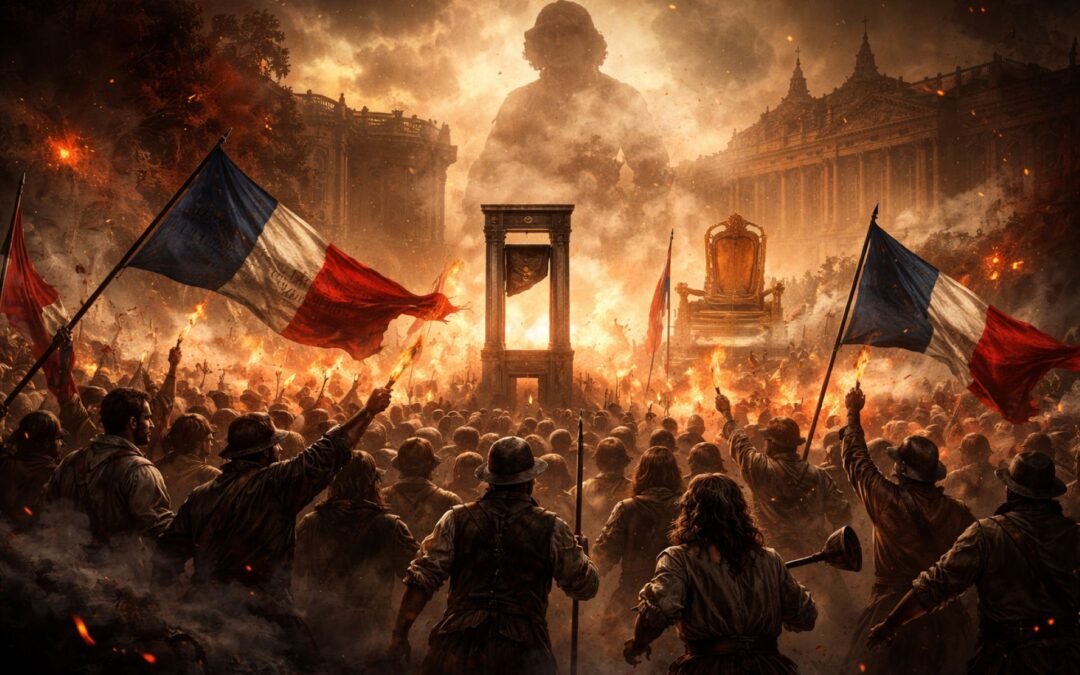
For centuries, France had been one of the most powerful and culturally influential nations in Europe. Its royal courts were famous for their luxury, its aristocracy enjoyed immense privilege, and its monarchy ruled with near absolute authority. Yet beneath the glittering surface of wealth and refinement lay deep inequalities that shaped everyday life for millions of ordinary people.
By the late eighteenth century, the gap between the privileged elites and the struggling masses had become impossible to ignore. Nobles and clergy lived comfortably, often paying little in taxes, while peasants and common citizens carried the overwhelming financial burden of the kingdom. Many were already struggling to survive, and when economic crisis struck, their hardships became unbearable.
At the same time, new ideas were spreading across Europe. Philosophers of the Enlightenment were questioning traditional authority and arguing that governments should exist to serve the people. Concepts such as liberty, equality, and political representation began to inspire growing numbers of citizens who were no longer willing to accept a rigid social system based purely on birth and privilege.
Meanwhile, France itself was sinking into financial disaster. Years of costly wars, lavish royal spending, and poor economic management had left the government deeply in debt. Instead of reforming the system or reducing aristocratic privileges, the monarchy continued to rely heavily on taxing the poorest members of society.
Under these pressures, tensions across the country steadily escalated. Hunger, resentment, and political frustration combined to create a volatile atmosphere. When the monarchy attempted to address the crisis through traditional institutions, it unintentionally set off a chain of events that would transform France forever.
What began as a call for reform soon evolved into one of the most dramatic political upheavals in history. Over the next decade, France would experience revolution, civil conflict, radical political experiments, and widespread violence. Kings would fall, republics would rise, and entirely new ideas about rights and government would reshape not only France but the modern world.
The French Revolution was not a single moment of rebellion, but a complex and turbulent process driven by inequality, fear, ambition, and hope. To understand how it unfolded, we must begin by looking at the society that existed before the revolution—and the conditions that made such a dramatic upheaval almost inevitable.
France Before the Revolution: Wealth at the Top, Misery Below
In the decades before the French Revolution, France was often regarded as one of the most prosperous and culturally refined countries in Europe. Its cities were vibrant centers of art, philosophy, and intellectual life. Royal courts hosted extravagant celebrations, aristocrats enjoyed luxurious lifestyles, and French culture set trends across the continent. On the surface, it appeared to be a flourishing kingdom.
But this prosperity was deeply uneven. French society was structured under a rigid social hierarchy known as the Three Estates, a system that divided the population into distinct groups with vastly different rights and privileges.
The First Estate consisted of the clergy—members of the Catholic Church. Although relatively small in number, the clergy held significant influence over both religion and education. They owned large amounts of land and collected a religious tax known as the tithe from the population. Despite their wealth and power, many members of the clergy were largely exempt from the heavy taxes imposed on ordinary people.
The Second Estate was made up of the nobility. These aristocrats occupied the highest positions in government, the military, and society. They controlled enormous estates, enjoyed legal privileges, and often paid very little tax. Many nobles spent their time at the royal court or managing their lands, living comfortably from the labor of others.
The Third Estate, however, included everyone else. This meant the vast majority of the population—peasants, laborers, artisans, merchants, and members of the emerging middle class. In fact, this estate represented roughly 98 percent of the French population. Yet despite its size, it possessed the least political power and carried the heaviest economic burdens.
For peasants living in rural areas, life could be extremely harsh. Many were required to give a portion of their harvest to their local lord, pay taxes to the state, and provide labor for public works without compensation. Even small farmers often struggled to produce enough food to support their families.
Urban workers faced their own difficulties. In cities like Paris, wages were often low and unstable, while the cost of basic necessities could rise quickly. Bread, the staple food of the French population, consumed a large portion of a working family’s income. When prices increased, survival itself could become uncertain.
Despite these hardships, the privileged classes continued to live extravagantly. Aristocrats attended lavish parties, wore expensive clothing, and spent enormous sums maintaining their status. Many seemed completely disconnected from the suffering of the people who supported their wealth.
This glaring inequality created a growing sense of injustice among the population. More and more people began questioning why society should be organized around birth and privilege rather than fairness and merit. While these frustrations simmered for years, they would soon be intensified by economic crisis and new revolutionary ideas that challenged the foundations of the old social order.
A Kingdom in Debt: War, Spending, and Economic Crisis
While social inequality had long existed in France, the situation became far more dangerous when the kingdom’s finances began collapsing in the eighteenth century. By the time Louis XVI came to the throne in 1774, France was already struggling under a massive national debt created by decades of expensive wars and government mismanagement.
One of the biggest financial disasters came from France’s long rivalry with Britain. The two powers had fought numerous conflicts throughout the eighteenth century, including the Seven Years’ War. France’s defeat in that conflict had been particularly costly. Not only did it lose much of its colonial territory in North America, but the war also left the French treasury severely strained.
Instead of focusing on rebuilding the country’s finances, the French monarchy continued spending heavily. Maintaining the royal court at Versailles required enormous sums of money. The palace functioned almost like a stage for aristocratic life, where nobles competed for royal favor through elaborate ceremonies, expensive clothing, and extravagant social events. The cost of sustaining this lifestyle placed further pressure on an already fragile economy.
Then came another costly decision. When the American colonies began their rebellion against Britain in the 1770s, France saw an opportunity to weaken its long-time rival. The French government provided financial and military support to the American revolutionaries, helping them secure independence.
Although this decision succeeded politically, it worsened France’s financial problems dramatically. The war required enormous loans, and when it ended, France found itself buried under even greater debt. The government had spent huge amounts of money with little realistic plan for how to repay it.
As the crisis deepened, the monarchy faced a difficult choice. It could attempt meaningful reforms by taxing the wealthy nobles and clergy who had long enjoyed financial privileges, or it could continue placing the burden on the lower classes.
Unfortunately, meaningful reform proved extremely difficult. The aristocracy fiercely defended its tax exemptions, and any attempt to change the system faced strong political resistance. As a result, the monarchy repeatedly fell back on the easiest option: increasing taxes on the people who could least afford them.
By the late 1780s, the financial crisis had reached a breaking point. The French government was effectively bankrupt, unable to meet its obligations or stabilize the economy. What had begun as a problem of debt was rapidly evolving into a full political crisis—one that the monarchy was increasingly incapable of controlling.
Enlightenment Ideas and the Growing Question of Power
While France struggled with economic hardship and social inequality, another powerful force was quietly reshaping the way people thought about authority and government. Throughout the eighteenth century, a movement known as the Enlightenment spread across Europe, encouraging people to question long-standing traditions and institutions.
Enlightenment thinkers believed that society should be guided by reason rather than unquestioned tradition. Philosophers such as Voltaire, Rousseau, and Montesquieu began challenging the legitimacy of absolute monarchy and hereditary privilege. They argued that political power should not simply belong to kings and aristocrats by birth, but should instead reflect the will and rights of the people.
These ideas circulated widely through books, pamphlets, and intellectual discussions in salons and coffeehouses. Members of the educated middle class, particularly lawyers, writers, and merchants, became deeply interested in these new ways of thinking. Many began to wonder whether France’s rigid social hierarchy was truly fair or necessary.
One of the most influential Enlightenment ideas was the concept of popular sovereignty—the belief that governments derive their authority from the people they govern. If rulers failed to protect the rights and interests of their citizens, then those citizens had the right to challenge or even replace them.
Another powerful concept was equality before the law. Enlightenment thinkers criticized systems where certain classes of people enjoyed special legal privileges while others carried the burden of taxes and labor. In a society increasingly influenced by these ideas, the traditional privileges of the clergy and nobility began to appear unjust.
For many ordinary people, these philosophical arguments helped articulate frustrations they had long felt but rarely expressed openly. The idea that society could be organized differently—that kings might be accountable to their subjects—was both radical and inspiring.
As economic hardship deepened and dissatisfaction with the monarchy grew, Enlightenment ideas provided a powerful intellectual framework for change. What had once been abstract discussions about liberty and equality were gradually becoming political demands.
In this way, the Enlightenment helped prepare the ground for revolution. When the crisis in France finally erupted, these ideas would play a major role in shaping the goals and ambitions of those determined to transform the country’s political system.
Louis XVI and Marie Antoinette: A Weak Monarchy in Crisis
When Louis XVI ascended to the throne in 1774, he inherited a kingdom on the brink of financial collapse. A weak and indecisive ruler, Louis lacked the strength and vision to confront the deepening crises facing France. His reign would become marked by failed attempts at reform and increasingly desperate decisions that would ultimately lead to his downfall.
Louis was not without good intentions—he genuinely wanted to fix the financial problems facing the country. However, he lacked the necessary political skill and decisiveness to enact meaningful change. Early in his reign, he attempted to call the Assembly of Notables, a body composed of nobles and clergy, to discuss reforms and tax increases. Unfortunately, the assembly was unwilling to cooperate, and many of the proposed reforms were rejected.
Louis’s inability to assert control over the nobility and the clergy—a group that held immense power—meant that any attempts at reform would always be blocked by the very people who had the most to lose. His failure to manage these factions weakened his authority and further eroded his standing with the public.
At the same time, his wife, Marie Antoinette, became a figure of public scorn. Born an archduchess of Austria, Marie Antoinette was originally seen as a symbol of political diplomacy—her marriage to Louis was intended to strengthen the alliance between France and Austria. However, her extravagant lifestyle and disregard for the economic suffering of the people quickly made her the target of public resentment.
Despite the crushing poverty and growing unrest among the French people, Marie Antoinette was notorious for her lavish spending on fashion, jewelry, and luxurious parties. Her reputation as the “Madame Deficit” only worsened as rumors circulated about her extravagant personal expenditures while France’s debt spiraled out of control.
To make matters worse, the royal couple’s personal life was far from ideal. The French people were not only concerned with the monarchy’s financial incompetence but also with its dysfunction. The king was known for his lack of assertiveness, while Marie Antoinette was often seen as disconnected from the struggles of the lower classes. Furthermore, the royal couple’s inability to produce an heir in the early years of their marriage caused additional tension, with many questioning the monarchy’s ability to provide stable leadership.
While the court at Versailles lived in excess, the rest of France struggled under a mounting crisis. Starving peasants, overtaxed and underfed, saw the monarchy’s excesses as a cruel reminder of their own suffering. As the economic situation worsened, the French public became increasingly frustrated with the royal family’s inability to address the crisis. What had once been a symbol of grandeur and strength now appeared weak, distant, and out of touch with the reality of life for the common people.
Louis XVI and Marie Antoinette were unable to recognize the extent of the brewing discontent, and their failure to act decisively only fueled the flames of revolution. As the French people grew more desperate, their confidence in the monarchy evaporated, setting the stage for the upheaval that would soon follow.
The Burden of Taxes and the Struggles of the Third Estate
By the late 1780s, France’s financial situation had become dire, and the burden of the nation’s debt was falling squarely on the shoulders of the Third Estate—the peasants, workers, and bourgeoisie (the middle class). These were the people who paid the majority of taxes, despite the fact that they held the least amount of wealth and power.
The First Estate (the clergy) and the Second Estate (the nobility) enjoyed numerous privileges, including exemptions from most taxes. This meant that the vast majority of the tax burden fell on the Third Estate, which made up about 98% of the population. Even though the Third Estate was the backbone of the economy, working tirelessly in fields, factories, and shops, it was continually exploited by both the government and the privileged classes.
Peasants, who made up the largest portion of the Third Estate, were burdened by multiple forms of taxation. They paid a taille (land tax), a gabelle (salt tax), a vingt-et-un (a tax on the sale of goods), and even had to pay tithes to the church. In addition, many peasants were subject to feudal dues, where they were forced to work on their lord’s land without pay or pay rent for the use of common resources like mills and ovens. These feudal dues, combined with the burden of taxes, left peasants with little to no ability to improve their lives.
The situation was only made worse by poor harvests in the late 1780s. A series of harsh winters and wet summers destroyed crops, resulting in food shortages and a skyrocketing price of bread—the staple food for most of the population. As prices soared, many in the Third Estate found themselves unable to afford basic sustenance. In urban areas like Paris, workers struggled to make ends meet, and the resentment toward the wealthy elite deepened.
The growing economic hardship led to widespread anger and disillusionment. The Third Estate, particularly the peasants and urban workers, began to question the fairness of a system where they were taxed heavily while the clergy and nobility enjoyed privileges that kept them exempt from contributing to the financial burden. These frustrations were compounded by the visible excesses of the royal court. The lavish spending of Louis XVI and Marie Antoinette, while the country teetered on the brink of bankruptcy, only fueled the perception that the monarchy and the aristocracy were out of touch with the suffering of the people.
The increasing resentment towards the nobility and the clergy, who continued to protect their own privileges while the masses suffered, played a crucial role in the growing discontent. It wasn’t just the financial burden that the Third Estate resented; it was the fundamental injustice of a system that allowed the privileged few to remain untouched while the majority struggled to survive.
By 1789, the situation was becoming untenable. As economic pressures mounted and hunger spread across the country, the French people were ready for change. Their anger at the inequality of the tax system and the lavish lifestyle of the elite would soon propel them into action, setting the stage for the revolution that would alter the course of French history.
Bread Shortages, Harsh Weather, and Rising Public Anger
The summer of 1788 was one of the hottest and driest in living memory, and its impact on France’s agricultural production was catastrophic. The crops failed. Bread, the most basic and essential food for the vast majority of the French population, became increasingly scarce. The poor harvests were followed by rising bread prices, which, for many, meant hunger and desperation. For the working classes, it was a matter of survival.
In the cities, especially Paris, bread became an increasingly rare and expensive commodity. The price of a loaf of bread was so high that many families could not afford to feed themselves, and the working poor began to take to the streets in protest. Food riots and violent protests broke out, as hungry people demanded that the government take action.
Meanwhile, the rural poor were also suffering. The failure of the harvest had left them with little or no income, as many had relied on the grain harvest for survival. They had no choice but to live off what little they could grow for themselves, if they had the means to do so at all. The once-vibrant French countryside, with its markets and fairs, had become a place of desolation for many.
To make matters worse, the economic situation was compounded by rising taxation. The tax burden on the Third Estate was unbearable, but it was only becoming worse. The monarchy had decided to increase taxes to fund the growing debt, forcing the peasants and working classes to bear the financial strain. These taxes only exacerbated the poverty and hardship already experienced by the people.
The angry mobs that had previously taken to the streets over bread shortages began to voice their frustration at the monarchy itself. The people of Paris, already disillusioned with the royal family and the nobility, felt that the system had abandoned them entirely. The king and queen’s lavish spending on personal luxuries seemed to represent a grotesque contrast to the suffering of the common folk.
And it wasn’t just the poor who were angry. Enlightenment ideas had begun to spread throughout France, and many of the middle class, including merchants and intellectuals, were also dissatisfied with the monarchy’s inability to address the economic crisis. The nobility’s refusal to pay taxes only fueled the anger of those who worked the hardest and had the least.
By the spring of 1789, public anger was at a boiling point. Bread prices had risen to levels never seen before, and the people were suffering in every corner of the country. The royal court at Versailles remained detached from the reality of the situation, continuing to indulge in parties and lavish lifestyles. This disconnect between the monarchy and the suffering of its people further fueled the growing dissatisfaction.
In Paris, the discontent was palpable. The streets were alive with the voices of those who had nothing left to lose. The French Revolution was not yet an official movement, but its seeds had already been sown. The people were tired of the injustices, and they were ready for change. What had started as hunger and economic hardship was rapidly evolving into a demand for political and social reform. The monarchy, unaware of how deeply their people had been pushed, was about to face a reckoning that would forever change the course of history.
The Estates-General and the Birth of the National Assembly
By the spring of 1789, France’s economic crisis was at its peak. Faced with mounting debt, an angry population, and the threat of widespread unrest, King Louis XVI called for the Estates-General to meet for the first time in over 170 years. This assembly was meant to address the kingdom’s financial problems and propose solutions. It was composed of representatives from the Three Estates: the clergy (First Estate), the nobility (Second Estate), and the common people (Third Estate).
However, the calling of the Estates-General revealed the deep divisions within French society. Each estate was granted one vote, which meant that the privileged clergy and nobility, who together made up a small percentage of the population, could easily outvote the Third Estate, which represented the overwhelming majority of the French people. This setup reinforced the inequality of the system, and the Third Estate, which was already frustrated by its powerlessness, saw this as yet another example of their disenfranchisement.
When the Estates-General convened in May 1789, the Third Estate found itself at a disadvantage. They were not only underrepresented in comparison to the other estates, but the monarchy and the aristocracy were also unwilling to grant them the influence necessary to propose significant reforms. The King had called the assembly in hopes of finding solutions to the kingdom’s fiscal crisis, but he made no effort to address the fundamental inequalities within the political system.
The Third Estate quickly realized that they would not be able to achieve meaningful change through the existing structure of the Estates-General. As they clashed with the other estates, members of the Third Estate began to consider a more radical solution: breaking away and forming their own government.
On June 17, 1789, the Third Estate declared itself the National Assembly. This was a revolutionary act, as it marked the first step toward dismantling the old political order and establishing a government that would be accountable to the people. The members of the National Assembly boldly proclaimed that they represented the will of the French people and that the Estates-General could no longer act as the sole governing body of France.
The decision to form the National Assembly was a direct challenge to King Louis XVI’s authority. However, the King was not immediately able to suppress this challenge. Instead, the situation began to escalate, and soon, tensions in Paris and beyond would force Louis to confront the new power rising within the National Assembly.
As the National Assembly began to take shape, the members began drafting new laws and pushing for reforms that would ensure more representation for the common people. They demanded that the monarchy share its power and that the political system be restructured to reflect the needs of the people.
This was a turning point. What had started as an attempt to address France’s financial crisis was evolving into a struggle for a more just, representative government. The National Assembly’s formation marked the beginning of a fundamental shift in French politics—a shift that would soon lead to the overthrow of the monarchy and the establishment of a republic.
The Tennis Court Oath and the Challenge to Royal Authority
As tensions between the estates grew, the National Assembly found itself in direct opposition to the monarchy. In a pivotal moment on June 20, 1789, the National Assembly was locked out of the meeting hall at Versailles. Faced with this rejection, the members of the Third Estate refused to back down. They moved to a nearby indoor Tennis Court and took an oath that would resonate through history—the Tennis Court Oath.
The oath, taken by nearly 600 members of the National Assembly, was a promise to not separate until a new constitution for France had been created. This dramatic gesture was a clear statement that the National Assembly would not be silenced, and it marked the first defiant act of the revolution. The members vowed to continue meeting, regardless of whether the King allowed it, and they made it clear that they were now the legitimate government of France.
The Tennis Court Oath was a moment of both determination and defiance. It was not just a commitment to reform—it was a rejection of the King’s authority and an assertion that sovereignty rested with the people. The Third Estate, which had long been marginalized and disenfranchised, was now claiming the right to shape the future of France.
King Louis XVI, aware of the growing unrest, initially resisted. He attempted to suppress the National Assembly by calling for the other estates to join him in rejecting the Third Estate’s actions. However, the King’s attempts to maintain control only served to further alienate him from the people. His authority was weakening, and the sense of rebellion among the National Assembly’s members continued to grow.
Meanwhile, in Paris and across the countryside, news of the Tennis Court Oath spread rapidly. The people, many of whom were already frustrated with their living conditions and the monarchy’s inability to address the crisis, found inspiration in this bold stand. The National Assembly’s commitment to reform became a rallying cry for those seeking change.
As the months passed, the tension between the monarchy and the revolutionaries only escalated. The National Assembly continued its work on drafting a constitution, while the King tried to assert his control over the situation. But with each passing day, the gap between the monarchy and the people widened, and the stage was set for even more dramatic events. The Tennis Court Oath had not only marked the beginning of the revolution; it had ignited a movement that would soon sweep across France and challenge the monarchy in ways that no one could have predicted.
Fear in Paris and the Storming of the Bastille
By the summer of 1789, France was on the brink of full-scale revolution. In Paris, fear and uncertainty were spreading like wildfire. The people, already suffering from high bread prices, poor harvests, and increasing poverty, were now hearing rumors that the King was preparing to use military force to crush the National Assembly and restore royal authority.
The fear of a royal crackdown was compounded by the sudden dismissal of Jacques Necker, the popular finance minister who had supported some reform efforts. His dismissal enraged the people, who saw it as an attempt by the monarchy to tighten its grip on power. Protestors took to the streets, calling for action, but they had no real weapons—until they heard about the Bastille.
The Bastille, a fortress prison in Paris, had long been a symbol of royal tyranny. Although it housed only a small number of prisoners at the time, its sheer size and oppressive architecture made it a potent symbol of the monarchy’s absolute power. The Bastille was also rumored to hold weapons and gunpowder that could be used to defend the revolutionaries.
On the morning of July 14, 1789, thousands of Parisians, fueled by anger and fear, gathered outside the Bastille. The crowd was a mixture of working-class men, artisans, and soldiers who had defected to the revolutionary cause. They demanded that the prison’s governor, Bernard-René de Launay, surrender the weapons and gunpowder inside the fortress.
De Launay hesitated, initially attempting to negotiate with the crowd. However, the situation quickly escalated, and violence erupted. The revolutionaries stormed the Bastille, overwhelming the guards and breaking through its gates. After hours of fighting, the prison was finally captured, and Governor de Launay was taken prisoner. Soon after, he was executed by the mob and his head was paraded on a pike through the streets of Paris.
The fall of the Bastille was a turning point. It marked the first major victory for the revolutionaries and sent a clear message to the monarchy that the people would no longer tolerate oppression. The event is often seen as the symbolic beginning of the French Revolution, a moment when the French people took their fate into their own hands and openly defied the power of the King.
News of the Bastille’s fall spread quickly, and similar uprisings occurred in other cities across France. The monarchy could no longer ignore the depth of the crisis facing the country. The storming of the Bastille was not just a symbolic act of rebellion; it was the first major military engagement of the revolution, and it shattered any remaining sense of security that the monarchy had.
The fall of the Bastille ignited a wave of revolutionary fervor. It emboldened the revolutionaries and further undermined the King’s authority. The revolution was no longer just a political movement—it had become a powerful force that would reshape France and the entire political landscape of Europe.
Radical Voices and the Spread of Revolutionary Violence
The storming of the Bastille marked a decisive moment in the French Revolution, but it also unleashed forces that would soon spiral beyond the control of even the revolutionaries themselves. As the revolutionary tide surged through Paris and the countryside, the initial calls for reform gave way to more radical demands. The desire for justice, equality, and revenge against a system of oppression quickly turned violent.
In the wake of the Bastille’s fall, there was a widespread fear of counter-revolutionary activity. Many aristocrats, clergy, and royalists feared for their safety and began fleeing France. This only heightened the paranoia among the revolutionaries, who feared that foreign monarchies and traitors within France were conspiring to restore the old order.
Radical leaders like Jean-Paul Marat, a physician and journalist, used these fears to stoke the flames of revolution. Marat, who had been advocating for a more extreme course of action, saw the revolution as a battle for survival. He published a radical newspaper, “The Friend of the People,” which called for violent measures against anyone perceived as an enemy of the revolution.
Marat’s inflammatory rhetoric found a receptive audience among the Parisian sans-culottes—working-class Parisians who became a key force behind the revolution. They were eager for change but also bitterly resentful of the aristocracy and the old social order. Under the influence of Marat’s writings, they began calling for the execution of anyone deemed to be counter-revolutionary. The call for “justice” soon turned into a call for bloodshed.
As the revolution spread to the provinces, the September Massacres of 1792 highlighted the increasingly violent mood of the revolutionaries. Rumors that counter-revolutionary forces were preparing to break out of prisons and assist foreign invaders led the revolutionary government to authorize the mass killing of suspected royalists and traitors. Over several days, revolutionary mobs stormed prisons, pulling out aristocrats, clergy, and any others thought to be sympathetic to the monarchy, and executed them on the spot. In total, around 1,200 to 1,400 people were killed during the massacres.
This wave of violence signaled the rise of the Reign of Terror, a period of extreme repression and bloody executions that would soon follow. It was a time when revolutionaries, now in power, began using terror as a tool to eliminate enemies and consolidate their control over France. While some saw the Reign of Terror as necessary to protect the revolution, others began to question whether the violence had gone too far.
The Committee of Public Safety, led by figures like Maximilien Robespierre, was formed to oversee the war effort and internal security. It soon took on dictatorial powers, and the guillotine became the symbol of this ruthless period. Thousands of people, including Queen Marie Antoinette, former nobles, and even some of the revolution’s own leaders, were sent to their deaths.
Robespierre and the radical Jacobins believed that the terror was justified by the need to protect the revolution and to root out anyone who might betray it. However, as the violence escalated and the number of executions increased, even some of Robespierre’s former allies began to see him as a danger to the revolution itself. The radicalization of the revolution and the growing thirst for violence led to a breakdown in unity among the revolutionaries.
Though the Reign of Terror was meant to secure the revolution, it began to alienate many who had initially supported it. As the bloodshed continued, France was becoming more divided than ever. The revolution had sparked hopes for freedom and equality, but the spread of revolutionary violence showed just how fragile those ideals were in the face of deep political instability. The revolutionaries now faced the difficult task of not only overthrowing the monarchy but also trying to maintain control over a country teetering on the edge of chaos.
The Declaration of the Rights of Man and Revolutionary Ideals
Amid the chaos and violence of the early revolution, the National Assembly began to take steps toward the creation of a new political and social order. One of the most significant achievements of this period was the adoption of the Declaration of the Rights of Man and of the Citizen on August 26, 1789. This document became a cornerstone of the revolution, articulating the fundamental principles of liberty, equality, and fraternity that would guide the new French Republic.
Inspired by Enlightenment ideas and the success of other revolutions, particularly in America, the Declaration outlined basic human rights that were meant to be universal and inalienable. It rejected the privileges of birth, affirming that all men are born free and equal in dignity and rights. It declared that the sovereignty of the nation resides in the people, and that laws must be based on the general will of the people, not the arbitrary power of the king or nobility.
The document also emphasized the importance of freedom of speech, freedom of the press, and the right to property. It stated that people should be allowed to express their opinions without fear of persecution, and that property was an inviolable right that could not be arbitrarily taken away. It was a bold statement of human rights, laying the groundwork for the new social contract that would replace the monarchy’s divine right to rule.
However, the Declaration was not without its limitations. Women were notably excluded from its full scope. While the document emphasized equality for all, it only applied to men, reinforcing the gender inequality that was still entrenched in French society. Olympe de Gouges, a playwright and activist, famously responded with her own version of the Declaration, the Declaration of the Rights of Woman and the Female Citizen, which demanded equal rights for women in all areas of life, including education, voting, and property ownership. Yet, her call for gender equality was largely ignored, and women would remain marginalized in the revolution’s early years.
The Declaration of the Rights of Man and of the Citizen was a monumental step toward dismantling the old regime and establishing a republic based on the principles of democracy and human rights. It inspired not only the revolution in France but also revolutionary movements across Europe and beyond. The idea that individuals had certain inalienable rights—regardless of their birth or social status—would go on to influence political thought for centuries.
Despite its aspirational ideals, the Declaration’s promises were difficult to implement in practice. The ongoing violence of the Revolution and the internal divisions among revolutionaries highlighted the challenges of translating these ideals into real change. The Reign of Terror, which followed the Declaration’s adoption, showed that while the revolution sought liberty and equality, achieving those goals would require overcoming immense obstacles, not only from the old regime but from within the revolution itself. As the revolution moved forward, the gap between the lofty ideals of the Declaration and the brutal realities of revolutionary politics would only widen.
The Women’s March on Versailles and the King’s Return to Paris
By the fall of 1789, the French Revolution was spiraling toward a critical turning point, and the monarchy’s grip on power was weakening. While the National Assembly was drafting a new constitution and pushing for reforms, the people of Paris remained deeply dissatisfied with the continued instability and the lack of tangible changes. The economy was in ruins, bread prices remained high, and hunger was widespread. In a highly symbolic act, the revolutionaries began to demand that the King and Queen leave their lavish palace at Versailles and come face-to-face with the hardships of the people.
The immediate catalyst for this movement was the rising cost of bread. In October, a particularly severe shortage of grain led to mass protests by women who, unable to feed their families, took to the streets. These women were not only frustrated by the high price of bread but were also enraged by the apparent indifference of the monarchy to their suffering. They were particularly incensed by Marie Antoinette’s lavish lifestyle, which they saw as emblematic of the monarchy’s disconnect from the everyday struggles of the people.
The protesters, initially a small group of market women, soon grew into a large, angry mob. Armed with weapons such as pitchforks and knives, the women marched from Paris to the royal palace at Versailles, about 12 miles away, demanding that the King and Queen return to Paris to address the crisis. They were joined by a growing crowd of workers, soldiers, and even some revolutionary leaders. The marchers believed that by bringing the King and Queen to Paris, they could force the monarchy to acknowledge the severity of the situation and take action.
As the mob arrived at Versailles, tensions reached a breaking point. The royal family, terrified by the angry crowd, sought refuge within the palace, but their security was no longer assured. In the chaos that followed, the King was forced to meet with the leaders of the protest and agree to their demands. On the evening of October 5, 1789, King Louis XVI and Marie Antoinette reluctantly agreed to leave Versailles and return to Paris with the mob, where they would be placed under the protection of the revolutionaries.
The next morning, the royal family was escorted by a crowd of thousands back to Paris. Their procession, marked by the symbolism of their forced relocation, was a humiliating moment for the monarchy. The marchers had won a significant symbolic victory. It was clear that the King, once a figure of absolute authority, was no longer in control. The monarchy was now effectively a prisoner of the revolution, a mere figurehead whose power had been irreversibly diminished.
The Women’s March on Versailles was a pivotal moment in the revolution. It demonstrated the growing power of the common people—particularly women—and underscored the deepening connection between the revolution and the working classes. The King’s forced return to Paris was not just a defeat for the monarchy; it also symbolized the collapse of the old regime. The once-opulent palace at Versailles, where the monarchy had lived in excess and isolation, was now irrelevant. The future of France would be shaped by the people in Paris, not the aristocrats at Versailles.
In the aftermath of the march, Louis XVI and Marie Antoinette were effectively under house arrest in the Tuileries Palace in Paris, and the monarchy’s authority was severely compromised. The royal family could no longer ignore the revolution or the growing demands for reform. Their fate was now inextricably tied to the revolution, and the once-imposing figure of the king was rapidly becoming a symbol of the past—a symbol of the old world that the revolutionaries sought to destroy.
The King’s Failed Escape and the Collapse of Trust
As the revolution continued to gain momentum, the monarchy’s position became increasingly precarious. King Louis XVI and his family were confined to the Tuileries Palace in Paris, surrounded by revolutionaries and the growing unrest of the French people. Despite being under house arrest, the royal family still held some hopes of restoring their power, and they began to secretly plan their escape from the capital.
In June 1791, Louis XVI and his family, accompanied by a few loyal servants, attempted to flee France in the dead of night. They disguised themselves as commoners and boarded a carriage, intending to make their way to Varennes, a town near the border with the Austrian Netherlands, where they could seek refuge and possibly mount a counter-revolutionary campaign with the help of foreign allies, particularly Marie Antoinette’s Austrian relatives.
However, their escape was doomed from the start. The royal family’s flight was poorly executed, and their movements quickly aroused suspicion. The King’s face was well-known, and it wasn’t long before a postmaster in Varennes recognized him and alerted the authorities. The royal family was captured and brought back to Paris, where their failed escape sent shockwaves throughout the country.
The news of the royal family’s attempt to flee further eroded the monarchy’s already crumbling authority. For many, it was clear that Louis XVI was not loyal to the revolution and had little intention of supporting the reforms that were sweeping the country. The King’s escape attempt was seen as an act of treason, a clear indication that he was trying to abandon his people in their moment of crisis.
The return of the royal family to Paris was humiliating. The people now saw the monarchy as an institution that could no longer be trusted. The King had attempted to escape, effectively admitting that he did not believe in the revolutionary ideals that had brought him back to Paris. Public opinion shifted sharply against him, and he was no longer viewed as a legitimate ruler. The trust between the monarchy and the people had been irreparably shattered.
In the wake of the failed escape, revolutionary leaders and the National Assembly found themselves at a crossroads. Some members of the assembly still sought to preserve the monarchy, but the increasingly radical factions saw the King’s actions as proof that he would never be a genuine ally to the revolution. The revolutionaries were now faced with the reality that they could not move forward with a king who was seen as a symbol of the old regime, whose loyalty lay with the aristocracy and foreign monarchies.
The failed escape marked a turning point in the revolution. The monarchy’s power had been irrevocably undermined, and the question of what to do with the King became a pressing issue. The people had made their discontent known, and the monarchy was no longer an institution that commanded respect or allegiance.
Louis XVI’s attempt to escape was more than just an act of cowardice—it was the beginning of the end for the French monarchy. It accelerated the process of radicalization within the revolution and set the stage for the eventual abolition of the monarchy and the establishment of the First French Republic. The collapse of trust in the monarchy would lead to one of the most dramatic and violent phases of the revolution, as the question of the King’s fate became a matter of national importance.
War, Radicalization, and the Fall of the Monarchy
By the summer of 1792, the French Revolution was entering a new and more dangerous phase. The monarchy was crumbling, the King’s failed escape had exposed his true loyalties, and the revolutionaries were now firmly entrenched in their radical ideals. But as the internal situation worsened, external pressures also mounted, as foreign monarchies watched with alarm the events unfolding in France.
In an effort to preserve the old order, countries like Austria, Prussia, and Great Britain began to mobilize against the revolution. In April 1792, France declared war on Austria, hoping to unite the nation against a common external enemy. However, the war quickly turned disastrous for France. The newly formed French army was poorly equipped, disorganized, and often demoralized, and they suffered a series of defeats on the battlefield. The external threat of foreign invasion, coupled with internal divisions, added to the revolutionaries’ sense of urgency.
At the same time, the pressure from within Paris was growing. The radicals, led by the Jacobins and their fiery leader Maximilien Robespierre, began calling for more drastic action to protect the revolution. Jean-Paul Marat, another prominent radical, used his publication “The Friend of the People” to whip up fervor among the masses, demanding that anyone suspected of being sympathetic to the monarchy or counter-revolutionary forces be eliminated.
The revolutionary government was caught between the external threat of foreign powers and the internal threat of a possible counter-revolution led by royalists and moderates. The French people were terrified of invasion and equally afraid that the monarchy might still be plotting to restore its power. Fear, exacerbated by the ongoing war and internal divisions, began to turn to violence.
In August 1792, the situation in Paris exploded. A mob of revolutionary extremists, fearing that royalists would free the King and restore the monarchy, stormed the Tuileries Palace. The King and his family were forced to flee to the Legislative Assembly for protection. The royal guard was massacred, and the palace was ransacked by the mob. Louis XVI, once the symbol of power and authority, was now a prisoner.
In the wake of the attack on the palace, a sense of chaos and fear gripped the country. The Jacobins and other radicals called for the suspension of the monarchy, and for the immediate establishment of a republic. By September, this radical shift in power culminated in the September Massacres, when mobs of revolutionaries stormed prisons across Paris and massacred thousands of prisoners, including many who were accused of being royalists or enemies of the revolution.
The September Massacres, though justified by the revolutionaries as a necessary act of self-defense, marked a new low in the violence of the revolution. The reign of terror that followed would bring even more bloodshed, but it also cemented the rise of radical leaders like Robespierre, who argued that the revolution could only survive through extreme measures.
In the face of this growing violence and instability, the Legislative Assembly was forced to take action. In September 1792, it declared the monarchy abolished, and the French Republic was born. Louis XVI was stripped of his title and imprisoned, and his family’s status was reduced to that of common prisoners.
The fall of the monarchy was both a victory for the revolution and a moment of irreversible change. The old system, based on centuries of monarchy and aristocracy, was shattered. France was no longer a kingdom, but a republic, where power theoretically resided with the people. Yet the transition from monarchy to republic would not be smooth. The next several years would be marked by increasing radicalization, political violence, and civil conflict, as the revolutionaries fought to determine what the new France would look like.
Louis XVI’s fate was sealed with the monarchy’s collapse. In January 1793, after a trial where he was found guilty of treason, the former king was sentenced to death. On January 21, 1793, he was executed by guillotine in Place de la Concorde, a public spectacle watched by thousands. His death marked the official end of the monarchy and the beginning of an even more turbulent period in the revolution’s history. The fall of the monarchy opened the door for the radical republic to take hold, but it also unleashed the forces of terror, paranoia, and bloodshed that would shape the course of France’s future.
The Execution of Louis XVI and the Birth of the French Republic
The execution of King Louis XVI on January 21, 1793, was one of the most symbolic and transformative events of the French Revolution. It marked not only the end of the monarchy but also the birth of the French Republic. The king, who had been at the heart of the French monarchy for most of his life, was now reduced to a common criminal in the eyes of the revolutionaries. His death was not just the execution of an individual, but the symbolic act of severing ties with the old feudal system and the absolute power of kings.
The king’s trial had been swift and brutal. Louis XVI was charged with treason for attempting to escape from Paris and for his perceived attempts to undermine the revolution. His supporters argued that he had been trying to flee to ensure the survival of the monarchy, but the revolutionaries saw it as an act of betrayal. The trial concluded with a guilty verdict, and Louis was sentenced to death by guillotine. His execution was carried out in Place de la Concorde, where tens of thousands of Parisians gathered to witness the event.
Louis XVI’s execution was an act of political theater, designed to demonstrate the triumph of the revolution over the monarchy. As the guillotine fell, many revolutionaries saw it as a necessary step toward securing the future of the revolution and ensuring that the old aristocratic order would never rise again. For the French people, it was a clear statement that their nation was now a republic, free from the rule of kings and hereditary privileges.
However, the execution also sparked a wave of political instability and heightened tensions both within France and abroad. The monarchy had been the central symbol of the old system, and with its fall, the revolutionaries were faced with the difficult task of defining the future of France. Would it be a democracy or a dictatorship? What would the role of the people be in this new republic? And how would the revolutionaries handle the growing opposition both within France and from foreign monarchies?
Louis XVI’s death also provoked outrage from European monarchies, who saw it as an attack on the entire system of monarchy. Many European powers, including Austria, Prussia, and Great Britain, were horrified by the execution and feared that revolutionary ideas would spread across their own borders. France soon found itself at war with these monarchies, further deepening the country’s political and military crisis.
Internally, the revolution was becoming increasingly radicalized. The revolutionaries, now without a monarch, were forced to confront the growing divisions within their own ranks. The Jacobins, led by Maximilien Robespierre, became the most influential faction, pushing for a more radical republic and greater measures of control over the country. The Girondins, a more moderate faction, favored a less centralized government and were increasingly at odds with the more radical elements of the revolution.
In the months following Louis’s execution, the Reign of Terror began, as Robespierre and the Committee of Public Safety took charge of the revolution. Revolutionary tribunals were established, and thousands of people suspected of being counter-revolutionaries were arrested and executed by guillotine. The revolution, which had started with ideals of liberty and equality, was now being driven by fear and paranoia, as the revolutionaries sought to root out any potential threats to the republic.
The execution of Louis XVI was a moment of both triumph and tragedy for the revolution. It was a victory over the old regime and the birth of the French Republic, but it also marked the beginning of a period of violence and political extremism that would consume the revolution in the years to come. The new republic would face immense challenges, both from internal divisions and from external threats, as it struggled to define its identity and secure its future. The death of the king was the end of one era, but the start of another, one filled with uncertainty and bloodshed.
The Reign of Terror and Robespierre’s Rule
The execution of Louis XVI was a watershed moment in the revolution, but it also marked the beginning of a period of extreme radicalization and violence that would come to define the revolution’s darkest chapter: the Reign of Terror. In the aftermath of the monarchy’s collapse, the revolutionaries, led by the Jacobins and their most prominent figure, Maximilien Robespierre, found themselves grappling with the immense challenges of consolidating power, defending the revolution, and silencing any opposition—at any cost.
The political situation in France was dire. The new French Republic faced external threats from a coalition of European monarchies, including Austria, Prussia, and Britain, who sought to restore the monarchy and destroy the revolution. At the same time, internal divisions within France were deepening, as counter-revolutionary forces—particularly royalists, clergy, and moderate revolutionaries—began to plot against the new republic.
In this climate of fear and instability, Robespierre and the Committee of Public Safety, which he led, argued that the revolution could only survive if its enemies were ruthlessly eliminated. Robespierre’s vision of a “Republic of Virtue” called for the radical reshaping of French society, with a central role for virtue, morality, and revolutionary justice. This vision, however, led to intolerant and authoritarian measures, which included widespread executions of perceived enemies of the revolution.
The Reign of Terror officially began in September 1793 when the Committee of Public Safety assumed full control over the revolutionary government. The Law of Suspects, passed shortly thereafter, expanded the definition of counter-revolutionary activity to include anyone suspected of being hostile to the revolution—whether through inaction, criticism, or even a lack of enthusiasm. The Revolutionary Tribunal was set up to expedite trials, and the guillotine became the symbol of the new government’s resolve to eliminate any threats to its power.
Over the next year, the guillotine claimed tens of thousands of lives, including that of Marie Antoinette and many other prominent royalists, moderates, and even former revolutionary leaders who had fallen out of favor with Robespierre and his allies. The September Massacres of 1792, in which mobs executed suspected royalists and counter-revolutionaries, set the tone for this bloodthirsty period.
While Robespierre and the Jacobins argued that these measures were necessary to preserve the revolution, the sheer scale of the violence soon began to alienate many. Even among the revolutionaries, there were growing concerns about the excessive power of the Committee of Public Safety and the radical policies being implemented. The line between revolutionary justice and tyranny became increasingly blurred.
As the Terror continued, Robespierre’s influence grew, but so did his paranoia. He began to view any opposition, no matter how moderate or reasonable, as a threat to the revolution. The Committee of Public Safety, once a tool to defend the revolution, became a mechanism for Robespierre to wield unchecked power. His speeches became more extreme, and he argued that anyone who didn’t support his vision of the Republic of Virtue was an enemy of the revolution—no matter their political alignment or past revolutionary activities.
However, the Terror eventually began to consume itself. As Robespierre and the Jacobins purged anyone they deemed counter-revolutionary, even their former allies began to fall victim to the relentless demands of the Terror. In 1794, Georges Danton, once a close ally of Robespierre, was executed after being accused of being too moderate. The growing discontent with the violence reached its peak when Robespierre himself was arrested and executed on July 28, 1794—an event that marked the end of the Reign of Terror.
Robespierre’s downfall was swift and brutal. His arrest came after a series of radical measures and public speeches that alienated even his closest supporters. In the Thermidorian Reaction, the revolutionary government rejected the policies that had led to Robespierre’s excesses and moved toward a more moderate stance. Robespierre’s death marked a significant turning point in the revolution, as the violent extremism of the Terror gave way to a more pragmatic, but still unstable phase of the revolution.
The Reign of Terror left a lasting mark on France, casting a shadow over the ideals of liberty and equality that had originally inspired the revolution. While Robespierre had sought to create a virtuous republic, his methods had led to fear, suspicion, and bloodshed. The Terror ultimately shattered the unity of the revolutionaries and set the stage for the rise of Napoleon Bonaparte, who would bring an end to the revolution and establish his own authoritarian rule. Yet, the ideals of the revolution—the rights of man, popular sovereignty, and the abolition of the monarchy—would continue to shape France and the world for years to come, even as the revolution’s radical period came to a violent and tragic close.
The Fall of Robespierre and the End of the Terror
The Reign of Terror officially ended with the fall of Maximilien Robespierre in July 1794. Although Robespierre had been one of the revolution’s most powerful and influential leaders, his increasingly dictatorial rule and the escalating violence of the Terror ultimately led to his downfall. The Thermidorian Reaction, as this period of moderation was called, signified a major shift away from the extreme measures that had dominated the revolution during the previous year.
By mid-1794, the constant executions, mass arrests, and growing political repression had caused significant unrest within the revolutionary government. Moderates, who had once been allies of Robespierre and the Jacobins, began to view him as a threat to their own survival. Even within the Committee of Public Safety, Robespierre’s radicalism alienated many of his fellow revolutionaries.
One of the key turning points leading to his downfall was his increasingly paranoid behavior. Robespierre’s speeches and actions grew more extreme, and he began accusing his fellow revolutionaries of being enemies of the state. The more Robespierre attempted to purify the revolution, the more his influence and alliances weakened.
In the days leading up to his arrest, Robespierre seemed to believe that he was the last guardian of the revolution’s ideals. He called for more purges, but this time, the National Convention—the governing body that had once supported him—revolted. On July 27, 1794 (9 Thermidor in the revolutionary calendar), Robespierre was arrested, along with many of his allies. The next day, July 28, he was executed by guillotine in the same Place de la Concorde where thousands had met the same fate during the Terror. The fall of Robespierre marked the end of the Reign of Terror.
Robespierre’s execution was celebrated by many as the end of the revolution’s most violent and oppressive phase. With his death, the Jacobin influence began to wane, and the Committee of Public Safety was weakened. The period that followed was characterized by political instability and the gradual re-emergence of more moderate forces, known as the Thermidorian reactionaries. The National Convention took steps to dismantle the mechanisms of terror, releasing many of the prisoners arrested during the purges and curbing the power of the Revolutionary Tribunal.
However, despite the end of the Terror, the revolution was far from over. The Republic was still under significant threat, both from internal royalist uprisings and external military pressure. Although the radical period of the revolution was over, France remained in a state of near-anarchy, as different factions vied for control.
This power vacuum ultimately set the stage for Napoleon Bonaparte, a military general who had gained fame for his successes in Italy, to rise to prominence. In 1799, just five years after Robespierre’s execution, Napoleon staged a coup d’état that overthrew the government and placed him in power, ending the revolution and marking the beginning of his rule as First Consul and, later, Emperor of France.
Though the revolution itself had ended, its impact was profound and far-reaching. The fall of Robespierre and the end of the Reign of Terror were symbolic of the revolution’s complex legacy—a revolution that sought to establish a new order based on liberty, equality, and fraternity, but was marred by violence, political infighting, and the failure to establish lasting stability.
Despite these flaws, the French Revolution reshaped the political landscape of France and the world. The abolition of the monarchy, the establishment of the Republic, and the radical shifts in political thought would continue to influence not only France but also other revolutions across Europe and the Americas for centuries to come. The Revolution’s core ideals—liberty, equality, and fraternity—would continue to resonate and shape modern democratic thought long after the fall of Robespierre and the end of the Terror.
The Directory and the Political Chaos of Post-Revolutionary France
With the fall of Robespierre and the end of the Reign of Terror, France entered a period known as the Directory, which lasted from 1795 to 1799. This period was marked by political instability, corruption, and economic turmoil as the revolutionaries attempted to stabilize the newly established French Republic. Despite the initial excitement of creating a new government, the Directory struggled to govern effectively and became increasingly unpopular.
After Robespierre’s execution, the National Convention set out to create a new constitution. The resulting Constitution of 1795 established the Directory, a five-member executive body intended to provide leadership and stability. However, the Directory was weak from the start. It faced constant opposition from royalist factions, who sought to restore the monarchy, and from radical revolutionaries, who believed that the revolution had not gone far enough.
Internally, the Directory was beset by corruption and inefficiency. The Thermidorian Reaction had replaced the revolutionary fervor of the previous years with a more moderate and pragmatic approach to governance, but this shift came at a price. The Directory was riddled with corruption, with directors and officials often using their positions to enrich themselves. The government was ineffective at addressing the country’s ongoing economic issues, and the French people were disillusioned by the lack of tangible results from the revolution.
In addition to these internal struggles, France was still embroiled in a series of foreign wars. The First Coalition, consisting of Austria, Prussia, Britain, and other monarchies, continued to wage war on revolutionary France. The French military was stretched thin, and despite the efforts of generals like Napoleon Bonaparte, France’s enemies were still a significant threat.
The Directory’s inability to achieve meaningful reforms and its reliance on military force only further alienated the people. Civil unrest continued to simmer, and in 1797, royalist uprisings in Paris were put down by the military. The Directory’s power was constantly threatened by counter-revolutionary forces who wanted to restore the monarchy and by radicals who sought a return to the more extreme policies of the earlier revolution.
In 1799, the Directory’s hold on power finally came to an end when Napoleon Bonaparte, the popular military general who had achieved significant victories in Italy and Egypt, staged a coup d’état. With the support of key political and military leaders, Napoleon overthrew the Directory and replaced it with a consulate, effectively making him the leader of France. The coup marked the end of the revolution’s most radical phase and the beginning of Napoleon’s rise to power as First Consul, a position he would use to establish his control over France.
The Directory, while having brought an end to the worst excesses of the revolution, failed to bring about lasting stability. Its political chaos, corruption, and reliance on military force demonstrated the challenges of creating a republic in the aftermath of the monarchy’s collapse. The revolution’s ideals—liberty, equality, and fraternity—had not yet been fully realized, and the French people were left searching for a leader who could bring stability and order to their fractured nation.
Napoleon’s rise to power marked the end of the revolutionary experiment and the beginning of a new era for France. While the Directory had tried to uphold the principles of the revolution, its failure paved the way for a more authoritarian regime. However, the legacy of the revolution—the idea that sovereignty lay with the people, that rights should be guaranteed, and that the monarchy had no place in modern government—would continue to influence not only France but the world for generations to come. The French Revolution, despite its flaws and contradictions, had reshaped the political landscape of Europe and left an indelible mark on the course of history.
The Rise of Napoleon Bonaparte
The chaotic final years of the French Revolution and the instability of the Directory set the stage for a new kind of leader—one who could bring order and stability to a nation still reeling from years of war, revolution, and political strife. This leader was Napoleon Bonaparte, a military general who had gained fame for his brilliant campaigns in Italy and Egypt. Though the revolution had dethroned the monarchy and created a republic, it had failed to bring the stability the French people desperately needed. Napoleon, with his ambition and military prowess, would eventually rise to power, marking the end of the revolution and the beginning of a new era in France.
Napoleon’s early career in the French military played a significant role in his ascent. Born on the island of Corsica in 1769, Napoleon’s humble beginnings did not deter him from pursuing a military career. He rose through the ranks quickly, showing exceptional talent in strategy and leadership. By the time the Revolution began, Napoleon had already established himself as a capable officer in the French army.
During the revolutionary wars, France’s enemies—particularly Austria, Prussia, and Britain—had been trying to crush the revolution and restore the monarchy. Napoleon distinguished himself in battle, especially during his campaign in Italy (1796–1797), where his tactics led to a series of remarkable victories. His success on the battlefield made him a national hero and helped boost his popularity, which would prove crucial in his rise to power.
In 1799, as the Directory was faltering, Napoleon returned from an unsuccessful campaign in Egypt to find France in a state of political crisis. The revolution had produced a government that was weak, divided, and increasingly unpopular. The people were dissatisfied with the Directory’s inability to solve the country’s financial problems, end the wars, or restore social order. Political factions in Paris were locked in constant conflict, and the nation seemed poised on the brink of collapse.
Seizing the opportunity, Napoleon, with the backing of influential political and military figures, orchestrated a coup d’état on November 9, 1799 (18 Brumaire). The coup overthrew the Directory and replaced it with a new governing body, the Consulate, with Napoleon as one of the three consuls. Within a short time, Napoleon maneuvered his way into the position of First Consul, effectively becoming the leader of France.
With the support of the military and key political elites, Napoleon consolidated power rapidly. In 1802, he declared himself Consul for Life, further solidifying his control. In 1804, a few years after stabilizing the country, he took the ultimate step in securing his power—he crowned himself Emperor of the French in a lavish ceremony in Notre Dame Cathedral in Paris. This act marked the end of the revolutionary ideals of a republic, and the dawn of a new imperial France under Napoleon’s rule.
Napoleon’s rise was the result of a combination of factors—his military genius, his ability to read the political landscape, and his exploitation of the revolutionary desire for stability. He promised to bring order to France, end the wars, and protect the gains of the revolution, such as the abolition of feudal privileges and the spread of legal equality. Many of his reforms, such as the Napoleonic Code, which standardized French law and guaranteed civil liberties, were based on revolutionary ideals.
However, Napoleon’s rule quickly grew more autocratic. While he did maintain some aspects of the revolutionary reforms, he increasingly relied on military might and imperial authority to sustain his power. His conquests across Europe aimed to spread revolutionary ideas, but they were also driven by personal ambition and a desire for glory. Napoleon would become not only the ruler of France but also the master of much of Europe, creating an empire that spanned from Spain to Russia at its height.
Despite his early successes, Napoleon’s empire would eventually begin to unravel. His aggressive expansionism, epitomized by his disastrous invasion of Russia in 1812, led to mounting military defeats. The coalition forces, including Britain, Prussia, and Russia, gradually wore down Napoleon’s empire. By 1814, after a series of defeats, he was forced to abdicate and was exiled to the island of Elba.
Though he briefly returned to power in 1815 for a period known as the Hundred Days, he was defeated at the Battle of Waterloo and exiled once again, this time to the remote island of Saint Helena, where he would die in 1821.
Napoleon’s rise and fall marked the end of the French Revolution and the beginning of a new era in European history. His legacy is complex: while he did preserve many of the revolution’s gains, such as legal equality and the abolition of feudalism, his rule was increasingly characterized by authoritarianism, military conquest, and imperial ambition. He reshaped not only France but also much of Europe, leaving a lasting impact on politics, law, and warfare. The French Revolution had begun as a struggle for liberty, equality, and fraternity, but it was Napoleon who would define the future of France and Europe for decades to come.
Conclusion
The French Revolution, which began in 1789 with hopes of creating a fairer and more just society, was a complex and tumultuous journey that reshaped France—and the world—forever. What started as a movement for political and economic reform rapidly spiraled into radical change, violence, and political instability. The fall of the monarchy, the rise of the Republic, the Reign of Terror, and the eventual emergence of Napoleon Bonaparte as a ruler signified the profound transformation of French society.
At the heart of the revolution was the idea of popular sovereignty—the belief that government should derive its power from the people, not from divine right or inherited privilege. This idea inspired countless movements across the globe and helped shape modern notions of democracy, civil rights, and the role of the state. The Declaration of the Rights of Man and of the Citizen outlined these ideals, emphasizing liberty, equality, and fraternity as the foundations for a new political order.
Yet, the revolution’s journey was fraught with contradictions. The same ideals of freedom and equality that inspired the revolution also led to violence and radicalization. The Reign of Terror, in which thousands of people were executed for suspected counter-revolutionary activity, demonstrated the challenges of maintaining revolutionary ideals in the face of fear, political infighting, and the pressure of external war. The execution of Louis XVI and the end of the monarchy marked a dramatic shift, but the question of how to build a new government without falling into the same tyranny they had overthrown remained unresolved.
The Directory, a more moderate government that followed the Terror, ultimately failed to provide the stability and direction that France needed. Its failure paved the way for Napoleon Bonaparte, who rose to power, effectively ending the revolution and establishing his own authoritarian regime. Though Napoleon preserved some revolutionary gains, such as the abolition of feudalism and the implementation of the Napoleonic Code, his rule grew increasingly autocratic, and the revolution’s promise of democracy gave way to imperial rule.
Despite its contradictions and violent phases, the French Revolution’s impact is undeniable. It abolished the monarchy, challenged the old social order, and spread ideas of equality and human rights that would echo through future revolutions across the globe. The revolution sparked a rethinking of how societies should be governed and what freedoms individuals should possess. Though Napoleon’s rise to power marked the end of the revolutionary experiment, the ideas of liberty, equality, and fraternity continued to shape political movements for generations.
In the end, the French Revolution was both a triumph and a tragedy. It demonstrated the power of the people to reshape their world, but it also revealed the dangers of unchecked power, radicalism, and the pursuit of idealistic change without careful consideration of its consequences. As France and Europe moved forward, the lessons of the revolution would continue to resonate, shaping the course of modern history and the ongoing struggle for justice, equality, and freedom.