
Introduction: Humanity’s Obsession With the Unanswerable
Some questions refuse to die.
They persist across centuries, cultures, and civilizations, quietly haunting the human mind. Long before science, before organized religion, even before written language, human beings were already grappling with them—questions so fundamental that entire belief systems were constructed in the attempt to answer them.
Why are we here?
Is there a God?
Do we truly choose our actions?
These are not just abstract curiosities. They shape how we live, how we judge, how we hope, and how we fear. Empires have risen and fallen under the weight of these ideas. Religions have flourished by offering answers. Philosophers have spent lifetimes dissecting them, only to leave behind more interpretations than conclusions.
And yet, despite thousands of years of debate, observation, and intellectual effort, we are still standing in the same place: uncertain.
This is the strange paradox of human existence. We are intelligent enough to ask these questions, but perhaps not equipped to answer them. Science continues to push boundaries and illuminate parts of reality that were once hidden in darkness. It may, one day, offer clarity where there is currently confusion. But for now, these questions remain suspended—unresolved, elusive, and deeply compelling.
What makes them even more fascinating is not just their difficulty, but their resistance to closure. Every answer seems to create new problems. Every theory leaves something unexplained. The closer we look, the more the ground beneath us seems to shift.
This article does not attempt to solve these questions. That would be an impossible task. Instead, it explores five of the most enduring philosophical questions—questions that continue to challenge our understanding of reality itself.
Not to find answers, but to understand why they may never come.
Does God Exist?
Few questions have shaped human history as profoundly as this one.
For most of our past, the answer wasn’t just a matter of personal belief—it was enforced. To deny the existence of God was not merely controversial; it was dangerous. Entire societies were built on the assumption that a divine force governed existence, and questioning that assumption could lead to exile, imprisonment, or worse.
Today, the landscape is different. The question still divides people, but the consequences are mostly intellectual rather than physical. What has emerged instead is a spectrum of positions—each attempting to deal with the same fundamental uncertainty.
At one end, there are atheists who reject the idea of God altogether. Their argument often rests on the absence of empirical evidence. If something exists, it should, in theory, leave behind traces that can be observed, tested, and verified. God, in this sense, appears invisible to scientific scrutiny. But this position carries its own difficulty: proving that something does not exist is just as problematic as proving that it does. The absence of evidence is not necessarily evidence of absence.
On the opposite side are theists, who affirm the existence of God. Their arguments take many forms. Some point to religious texts—the Bible, the Quran—as works of such depth and complexity that they seem unlikely to be purely human creations. Others appeal to the apparent design of the universe: the precise conditions that allow life to exist, the intricate structure of biological systems, the sheer order underlying chaos. To them, these are not coincidences but signs of intention.
Between these two positions lies agnosticism, which avoids commitment altogether. Agnostics argue that the question itself may be beyond human capacity to answer. If God exists outside the boundaries of space, time, and physical law, then the tools we use to understand reality—science, observation, logic—may simply be inadequate.
But there is a deeper complication that often goes unnoticed.
When we ask, “Does God exist?”, what exactly are we referring to?
Are we talking about the personal God described in religious traditions—one who listens, judges, and intervenes? Or are we referring to something more abstract: a creator of the universe, an initial cause, a force beyond comprehension? These are not the same ideas, yet they are often treated as if they are.
The ambiguity of the question makes it even harder to answer. It’s like trying to prove the existence of something without first agreeing on what that thing is.
And then there is the scale of the universe itself. The more we learn about it, the more it expands beyond our imagination. Billions of galaxies, each containing billions of stars, stretching across distances that are almost impossible to comprehend. In such a vast and complex reality, the idea that we could definitively determine its origin—or its creator—begins to feel increasingly unlikely.
Perhaps God exists. Perhaps not.
Or perhaps the question itself is too large, too undefined, and too far removed from our limited perspective to ever be resolved in a way that satisfies everyone.
Do We Have Free Will?
At first glance, the answer feels obvious.
Of course we have free will. We make choices every day—what to eat, what to say, where to go. Our entire sense of identity is built on the assumption that we are the authors of our actions. Without that belief, concepts like responsibility, guilt, and even pride begin to lose their meaning.
But the moment we examine it more closely, the certainty starts to slip.
One of the oldest tensions surrounding free will comes from religion. Many traditions suggest that a higher power already knows—or has even predetermined—the course of our lives. And yet, those same traditions often insist that we are morally accountable for our decisions. This creates a strange duality: we are both guided and free, both destined and responsible.
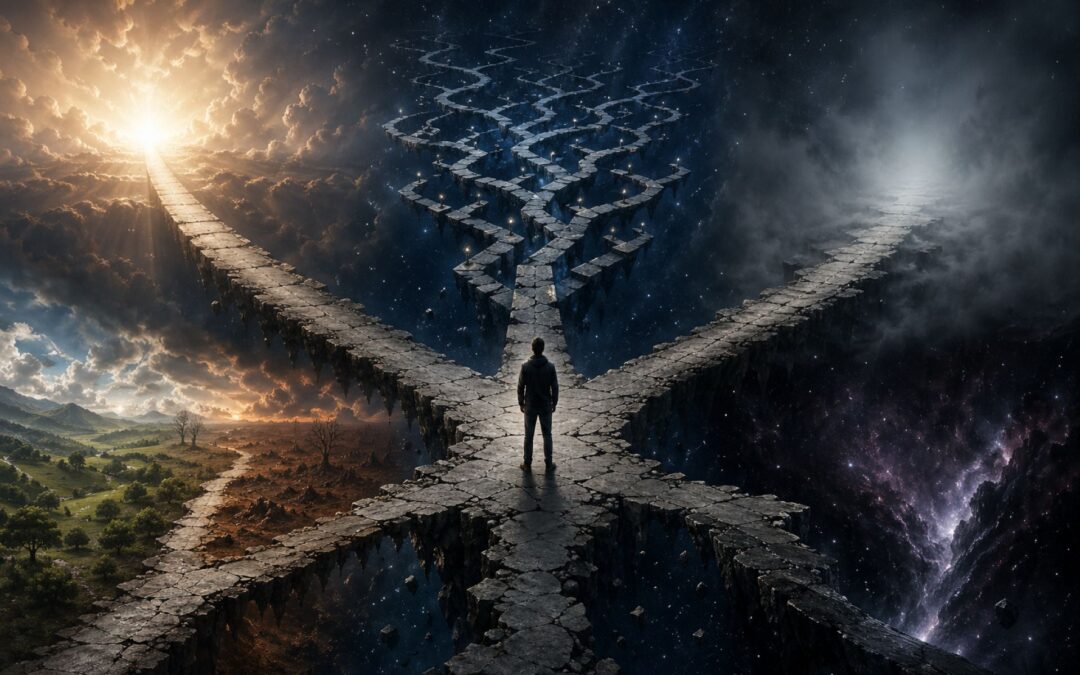
Some interpretations attempt to resolve this by imagining reality as a kind of branching network. Instead of a single fixed path, there are countless possible routes laid out in advance. Within this network, we make choices, but only among options that already exist. In this sense, we are free—but only within boundaries we did not create.
Then there is a more unsettling possibility.
What if reality itself is not what it seems?
If we are living in some form of simulated environment—a controlled system governed by underlying code—then every event, including our decisions, could be part of a pre-designed structure. In such a scenario, free will becomes difficult to defend. A simulation, by definition, operates according to rules that were established before it began.
Even if we set aside speculative ideas like simulation theory, the challenge doesn’t disappear. It simply moves inward—into the human brain.
Modern neuroscience has started to raise uncomfortable questions about the nature of choice. Studies suggest that decisions may be initiated in the brain before we become consciously aware of them. In other words, what we experience as a deliberate choice might actually be the final step in a process that has already been set in motion beneath the surface.
If the subconscious mind decides first and consciousness follows later, then what role does our sense of “I” really play?
Are we choosing—or are we just observing choices as they unfold?
This doesn’t necessarily prove that free will is an illusion, but it does weaken the intuitive certainty we place in it. It suggests that what feels like control may, in part, be a carefully constructed experience rather than an objective reality.
And yet, abandoning free will entirely comes with its own problems.
If we are not in control, then can anyone truly be held responsible for their actions? Can we blame, praise, or judge in any meaningful way? A world without free will would force us to rethink the foundations of ethics, law, and personal identity.
So we remain caught in a strange position.
We experience ourselves as free, but the deeper we investigate, the less clear that freedom becomes.
Why Are We Here?
At some point, almost everyone asks this question.
Not out of curiosity alone, but out of a deeper need—a desire to believe that our existence is not random, that there is some underlying purpose guiding it. Human beings are not just conscious; we are meaning-seeking. We look for patterns, narratives, and reasons, even in places where none may exist.
Religion has historically provided the most direct answers. In many traditions, human life is part of a larger plan. We are here to serve, to obey, to grow, or to prepare for something beyond this world. These explanations offer clarity and structure. They give life direction, and for many, that direction is enough.
But philosophy has often taken a more skeptical route.
Few thinkers captured this skepticism as starkly as Albert Camus. He argued that the search for inherent meaning is, ultimately, futile. According to him, the universe does not provide answers because it does not contain them. It is indifferent—silent in the face of our questions.
This idea forms the foundation of what is known as absurdism.
The “absurd” arises from the conflict between two things: our intense desire for meaning and the universe’s complete lack of response. We keep asking “why,” and the world keeps offering nothing in return. Not because the answer is hidden, but because there may be no answer to find.
At first, this perspective can feel unsettling, even bleak. If there is no inherent purpose, then what anchors our lives? What justifies our efforts, our struggles, our ambitions?
But Camus did not see this as a reason for despair. On the contrary, he saw it as a form of liberation.
If the universe does not impose meaning, then we are not bound by it. We are free to experience life without the pressure of fulfilling some grand, predetermined purpose. Meaning, in this sense, becomes something we create—or perhaps something we stop trying to define altogether.
This is where his ideas begin to echo certain Eastern philosophies.
In Taoist thought, for example, the emphasis is not on discovering a fixed purpose but on aligning with the natural flow of life. There is no ultimate goal waiting at the end of the journey. The journey itself is the point. Trying to impose rigid meaning on existence is seen not as enlightenment, but as resistance.
From this perspective, the question “Why are we here?” might be slightly misplaced.
It assumes that existence must have a reason in the way a tool has a function. But what if life is not a tool? What if it is closer to a process—something that unfolds rather than something that needs to be justified?
This doesn’t resolve the question.
It simply changes how we relate to it.
Instead of searching for a definitive answer, we begin to notice something else: that the need for meaning may tell us more about ourselves than about the universe we inhabit.
What Is Good and Evil?
Few ideas feel as instinctively real as the difference between good and evil.
From an early age, we are taught to distinguish between right and wrong. Entire legal systems, cultures, and religions are built on this distinction. It shapes how we judge others, how we justify our actions, and how we make sense of the world around us.
And yet, when we try to define it precisely, the clarity begins to dissolve.
One of the simplest ways to approach the question is to treat good and evil as subjective. What is considered good in one culture may be seen as wrong in another. History offers countless examples of this. Practices once widely accepted are now condemned, while behaviors once rejected have become normalized. From this perspective, morality appears to be fluid—something that evolves with time, context, and perspective.
But not everyone is satisfied with that answer.
Some argue that there must be objective elements of good and evil—principles that hold true regardless of opinion or circumstance. Without some form of moral foundation, it becomes difficult to justify why certain actions—violence, cruelty, injustice—should be condemned at all. If everything is relative, then nothing is truly wrong.
Philosophical traditions have attempted to navigate this tension in different ways.
The Stoics, for example, framed morality in terms of virtue and vice. Actions that align with reason, discipline, and wisdom contribute to a flourishing life—they are “good.” Actions driven by excess, ignorance, or emotional instability lead to suffering—they are “bad.” In this framework, morality is less about rules and more about outcomes, particularly the outcome of inner harmony.
Buddhist philosophy takes a slightly different approach. Instead of labeling actions as inherently good or evil, it focuses on cause and effect. Actions that lead to suffering—either for oneself or others—are discouraged, while those that reduce suffering are encouraged. Morality becomes a practical system rooted in consequences rather than absolute judgments.
Then there is the Taoist perspective, which introduces yet another layer of complexity. According to Taoism, good and evil can be understood in terms of alignment. Actions that flow with the natural order of things are considered harmonious, while those that resist or disrupt that flow are seen as problematic.
But even this raises difficult questions.
Human beings constantly go against the “natural” flow. We build cities, fly across continents, alter landscapes, and reshape the environment to suit our needs. Are these actions inherently wrong simply because they oppose nature? Or are they expressions of human ingenuity—something that could just as easily be interpreted as “good”?
This is where the distinction becomes increasingly unstable.
What appears harmful from one perspective may be beneficial from another. An action that causes suffering in the short term may lead to growth in the long term. Something considered virtuous in one context may be destructive in another.
The deeper we examine it, the harder it becomes to draw a clear line.
Good and evil may not be fixed categories waiting to be discovered. They may be frameworks we construct in an attempt to navigate a world that is far more complex than our definitions allow.
Is There an Afterlife?
If there is one question that has followed humanity from its earliest days, it is this.
What happens when we die?
Unlike many other philosophical problems, this one carries a certain weight—an emotional gravity that makes it impossible to ignore. It is not just about curiosity. It is about fear, hope, and the deep discomfort of not knowing what lies beyond the boundary of life.
Religion has long stepped in to fill this void.
Many traditions offer detailed visions of what comes next. Some describe a paradise of endless reward, where suffering disappears and fulfillment is eternal. Others warn of punishment—of consequences that extend far beyond a single lifetime. These ideas are powerful, not only because they provide answers, but because they shape behavior. The promise of heaven and the threat of hell have influenced human action for centuries, acting as both comfort and control.
But despite their influence, these claims share a common limitation.
They cannot be proven.
Science, for all its progress, remains silent on the question of what happens after death. It can describe the biological process—the shutting down of the body, the cessation of brain activity—but it cannot reach beyond that point. There is no measurable data, no observable evidence that confirms or denies the existence of an afterlife.
And so, the question remains open.
Some philosophical traditions approach it differently, shifting the focus rather than trying to provide a definitive answer.
In Buddhism, for example, the idea of an afterlife is not centered around a permanent soul moving from one place to another. Instead, it is framed as a continuous process—a cycle of birth, death, and rebirth driven by karma, the accumulation of actions and their consequences. In this view, what continues is not a fixed identity, but a kind of momentum, a transfer of experience and influence from one existence to another.
From this perspective, the afterlife is not a separate destination. It is an extension of the same process that defines life itself.
But even this interpretation has its limits.
Buddhist teachings also introduce the concept of Nirvana—a state beyond the cycle of birth and death. It is often described through metaphor rather than definition, like the extinguishing of a flame. Not because something is destroyed in the conventional sense, but because the conditions that sustained it no longer exist.
What makes this particularly challenging is that Nirvana—and the idea of complete “nothingness”—may be fundamentally beyond human comprehension. Our minds are built to understand things in terms of existence: objects, experiences, identities. Trying to imagine the absence of all of these at once stretches the limits of thought itself.
So even when a framework is offered, it does not fully resolve the mystery.
Whether the afterlife is a continuation, a transformation, or an end, we are left with the same barrier: we cannot observe it, test it, or return from it with certainty.
And perhaps that is why the question endures.
Not because it is unimportant, but because it touches the very edge of what we are capable of knowing.
Conclusion: Living Without Answers
After everything—centuries of thought, layers of belief, and countless attempts at explanation—we arrive at a strangely quiet place.
No definitive answers. No final conclusions. Just questions that remain exactly as they were: open.
This can feel frustrating at first. We are conditioned to seek resolution. We want clarity, certainty, something solid to hold onto. Unanswered questions create tension, and our instinct is to resolve that tension as quickly as possible.
But these questions don’t behave like ordinary problems.
They resist closure not because we haven’t tried hard enough, but because they may exist beyond the limits of what we can fully understand. The tools we rely on—logic, observation, reasoning—work incredibly well within the boundaries of the physical world. But when we apply them to questions about ultimate origins, purpose, or existence itself, they begin to lose their grip.
And yet, there is something valuable in that uncertainty.
When answers are unavailable, something else becomes possible. Instead of treating these questions as problems to be solved, we can begin to see them as spaces to explore. They invite reflection rather than conclusion, awareness rather than certainty.
In a way, the absence of clear answers gives us room to breathe.
If there is no universally agreed-upon purpose, then we are not confined by one. If good and evil are not perfectly defined, then we must think more carefully about how we act. If free will is uncertain, then the experience of choosing becomes something to observe, not just assume. And if the afterlife remains unknown, then the life we are currently living takes on a different kind of significance.
Not because it is part of a larger plan, but because it is immediate, tangible, and undeniably real.
Perhaps that is the quiet shift these questions offer.
They move us away from the illusion of certainty and toward a more honest engagement with reality—one that accepts limits without collapsing into despair. We may never fully answer these questions, but in asking them, we begin to understand something else:
Not the universe itself, but our place within it.