
The Moment Panic Takes Over
It rarely begins with a single event. Panic builds quietly—through headlines, notifications, urgent opinions, and the steady hum of uncertainty. One moment, you’re simply observing what’s happening around you. The next, you’re caught in a storm of reactions—people speaking with absolute certainty, others predicting disaster, decisions being made not from clarity but from fear.
In these moments, something subtle but dangerous occurs: rationality takes a backseat.
Panic isn’t just fear. Fear, by itself, can be useful. It alerts us, sharpens our attention, and prepares us to act. Panic, on the other hand, is what happens when fear overwhelms reason. It is emotional turbulence so intense that it disrupts our ability to think clearly. We stop evaluating, and start reacting. We stop seeing things as they are, and begin seeing them as threats—amplified, exaggerated, and often misunderstood.
What makes panic particularly powerful is how easily it spreads. You don’t need to be directly affected by a crisis to feel its weight. All it takes is exposure—to strong language, confident predictions, or the visible anxiety of others. The more voices repeat the same urgency, the more real and immediate the threat begins to feel. And before long, you’re no longer responding to reality—you’re responding to the atmosphere around it.
This is the essence of collective hysteria: a shared emotional state where clarity dissolves and reaction takes over.
The real challenge, then, isn’t just dealing with the situation itself. It’s maintaining your footing while everything around you seems to be losing balance. Because once panic sets in, even the simplest decisions become distorted. We overestimate risks, underestimate our ability to cope, and often act in ways that make things worse—not better.
This is precisely where Stoic philosophy, and especially the reflections of Marcus Aurelius, becomes relevant. Not as abstract wisdom, but as a practical guide for moments like these—when the world feels loud, uncertain, and unstable.
Before we can deal with panic in others, we first have to understand why it takes hold of us so easily.
Why Panic Feels So Powerful
Panic doesn’t arise out of nowhere. It feeds on something deeper—our relationship with uncertainty.
At its core, panic is a reaction to what we don’t fully understand. When events unfold in ways that feel unfamiliar or unpredictable, the mind instinctively tries to fill in the gaps. And it rarely does so calmly. Instead, it imagines worst-case scenarios, exaggerates risks, and treats ambiguity as danger.
This is why panic feels so convincing. It presents itself not as emotion, but as urgent truth.
A big part of this comes from the illusion of novelty. When something disruptive happens—a financial downturn, a sudden illness, a global crisis—it feels unprecedented. As if we’ve entered uncharted territory where the usual rules no longer apply. That sense of “this has never happened before” destabilizes us. It removes the mental anchors we rely on to stay grounded.
But the feeling is deceptive.
What intensifies this reaction even further is the presence of other people. Panic is rarely a solitary experience. It spreads through observation and imitation. When we see others reacting strongly—stockpiling, arguing, making drastic decisions—it signals that something must be seriously wrong. Even if we were initially calm, the collective response begins to shape our own.
This is the mechanism of emotional contagion. We don’t just think individually; we absorb the emotional climate around us. The louder and more dramatic that climate becomes, the harder it is to remain unaffected.
Add to this the influence of constant information. In a world where news cycles never stop and opinions travel instantly, we are exposed to an overwhelming volume of reactions. Not just facts, but interpretations—often extreme, often confident, and often driven by fear or self-interest. The result is a distorted sense of reality, where rare events feel common, and manageable situations feel catastrophic.
Under these conditions, panic feels almost rational.
But this is where the Stoics would draw a clear line. What feels real is not always what is true. The intensity of a reaction does not determine the accuracy of the situation. And the number of people panicking does not validate the panic itself.
Understanding this is the first step toward breaking its hold.
Because once you see how panic is constructed—through uncertainty, perceived novelty, social influence, and distorted information—you begin to recognize that its power comes not from the events themselves, but from how those events are interpreted.
And that realization opens the door to a very different way of responding.
Nothing New Under the Sun
One of the most stabilizing ideas in Stoic philosophy is also one of the simplest: what is happening now has happened before.
To the modern mind, this can sound dismissive. After all, every crisis feels unique while we’re living through it. The details are different, the scale may vary, and the context is always changing. But this is precisely the point that Marcus Aurelius invites us to look beyond.
Beneath the surface, the patterns remain the same.
Wars, plagues, economic collapses, political turmoil, personal loss—these are not anomalies in human history. They are recurring themes. Open any historical account and you’ll find the same cycles unfolding again and again, only with different names, places, and faces. Entire civilizations have faced uncertainty, disruption, and fear. Individuals across centuries have experienced the same anxieties we feel today.
What changes is not the nature of events, but our perception of them.
When we are caught in the immediacy of the present, everything feels amplified. The mind treats current events as if they exist in isolation, disconnected from the long chain of human experience. This creates the illusion that we are facing something entirely new—something unprecedented and therefore uncontrollable.
But the moment we step back and place our situation within a broader historical frame, something shifts.
What felt overwhelming begins to look familiar.
This is not meant to trivialize hardship. Pain, loss, and uncertainty are real, no matter how many times they’ve occurred before. But recognizing their recurrence changes how we relate to them. Instead of seeing ourselves as victims of a unique and chaotic moment, we begin to see ourselves as participants in an ongoing human story—one that has always included both stability and disruption.
And more importantly, one that people have navigated before.
This perspective does something powerful to panic: it weakens its foundation. Panic thrives on the belief that we are facing the unknown. But if what we’re experiencing is, in essence, “the same old thing,” then it is not truly unknown. It is simply unfamiliar to us personally, not to humanity as a whole.
What feels new today will become ordinary tomorrow. What seems chaotic now will eventually be understood, adapted to, and integrated into the flow of life.
This is the shift Marcus Aurelius encourages—not to deny the present, but to contextualize it.
Because when we realize that life moves in recurring patterns, the urgency begins to fade. The emotional intensity softens. And in its place, something much more useful emerges: perspective.
And with perspective comes the possibility of calm.
The Real Cause of Panic: Misjudgment, Not Events
It’s easy to believe that panic is caused by what happens to us. A crisis unfolds, something is at risk, and panic feels like the natural response. But from a Stoic perspective, this is a misunderstanding.
Events, by themselves, do not contain panic.
They simply occur.
What transforms an event into something overwhelming is the meaning we attach to it. The interpretation. The judgment. And this is where things begin to unravel. Because the mind does not just observe reality—it evaluates it, often instantly and unconsciously.
A sudden change becomes a threat.
Uncertainty becomes danger.
Loss becomes catastrophe.
And once these judgments are made, panic follows as a consequence.
This is why two people can face the same situation and respond in completely different ways. One remains composed, assessing what needs to be done. The other spirals into anxiety and reaction. The external event is identical. The internal response is not.
The difference lies in perception.
The Stoics were very clear on this point: it is not things themselves that disturb us, but our opinions about them. While this idea is often associated with Epictetus, it runs through the reflections of Marcus Aurelius as well. Again and again, he reminds himself to see things plainly—to strip away exaggeration, fear, and unnecessary interpretation.
Because the moment we do that, something important becomes visible.
Most of what we panic about is not the event itself, but the story we tell ourselves about it.
We imagine outcomes that haven’t happened. We assume permanence in situations that are temporary. We take what is uncertain and treat it as if it were already decided. In doing so, we multiply the weight of the situation far beyond what is actually present.
This doesn’t mean we should ignore problems or pretend everything is fine. It means we should be precise in how we understand them.
What is actually happening right now?
What do I know for certain?
What is within my control?
These questions bring the mind back to reality. They interrupt the chain reaction that leads from event to interpretation to panic. And once that chain is broken, the emotional intensity begins to subside.
What remains is not indifference, but clarity.
And clarity is what allows us to act well.
Because if panic is rooted in misjudgment, then the solution is not to control events—that’s often impossible—but to refine how we perceive them. To train the mind to respond with accuracy rather than assumption, with reason rather than reaction.
This is where real control lies.
Not in the world outside, but in the lens through which we see it.
How to Stop Panic at Its Source
If panic begins with misjudgment, then it doesn’t need to be fought at the level of emotion—it needs to be addressed at the level of thought.
The first step is deceptively simple: pause.
Not react, not suppress, not distract—but pause long enough to observe what is actually happening inside the mind. Because panic thrives on speed. It builds momentum when thoughts go unchecked, when one fearful interpretation immediately leads to another. By interrupting that flow, even briefly, we create space for something else to enter—awareness.
In that space, we can begin to examine the situation more carefully.
What am I reacting to right now?
Is it the event itself, or my interpretation of it?
Am I responding to facts, or to imagined outcomes?
These questions are not meant to produce perfect answers instantly. Their purpose is to slow the mind down and redirect it toward reality. And the more we practice this, the more natural it becomes to distinguish between what is happening and what we are adding to it.
From there, the focus shifts to rational judgment.
Instead of asking, “How do I feel about this?”, we begin asking, “What is the reasonable response here?” This subtle shift changes everything. It moves us out of emotional reactivity and into deliberate action. The situation is no longer something overwhelming us—it becomes something we can engage with, step by step.
Another essential part of this process is accepting the transient nature of things. Much of panic comes from the assumption that the current state of affairs is permanent, or at least long-lasting enough to define our future. But as Marcus Aurelius repeatedly reminds himself, everything is in flux.
What is intense now will pass.
What feels unstable will settle.
What seems unbearable will, in time, become manageable.
This isn’t blind optimism—it’s observation. Life has always moved in cycles. Situations change, adapt, and resolve, often in ways we couldn’t predict at the height of our concern.
When we internalize this, panic loses one of its strongest pillars: the belief that “this is how things will always be.”
Finally, there is the practice of returning to what is within our control.
Panic tends to expand our focus outward, toward everything that could go wrong but lies beyond our influence. The mind jumps from one possibility to another, trying to manage an entire future that doesn’t exist yet. This is exhausting—and ultimately futile.
The Stoic response is to narrow that focus.
What can I actually do right now?
What is the next reasonable step?
How can I act in a way that is constructive, not reactive?
By anchoring ourselves in the present moment and in our sphere of control, we regain stability. The situation may still be uncertain, but we are no longer lost in it.
We are grounded.
And from that position, panic cannot take hold in the same way.
The Discipline of Perspective
Once we begin to interrupt panic at its source, the next step is strengthening the mind so it doesn’t return so easily. And this is where perspective becomes a discipline—not something we occasionally remember, but something we actively cultivate.
Because without perspective, everything feels immediate. Personal. Overwhelming.
A single setback can feel like a defining moment. A sudden disruption can seem like the end of stability. When our view is narrow, even small disturbances appear enormous. The mind loses proportion, and with it, its sense of balance.
Perspective restores that proportion.
It does this by expanding the frame through which we see our situation. Instead of looking only at what is happening to us right now, we begin to place it within a larger context—across time, across people, across experience. And when we do that, something shifts almost instantly.
What felt isolating becomes shared.
What felt permanent becomes temporary.
What felt overwhelming becomes understandable.
This doesn’t remove difficulty, but it changes our relationship to it.
When we realize that countless others have faced similar hardships—loss, uncertainty, instability—we stop interpreting our situation as uniquely unbearable. We begin to see it as part of the broader human condition. And that recognition carries a quiet strength: if others have endured and adapted, so can we.
This is the kind of thinking Marcus Aurelius practiced constantly. He would remind himself not to get lost in the immediacy of events, but to step back and observe them from a wider vantage point. To see life not as a series of isolated crises, but as a continuous flow of change.
There is also another layer to this discipline—one that turns our attention outward.
When panic narrows our perspective, we become self-centered in the most literal sense. Everything revolves around how events affect us. Our fears, our losses, our uncertainty. But when perspective expands, we begin to notice something else: we are not alone in what we’re experiencing.
Others are navigating the same storm.
Some are struggling more than we are. Some are facing challenges we cannot see. And this awareness subtly shifts our mindset from fear to responsibility. Instead of asking, “What is happening to me?” we begin asking, “What is needed right now?”
This is where perspective becomes not just calming, but orienting. It gives direction.
Because once we see clearly—once we understand the scale and nature of what is happening—we are far less likely to react impulsively. We don’t get swept away by every shift in emotion or every alarming piece of information. We remain steady, grounded in a broader understanding of reality.
And that steadiness is what keeps panic from returning with the same force.
It is not that we become immune to fear.
It is that we no longer lose ourselves in it.
Acting Rationally in Irrational Times
Clarity of mind is only valuable if it translates into action. It’s not enough to understand panic—we have to behave differently because of that understanding.
And this is where things often break down.
Even when we recognize that panic is irrational, there is still a strong pull to act in accordance with it. When everyone around us is reacting, doing something—anything—feels better than remaining still. Urgency creates the illusion that action, even misguided action, is better than restraint.
But from a Stoic perspective, action is only meaningful when it is guided by reason.
This means slowing down enough to evaluate what actually needs to be done. Not what feels urgent, not what others are doing, but what the situation truly calls for. In many cases, the rational response is far less dramatic than the emotional one.
It might be preparation without excess.
It might be caution without paranoia.
It might even be inaction—choosing not to interfere, not to escalate, not to contribute to the noise.
This restraint is often misunderstood. It can look passive from the outside, especially in a world that equates movement with effectiveness. But there is a difference between passivity and discipline. One avoids action out of fear; the other chooses action carefully, based on understanding.
Marcus Aurelius repeatedly emphasizes this idea of measured response. To act in accordance with nature—both our own and that of the world—means to respond proportionally. Not too little, not too much, but exactly what is required.
Panic disrupts this balance.
It pushes us toward extremes. We either overreact, trying to control everything at once, or we become paralyzed, unable to act at all. In both cases, we lose effectiveness. Our actions no longer align with reality—they become reactions to our own internal chaos.
Rational action, by contrast, is grounded.
It begins with a clear assessment: What is actually happening? From there, it moves to intention: What would be the most constructive response? And finally, it leads to execution: acting with precision, without unnecessary escalation.
This is especially important in times of crisis. Because in such moments, small actions—done correctly—matter far more than large, impulsive gestures. Often, the most helpful thing we can do is also the simplest. Not interfering where we shouldn’t. Not amplifying fear. Not adding to confusion.
Just doing what needs to be done.
And nothing more.
This kind of behavior doesn’t draw attention. It doesn’t feel heroic. But it is exactly what prevents situations from deteriorating further.
In a world that is reacting emotionally, rational action becomes a stabilizing force.
And sometimes, that is the most valuable contribution we can make.
Duty to the Collective: A Stoic Responsibility
Panic doesn’t just affect the individual—it reshapes the behavior of entire groups. And when that happens, the consequences extend far beyond personal discomfort. Decisions made in fear ripple outward, often undermining the very systems that keep society functioning.
This is why, from a Stoic perspective, our responsibility during times of crisis is not limited to managing our own emotions. It also includes how our actions affect others.
Marcus Aurelius returns to this idea repeatedly: we are not isolated beings. We are part of a larger whole. Our nature is social, and our role within that structure carries obligations. To act rationally is not just a personal virtue—it is a contribution to the stability of the community.
Panic works against this.
When fear takes over, people tend to prioritize immediate self-interest. They hoard resources, spread unverified information, act impulsively, and sometimes even turn against one another. These reactions may feel justified in the moment, but collectively, they create more chaos than the original problem.
What began as uncertainty becomes disorder.
The Stoic alternative is grounded in cooperation. Instead of asking, “What do I need to feel safe right now?”, the question becomes, “What does the situation require for things to function well?” This shift may seem subtle, but it has profound implications.
It leads to restraint where excess would harm others.
It leads to clarity where confusion might spread.
It leads to action that supports, rather than disrupts, the collective.
In practical terms, this often means doing less, not more. It means avoiding unnecessary interference, following sensible guidelines, and trusting that stability is built through coordinated effort—not individual overreaction.
There is also a deeper layer to this responsibility.
When we remain calm while others panic, we don’t just avoid contributing to the problem—we become part of the solution. Our composure has a quiet influence. It creates contrast. It shows that another way of responding is possible.
Not through argument or force, but through example.
This is especially important because panic often thrives on imitation. People mirror what they see. If the dominant behavior is fear, fear spreads. But if there are individuals who remain steady, deliberate, and composed, that influence can spread as well—often just as quickly.
This is what it means to act in accordance with both our own nature and the nature of the whole.
To be rational when others are reactive.
To be measured when others are excessive.
To be constructive when others are destructive.
Not for recognition, but because it is the right thing to do.
And in times of crisis, that quiet alignment between personal conduct and collective need is what holds everything together.
Guarding the Mind from External Noise
Even with the best intentions, maintaining clarity becomes difficult if we constantly expose ourselves to confusion. The mind cannot remain steady if it is continuously fed with agitation.
And this is exactly what happens in times of crisis.
Information multiplies. Opinions intensify. Every update feels urgent, every voice sounds certain, and every headline competes for attention. What begins as an attempt to stay informed quickly turns into overload. Instead of gaining clarity, we become immersed in a stream of interpretations—many of them exaggerated, some of them misleading, and most of them designed to provoke a reaction.
This is not accidental.
Much of what we consume is shaped by incentives. Attention is valuable, and fear captures attention more effectively than calm analysis. The more dramatic the narrative, the more likely it is to spread. Over time, this creates a distorted picture of reality, where rare events appear constant and manageable situations feel catastrophic.
Under these conditions, panic becomes almost inevitable.
That’s why guarding the mind is not optional—it is essential.
This doesn’t mean ignoring what’s happening in the world. It means being selective about how much of it we allow in, and how we engage with it. There is a difference between staying informed and being consumed. One supports rational action; the other undermines it.
Marcus Aurelius understood this in his own way. While he didn’t face modern media, he was certainly aware of how external influences could disturb the mind. His solution was not withdrawal from responsibility, but discipline in attention—choosing carefully what deserves focus, and what does not.
This discipline often leads us back to something very simple: our immediate environment.
What is directly in front of us?
What can we influence right now?
What is actually required of us in this moment?
By returning to these questions, we shift our attention away from the abstract and uncontrollable, and toward the concrete and manageable. The noise fades, not because it disappears, but because we stop giving it authority over our thinking.
There is also a subtle psychological benefit to this.
When we reduce exposure to constant external input, the mind begins to settle. Thoughts slow down. Reactions lose their intensity. And in that quieter state, it becomes much easier to apply the principles we’ve been building—rational judgment, perspective, and measured action.
Without this boundary, those principles struggle to take hold.
Because no matter how clear we try to be, a mind that is constantly stimulated by fear cannot remain stable for long.
Guarding the mind, then, is not avoidance.
It is protection.
A deliberate choice to preserve clarity in an environment that often works against it.
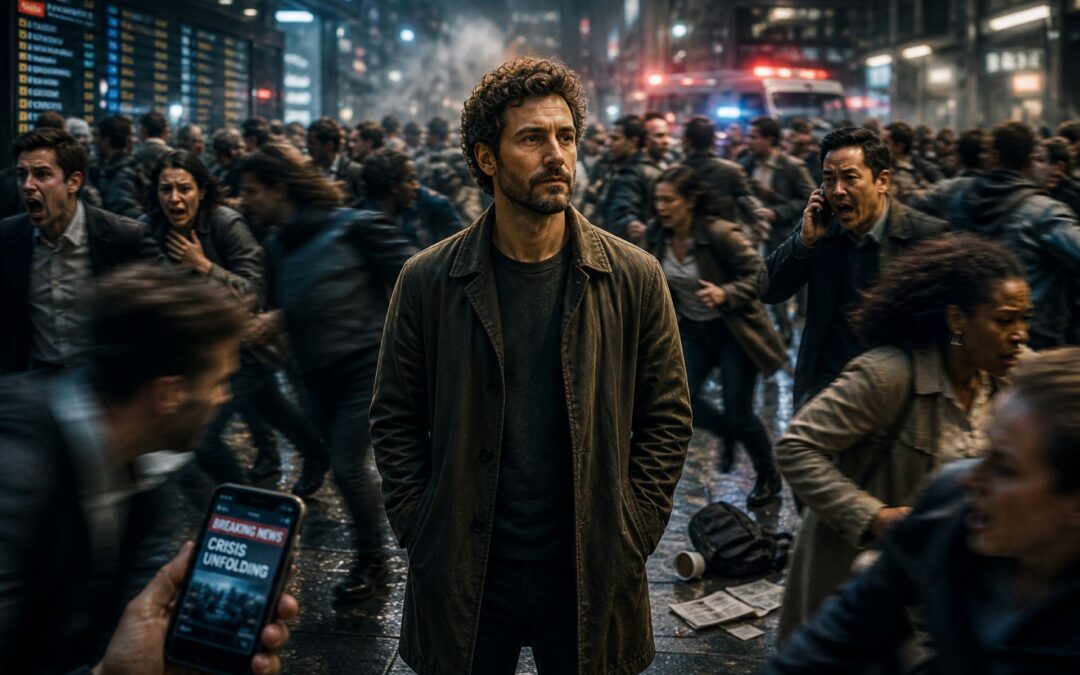
Facing a Panicking Crowd Without Losing Yourself
It is one thing to remain calm on your own. It is something else entirely to stay composed when everyone around you is not.
Because panic is rarely contained within the individual—it expresses itself outwardly. In tone, in behavior, in decisions. People become louder, more certain, more reactive. Urgency replaces reflection. And in that environment, maintaining your own clarity begins to feel like going against the current.
This is where the real test begins.
Human beings are deeply influenced by the groups they belong to. We don’t just observe others—we align with them, often unconsciously. When a crowd moves in a certain direction, there is a powerful pull to follow. Not necessarily because we agree, but because resistance feels uncomfortable, even isolating.
This is the force of herd behavior.
And in moments of panic, it becomes amplified.
You see it in sudden trends—mass buying, collective outrage, rapid shifts in opinion. Actions that might seem irrational in isolation begin to feel justified when everyone else is doing them. The individual dissolves into the group, and with that, personal judgment weakens.
To resist this is not easy.
It requires a kind of internal stability that doesn’t depend on external validation. The ability to remain anchored in your own reasoning, even when it contradicts the atmosphere around you. Not out of stubbornness, but out of clarity.
Marcus Aurelius often reflected on this kind of independence. He reminded himself that the behavior of others—no matter how chaotic or unreasonable—does not dictate how he should think or act. Their noise does not have authority over his mind.
This doesn’t mean detaching from reality or ignoring what others are doing. It means engaging with it without being absorbed by it.
You can observe panic without participating in it.
You can understand fear without adopting it.
You can respond to a situation without mirroring the reactions of the crowd.
This is what it means to maintain your center.
And interestingly, this kind of composure has an effect. Even if it doesn’t immediately change others, it creates contrast. In a room full of agitation, calm stands out. It introduces a different rhythm—slower, steadier, more deliberate.
Not everyone will notice it. Not everyone will respond to it. But its presence matters.
Because panic thrives on uniformity. It spreads when everyone reacts in the same way. But the moment even a few individuals break that pattern—choosing clarity over reaction—the dynamic begins to shift, however slightly.
This is not about control.
It’s about influence through example.
And it begins with a simple but demanding task: to remain yourself, even when the crowd is losing itself.
When Others Refuse to Be Calm
At some point, you realize that not everyone wants to remain calm.
Even when the situation doesn’t justify panic, even when a rational perspective is available, many people will still choose fear. They will cling to dramatic interpretations, escalate minor issues, and react in ways that seem unnecessary—or even harmful.
And the natural impulse is to intervene.
To explain. To correct. To calm them down.
But this is where another important Stoic principle comes into play: the limits of control.
You can influence, but you cannot decide for others. You can present a different perspective, but you cannot force someone to adopt it. And when a person is deeply caught in panic, they are often not receptive to reason. Their state of mind is already closed off, driven more by emotion than by understanding.
Trying to force clarity in that moment rarely works.
In fact, it often has the opposite effect. It creates resistance, fuels further agitation, and pulls you into the very emotional dynamic you’re trying to avoid. What began as an attempt to help turns into an argument, and from there, into frustration.
This is why restraint is necessary—not just in action, but in expectation.
Marcus Aurelius frequently reminded himself that other people will act according to their own understanding, their own fears, and their own limitations. Expecting otherwise only leads to disappointment. Accepting this, however, allows you to remain steady.
You can offer calm without insisting on it.
You can act rationally without demanding that others do the same.
You can maintain your clarity without needing external validation.
This doesn’t mean indifference.
If someone is open, if they are willing to listen, then guidance can be useful. A calm presence, a measured response, a different way of looking at things—these can all help. But the key is recognizing when that openness is there, and when it is not.
Because when it isn’t, the most rational choice is often to step back.
Not in defeat, but in discipline.
To preserve your own state of mind, rather than sacrificing it in an attempt to change someone else’s. To remain grounded, rather than getting pulled into cycles of reaction that lead nowhere.
There is also a certain freedom in this.
When you stop trying to control how others think, speak, or behave, you free up your attention for something far more productive: your own actions. Your own responses. Your own role in the situation.
And this is ultimately where your influence is strongest.
Not in shaping the minds of others, but in mastering your own.
Because in a world where many people are reacting unconsciously, simply remaining conscious—clear, steady, and deliberate—is already a rare and powerful thing.
The Stoic Ideal: Unshaken in the Storm
If there is one image that captures the Stoic response to panic, it is this: a person standing steady while everything around them is in motion.
Not rigid. Not detached. But grounded.
Because the goal of Stoicism is not to eliminate emotion or withdraw from life. It is to develop a kind of inner stability that allows us to engage with reality without being overwhelmed by it. To remain clear when things are unclear. To remain deliberate when others are reactive.
This is the ideal that Marcus Aurelius points toward—not perfection, but steadiness.
A mind that does not collapse under pressure.
A judgment that is not distorted by fear.
An individual who acts based on reason, regardless of the surrounding noise.
What makes this powerful is not that it changes the external situation immediately. The world will still be uncertain. People will still panic. Events will still unfold in ways we cannot predict or control.
But our relationship to those events changes completely.
Instead of being pulled in every direction, we become anchored. Instead of reacting to every shift, we respond with intention. Instead of amplifying chaos, we introduce order—first within ourselves, and then, indirectly, in the world around us.
This kind of composure is often misunderstood.
It can look like indifference to those who are caught up in emotion. It can seem distant or overly controlled. But in reality, it is a form of strength. Not the loud, visible kind, but the quiet kind that endures.
Because staying calm when everything is easy requires no effort.
Staying calm when everything is uncertain—that is discipline.
And over time, this discipline becomes part of who we are. It shapes how we interpret events, how we make decisions, and how we move through the world. Panic may still arise, but it no longer takes control in the same way. It is recognized, understood, and allowed to pass without dictating our actions.
This is what it means to be unshaken.
Not untouched by difficulty, but not ruled by it either.
To stand in the middle of disorder with a clear mind and a steady hand—doing what needs to be done, no more, no less.
And in a world that often loses itself to fear, that kind of presence is rare.
But it is also exactly what is needed.
Conclusion
Panic promises urgency, but delivers confusion.
It convinces us that something must be done immediately, even when we don’t fully understand what that “something” is. It pulls us away from clarity, away from proportion, and away from the kind of thinking that actually helps us navigate difficult situations.
What Marcus Aurelius offers is not a way to eliminate uncertainty, but a way to meet it without losing ourselves.
To see events as they are, not as they appear in moments of emotional intensity.
To recognize that what feels unprecedented is often part of a repeating pattern.
To understand that panic begins in the mind, not in the world.
And to act—not based on fear—but based on reason and responsibility.
In doing so, we shift from being participants in chaos to becoming stabilizing forces within it.
This doesn’t require grand gestures. It doesn’t require perfect composure at all times. It simply requires a commitment to returning—again and again—to clarity. To pause before reacting. To question before assuming. To act only when action is justified.
And perhaps most importantly, to accept that while we cannot control how others respond, we always retain authority over our own mind.
In moments when the world feels loud, uncertain, and unstable, that may not seem like much.
But it is everything.
Because when panic spreads, rationality becomes rare.
And when rationality becomes rare, those who preserve it become invaluable.