
In the early fourteenth century, the political landscape of the Indian subcontinent was undergoing dramatic upheaval. The powerful kingdoms that had once dominated South India had been weakened or destroyed by repeated invasions from the north. The expansion of the Delhi Sultanate had pushed deep into the Deccan, dismantling long-standing royal houses and destabilizing centuries-old political systems. For many regions, this period marked not just conquest but a profound crisis of authority.
Yet history rarely moves in a straight line. From the ruins of shattered dynasties and exhausted armies, new opportunities emerged. Ambitious leaders, soldiers, administrators, and adventurers—many of them from modest backgrounds—began carving out new states across the Deccan plateau. In this environment of uncertainty and competition, two powerful kingdoms rose to dominate southern India: the Vijayanagara Empire and the Bahmani Sultanate.
Founded in the 1330s by the brothers Harihara I and Bukka Raya I, Vijayanagara quickly emerged as a formidable power. Positioned strategically along the Tungabhadra River, the empire expanded across much of southern India, drawing strength from fertile agricultural lands, rich mineral resources, and flourishing maritime trade networks. Its capital—today known as Hampi—became one of the largest and most dazzling cities in the world, a place of bustling markets, monumental temples, and cosmopolitan culture.
At its height, Vijayanagara was not merely a regional kingdom but one of the great imperial powers of the late medieval world. Its rulers commanded enormous armies, controlled hundreds of ports, and presided over a vibrant society that blended traditions from across South Asia and beyond. Persian diplomats, Portuguese travelers, and merchants from across the Indian Ocean all recorded their astonishment at the scale and wealth of the empire.
But the story of Vijayanagara is not only one of triumph. Like many great empires, its rise contained the seeds of its eventual fall. Political intrigue, dynastic violence, and shifting alliances slowly weakened the stability of the state. At the same time, rival powers in the Deccan learned from their defeats, reorganizing their armies and forging new alliances.
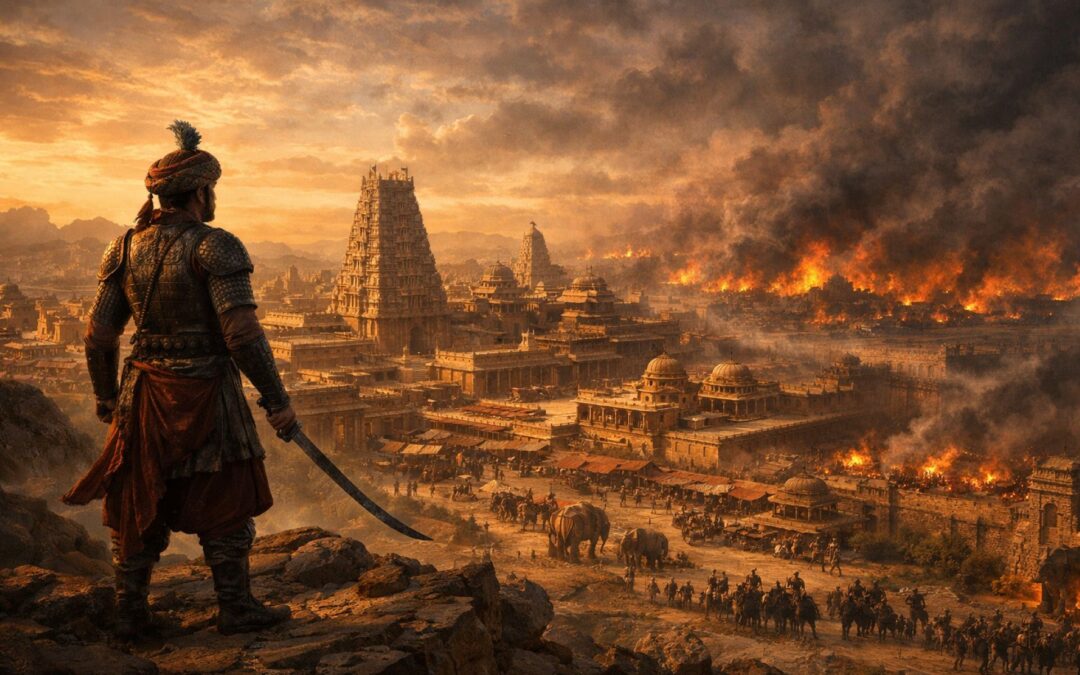
The final catastrophe came in 1565 at the Battle of Talikota. In one of the most decisive battles in Indian history, a coalition of Deccan sultanates crushed the Vijayanagara army. The victorious forces then marched on the imperial capital, reducing one of the greatest cities of the medieval world to ruins in a matter of days.
The fall of Vijayanagara marked the end of an era. Yet its legacy endured—in the architecture of southern India, in its literary traditions, and in the memory of a kingdom that had once stood as one of the most powerful and cosmopolitan empires of the medieval subcontinent.
The rise and fall of Vijayanagara is therefore not just the story of a single kingdom. It is a story about how states are built from chaos, how cultures evolve through exchange and adaptation, and how even the mightiest empires can collapse when ambition, rivalry, and miscalculation converge.
The Collapse of Delhi’s Authority in South India
At the beginning of the fourteenth century, the political balance of the Indian subcontinent appeared firmly tilted in favor of the Delhi Sultanate. Under powerful rulers like Alauddin Khalji and his successors, the sultanate had launched a series of ambitious campaigns that pushed its authority deep into the Deccan and beyond. Armies from Delhi swept across the subcontinent, defeating long-established kingdoms and extracting tribute from territories that had previously operated independently for centuries.
The southern kingdoms of the Kakatiya Dynasty, the Hoysala Empire, and the Pandya Kingdom were among those that fell victim to this northern expansion. Cities were captured, treasuries emptied, and royal houses forced into submission. For a brief period, it seemed as though Delhi had succeeded in establishing a vast imperial network stretching across much of India.
But this dominance proved difficult to maintain.
The Deccan and southern India lay far from the administrative centers of northern power. Communication across such vast distances was slow, and maintaining control over distant territories required enormous logistical and financial resources. Local resistance remained persistent, and newly conquered regions often rebelled the moment imperial authority weakened.
These problems intensified dramatically during the reign of Muhammad bin Tughluq, one of the most controversial rulers in medieval Indian history. Muhammad bin Tughluq was ambitious and intellectually curious, but many of his policies proved disastrously impractical. His attempts to centralize power, increase taxation, and reorganize administration triggered widespread unrest across the empire.
One of his most infamous decisions was the attempt to move the capital of the sultanate from Delhi to the Deccan city of Daulatabad. The relocation forced large segments of the population—including nobles, scholars, merchants, and administrators—to undertake a difficult journey south. The policy caused enormous suffering and administrative chaos, and it ultimately failed. When the court eventually returned to Delhi, the empire had already begun to fracture.
In the Deccan and southern India, local governors, military commanders, and regional elites quickly recognized the opportunity created by the weakening of central authority. Many of them had originally been appointed by Delhi to administer conquered territories, but now they began to declare independence.
By the early 1330s, revolts and secessions were spreading across the southern provinces. Among the emerging powers were two states that would soon dominate the politics of the Deccan: the Hindu-led Vijayanagara Empire in the south and the Muslim-led Bahmani Sultanate in the north.
Both states were born from the collapse of Delhi’s authority. Both inherited the military traditions, administrative systems, and political ambitions of the era that had preceded them. And both would spend the next two centuries locked in a fierce struggle for control of the Deccan plateau.
From the ashes of imperial overreach, a new chapter in Indian history was about to begin.
Founding of the Vijayanagara Empire
In the political vacuum created by the weakening of the Delhi Sultanate, ambitious regional leaders across the Deccan began carving out new realms. Among them were two brothers who would lay the foundations of one of the most powerful states in South Indian history: Harihara I and Bukka Raya I.
The early lives of the brothers remain partly shrouded in legend, but historical evidence suggests that they had served as military commanders or administrators under earlier regional powers before briefly falling under the control of the Delhi Sultanate. When the authority of Delhi weakened in the south during the early fourteenth century, the brothers seized the opportunity to establish their own independent state.
Around 1336, Harihara and Bukka declared independence and began consolidating control over territories along the Tungabhadra River in present-day Karnataka. This region was strategically important. It lay at the crossroads of several trade routes, possessed fertile agricultural lands, and was protected by rugged terrain that made large-scale invasions difficult.
To anchor their new state, the brothers established a capital near the ancient settlement of Hampi. The site was ideal for defense. Massive granite boulders, natural ridges, and the Tungabhadra River itself formed a formidable natural barrier against potential enemies. Over time, the city would expand into one of the most magnificent urban centers of the medieval world.
The new kingdom was named Vijayanagara, meaning “City of Victory.” The choice of name reflected the founders’ ambitions. They were not simply creating another regional principality; they intended to build a powerful empire capable of dominating southern India.
From the beginning, the rulers of Vijayanagara pursued aggressive expansion. They moved quickly to absorb territories that had once belonged to the fallen kingdoms of the Deccan and South India. Over the next several decades, their armies pushed into Karnataka, Andhra, and Tamil regions, bringing vast areas under imperial authority.
The rise of Vijayanagara also coincided with the emergence of another powerful state to the north. In 1347, the Bahmani Sultanate was founded by Ala-ud-Din Bahman Shah after he rebelled against the Delhi Sultanate. Like Vijayanagara, the Bahmani state was born from the collapse of northern imperial control.
The emergence of these two rival powers fundamentally reshaped the political landscape of the Deccan. Both sought to expand their influence across the same strategic territories, particularly the fertile lands between the Krishna and Tungabhadra rivers. Their rivalry would soon become one of the defining conflicts of medieval Indian history.
For Vijayanagara, however, the early decades were a period of rapid growth. By building strong military institutions, cultivating agricultural productivity, and controlling important trade routes, the new empire quickly transformed itself from a regional power into the dominant force of southern India.
The stage was now set for a long and bitter struggle that would shape the destiny of the Deccan for the next two centuries.
The Bahmani Sultanate and the Struggle for the Deccan
The rise of the Vijayanagara Empire was quickly matched by the emergence of a powerful rival to the north. In 1347, the Bahmani Sultanate declared its independence from the weakening Delhi Sultanate. Founded by Ala-ud-Din Bahman Shah, the new state rapidly consolidated control over much of the northern Deccan.
The political geography of the region ensured that conflict between these two emerging powers was almost inevitable. Between them lay one of the most contested regions in medieval Indian history: the fertile land between the Krishna and Tungabhadra rivers known as the Raichur Doab. Rich in agriculture, dotted with heavily fortified cities, and strategically positioned between north and south, the region was immensely valuable to both empires.
The Strategic Importance of the Raichur Doab
The Raichur Doab quickly became the central battleground in the long struggle between Vijayanagara and the Bahmani Sultanate. Control of this territory meant access to fertile farmland capable of sustaining large armies and populations. It also offered strategic control over key fortresses that guarded important routes between the northern Deccan and the southern peninsula.
As a result, the region changed hands repeatedly over the centuries. Both powers invested heavily in strengthening the defenses of its cities, constructing formidable walls and fortifications that could withstand prolonged sieges. Raichur itself became one of the most coveted strongholds in the Deccan.
For Vijayanagara, holding the Doab was essential to protecting its northern frontier. For the Bahmani rulers, capturing it represented a chance to push their influence deeper into southern India. The struggle for this territory therefore became both a military and symbolic contest between the two states.
Early Wars Between Vijayanagara and the Bahmani Sultanate
From the late fourteenth century onward, the Deccan was dominated by near-constant warfare between Vijayanagara and the Bahmani Sultanate. Campaigns were launched almost every decade as each side attempted to seize territory, destroy enemy fortresses, or extract tribute from the other.
The Bahmani rulers benefited from strong connections with the broader Islamic world. They recruited soldiers, engineers, and administrators from across Central Asia, Persia, and the Middle East. These immigrants—often called “Westerners” in contemporary accounts—brought with them valuable military and technological expertise. Their presence strengthened the Bahmani state and created a highly competitive political and military environment.
Despite its larger population and greater economic resources, Vijayanagara sometimes struggled to match this influx of talent. In several conflicts during the early fifteenth century, the Bahmani armies managed to defeat their southern rival. One such war in 1408 forced Vijayanagara to accept humiliating terms, including the payment of tribute.
Yet these setbacks also forced the rulers of Vijayanagara to reconsider their approach. The empire’s leaders began to realize that maintaining dominance in the Deccan required more than sheer manpower. It required new military techniques, a broader administrative base, and a willingness to adapt to the changing political realities of the region.
This realization would eventually lead to major reforms under one of the empire’s most capable rulers.
Transformation Under Deva Raya II
By the early fifteenth century, the long rivalry between the Vijayanagara Empire and the Bahmani Sultanate had revealed a troubling reality for Vijayanagara’s rulers. Despite possessing greater territory, population, and economic resources, the empire was not consistently able to defeat its northern rival. Military setbacks and humiliating treaties exposed weaknesses in its organization and strategy.
When Deva Raya II ascended the throne in the 1420s, he recognized that the empire would have to transform itself if it hoped to survive the fierce competition of the Deccan.
Military Reforms and the Integration of Muslim Talent
One of Deva Raya II’s most important decisions was to break with the rigid ideological boundaries that had shaped earlier policies. The rulers of Vijayanagara had long presented themselves as defenders of Hindu political power in the south, particularly in opposition to the Muslim-ruled states of the Deccan. While this identity had helped rally support during the empire’s early years, it also limited the pool of talent available to the state.
Meanwhile, the Bahmani Sultanate had been drawing upon a vast network of skilled immigrants from across the Islamic world. Soldiers, engineers, administrators, and scholars from Persia, Central Asia, and the Middle East were recruited into Bahmani service, bringing advanced military techniques and valuable experience.
Deva Raya II concluded that Vijayanagara could not afford to ignore such expertise.
He began actively recruiting Muslim soldiers and commanders into imperial service. These new recruits were granted land, titles, and positions within the army. Their presence introduced new cavalry tactics and military technologies that strengthened Vijayanagara’s forces. By incorporating skilled warriors from different backgrounds, the empire dramatically improved its ability to compete with its northern rivals.
This policy also reflected a broader shift in the empire’s identity. Vijayanagara was no longer simply a regional kingdom defending tradition—it was becoming a cosmopolitan imperial state willing to draw talent from across cultural and religious boundaries.
The Cosmopolitan Capital of Vijayanagara
These reforms coincided with the rapid growth of the imperial capital at Hampi. During the reign of Deva Raya II, the city expanded into one of the largest and most impressive urban centers in the world.
Contemporary travelers were astonished by its scale. The Persian ambassador Abdur Razzaq visited the city in the mid-fifteenth century and described it as a place unlike any he had seen before. According to his account, the city was surrounded by multiple layers of fortifications, with vast spaces inside containing fields, gardens, markets, temples, and palaces.
The capital was home to an extraordinary diversity of people. Merchants from across the Indian Ocean traded in its bazaars, while scholars, poets, artisans, and diplomats gathered at the imperial court. The city’s architecture reflected this cultural blending. Traditional South Indian temple structures stood alongside buildings influenced by Persian styles, featuring arches, domes, and ornamental columns.
Vijayanagara’s rulers actively cultivated this atmosphere of prosperity and cosmopolitanism. Festivals, artistic patronage, and public works projects reinforced the prestige of the empire. Extensive irrigation systems supported agriculture across the surrounding countryside, while trade networks connected the empire to markets stretching from Southeast Asia to the Middle East.
By the mid-fifteenth century, these transformations had reshaped Vijayanagara into a powerful and confident empire. Its armies were stronger, its capital richer, and its political system more adaptable than ever before.
This period marked the beginning of the empire’s first great golden age.
The First Golden Age of Vijayanagara
By the middle of the fifteenth century, the reforms and expansions initiated under rulers such as Deva Raya II had transformed the Vijayanagara Empire into one of the most formidable states in the Indian subcontinent. Military strength, economic prosperity, and cultural vitality combined to create a period often described as the empire’s first golden age.
The influence of Vijayanagara now extended across vast territories of southern India. Its rulers controlled fertile agricultural lands, commanded significant mineral resources, and maintained thriving trade networks that connected the subcontinent with distant regions of Asia and the Middle East. This combination of resources enabled the empire to sustain enormous armies and finance ambitious architectural and cultural projects.
Economic Strength and Maritime Trade
The wealth of Vijayanagara rested on a strong economic foundation. The empire’s rulers invested heavily in agriculture, building extensive irrigation systems that transformed dry landscapes into fertile farmland. Tanks, canals, and reservoirs ensured reliable water supplies, supporting large populations and producing agricultural surpluses that could be taxed by the state.
Beyond agriculture, the empire benefited greatly from trade. Vijayanagara controlled numerous ports along India’s western and eastern coasts, linking it to the commercial networks of the Indian Ocean. Merchants from Arabia, Persia, Southeast Asia, and China traded valuable commodities such as spices, textiles, precious stones, and horses.
Horses were particularly important. The cavalry was a critical component of medieval warfare in India, yet high-quality warhorses could not be bred easily in the subcontinent’s climate. As a result, Vijayanagara imported large numbers of horses from the Middle East through its coastal ports. Control of maritime trade routes ensured that the empire could maintain a steady supply of these essential military resources.
Foreign visitors frequently remarked on the empire’s prosperity. Markets in the capital overflowed with goods from across the world, and the surrounding countryside was carefully cultivated. The economic strength of Vijayanagara allowed its rulers to maintain both military dominance and an impressive level of urban development.
Cultural Synthesis and Imperial Identity
Economic success also supported a flourishing cultural environment. The rulers of Vijayanagara were generous patrons of literature, religion, and the arts. Temples, monuments, and public buildings were constructed on an enormous scale, many of which still stand today in the ruins of Hampi.
Architecture during this period displayed a remarkable blend of influences. Traditional Dravidian temple designs—characterized by towering gateways and elaborate stone carvings—remained central to the empire’s cultural identity. Yet these structures were often complemented by architectural elements inspired by Persian and Central Asian styles, including arches and decorative columns.
Daily life also reflected this cultural blending. Residents of the empire wore clothing that combined South Indian traditions with influences from the Islamic world. Court culture welcomed scholars, artists, and administrators from a variety of backgrounds, creating an atmosphere of intellectual exchange.
This synthesis of cultures strengthened Vijayanagara’s imperial identity. Rather than existing as an isolated Hindu kingdom, the empire became a dynamic center where ideas, technologies, and traditions from different parts of the world were integrated into a unique and powerful civilization.
Yet beneath the surface of prosperity, new challenges were beginning to emerge. Political rivalries within the ruling elite and growing instability in the royal succession would soon threaten the foundations of the empire’s success.
Political Intrigue and Dynastic Instability
Despite the prosperity and strength that characterized the first golden age of the Vijayanagara Empire, the stability of the state increasingly depended on the personal authority of its rulers. Like many medieval empires, Vijayanagara lacked a rigid and universally accepted system of succession. Power often passed through complicated family networks, rival claimants, and powerful nobles, creating fertile ground for intrigue and betrayal.
The reign of Deva Raya II marked the height of Vijayanagara’s early power, but even during his lifetime tensions within the ruling elite were already beginning to surface. Imperial authority rested not only on the emperor but also on a network of nobles, ministers, military commanders, and provincial governors who controlled large territories and commanded their own armed forces.
These powerful figures were essential to the empire’s functioning, yet they also posed a constant threat to political stability. Rivalries among court factions could easily escalate into conspiracies, assassinations, and open rebellion.
One dramatic example of this instability emerged in the mid-fifteenth century when a member of the royal family attempted to seize the throne through violence. According to contemporary accounts, a princely conspirator invited high-ranking nobles and officials to a ceremonial banquet. Because of caste customs, guests arrived in separate groups, allowing the conspirators to isolate and murder them one by one. Musicians were reportedly hired to drown out the cries of the victims.
The plot went even further. The conspirator personally approached the emperor under the pretense of delivering an invitation to the banquet. Once inside the royal chambers, he attacked the ruler with a dagger, believing that the empire could be seized through assassination.
Remarkably, the emperor survived the attempt. Wounded but still alive, he managed to call for help and expose the plot. The conspirators were captured, but the damage had already been done. The episode revealed how fragile the political order of Vijayanagara had become.
External enemies quickly sensed this weakness. The Bahmani Sultanate, always alert to opportunities in the Deccan, launched new invasions as instability spread within the empire. Vijayanagara was forced into difficult negotiations, and some of its earlier territorial gains were threatened.
After the death of Deva Raya II, the situation deteriorated further. His successors proved less capable of maintaining control over the powerful nobles and provincial governors who formed the backbone of the empire. Internal rivalries intensified, and the imperial court became increasingly vulnerable to coups and assassinations.
By the late fifteenth century, Vijayanagara faced a dangerous combination of problems: weakening central authority, ambitious regional leaders, and growing pressure from external enemies. These challenges would soon lead to dramatic political change within the empire itself.
The Rise of the Tuluva Dynasty
By the late fifteenth century, the political situation within the Vijayanagara Empire had become deeply unstable. The authority of the ruling dynasty had eroded after decades of weak leadership, court intrigue, and repeated military setbacks. Provincial governors increasingly acted independently, and the central government struggled to maintain control over distant territories.
The crisis deepened as a series of violent successions shook the imperial court. Emperors were murdered, rival princes plotted against one another, and the throne passed between rulers who often lacked the ability—or the will—to restore order. At the same time, external threats continued to grow. The empire lost important territories, and its enemies sensed an opportunity to exploit its internal divisions.
One of the most significant blows came with the loss of the coastal city of Goa. Control of Goa had been vital because it served as a gateway for the import of Middle Eastern horses, a resource essential for maintaining effective cavalry forces. Without reliable access to these horses, Vijayanagara’s military capabilities were weakened at a time when powerful rivals were strengthening their own armies.
As instability spread, a prominent military commander named Saluva Narasimha emerged as a defender of the state. Narasimha had risen through the ranks of the imperial military and had earned widespread respect for his leadership and competence. Watching the empire slide toward collapse, he became convinced that drastic action was necessary.
In 1485, Saluva Narasimha seized power and established a new ruling line known as the Saluva dynasty. His takeover was not merely an act of ambition; many contemporaries viewed it as an attempt to rescue the empire from complete disintegration. By removing the ineffective ruling house, Narasimha hoped to restore stability and rebuild imperial authority.
Yet the transition proved far from smooth. Narasimha’s reign was short, and when he died, his heirs were still young and inexperienced. The administration of the empire fell into the hands of powerful regents and military commanders who competed for influence over the throne.
Among these figures was a talented statesman named Tuluva Narasa Nayaka. Originally a trusted general and advisor, Narasa Nayaka gradually consolidated power within the empire. Through careful political maneuvering and military strength, he became the true authority behind the throne.
By the early sixteenth century, Narasa Nayaka’s family had established its own ruling house, known as the Tuluva dynasty. Under this new leadership, the empire would experience a dramatic revival.
The most famous ruler of this dynasty—one who would elevate Vijayanagara to the height of its power—was soon to ascend the throne.
Krishnadevaraya and the Zenith of Vijayanagara Power
When Krishnadevaraya ascended the throne in 1509, the Vijayanagara Empire entered what many historians consider the height of its power and prestige. The new ruler inherited a state that had recently emerged from decades of internal instability, yet under his leadership the empire would experience a remarkable revival.
Krishnadevaraya was an unconventional emperor. Born to a concubine rather than the principal queen, he did not initially appear to be the most obvious candidate for the throne. Yet once in power, he quickly proved himself to be one of the most capable rulers in South Indian history.
Contemporary accounts portray him as energetic, disciplined, and deeply involved in both administration and military affairs. He maintained strict personal routines, beginning each day with rigorous physical exercise before attending to the business of the state. At the same time, he was an accomplished intellectual who composed literary works in several languages, including Telugu, Kannada, and Sanskrit.
Under Krishnadevaraya’s rule, Vijayanagara regained its military momentum and expanded its influence across southern India. Rival kingdoms were subdued, rebellious territories were brought back under imperial control, and the empire’s authority over the Deccan once again became a dominant force in regional politics.
Administration, Culture, and Imperial Governance
Krishnadevaraya combined military leadership with careful attention to governance. He strengthened the administrative structure of the empire, ensuring that provincial governors remained loyal while maintaining effective taxation and military recruitment systems.
The emperor was also a renowned patron of culture and learning. His court attracted poets, scholars, and artists from across southern India. Literature flourished during his reign, particularly in the Telugu language, which received significant royal patronage. Krishnadevaraya himself contributed to this cultural flowering through his own writings, demonstrating the intellectual ambitions of the Vijayanagara court.
The capital city of Hampi expanded dramatically during this period. By the early sixteenth century, the city had grown into one of the largest urban centers in the world, with estimates suggesting a population of nearly half a million people. Its markets overflowed with goods, its temples and palaces displayed extraordinary architectural sophistication, and its streets bustled with merchants and visitors from across Asia and Europe.
Foreign travelers were deeply impressed by what they saw. The Portuguese visitor Domingo Paes described the city as one of the most prosperous and well-organized he had encountered, noting its broad avenues, extensive irrigation systems, and thriving commercial activity.
War With the Deccan Sultanates and the Siege of Raichur
Krishnadevaraya’s reputation as a military leader was cemented through his campaigns against rival powers in the Deccan. Among the most famous of these conflicts was his war against the Bijapur Sultanate over control of the strategic fortress of Raichur.
In 1520, Krishnadevaraya launched a massive campaign to capture the city. His army reportedly included hundreds of thousands of infantry, tens of thousands of cavalry, and a vast array of war elephants. The scale of the mobilization reflected the importance of Raichur, which lay in the contested region between the Krishna and Tungabhadra rivers.
Although the fortress was heavily defended, the Vijayanagara forces managed to undermine its walls using teams of laborers armed with pickaxes and crowbars. The defenders attempted to repel them with artillery, but the positioning of the cannons made it difficult to strike the workers below.
When the ruler of Bijapur, Ismail Adil Shah, arrived with his own army to relieve the siege, a decisive battle followed. The Bijapur forces possessed a large number of cannons, but their artillery was poorly coordinated. After a powerful initial volley, Vijayanagara’s cavalry launched a devastating charge that shattered the enemy lines.
The battle ended in a dramatic victory for Krishnadevaraya. The fortress of Raichur surrendered soon afterward, marking one of the greatest triumphs of his reign. The victory demonstrated not only the strength of Vijayanagara’s army but also the strategic skill of its emperor.
By the early sixteenth century, the empire stood at the peak of its power. Its armies dominated southern India, its capital dazzled visitors from across the world, and its ruler commanded immense prestige.
Yet even at this moment of triumph, forces were beginning to gather that would eventually threaten the empire’s survival.
The Fragmentation of the Bahmani Sultanate
While the Vijayanagara Empire was reaching the height of its power under Krishnadevaraya, dramatic changes were unfolding in the northern Deccan. The once formidable Bahmani Sultanate was beginning to fracture under the weight of internal rivalries and political instability.
For much of the fifteenth century, the Bahmani state had remained Vijayanagara’s most dangerous rival. It possessed a strong military, a sophisticated administrative system, and deep connections with the wider Islamic world that allowed it to recruit talented soldiers, scholars, and engineers. These advantages had often enabled the Bahmani rulers to compete effectively with the larger southern empire.
Yet the strength of the Bahmani Sultanate depended heavily on capable leadership and careful management of its diverse ruling elite. Within the state, tensions had long existed between two powerful factions: the foreign-born elites—often called “Westerners”—who had migrated from Persia and Central Asia, and the locally born Muslims of the Deccan known as “Deccanis.” Competition between these groups frequently created political instability at court.
One of the few figures capable of managing these rivalries was the influential statesman Mahmud Gawan. Serving as a powerful minister during the late fifteenth century, Gawan worked tirelessly to maintain unity within the state and strengthen its institutions. His administrative reforms and diplomatic skill helped preserve Bahmani authority during a difficult period.
However, Gawan’s success also earned him powerful enemies. Court rivals forged documents accusing him of treason and presented them to the Bahmani ruler while he was intoxicated. In a tragic display of political intrigue, the sultan ordered Gawan’s execution in 1481 without fully investigating the charges.
The consequences were disastrous.
With the death of Mahmud Gawan, the delicate balance between the rival factions collapsed. The authority of the central government weakened rapidly as powerful regional governors began to assert their independence. Within a decade, the once unified Bahmani Sultanate had effectively disintegrated.
By the end of the fifteenth century, five successor states had emerged from its ruins: the Bijapur Sultanate, the Ahmadnagar Sultanate, the Golconda Sultanate, the Bidar Sultanate, and the Berar Sultanate.
To many observers, this fragmentation appeared to be a tremendous opportunity for Vijayanagara. Instead of facing a single powerful adversary in the Deccan, the empire now confronted a collection of smaller states that frequently competed with one another.
For the moment, the balance of power seemed to favor Vijayanagara. But the political rivalries among the Deccan sultanates would eventually take an unexpected turn—one that would have devastating consequences for the southern empire.
Rama Raya and the Politics of Deccan Rivalries
After the death of Krishnadevaraya, the Vijayanagara Empire remained powerful, but the political balance within the state began to shift. Real authority gradually moved away from the throne and into the hands of influential nobles and military leaders. Among them, one figure would come to dominate the politics of the empire: Aliya Rama Raya.
Rama Raya was not originally from the royal family. He had served in the Deccan before entering Vijayanagara’s service, and his rise within the empire was largely the result of political skill and strategic marriage. By marrying one of Krishnadevaraya’s daughters, he secured a powerful position within the ruling elite and gradually entrenched himself in the machinery of the state.
By the early 1540s, Rama Raya had become the dominant figure in imperial politics. Although the empire technically had a reigning emperor, Rama Raya ruled as regent and exercised authority as if he were the sovereign himself. The nominal ruler was effectively sidelined while Rama Raya directed military campaigns, diplomacy, and administration.
His political strategy focused on manipulating the rivalries among the successor states of the fallen Bahmani Sultanate. The Deccan had fractured into competing sultanates such as the Bijapur Sultanate, the Ahmadnagar Sultanate, and the Golconda Sultanate. Rama Raya believed that Vijayanagara could maintain its dominance by carefully balancing these states against one another.
At first, this strategy proved highly successful. Rama Raya frequently intervened in the internal conflicts of the Deccan sultanates, supporting one ruler against another or switching sides when it suited Vijayanagara’s interests. By doing so, he ensured that none of the northern states could become strong enough to threaten the empire on its own.
However, this approach also created growing resentment among the Deccan rulers.
Rama Raya’s military campaigns were often accompanied by acts of extreme brutality. Cities were plundered, religious sites were desecrated, and civilians suffered heavily during invasions. While such violence was not uncommon in medieval warfare, Rama Raya’s aggressive policies left deep scars across the region.
Even his allies began to distrust him. In several cases, territories belonging to friendly states were seized or devastated by Vijayanagara’s armies after joint campaigns had concluded. Rama Raya’s willingness to betray allies for short-term advantage made him feared but also deeply unpopular among the rulers of the Deccan.
Gradually, the leaders of the Deccan sultanates began to realize that their constant rivalries were playing directly into Vijayanagara’s hands. As long as they fought one another, Rama Raya could manipulate the balance of power and maintain his empire’s dominance.
By the early 1560s, a new consensus began to emerge among these rival states. However bitter their differences might be, they all faced a common threat in the aggressive expansion of Vijayanagara.
For the first time in decades, the sultanates of the Deccan began to consider setting aside their rivalries and forming a united front.
The Alliance of the Deccan Sultanates
By the early 1560s, the rulers of the Deccan had grown increasingly alarmed by the power and unpredictability of Aliya Rama Raya. For decades, Rama Raya had successfully manipulated the rivalries among the successor states of the former Bahmani Sultanate, playing one ruler against another while expanding the influence of the Vijayanagara Empire.
Yet this strategy contained a fundamental flaw. Each intervention deepened the resentment of Vijayanagara’s neighbors. Cities had been plundered, alliances broken, and territories seized. Even states that had once cooperated with Rama Raya found themselves humiliated or betrayed.
One episode particularly highlighted the growing distrust. During a campaign in the Deccan, Vijayanagara’s forces devastated enemy territory with unusual ferocity. Mosques were destroyed, towns were pillaged, and civilians were subjected to widespread violence. Although acts of destruction were a common feature of medieval warfare, the scale and symbolism of these actions alarmed even Rama Raya’s allies.
Among the most concerned was the ruler of the Bijapur Sultanate, Ali Adil Shah I. He had once cooperated closely with Rama Raya in conflicts against other Deccan powers, but the relationship deteriorated after Vijayanagara forces began interfering directly in his own territories.
Meanwhile, diplomatic ties between the Deccan states began to shift. The rulers of the Ahmadnagar Sultanate and the Golconda Sultanate strengthened their relationship through political alliances and marriage ties. The possibility of a coordinated response to Vijayanagara’s dominance gradually took shape.
By 1564, a remarkable development occurred. Several Deccan sultanates—longtime rivals that had frequently fought one another—agreed to set aside their differences and cooperate against a common enemy. The rulers of Bijapur, Ahmadnagar, Golconda, and Bidar joined forces in a coalition designed to confront Vijayanagara directly.
For the first time in generations, the Deccan states were united.
This alliance represented a profound strategic shift. Instead of facing divided enemies, Vijayanagara now confronted a coordinated coalition that combined the resources, armies, and artillery of multiple kingdoms.
The leaders of the sultanates understood that the coming conflict would determine the balance of power in southern India. If Vijayanagara were defeated, the dominance it had exercised over the Deccan for centuries would finally come to an end.
The two sides would soon meet in one of the most decisive battles in the history of the Indian subcontinent.
The Battle of Talikota and the Fall of Vijayanagara
In early 1565, the long struggle between the Vijayanagara Empire and the united Deccan sultanates reached its climax. The armies of the coalition—led by the rulers of the Bijapur Sultanate, Ahmadnagar Sultanate, Golconda Sultanate, and Bidar Sultanate—marched south to confront Vijayanagara’s forces.
The decisive encounter took place near the village of Talikota in present-day Karnataka in what became known as the Battle of Talikota.
Both sides assembled enormous armies. Vijayanagara fielded a massive force composed of infantry, cavalry, and war elephants, reflecting the empire’s immense resources. Despite internal tensions within the state, its military strength remained formidable. At the center of the army stood the aging regent Aliya Rama Raya, who personally directed the campaign.
Yet the coalition of Deccan sultanates possessed a crucial advantage: artillery.
Over the previous decades, the Deccan states had invested heavily in gunpowder technology and foreign military expertise. Their artillery units included experienced gunners from Central Asia and the Ottoman world, and their cannons were among the most advanced in the region. These weapons would play a decisive role in the coming battle.
As the two armies approached one another, the Deccan coalition carefully coordinated its artillery. Unlike earlier conflicts in which cannon fire had been poorly organized, the sultanates staggered their volleys to maintain continuous pressure on the advancing Vijayanagara forces. The sustained bombardment disrupted enemy formations and inflicted heavy casualties before the main armies even clashed.
Amid the chaos of battle, the fate of the empire turned on a dramatic moment.
According to some accounts, Rama Raya was struck down during the fighting by artillery fire that transformed coins into deadly projectiles when fired from a cannon. Other reports claim that he was captured after being thrown from his horse and then executed on the battlefield by his enemies. Regardless of the exact details, his death had an immediate and devastating effect.
Rama Raya had been the central figure holding the empire’s military command together. Once news of his death spread through the ranks, discipline collapsed. Vijayanagara’s armies, despite their numerical strength, began to break apart and retreat in confusion.
The coalition forces quickly pressed their advantage. What had begun as a hard-fought battle rapidly turned into a catastrophic defeat for Vijayanagara. The once-mighty imperial army scattered across the battlefield, leaving the road to the capital wide open.
The defeat at Talikota marked a turning point in the history of South India. Within days, the victorious armies began their march toward the imperial capital, where one of the most dramatic episodes of destruction in medieval Indian history would soon unfold.
The Destruction of the Imperial Capital
With the defeat of the Vijayanagara Empire at the Battle of Talikota, the empire’s military defenses collapsed almost instantly. The death of Aliya Rama Raya had shattered the command structure of the army, and the surviving forces scattered across the countryside in disarray.
The victorious armies of the Deccan sultanates quickly advanced toward the imperial capital at Hampi. For generations, the city had stood as one of the greatest urban centers of the medieval world. Its vast markets, monumental temples, royal palaces, and fortified walls had impressed travelers from Persia, Portugal, and across the Indian Ocean.
Now it stood defenseless.
Those with the means to flee escaped the city before the invaders arrived. Nobles, merchants, and wealthy residents gathered what valuables they could carry and fled southward with the remnants of the imperial court. Others, lacking the resources or warning to escape, remained behind.
When the armies of the Deccan coalition entered Vijayanagara, they unleashed a wave of destruction that would become legendary.
Palaces were looted, temples were desecrated, markets were plundered, and homes were burned. Priceless works of art and architecture were smashed or stripped of their valuables. Civilians who had remained in the city were killed, enslaved, or forced to flee into the surrounding countryside.
The devastation unfolded rapidly. Within a matter of days, one of the largest and most magnificent cities of the medieval world was reduced to a smoldering ruin. Structures that had taken decades to build were destroyed in a frenzy of violence and looting.
The destruction of Vijayanagara shocked observers across the region. For centuries, the city had symbolized imperial wealth, cultural achievement, and political power. Its sudden collapse seemed almost unimaginable.
Even today, the vast ruins scattered across the rocky landscape of Hampi testify to the scale of what was lost. Massive temple complexes, shattered halls, and abandoned marketplaces stand as silent reminders of a city that once rivaled the greatest capitals of its age.
The fall of the capital marked the effective end of Vijayanagara as a dominant imperial power in southern India. Yet the empire itself did not disappear immediately. The surviving rulers and nobles would attempt to preserve what remained of their state in the years that followed.
The Aftermath and Survival of a Shattered Empire
Although the destruction of the capital at Hampi was catastrophic, the Vijayanagara Empire did not vanish overnight. The imperial court and many surviving nobles managed to escape the disaster following the Battle of Talikota, carrying with them what remained of the royal treasury and administrative apparatus.
Leadership passed to Tirumala Deva Raya, the brother of the fallen regent Aliya Rama Raya. Recognizing that the ruined capital could no longer serve as the center of imperial authority, Tirumala relocated the court further south. Over the following decades, the empire would operate from a succession of new capitals, including Penukonda Fort and later Chandragiri Fort.
Despite the trauma of Talikota, Vijayanagara’s political structures proved surprisingly resilient. The empire retained control over portions of southern India, and its rulers continued to exercise authority over several regional governors and subordinate states. However, the scale of power that Vijayanagara had once enjoyed was gone forever.
The Deccan sultanates divided much of the empire’s former northern territory among themselves. Regions that had once been contested battlegrounds between Vijayanagara and the Deccan states now fell permanently outside imperial control. Meanwhile, local governors in southern India gained greater autonomy as the weakened central government struggled to maintain authority.
Over time, the empire gradually transformed into a smaller regional kingdom rather than a dominant imperial power. Successive rulers attempted to preserve their legitimacy by maintaining court traditions, supporting temples, and patronizing literature and art. Yet the economic and military foundations that had once sustained Vijayanagara’s greatness had been irreparably damaged.
The remnants of the empire survived for several decades after Talikota, but their influence steadily declined. By the mid-seventeenth century, the last vestiges of the once-mighty state had disappeared. In 1646, the remaining territories that had once belonged to Vijayanagara were absorbed by rising regional powers.
Even in decline, however, the legacy of Vijayanagara endured. The temples, monuments, and cultural traditions that flourished during its golden age continued to shape the political and cultural life of southern India for generations.
The empire itself had fallen, but its impact on the history of the subcontinent would prove far more lasting.
Conclusion
The story of the Vijayanagara Empire is one of the most dramatic cycles of rise and fall in the history of the Indian subcontinent. Born out of the collapse of the Delhi Sultanate in the fourteenth century, the empire emerged as a powerful new state that reshaped the political landscape of southern India. Through military expansion, economic strength, and cultural patronage, Vijayanagara transformed itself from a regional power into one of the greatest empires of the late medieval world.
At its height, the empire stood as a center of extraordinary wealth and cultural vitality. Its capital at Hampi dazzled foreign visitors with its immense markets, monumental temples, and vast fortifications. Its rulers commanded enormous armies, controlled extensive trade networks across the Indian Ocean, and presided over a society where diverse traditions and influences blended into a unique imperial culture.
Yet Vijayanagara’s success also carried within it the seeds of its destruction. Internal rivalries, dynastic instability, and the rise of powerful political figures such as Aliya Rama Raya gradually altered the balance of power within the empire. Aggressive foreign policies and repeated interventions in the politics of the Deccan created deep hostility among neighboring states.
When those rivals finally united, the consequences were devastating. The defeat at the Battle of Talikota shattered the empire’s military power and opened the way for the destruction of its magnificent capital. In a matter of days, one of the largest and richest cities of the medieval world was reduced to ruins.
Although the empire survived for several decades afterward as a diminished kingdom, the battle marked the end of Vijayanagara’s dominance in southern India. The political order that had shaped the Deccan for more than two centuries was permanently transformed.
Today, the silent ruins scattered across the rocky hills of Hampi stand as a powerful reminder of this lost empire. Massive temple complexes, pillared halls, and shattered palaces testify to a civilization that once rivaled the greatest powers of its age.
The rise and fall of Vijayanagara illustrates a timeless lesson of history: even the most powerful empires can crumble when internal divisions, strategic miscalculations, and determined enemies converge. Yet the cultural and architectural achievements of Vijayanagara ensure that its legacy continues to shape the historical memory of South India long after the empire itself disappeared.