
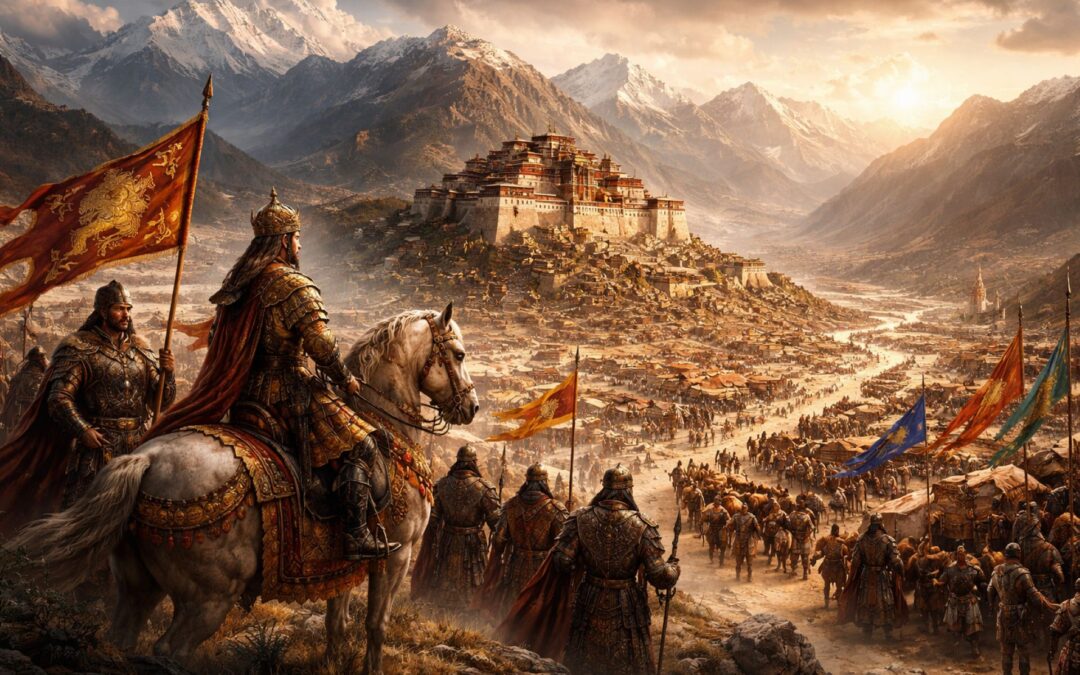
High in the vast, windswept plateau of Central Asia—where the air is thin and the mountains seem to touch the sky—an empire once rose that rivaled the great powers of its time. It commanded armies across deserts and mountains, challenged imperial China, influenced the politics of India, and controlled vital arteries of the Silk Road.
This was the Tibetan Empire.
Long before Tibet became synonymous with monasteries and meditation, it was a land of warlords, strategists, diplomats, and conquerors. Its rulers built a formidable state from a fractured landscape of warring clans, transforming a rugged highland society into a geopolitical powerhouse that reshaped the balance of power across Asia.
At its peak, the Tibetan Empire was not a peripheral kingdom—it was a central player in a vast network that connected India, China, and Central Asia. It absorbed ideas, technologies, and religions from all directions, becoming a melting pot of cultures even as it expanded through force and strategy.
Yet, despite its scale and influence, this empire has largely faded from popular memory—overshadowed by the civilizations it once rivaled.
This is the story of how Tibet rose—from scattered tribes in the mountains to a Silk Road superpower—and how that transformation would ultimately redefine its identity for centuries to come.
The Land Beyond the Myth
Today, Tibet is often imagined as a quiet, spiritual sanctuary—an isolated world of monasteries, prayer flags, and serene monks detached from the chaos of history. But this image is a relatively recent layer, shaped by centuries of religious evolution and modern geopolitics.
In the early medieval era, Tibet was something entirely different.
It was a land of extremes. Vast plateaus stretched endlessly under open skies, broken by fertile valleys where communities could sustain agriculture and pastoral life. These valleys became the heart of Tibetan settlement—pockets of life surrounded by some of the harshest terrain on Earth. Above them, rocky ridges and steep slopes were crowned with fortified strongholds, designed to endure long sieges and repel rival clans.
This was not a peaceful land. It was a contested one.
Tibetan society in this period was dynamic, restless, and often violent. Clans competed constantly for land, resources, and influence. Raiding was not merely opportunistic—it was embedded in the economic and political fabric of the region. Power was fluid, alliances were temporary, and survival often depended on strength and strategy rather than tradition or legitimacy.
And yet, Tibet was not isolated.
Despite its imposing geography, it sat at a critical crossroads of the ancient world. Trade routes linked it—directly and indirectly—to the great civilizations of India, China, and Persia. Merchants, scholars, and travelers passed through its highland corridors, bringing with them new ideas, technologies, and beliefs. Tibet became, in many ways, a meeting ground of cultures—a frontier where different worlds collided and interacted.
This combination of harsh geography, constant conflict, and cultural exchange created a unique environment—one that was perfectly suited for the rise of a powerful state.
But before an empire could emerge, the land itself had to be unified.
And that was no easy task.
A Fractured Plateau of Warring Clans
Before the rise of emperors and imperial ambitions, Tibet was a patchwork of rival clans—each fiercely independent, deeply territorial, and locked in an almost constant cycle of conflict.
There was no unified state. No central authority. No overarching identity beyond kinship and survival.
Instead, power was local and fragmented.
Each clan controlled its own valley or stretch of land, often centered around a fortified stronghold that served as both residence and last line of defense. These natural and man-made fortresses gave clans a degree of autonomy, allowing them to resist invasions and endure prolonged sieges. Geography itself reinforced this fragmentation—mountains and plateaus acted as barriers, isolating communities and making large-scale political unity difficult to achieve.
Conflict was not the exception—it was the norm.
Clans raided one another for livestock, land, and prestige. These raids were not random acts of violence but structured extensions of economic and political competition. Success in battle enhanced a clan’s status, while defeat could mean subjugation or extinction. Alliances formed and dissolved quickly, often dictated by immediate needs rather than long-term strategy.
In such an environment, leadership was constantly tested.
Chieftains rose through a combination of lineage, charisma, and military success. Some managed to build broader coalitions, temporarily extending their influence over neighboring groups. But these proto-alliances were fragile. Without a centralized system to enforce loyalty, they often collapsed as quickly as they formed.
Amid this instability, one idea lingered—but rarely held power: the notion of a senpo, a divinely sanctioned ruler descended from a sacred lineage.
In theory, this figure was meant to unify the clans under a single authority. In practice, most clans ignored this claim whenever it conflicted with their own interests.
Tibet, at this stage, was a land that resisted unity.
And yet, it was precisely this fractured, competitive landscape that would eventually produce a leader capable of overcoming it—someone who could transform shifting alliances into a lasting foundation for empire.
That transformation would begin with a man named Namri Songtsen.
Namri Songtsen and the First Steps Toward Unity
The transformation of Tibet from a fractured highland mosaic into a unified political force did not happen overnight. It began with a leader who understood that survival in such a volatile landscape required more than brute strength—it required strategy.
That leader was Namri Songtsen.
Belonging to the Yarlung dynasty in southern Tibet, Namri was not just another clan chieftain. He carried the title of senpo—a ruler believed to possess a divine mandate. But in a land where power was earned through force and alliances, such legitimacy meant little unless it could be backed by action.
And Namri acted decisively.
Rather than relying solely on conquest, he first focused on building alliances. He brought together neighboring clans through diplomacy, negotiation, and calculated cooperation—gradually expanding his influence without triggering immediate large-scale resistance. This approach allowed him to consolidate power in a way that many before him had failed to achieve.
But diplomacy had its limits.
Namri’s rise inevitably brought him into conflict with rival leaders, the most formidable of whom was a charismatic chieftain known as Lord Zingpo. Like Namri, Zingpo had forged his own network of alliances and posed a serious challenge to Yarlung dominance.
What followed was a decisive struggle for control of the Tibetan heartland.
After a series of clashes, Namri emerged victorious. Zingpo’s coalition collapsed, and his territories were absorbed into Namri’s growing domain. With this victory, Namri extended his authority over much of central and southern Tibet—the core regions that would later form the backbone of the empire.
For the first time, the idea of a unified Tibet began to feel tangible.
Yet, this unity was fragile.
Namri’s power depended heavily on his personal leadership and the alliances he had carefully constructed. There was no fully developed administrative system, no institutional framework to guarantee stability beyond his lifetime.
And that weakness would soon be exposed.
At the height of his power, Namri Songtsen was assassinated—poisoned, likely by rivals who saw an opportunity to dismantle what he had built.
His death could have undone everything.
Instead, it marked the beginning of something even greater.
Songtsen Gampo: The Architect of Empire
When Namri Songtsen died, the fragile unity he had built stood on the brink of collapse. His heir, Songtsen Gampo, was only thirteen years old—a boy thrust into a volatile world of rival clans, lingering loyalties, and unfinished wars.
By all expectations, this should have been the end of Yarlung dominance.
Instead, it was the beginning of an empire.
Songtsen moved quickly and decisively. One of his first acts as ruler was to identify and punish those responsible for his father’s assassination, sending a clear message that authority would not be questioned. But vengeance alone was not enough—rebellion was already brewing.
The territories once controlled by Namri’s defeated rivals rose in insurgency, sensing weakness in the young ruler. Songtsen responded with force. He crushed the uprisings, reasserted control over the heartland, and stabilized the political core of Tibet.
What set him apart, however, was not just his ability to restore order—but his vision of what Tibet could become.
Where his father had relied heavily on alliances, Songtsen aimed for something more permanent: direct control through conquest.
He began by securing Tibet’s borders. Marching westward, he subdued hostile forces threatening the frontier, ensuring that internal consolidation would not be undermined by external instability. With the core secure, he turned outward.
Buffer kingdoms—such as Zhangzhung, Nepal, and Asha—stood between Tibet and broader regional influence. As long as these states remained independent, Tibet would remain contained within its plateau.
Songtsen intended to change that.
He established a new capital at Lhasa, transforming it into the political and strategic center of his growing state. From here, he began laying the groundwork for systematic expansion—one that combined military campaigns, diplomacy, and long-term planning.
This was no longer a coalition of clans.
Under Songtsen Gampo, Tibet was becoming something entirely new—a centralized, expansionist power with imperial ambitions.
And for the first time, those ambitions extended far beyond the plateau.
Conquest, Espionage, and Expansion
With the Tibetan heartland secured, Songtsen Gampo turned his attention outward. His goal was clear: eliminate the buffer kingdoms surrounding Tibet and transform his realm into a dominant regional power.
But conquest, in his hands, was not just about brute force—it was about strategy.
One of his most decisive campaigns was against the kingdom of Zhangzhung, a powerful state to the west that controlled key trade routes and posed a constant strategic threat. Rather than launching a direct assault, Songtsen employed a far more subtle approach.
He used espionage.
Through a carefully arranged political marriage, his daughter was sent to the Zhangzhung court. Unhappy in her new environment, she became an invaluable asset—secretly relaying detailed information about troop movements, court politics, and vulnerabilities within the kingdom.
Armed with this intelligence, Songtsen struck at the perfect moment.
His forces launched a surprise attack while the Zhangzhung king was away from his stronghold. The operation was swift and devastating. The king was killed, his armies defeated, and his territories absorbed into the expanding Tibetan state.
It was a masterclass in combining intelligence with military power.
This victory had far-reaching consequences. With Zhangzhung under Tibetan control, Songtsen secured the western flank and gained access to important routes linking Tibet to Central Asia.
But his ambitions did not stop there.
To the south, events in Nepal presented a unique opportunity. A deposed king, Narendra Deva, had fled into exile at Songtsen’s court in Lhasa. Instead of merely offering refuge, Songtsen saw strategic value in the situation.
After years of hosting the exiled ruler, he provided him with a Tibetan army.
Together, they marched back into Nepal, defeated the usurpers, and restored Narendra Deva to the throne. But this was not a simple act of generosity—Nepal effectively became a vassal state, aligning its interests with Tibet and opening access to trade routes that extended deep into the Indian subcontinent.
Through a combination of calculated warfare and diplomatic maneuvering, Songtsen Gampo reshaped the political map around Tibet.
What had once been a cluster of independent kingdoms was now either conquered or brought into Tibet’s sphere of influence.
And with each victory, Tibet moved closer to becoming not just a regional power—but a force that could rival the great empires of its time.
India’s Influence: Script, Knowledge, and Statecraft
While Songtsen Gampo expanded Tibet’s borders through conquest and diplomacy, he was equally aware that true power required more than territory—it required ideas.
And for that, he turned south.
India, at the time, was one of the great centers of learning, religion, and political thought. Its intellectual traditions, administrative systems, and religious philosophies had already influenced vast parts of Asia. Songtsen recognized that if Tibet was to become a lasting empire, it needed to absorb and adapt this knowledge.
What followed was a deliberate and far-reaching exchange.
Tibetan envoys were sent to the Indian subcontinent, tasked with studying its systems of governance, religion, medicine, and language. At the same time, Indian scholars, physicians, and experts were invited to Lhasa, transforming the Tibetan court into a hub of cross-cultural interaction.
One of the most significant outcomes of this exchange was the creation of the Tibetan script.
According to tradition, Songtsen’s minister Thonmi Sambhota traveled to India, where he studied various writing systems under learned teachers. Drawing inspiration from Indian scripts, he developed a standardized writing system for the Tibetan language upon his return.
This was a turning point.
For the first time, Tibet had a formal means of recording laws, maintaining administrative records, and producing literature. Oral traditions began to be supplemented—and gradually replaced—by written systems of governance and communication.
With writing came structure.
The Tibetan state began to formalize its administration. Laws were codified, records were maintained, and a more organized bureaucratic system took shape. Elements of Indian political thought and legal philosophy influenced these developments, giving the empire a more coherent and durable framework.
Even the military was reshaped.
Songtsen introduced administrative divisions that cut across traditional clan boundaries, weakening the independent power of local elites and integrating them into a centralized system. A structured military draft ensured that the empire could mobilize forces efficiently, transforming what had once been loosely organized clan warriors into a more unified fighting force.
Culturally, too, the impact was profound.
Buddhist ideas began to enter Tibet during this period, largely through Indian influence. While still limited to segments of the aristocracy, these ideas planted the seeds of a transformation that would later redefine Tibetan identity.
In many ways, this phase marked Tibet’s transition from a conquering state to a civilizational power.
It was no longer just expanding—it was evolving.
Diplomacy and War with Tang China
As Tibet expanded westward and southward, another power loomed to the east—one far older, wealthier, and more established than any kingdom on the plateau.
The Tang Dynasty of China.
For Songtsen Gampo, relations with Tang China were both an opportunity and a challenge. Recognition from the Chinese court would elevate Tibet’s status on the global stage. Rejection, however, would be an insult—and a potential threat.
At first, Tibet chose diplomacy.
In 634 CE, Songtsen sent an ambassador to the Tang court in Chang’an, seeking to establish formal relations. The mission achieved little. Undeterred, he sent his trusted prime minister, Gar Tongtsen, a few years later with a more ambitious request: a Chinese princess in marriage, a symbol of equality between rulers.
But the Tang court did not yet see Tibet as an equal.
At the same time, a prince from the Asha Kingdom made a similar request. The Chinese emperor, viewing Asha as the more immediate concern due to its raids on Chinese territory, chose to favor them instead. The princess was promised elsewhere.
Gar Tongtsen returned empty-handed.
To Songtsen Gampo, this was not just a diplomatic failure—it was a direct insult. Tibet had grown in power and prestige, and yet it was still being treated as a lesser state.
His response was swift—and decisive.
Tibetan forces launched campaigns into eastern and northern regions, subduing neighboring groups including the Asha and the Tanguts. One by one, these territories fell under Tibetan control. With each victory, the Tibetan army moved closer to China’s borders.
This was no longer diplomacy.
It was a demonstration of power.
With his armies now positioned at the frontier, Songtsen renewed his demand for a Chinese princess—this time backed by a clear threat of invasion. The Tang emperor, underestimating Tibetan strength, chose confrontation and sent an army to push them back.
It was a costly mistake.
The Chinese forces were defeated, and Tibet’s military capability was made unmistakably clear. What had once been dismissed as a distant highland power now stood as a formidable empire on China’s doorstep.
The balance had shifted.
In 641 CE, Gar Tongtsen returned once more to Chang’an. This time, the Tang emperor agreed. His daughter, Princess Wencheng, was sent to Tibet in marriage, accompanied by a royal entourage of scholars, artisans, and specialists.
The marriage brought peace—but it also brought something far more valuable.
Recognition.
For the first time, Tibet was acknowledged as a major power in East Asia—one capable of negotiating with China not as a subordinate, but as an equal backed by strength.
Royal Alliances and Cultural Transformation
The marriage alliances forged by Songtsen Gampo were more than symbols of diplomacy—they became powerful channels of cultural transformation that reshaped Tibetan society from within.
Two foreign queens stood at the center of this change: Princess Bhrikuti of Nepal and Princess Wencheng of China.
Each arrived in Tibet from a different civilizational world, and each carried with her a distinct set of ideas, traditions, and influences.
Princess Bhrikuti, associated with the Indian cultural sphere through Nepal, is often credited with deepening Tibet’s early exposure to Buddhism. Devout and committed, she is said to have supported the construction of temples and monasteries, helping introduce Buddhist practices to the Tibetan elite. Her presence reinforced the intellectual and religious connections that Tibet had already begun to build with the Indian subcontinent.
Princess Wencheng’s influence was broader and more visibly transformative.
She arrived in Lhasa with an extensive retinue—nobles, scholars, craftsmen, and artisans—along with technologies and cultural practices from Tang China. According to Chinese accounts, she encouraged the adoption of Chinese styles of dress, architecture, and courtly customs. Whether or not these changes were universally embraced, they signaled a new openness within the Tibetan court to external influences.
Together, these alliances turned Lhasa into a cosmopolitan center.
Ideas flowed in from multiple directions—Indian philosophy, Chinese technology, Central Asian trade practices. Temples were built, artistic traditions evolved, and new forms of knowledge began to take root. Tibet was no longer just absorbing influence—it was actively integrating it into its own identity.
Buddhism, in particular, began to gain a foothold.
However, its spread was still limited. It remained largely confined to the aristocracy and the royal court, coexisting with older belief systems and rituals that continued to dominate everyday life. The transformation was gradual, not immediate.
Still, the seeds had been planted.
Through these royal alliances, Tibet was undergoing a subtle but profound shift—from a purely martial state into a cultural crossroads, where power was expressed not only through conquest, but through the exchange and adaptation of ideas.
This dual identity—warrior empire and cultural hub—would define Tibet’s rise in the years to come.
Empire at Its Peak: Controlling the Silk Road
With its borders secured and its internal structures strengthened, the Tibetan Empire entered a new phase—one defined not just by expansion, but by strategic dominance.
At the center of this transformation was Gar Tongtsen, the same brilliant statesman who had negotiated with the Tang court. After the death of Songtsen Gampo, the empire passed to a child heir, leaving a power vacuum that Gar was uniquely positioned to fill.
As regent, he became the true architect of Tibet’s next great leap.
His ambitions extended far beyond the plateau. He understood that the real prize lay not in isolated conquests, but in controlling the Silk Road—the vast network of trade routes that connected China to Central Asia, India, and the Persian world.
Control the Silk Road, and you controlled the flow of wealth, goods, and influence across Eurasia.
Gar moved decisively.
Tibetan forces pushed westward across the mountains, entering regions like Kashmir and forging alliances with Turkic powers. Together, they targeted the rich trade hubs of the Tarim Basin—cities like Khotan and Kashgar, which were vital links in the overland trade network.
These were not just cities—they were gateways.
One by one, they fell under Tibetan control. With these conquests, Tibet effectively severed China’s overland connection to India and Persia, disrupting long-established trade routes and forcing the Tang Empire onto the defensive.
For a time, Tibet held the upper hand.
Caravans that once moved freely under Chinese influence now passed through territories controlled or contested by Tibetan forces. Wealth flowed into the empire, and its strategic importance grew exponentially. Tibet was no longer just a participant in Silk Road trade—it was a gatekeeper.
Yet, this expansion came at a cost.
The newly conquered regions were culturally diverse and often resistant to Tibetan rule. In places like Khotan, Tibetan forces were remembered not as liberators but as conquerors—accused in local records of plundering cities and desecrating religious institutions. This revealed a stark contrast between the refined cultural developments in Lhasa and the brutal realities of imperial expansion on the frontier.
Still, from a geopolitical standpoint, the achievement was undeniable.
At its height, the Tibetan Empire stretched across vast territories, linking the high plateau to the deserts of Central Asia and the trade networks beyond. It had transformed itself into a continental power, capable of shaping the economic and political dynamics of the entire region.
But such rapid expansion also introduced new vulnerabilities.
The empire had grown powerful—but it had also grown complex.
And complexity, as history often shows, invites instability.
Power Struggles Within: The Rise of the Gar Clan
The Tibetan Empire had reached extraordinary heights—but its greatest challenge was no longer external.
It was internal.
With the death of strong rulers and the succession of young or less assertive emperors, real power began to shift away from the throne and into the hands of influential noble families. Chief among them was the Gar clan, whose rise would reshape the empire from within.
At the center of this shift was Gar Tongtsen’s legacy.
Having served as regent during a period of imperial expansion, he had accumulated immense authority. But after his death, that authority did not return fully to the emperor. Instead, it passed into the hands of his sons, who inherited not just his position—but his networks, armies, and influence.
What followed was a quiet but profound transformation of the state.
The Gar clan effectively divided control of the empire among themselves, governing vast regions as semi-independent power centers. Each branch of the family operated with considerable autonomy, commanding troops, collecting resources, and making decisions that would normally fall under imperial authority.
On paper, the Tibetan Empire remained unified.
In practice, it was becoming increasingly fragmented.
This decentralization created a dangerous imbalance. While the empire continued to function and even maintain its external strength, the authority of the senpo—the emperor—was steadily eroding. The throne was no longer the unquestioned center of power.
Instead, it was one player among several.
Tensions were inevitable.
The Gar clan’s dominance was both a strength and a liability. On one hand, their leadership ensured continuity in governance and military campaigns. On the other, their growing independence threatened the very unity that had made Tibet powerful in the first place.
This was not open rebellion—but it was something just as destabilizing: a slow drift toward internal division.
And history has shown that empires rarely fall apart in a single moment.
They weaken gradually—through shifts in power, competing loyalties, and the erosion of central authority.
For Tibet, that process had already begun.
The Return of Imperial Authority
The dominance of the Gar clan could not last forever.
While they had helped sustain the empire during a period of expansion, their growing power had come at the expense of the throne. Over time, the imbalance became too great to ignore. The Tibetan state—once unified under a strong senpo—was now drifting toward fragmentation.
It would take a determined ruler to reverse that trend.
That ruler emerged in the form of Dusong Mangpoje, a descendant of Songtsen Gampo, who came to power in the late 7th century. He inherited an empire still vast and influential, but internally unstable—its authority divided, its loyalties uncertain.
Dusong understood that reclaiming imperial control would require more than symbolic gestures.
It would require confrontation.
The opportunity came as the Gar clan’s position began to weaken. External pressures, particularly from a resurgent Tang China, exposed cracks in their authority. In Central Asia, Tibetan control over key Silk Road regions was being challenged, and the Gar leadership struggled to maintain its grip.
Dusong moved decisively.
One by one, leading members of the Gar clan were targeted. Some were defeated in military campaigns, others were captured or executed. In a calculated series of actions, the emperor dismantled the power structure that had dominated Tibet for decades.
The most dramatic moment came when the remaining members of the clan were lured into a trap.
Under the pretense of a royal hunt, Dusong gathered them together—only to unleash his forces in a sudden and brutal purge. The leadership of the Gar clan was effectively wiped out in a single, decisive stroke.
The message was unmistakable.
The age of divided authority was over.
With the Gar clan eliminated, power returned firmly to the throne. The senpo once again became the central figure of the empire, capable of directing policy, commanding armies, and shaping the future of Tibet without internal rivals undermining his rule.
This restoration of authority brought a renewed sense of cohesion.
The empire, though still facing external challenges, had regained its internal balance. The foundations laid by Songtsen Gampo were no longer overshadowed by competing elites—they were once again under imperial control.
But unity alone was not enough.
The world beyond Tibet was changing rapidly, and new forces—political, cultural, and religious—were beginning to reshape the empire in ways that no ruler could fully control.
Buddhism, Backlash, and Internal Conflict
As Tibet stabilized politically, another force—far less predictable than clan rivalries or military threats—began to reshape the empire from within.
Religion.
By the early 8th century, Buddhism had established a modest but growing presence in Tibet, largely confined to the royal court and segments of the aristocracy. But events beyond Tibet’s borders would accelerate its influence in ways no one had anticipated.
In Tang China, internal turmoil led to a wave of suspicion toward foreign influences. Buddhist monks—many of whom were seen as outsiders—became targets of growing xenophobia. As tensions rose, these monks were expelled from Chinese territories.
They needed refuge.
And they found it in Tibet.
Lhasa, already a cosmopolitan center, welcomed them. Under the patronage of influential figures like Princess Jincheng, a devout Buddhist married into the Tibetan royal family, monasteries were built and refugee communities began to flourish. The influx of monks brought not just religious teachings, but texts, rituals, and institutional structures that strengthened Buddhism’s presence in the region.
For a moment, it seemed as though Tibet was on the verge of a religious transformation.
But this rapid change triggered resistance.
Many native Tibetans viewed the growing influence of foreign monks with suspicion. Buddhism, still seen as an imported belief system, clashed with longstanding local traditions and spiritual practices. What had once been a slow cultural shift was now becoming a source of tension.
Then came disaster.
A devastating smallpox epidemic swept through Tibet, likely carried inadvertently by the very networks of movement that had brought monks into the region. As the disease spread, fear turned into blame.
The foreign monks became easy targets.
Resentment hardened into hostility. The same communities that had once welcomed Buddhist refugees now began to see them as a threat—not just to cultural identity, but to survival itself.
The backlash was swift.
The government ordered the expulsion of foreign monks, dismantling much of the Buddhist presence that had recently taken root. Anti-Buddhist sentiment intensified, and in the decades that followed, laws were enacted to restrict or suppress Buddhist practices.
For a time, it appeared that Buddhism’s foothold in Tibet might disappear altogether.
But the deeper conflict was not just about religion—it was about power.
Different factions within the elite used the issue of Buddhism to advance their own political agendas. Support for or opposition to the religion often aligned with broader struggles over influence and authority within the empire.
The result was a period of internal instability masked by outward strength.
From the outside, the Tibetan Empire still appeared formidable. But within, it was grappling with a profound question:
What kind of civilization would it become?
That question would soon be answered by one of the most consequential rulers in Tibetan history.
Trisong Detsen and the Strategic Turn to Buddhism
By the mid-8th century, the Tibetan Empire stood at a crossroads.
It was still vast, still powerful—but beneath the surface, it was unstable. Political intrigue simmered at court, rival factions competed for influence, and the question of religion remained unresolved. Buddhism had been introduced, embraced, rejected, and suppressed—but never fully settled.
Into this uncertainty stepped one of Tibet’s most consequential rulers: Trisong Detsen.
He inherited an empire that was not on the verge of collapse—but was dangerously close to fragmentation. The throne needed not just authority, but legitimacy. It needed a unifying force that could rise above clan loyalties and political rivalries.
Trisong found that force in Buddhism.
But his decision to elevate Buddhism was not purely spiritual—it was deeply strategic.
By declaring Buddhism the state religion, Trisong did more than endorse a belief system. He reshaped the ideological foundation of the empire. Many of the elites who opposed him were also aligned with traditional, pre-Buddhist power structures. By backing Buddhism, he effectively undermined his political rivals, distancing them from the center of power.
Religion became a tool of consolidation.
At the same time, Buddhism offered something that Tibet had long lacked—a shared intellectual and moral framework that transcended clan divisions. It provided a language of legitimacy that was not tied to lineage or regional identity, but to a broader, universal tradition connected to India and the wider Buddhist world.
Trisong actively supported the growth of Buddhist institutions.
Monasteries were established, scholars were invited, and religious learning was encouraged at a scale not seen before in Tibet. What had once been confined to small circles of the elite was now being expanded into a more structured and influential system.
And timing worked in his favor.
To the east, the Tang Dynasty was reeling from the devastating An Lushan Rebellion, which had weakened China’s internal stability and its ability to project power outward. This created a rare window of opportunity.
With China distracted, Tibet was free to act.
The empire began to reassert itself across key regions, including parts of the Silk Road that had previously slipped from its control. Military expansion resumed, but now it was paired with a stronger ideological core—one that unified the empire from within even as it pushed outward.
Under Trisong Detsen, Tibet was not just regaining strength.
It was redefining itself.
The warrior empire of earlier generations was evolving into something more complex—a state where power, culture, and religion were deeply intertwined.
And for a brief moment in history, it seemed poised to enter a true golden age.
A Golden Age on the Horizon
By the latter half of the 8th century, the Tibetan Empire stood at a rare and powerful intersection of opportunity.
Internally, it had regained stability. The authority of the senpo had been reasserted, rival factions had been weakened, and under Trisong Detsen, a new ideological foundation—Buddhism—was beginning to unify the empire beyond clan loyalties.
Externally, its greatest rival was faltering.
The Tang Dynasty, long the dominant power in East Asia, had been shaken by the catastrophic An Lushan Rebellion. The rebellion drained resources, fractured political cohesion, and forced China to turn inward. For the first time in decades, Tibet faced a weakened opponent on its eastern frontier.
For an ambitious empire, this was more than a moment.
It was an opening.
Tibetan forces moved to capitalize on the shifting balance. Campaigns were launched to reclaim influence over the Silk Road routes, particularly in the Tarim Basin and surrounding regions that had once slipped from Tibetan control. Control over these routes meant control over the flow of goods, ideas, and wealth across Eurasia—and Tibet was determined to reestablish itself as a central player.
At the same time, Tibet’s position as a cultural crossroads deepened.
With stronger ties to India through Buddhism, continued interaction with Chinese traditions, and longstanding connections to Central Asia, the empire became a conduit through which knowledge and culture flowed in multiple directions. Religious texts were translated, artistic styles evolved, and intellectual exchange flourished.
This was not just expansion—it was integration.
The Tibetan Empire was now both a military power and a civilizational force. It had the capacity to project strength across vast distances while also shaping the cultural and intellectual landscape of the regions it touched.
From the high plateau, Tibet influenced a world far larger than itself.
And yet, as history often reminds us, moments of peak power are also moments of vulnerability.
The very forces that enabled this rise—expansion, cultural transformation, and centralization—would, in time, introduce new pressures and contradictions. But in this moment, those challenges were still on the horizon.
For now, Tibet stood at the height of its potential.
A warrior empire, a cultural hub, and a Silk Road superpower—all at once.
Conclusion: From Warrior Empire to Spiritual Legacy
The Tibetan Empire began as a land of warring clans—harsh, fragmented, and defined by survival. Through the ambition of its rulers and the resilience of its people, it transformed into something far greater: a unified state, a conquering force, and ultimately, a Silk Road superpower that reshaped the political and cultural landscape of Asia.
At its height, Tibet stood shoulder to shoulder with the great empires of its time. It challenged Tang China, influenced the politics of the Indian subcontinent, and controlled critical trade routes that connected civilizations across Eurasia. It was not isolated—it was central. Not passive—but deeply engaged in the currents of history.
And yet, this is not how Tibet is remembered today.
Over time, the empire’s identity shifted. The strategic adoption of Buddhism—initially a tool of political consolidation—gradually became the defining feature of Tibetan civilization. The warrior ethos that had once driven expansion gave way to a spiritual tradition that would come to shape Tibet’s global image for centuries.
This transformation is what makes the story of the Tibetan Empire so compelling.
It is not just the story of rise and power—but of evolution. Of how a society can move from conquest to contemplation, from domination to devotion, without losing the threads of its past.
The Tibet we recognize today is only one chapter of a much larger story.
Behind the monasteries and mountain silence lies the memory of an empire that once commanded armies, shaped trade, and stood at the crossroads of the ancient world—an empire that, for a time, helped define the very fabric of Eurasian history.