
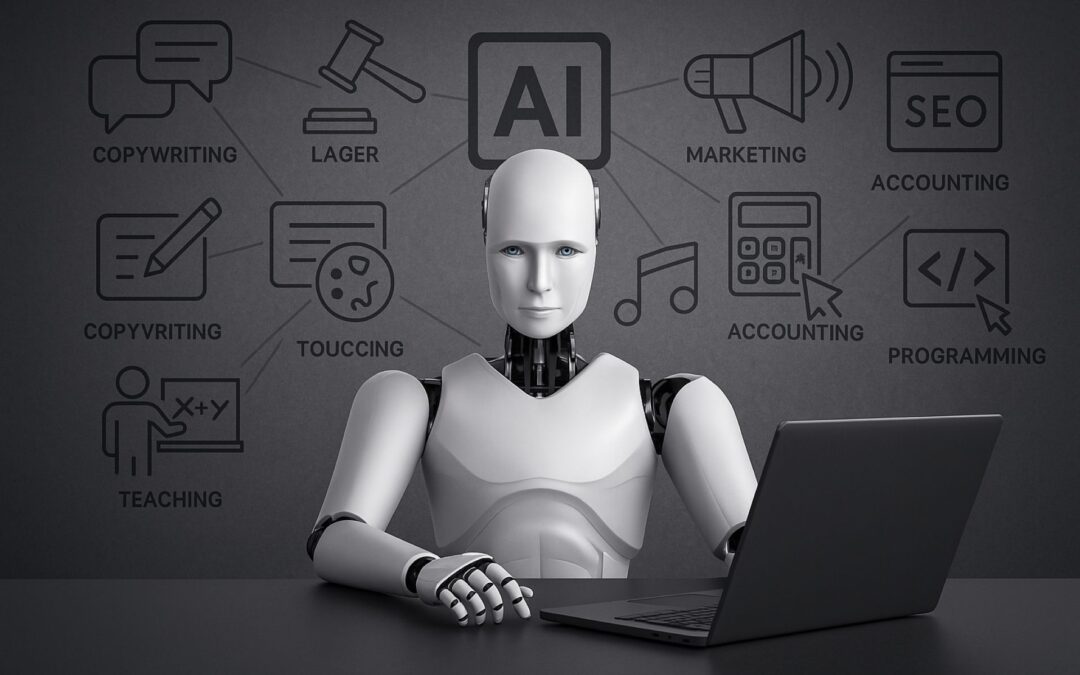
The rapid advance of artificial intelligence is rewriting the rules of work and expertise faster than we ever imagined. Skills that were once pillars of entire industries are evaporating, not because they’ve lost value, but because AI can perform them better, faster, and cheaper. The future doesn’t wait — it’s here, demanding we adapt or become obsolete.
Here are ten skills that AI has effectively rendered useless, reshaping the professional landscape and challenging us to rethink how we create value.
1. Copywriting
Copywriting has long been considered a domain of human creativity and persuasion—the ability to craft compelling narratives, evoke emotion, and influence behavior through carefully chosen words. It’s a nuanced skill involving tone, cultural context, and psychological triggers, making it a bastion of human uniqueness. Yet, AI’s incursion into this territory is nothing short of revolutionary.
Modern AI language models don’t just spit out generic sentences; they analyze vast datasets, learning writing styles, audience preferences, and even subtle linguistic cues. They generate content tailored to specific purposes—be it product descriptions, social media posts, or long-form articles—at lightning speed. What would take a human copywriter hours or days to produce can now be generated in minutes, if not seconds, often at a fraction of the cost.
Major news organizations like The Los Angeles Times and The Washington Post are already automating their data-heavy content streams—sports results, election tallies, financial reports—with AI. These pieces rely heavily on structured data, making them perfect candidates for AI generation. Forbes and The Guardian have followed suit, outsourcing routine writing tasks to AI and reallocating human talent to oversight roles.
The impact on mid-level copywriters is profound. Roles that once required skilled writing and research are diminishing because AI can replicate acceptable quality at scale. This forces copywriters to rethink their value proposition. The new copywriter isn’t the wordsmith churning out dozens of articles per week; they are the strategist who fine-tunes AI output, fact-checks information, and injects creativity and authenticity that AI cannot yet replicate.
Furthermore, AI-generated content floods the internet with a deluge of mediocre writing. The democratization of content creation means more quantity but often less quality, as many rely solely on AI without human refinement. This saturation dilutes audience attention, elevating the need for unique, deeply insightful, or emotionally resonant writing that breaks through the noise.
Ultimately, writing as a basic skill has been commoditized. Survival in this landscape requires mastering AI tools to augment one’s work, shifting from producing content to curating and directing AI-generated narratives with precision and originality.
2. Basic Customer Support
Customer support has traditionally relied on human interaction—patience, empathy, problem-solving. But AI is rapidly dismantling the assumption that this must always involve a human agent. Advanced natural language processing and conversational AI have evolved to the point where distinguishing between a human and a bot during customer interactions is increasingly difficult.
Consider the current generation of chatbots: they interpret queries with high contextual understanding, maintain conversational flow, and even recognize emotional undertones. Unlike humans, AI support agents don’t succumb to fatigue, frustration, or mood swings. They provide consistent service, available 24/7, capable of handling thousands of simultaneous interactions without a dip in quality.
The backbone of this revolution is natural language understanding, which allows AI to grasp not only the literal meaning of words but also intent, sentiment, and nuance. This capability enables AI to answer questions, troubleshoot common problems, and guide users through complex processes without human intervention.
One of the biggest pain points in customer service has always been the knowledge gap—agents unfamiliar with products, unable to resolve issues efficiently, or stuck in rigid scripts. AI draws on massive, up-to-date knowledge bases, offering precise, relevant answers instantly. It learns and adapts with every interaction, improving over time.
For companies, deploying AI-driven support reduces operational costs dramatically by automating first-level support and freeing human agents to tackle genuinely complex or sensitive cases. For customers, it means faster response times and fewer frustrating transfers.
However, this transformation spells obsolescence for many entry-level customer service roles. The frontline human agent is being replaced by a virtual assistant who never sleeps, never errs from exhaustion, and constantly upgrades its expertise.
The role that remains for humans is oversight—training AI with the right data, monitoring interactions for quality and compliance, and stepping in when empathy and complex judgment are indispensable. In other words, customer support is transitioning from human-led conversations to AI-managed ecosystems, with humans as supervisors rather than operators.
This shift challenges us to reimagine customer service as a hybrid function, leveraging AI for efficiency and scale while preserving the uniquely human elements where they matter most. Basic customer support, in its traditional form, is rapidly becoming a relic of the past.
3. Lawyers
The legal profession has long been steeped in tradition, characterized by exhaustive research, voluminous document review, and meticulous contract drafting. At its core, the job of a lawyer is to interpret complex legal frameworks and apply them to specific cases or client needs. This process, while intellectually demanding, is fundamentally data-driven, involving the analysis of statutes, precedents, and regulatory codes—a perfect environment for AI’s analytical prowess.
Since as early as 2016, large law firms have quietly integrated AI tools into their workflows, harnessing machine learning algorithms to sift through mountains of legal documents with unprecedented speed and accuracy. Tasks that once required teams of junior associates now can be executed in minutes by AI platforms capable of flagging risky clauses, identifying relevant case law, and even predicting the likely outcome of litigation based on historical data.
The transformative effect of AI on legal services is multifaceted. First, it dramatically reduces the time and costs associated with routine research and contract review. Clients benefit from faster turnaround and potentially lower legal fees. Second, it enhances accuracy by minimizing human error and ensuring compliance with evolving laws. Third, it frees up human lawyers to focus on strategic thinking, negotiation, advocacy, and complex decision-making—areas where nuanced judgment and interpersonal skills remain irreplaceable.
However, this shift threatens to render many traditional legal roles—especially entry- and mid-level positions—obsolete. The legions of junior associates tasked with research and drafting may find their responsibilities increasingly automated. Legal education and career trajectories will inevitably adapt, with a growing emphasis on skills that complement AI rather than compete with it.
Moreover, the democratization of legal knowledge through AI platforms can expand access to justice by providing affordable, data-driven advice to individuals and small businesses. Yet this also raises questions about the ethical and regulatory frameworks surrounding AI’s role in law, including accountability and confidentiality.
In sum, the future of legal work is hybrid—AI as an indispensable assistant, augmenting human expertise. Lawyers who embrace AI as a tool for efficiency and insight will thrive; those who cling to old models risk obsolescence in a rapidly evolving landscape.
4. Programmers (Entry to Mid-Level)
Programming, traditionally seen as a highly specialized and technical profession, is experiencing a radical transformation driven by AI-powered automation and low-code/no-code platforms. The barriers to creating software and digital solutions are falling away, opening doors for non-programmers and fundamentally reshaping the roles of entry- and mid-level developers.
AI tools such as The Grid and AutoCode are early harbingers of this shift. The Grid leverages AI to autonomously design and code websites from content inputs, effectively eliminating the need for manual layout design and front-end coding. AutoCode interprets natural language instructions, converting plain English commands into functional code snippets, significantly reducing the need for developers to write every line manually.
These advancements are part of a broader trend toward “democratizing” software development. As AI matures, it increasingly handles routine coding tasks: generating boilerplate code, debugging, refactoring, and integrating standard APIs. This reduces the workload on junior programmers who previously spent large portions of their time on repetitive tasks.
Consequently, the demand for programmers who only possess surface-level coding skills diminishes. The profession bifurcates—while automation absorbs routine work, human developers focus on complex problem-solving, system architecture, creative coding, and innovation that AI cannot yet replicate.
However, the transition poses significant challenges. Programmers must upskill rapidly, learning to work alongside AI as collaborators rather than competitors. Understanding how to prompt AI effectively, evaluate its output critically, and integrate AI-generated code securely and efficiently becomes essential.
Moreover, as software development becomes accessible to a broader audience through AI and visual programming tools, the competitive landscape intensifies. Businesses can prototype and deploy digital products faster and with fewer specialized resources, pressuring traditional programming roles.
In essence, entry- and mid-level programming roles face significant obsolescence, but programming as a discipline evolves toward higher-order thinking, creativity, and AI-human collaboration. Programmers who adapt to this new reality by mastering AI integration and focusing on strategic development will remain indispensable in the tech ecosystem.
5. SEO Specialists
Search Engine Optimization once required painstaking manual labor: keyword research, backlink strategies, on-page tweaks, and staying ahead of the ever-shifting algorithms of search engines like Google. For years, SEO specialists served as gatekeepers, optimizing content and websites to climb the rankings, often through trial, error, and intuition.
Now, AI is rewriting the playbook entirely. Modern AI systems analyze entire websites in moments, assessing technical SEO health, content relevance, user behavior signals, and even the competitive landscape. These systems don’t just identify problems—they implement solutions automatically, adjusting metadata, refining internal linking, and optimizing page load speeds with precision.
Moreover, AI can predict changes in search algorithms before they roll out by analyzing massive datasets and historical patterns, giving businesses a preemptive edge. Coupled with AI-generated content optimized for search intent and engagement metrics, traditional manual SEO tactics are rapidly becoming obsolete.
This evolution challenges SEO professionals to pivot from hands-on optimization to a strategic oversight role—interpreting AI insights, managing AI tools, and focusing on broader digital marketing strategies. The value now lies in understanding AI-driven SEO systems deeply and leveraging them creatively, rather than executing manual fixes.
6. Marketing
Marketing’s old narrative—centered on human creativity, intuition, and strategic insight—is being disrupted at every turn by AI. The discipline, once reliant on human analysis of customer data and gut instinct, now benefits from AI’s unparalleled ability to process vast datasets, uncover patterns, and automate campaign execution.
AI’s strength lies in three core areas: audience targeting, content creation, and ad management. It segments audiences with surgical precision by analyzing demographics, online behavior, and purchasing patterns, enabling hyper-personalized marketing that drives higher conversion rates.
On content creation, AI generates diverse materials—from compelling social media posts to entire advertising campaigns—in seconds. This automation slashes turnaround times and allows brands to maintain a constant digital presence with minimal human input.
Ad management is also revolutionized. AI continuously tests variations of ads, adjusts bids, and reallocates budgets in real time to maximize ROI. Campaigns become self-optimizing machines that adapt fluidly to market responses.
Critics argue AI lacks true creativity and emotional intelligence, but emerging phenomena like AI-generated influencers—virtual personalities with massive online followings—challenge that notion. These AI personas create authentic-seeming content, engage audiences, and monetize their reach without human involvement.
The future marketer must therefore embrace AI as a co-creator and strategist, focusing on designing AI-driven campaigns, interpreting complex data, and injecting uniquely human creativity where it still matters. The old guard of manual marketing will fade as AI reshapes the entire ecosystem.
7. Accounting
Accounting, historically a labor-intensive process requiring meticulous data entry, reconciliation, and compliance, is undergoing a quiet revolution fueled by AI. AI-powered accounting platforms automate the end-to-end bookkeeping cycle: generating invoices, categorizing expenses, tracking cash flow, and preparing tax filings with remarkable speed and accuracy.
These intelligent systems integrate with banking, payroll, and financial reporting tools, providing businesses with real-time financial visibility and actionable insights. AI can detect anomalies, predict cash shortages, and even recommend cost-saving measures, transforming accounting from a reactive task to a proactive strategic function.
For instance, platforms like Xero leverage machine learning to understand transaction patterns, automatically classify expenses, and forecast financial trends, all while reducing human error and saving countless hours of manual work.
The implications for traditional accountants are profound. Routine tasks once consuming most of their time are now automated, diminishing demand for entry-level accounting roles. Instead, accountants are transitioning into advisory roles, interpreting AI-generated data, guiding financial strategy, and managing exceptions.
Businesses benefit from lower operational costs, faster reporting, and more accurate compliance. The human accountant becomes less a data clerk and more a financial consultant, focusing on complex analysis, personalized advice, and ethical considerations—domains where AI’s reach remains limited.
In short, AI is turning accounting into a high-value, insight-driven profession, sidelining routine processes and elevating the strategic role of human expertise.
8. Basic Graphic Design
Graphic design has traditionally been seen as a specialized craft—an intersection of artistry, technical skill, and brand storytelling. Designers spend hours mastering tools like Adobe Photoshop or Illustrator, carefully crafting logos, promotional materials, and digital assets to visually communicate a brand’s identity and message. Yet, the emergence of AI-powered design tools is dismantling many of these traditional workflows.
Today’s AI design platforms can generate high-quality logos, social media graphics, banners, and even full branding packages with minimal human input. All it takes is a simple text prompt describing the business, its values, and the desired style. The AI then analyzes millions of design examples, color theories, typography rules, and composition principles to produce polished, professional visuals instantly.
For small businesses, startups, or individuals with limited budgets, this is a game-changer. They no longer need to hire expensive designers for basic visual needs. A local coffee shop, for example, can get a compelling logo and brand collateral by simply describing their ethos and style preferences. This accessibility democratizes design, but also disrupts the market for entry-level and routine design services.
However, this doesn’t render graphic design obsolete altogether. Complex projects—requiring deep brand strategy, conceptual innovation, or human emotional insight—still demand seasoned designers. The creative process, human intuition, and cultural sensitivity remain challenging for AI to replicate fully. But as AI takes over standardized and repetitive design tasks, human designers must pivot toward roles that emphasize creativity, conceptual thinking, and strategic brand development.
This paradigm shift invites designers to evolve from being sole creators to becoming curators, art directors, and collaborators with AI tools. Mastery of AI-assisted design platforms and focusing on high-level creative problem-solving will be key differentiators in the near future.
9. Music Production
Music production has long been heralded as a uniquely human endeavor—a marriage of emotion, technical skill, and artistic expression. Composers and producers painstakingly craft melodies, harmonies, rhythms, and lyrics to evoke feelings and connect deeply with listeners. But AI is rapidly entering this intimate creative space, challenging the traditional notions of originality and authorship.
By analyzing vast libraries of music across genres and eras, AI systems learn patterns in chord progressions, song structures, rhythmic motifs, and lyrical themes. Using these insights, AI can compose new pieces that statistically maximize emotional impact or commercial appeal. For example, it can generate chord progressions likely to resonate with listeners or craft lyrics mimicking popular themes.
Critics argue that AI-produced music amounts to remixing or “stealing” from existing works, raising thorny ethical questions about copyright and creative ownership. Yet the reality is more nuanced: AI’s creations are synthetic, derived from aggregated data but novel in arrangement. This blurs the boundary between inspiration and imitation, forcing the music industry to confront new legal and philosophical challenges.
Practically, AI-generated music is already used extensively in advertising, film scoring, and background music, where bespoke human composition may be cost-prohibitive or time-consuming. Emerging AI tools even enable amateur musicians to produce polished tracks without deep musical training.
For professional musicians and producers, this technological intrusion is a double-edged sword. On one hand, AI can serve as a powerful creative assistant—generating ideas, suggesting arrangements, or experimenting with new sounds. On the other, it commoditizes music creation, potentially saturating the market and diminishing the uniqueness of human-crafted compositions.
Ultimately, music production is evolving into a collaborative dance between human emotion and algorithmic precision. Musicians who leverage AI as a creative partner, focusing on authentic expression and innovation, will continue to define the artform in an increasingly AI-augmented world.
10. Teaching (Basic Knowledge Transfer)
Education and teaching have traditionally been rooted in human interaction—mentorship, dialogue, inspiration, and the transmission of not just facts but wisdom born of experience. However, AI’s rapid advances in natural language understanding and adaptive learning systems are reshaping how knowledge is conveyed, particularly for foundational and technical subjects.
With well-crafted prompts, AI-powered tutors can deliver targeted explanations, walk learners through complex problems step-by-step, and customize lessons to individual learning speeds and styles. For example, someone learning coding can query an AI for not only the code itself but also for clarifications on how and why certain functions work, enabling a deeper understanding without requiring human instruction.
This rapid, on-demand access to curated knowledge accelerates learning far beyond traditional classroom models or static online courses. AI systems can synthesize vast amounts of information, distill core concepts, and present them interactively—responding in real-time to questions and adapting content based on progress.
While AI excels in transmitting factual and procedural knowledge quickly, it cannot replicate the emotional intelligence, mentorship, motivational support, or real-world contextualization that human teachers provide. The relational aspects of teaching—encouragement, empathy, personalized guidance—remain essential to holistic education.
Consequently, basic knowledge transfer—especially in technical fields or rapidly changing disciplines—is increasingly automated. This threatens traditional teaching roles focused solely on information delivery. Educators are called to reinvent themselves as facilitators, coaches, and mentors who foster critical thinking, creativity, and interpersonal skills that AI cannot mimic.
In sum, AI augments education by democratizing access to knowledge and personalizing learning, but it also challenges teachers to emphasize the irreplaceable human elements that inspire, guide, and transform learners beyond mere facts.
The New Reality: Adapt or Become Irrelevant
The trajectory is clear: most businesses will soon need just a handful of humans managing AI systems — the “AI handlers” — and perhaps a metaphorical “dog” to keep those humans in check.
To thrive in this upheaval, mastering AI usage isn’t optional. It’s the only path to 10x your productivity, creativity, and relevance. This global technological Blockbuster demands swift adaptation. Resist, and risk extinction. Embrace, and become indispensable.
The future belongs to those who understand AI not as a threat, but as an extension of their capabilities — a powerful ally in an ever-accelerating world.