
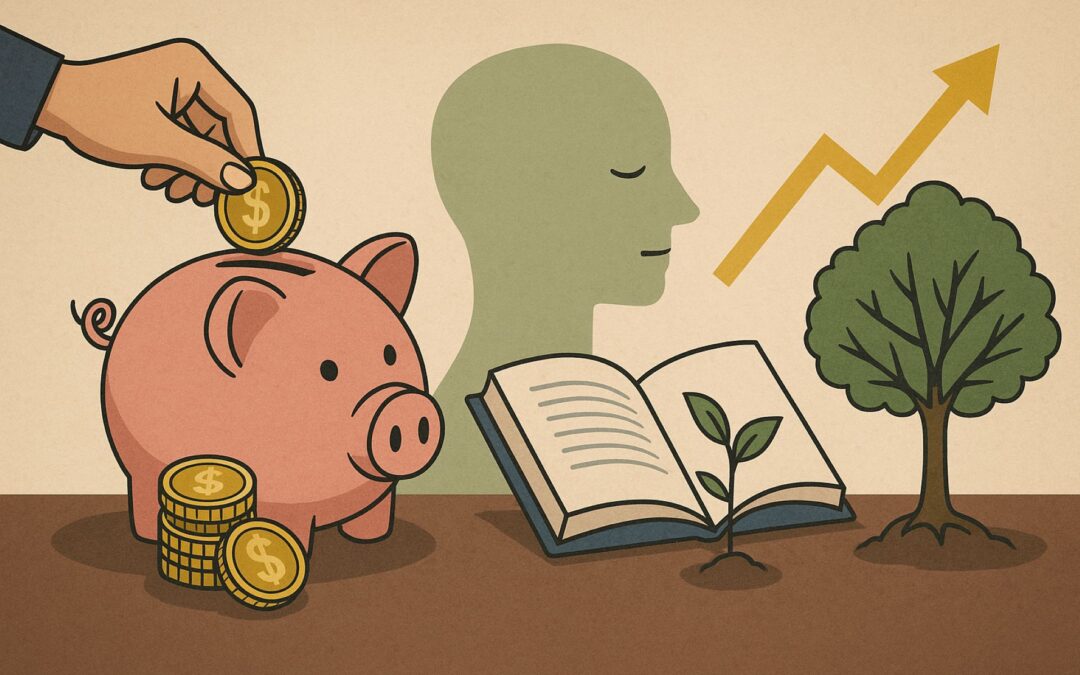
Ever wondered how small actions lead to big results? That’s the magic of things that compound in life. Whether it’s investing a little money today or improving a small skill, the power of compounding can transform your world. Picture this: A tiny seed grows into a towering tree, just like small daily habits can create a massive impact over time.
From your personal growth to financial investments, every choice you make builds on itself. Think of it as a snowball rolling downhill—it gains size and momentum with every turn. Ready to harness this incredible force? Let’s dive right in and explore how these 15 compounding elements can supercharge your life.
What You Believe About Yourself
Your beliefs about yourself are the bedrock upon which your entire life is constructed. These internal narratives are not just fleeting thoughts; they are the subconscious scripts that dictate how you interpret every experience and how you show up in the world. The stories you tell yourself about your abilities, worth, and identity act as a self-fulfilling prophecy, quietly influencing your choices and behaviors with a force that compounds relentlessly over time.
For instance, if you were repeatedly told that you are intelligent, capable, or creative during your formative years, you likely internalized those affirmations, which then shaped your confidence and willingness to take on challenges. You began to act “smart” because that’s who you believed you were supposed to be. This belief didn’t just boost your self-esteem; it rewired your brain to seek out opportunities that reinforced that identity, pushing you into environments where your intellect could flourish and be acknowledged.
Conversely, if you were branded as shy, awkward, or incapable, those limiting labels tend to become prisons. You start to avoid social situations, opportunities, and risks that might disconfirm your perceived limitations. The compounding effect here is insidious: the more you act as the shy person, the more you reinforce that self-image, which influences how others treat you, what they expect of you, and what you ultimately achieve.
What makes this compounding belief so profound is that it transcends your internal world and manifests externally. Your posture, tone, confidence, and risk appetite all subtly shift based on what you believe. This shapes the decisions you make—from the projects you pursue to the people you surround yourself with—creating a feedback loop that can either elevate or diminish your potential. Deep, soulful belief in your worth and capabilities thus becomes the catalyst for success, proving that the ROI of your self-perception is one of the highest and most enduring forms of capital you will ever invest in.
Bad Decisions
Bad decisions have a disproportionately destructive compounding effect that often goes unnoticed until it’s too late. While good decisions tend to accumulate benefits slowly and steadily, bad decisions accelerate decline in a more chaotic and unforgiving fashion. Think of bad decisions as small cracks in a foundation: if ignored, they grow exponentially, threatening to collapse entire structures of your life.
The danger lies in the compound interest of consequences. One seemingly minor misstep—whether it’s trusting the wrong person, neglecting health, making a poor financial choice, or missing critical deadlines—can trigger a cascade of negative outcomes. For example, an early bad hire in a business may lead to missed opportunities, damaged client relationships, and a toxic culture that spirals out of control. These outcomes don’t merely add up; they multiply, each layer of damage making the next worse.
The analogy to debt owed to a predatory lender is apt here. Just like high-interest loans grow rapidly and suffocate financial stability, bad decisions compound faster and more aggressively than good ones. This creates a tightening spiral that can be difficult to escape without deliberate intervention.
However, what differentiates the catastrophic from the manageable is awareness and correction. The moment you recognize a bad decision and actively address it, you shift the compounding effect from one of regret to one of wisdom. Each course correction builds your ability to spot pitfalls earlier, think more critically, and make better calls in the future. The key is not just to avoid bad decisions—which is impossible—but to develop the agility to detect, rectify, and learn from them swiftly before the damage compounds beyond repair.
Long-Term Investments
Long-term investments are the quintessential embodiment of the compounding principle. They require a steadfast commitment to patience, discipline, and vision—qualities increasingly rare in a culture obsessed with instant results. The power of long-term investing is not in immediate gratification but in harnessing the multiplier effect of time, turning small, consistent contributions into exponential growth.
In financial terms, this means putting money into vehicles like index funds, retirement accounts, or diversified portfolios and allowing them to appreciate over decades. But the concept of long-term investment transcends money. It applies equally to personal development, relationships, health, and skills. Nurturing any of these areas over years or decades multiplies their returns beyond what short bursts of effort can achieve.
The most significant hurdle to realizing the magic of long-term investments is our innate impatience. We live in an era of on-demand everything, where immediate feedback loops distort our sense of time and value. This impatience often leads to premature withdrawal, chasing quick wins, or abandoning promising ventures at the first sign of trouble.
Those who master the art of long-term investment develop a unique mindset: they cultivate resilience against short-term noise, an ability to delay gratification, and a faith in gradual progress. This mindset allows them to “leave the seeds in the ground,” trusting that over time, the growth will accelerate and compound into something far greater than the sum of its parts.
Ultimately, long-term investments are a testament to strategic foresight. They reward the willingness to forgo momentary pleasure for sustained prosperity, transforming modest beginnings into legacies that endure.
A Great Hire
Hiring the right person is one of the most leveraged decisions any leader or entrepreneur can make. A great hire is not merely a functional addition to the payroll but a powerful multiplier of organizational capacity, culture, and momentum. The impact of a single outstanding employee compounds over time, far exceeding the sum of their individual tasks.
Unlike mediocre hires who require close supervision and often drain resources, great hires operate autonomously, bringing solutions instead of problems. They exhibit initiative, creativity, and an ability to uplift the entire team. This elevates not only productivity but also morale, fostering an environment where others are inspired to perform at their best.
Beyond skills and output, a great hire shapes the cultural DNA of an organization. Culture, often described as “how things get done around here,” sets the emotional tone and shared values of a workplace. The right person in the right role acts like the opening chapter of a novel—setting expectations, mood, and direction that influence every subsequent page. Their attitudes, work ethic, and interpersonal style cascade through teams, creating a reinforcing loop of excellence.
The compounding effect also manifests in leadership development. Exceptional hires often become mentors, innovators, and future leaders, amplifying their influence exponentially. This makes the process of finding, recruiting, and nurturing great talent one of the highest ROI activities for sustainable growth.
Investing effort upfront in attracting and retaining these individuals pays off over years, creating a legacy of high performance and continuous improvement. The difference between a good hire and a great hire can be the difference between stagnation and transformative success.
Quality Advice and Guidance
Quality advice is far more than just instructions—it is the transmission of wisdom that fundamentally reshapes how you perceive and engage with the world. The true compounding power of great advice lies in its ability to teach you how to think rather than merely telling you what to do. When advice shifts your mental frameworks, it enables you to tackle a myriad of challenges with clarity, confidence, and creativity long after the initial guidance has been given.
Consider the profound impact of a mentor who not only believes in your potential but also challenges your assumptions and exposes you to new perspectives. This mentor’s insights act like seeds planted deep in fertile soil, germinating into improved judgment, sharper intuition, and smarter decisions. The initial boost in motivation they provide is just the surface; the real value compounds as you integrate their lessons into your daily habits and decision-making processes.
The multiplier effect of quality advice becomes even more significant when you have access to multiple mentors or a strong advisory network. Each piece of guidance adds a layer of insight, helping you avoid common pitfalls and seize hidden opportunities. This accumulated wisdom accelerates your progress exponentially, propelling you forward faster than trial-and-error alone ever could.
In practical terms, investing time in seeking out and applying high-caliber advice means faster learning curves, fewer costly mistakes, and more strategic risk-taking. Over the long run, this kind of guidance compounds into a competitive advantage that is nearly impossible to replicate through effort alone.
True Friendships
True friendships are among life’s most valuable and enduring forms of emotional and social capital. Unlike casual acquaintances or transactional relationships, these friendships are built on mutual trust, shared experiences, and sustained investment over years or even decades. The compounding effect of these bonds enriches your emotional resilience, personal growth, and overall well-being in profound ways.
At their core, true friends serve as mirrors and anchors. They reflect back your strengths and weaknesses with honesty, provide unwavering support during hardships, and amplify your joy in moments of success. These relationships form a sanctuary—a place where you can be authentic, vulnerable, and deeply understood without fear of judgment. This emotional security compounds over time, creating a foundation that nurtures self-confidence and mental fortitude.
Beyond emotional benefits, true friendships often become powerful networks of opportunity and collaboration. Trusted friends open doors to new ideas, introductions, and ventures that would otherwise remain inaccessible. Their accumulated knowledge and connections multiply the resources available to you, creating a web of compounded social advantage.
Maintaining these friendships requires conscious effort, especially as life’s demands increase and paths diverge. Yet the rarity and quality of long-lasting friendships only enhance their value. Over time, you come to realize that cultivating a handful of deep, enduring friendships pays dividends far greater than a thousand superficial connections.
Your Work Environment
Your work environment is not just the physical place where tasks get done—it is an intricate ecosystem that profoundly influences your habits, mindset, energy levels, and ultimately your trajectory of success. Because work occupies such a large slice of your life, the cumulative effects of your daily environment compound continuously, shaping your health, attitudes, and performance in subtle but powerful ways.
The ergonomic setup, ambient conditions like lighting and noise, and even the aesthetics of your workspace all contribute to how focused, creative, and energized you feel throughout the day. Poor conditions—such as uncomfortable seating, excessive noise, or inadequate lighting—slow your productivity and degrade your well-being. Over time, these seemingly minor irritations accumulate, leading to chronic stress, physical ailments, or burnout.
Beyond the physical, the psychological atmosphere created by organizational culture, leadership, and coworker interactions exerts a profound influence. A supportive, growth-oriented environment fosters motivation, learning, and innovation, compounding positive habits and high performance. In contrast, toxic workplaces marked by mistrust, micromanagement, or negativity corrode morale and amplify stress, compounding detrimental effects on mental health and engagement.
Your work environment also directly affects your belief systems and worldview, subtly influencing how you perceive challenges and possibilities. Since the majority of your waking hours are spent at work, optimizing this environment isn’t a luxury—it’s foundational to sustainable success and satisfaction. Small investments in improving physical comfort, cultivating positive relationships, and shaping a culture of respect can yield compounding returns in creativity, output, and personal fulfillment.
Real Skills
Real skills are among the most tangible and reliable forms of compounding assets you can acquire. These are the practical abilities and competencies that not only increase your immediate value but also expand your capacity for future learning, problem-solving, and opportunity creation. The earlier you develop real skills, the longer you have to compound their benefits across your personal and professional life.
Mastering core skills—whether it’s digital tools like Photoshop and Canva, communication and copywriting, or strategic thinking—grants you autonomy and agility. For example, learning how to design your own visuals eliminates bottlenecks, enabling faster execution of projects and clearer personal branding. Developing strong communication skills empowers you to articulate ideas, inspire teams, negotiate deals, and build influential networks.
Each time you apply a skill, you reinforce neural pathways that enhance mastery, leading to faster, more intuitive, and higher-quality output. This cumulative improvement increases your efficiency and effectiveness, multiplying the impact of your efforts. Skills also compound in their ability to open doors—once you’re proficient in one area, you often gain easier access to adjacent skills and opportunities, creating a cascade of growth.
Furthermore, real skills enhance your adaptability in a rapidly changing world. In an era where industries and technologies evolve swiftly, possessing foundational, transferable skills allows you to pivot and thrive amidst uncertainty. This dynamic compounding effect ensures that your competencies grow in value, not diminish, as time passes.
Investing in skill development is therefore not a one-time task but a lifelong strategy that compounds into greater freedom, wealth, influence, and fulfillment.
1% Improvements
The concept of 1% improvements, often referred to as marginal gains or incremental progress, is deceptively simple but extraordinarily powerful when viewed through the lens of compounding. Small, seemingly trivial enhancements—improving your processes, habits, or skills by just one percent—may feel inconsequential in the short term. However, these tiny advantages multiply over time, yielding transformational outcomes that far exceed initial expectations.
Imagine a business optimizing its conversion rate from 2% to 3%. At first glance, that’s a 1 percentage point increase. But in reality, it represents a 50% improvement in performance—a leap that can mean the difference between stagnation and explosive growth. This same principle applies to personal development: improving your reading speed, sharpening communication, enhancing physical fitness, or tweaking time management by just a little bit every day compounds into exponential growth.
The power of 1% improvements lies in consistency and accumulation. Each gain builds on the last, creating a snowball effect that accelerates your momentum. Unlike radical changes that can be difficult to sustain, incremental progress is manageable, less intimidating, and more adaptable to daily life. Over months and years, this relentless pursuit of marginal gains rewires your habits, elevates your standards, and shifts your trajectory toward extraordinary success.
Adopting this mindset encourages a focus on continuous learning and optimization. It teaches patience and resilience, proving that slow and steady improvements can outpace sporadic bursts of effort. In essence, small choices and tiny improvements are the hidden architects of greatness.
Building Once and Selling Millions of Times
In the digital age, the ability to build something once and distribute it infinitely is one of the most potent manifestations of compounding. This concept revolves around creating scalable assets—products, services, or content—that can reach millions of people without proportional increases in effort or cost.
Digital media, software, online courses, and books exemplify this phenomenon. You might spend months or even years crafting a high-quality online course, an app, or a video series. Once completed and launched, however, these creations can be consumed by millions repeatedly without additional production costs. This leverage allows creators to multiply their impact and revenue exponentially.
Unlike traditional businesses tethered to physical goods or hourly labor, scalable digital assets remove the linear constraints of time and resources. Each additional sale or view adds incremental revenue without requiring new work, compounding income in a way that traditional models cannot match.
This strategy demands an upfront investment of creativity, research, and refinement, but the payoff is a durable and growing income stream. Moreover, it allows for reinvestment in future projects, fueling an ongoing cycle of innovation and expansion.
By embracing scalable creation, entrepreneurs tap into compounding returns that can transform small beginnings into global reach and significant wealth, all while freeing up their time for new ventures.
Automated Investments
Automated investments harness compounding by blending disciplined strategy with behavioral science. One of the biggest barriers to effective investing is human psychology—emotions like fear and greed lead to inconsistent actions that undermine growth. Automation removes these pitfalls by creating a system where money is invested regularly, systematically, and without emotional interference.
The phrase “set it and forget it” captures this approach. By programming a fixed percentage of income to be automatically deposited into diversified investment vehicles such as index funds or retirement accounts, you harness the power of compounding returns over long periods. This strategy prioritizes time in the market over timing the market, which has proven to be a more reliable path to wealth accumulation.
Automation also accommodates income fluctuations by adjusting contributions proportionally, smoothing the investment process through ups and downs. This consistency builds a growing portfolio that compounds returns year after year, quietly but relentlessly increasing net worth.
Additionally, automated investments foster financial discipline by making saving and investing a default behavior rather than an optional choice. This removes the friction of decision fatigue and the temptation to spend money impulsively.
In sum, automating your investments turns compounding into an effortless engine of growth, empowering wealth-building through patience, consistency, and avoidance of costly emotional mistakes.
Charitable Work and Small Acts of Kindness
Charitable work and small acts of kindness create a ripple effect that compounds beyond immediate perception, influencing lives, communities, and even your own well-being in profound and lasting ways. Each altruistic action plants seeds of goodwill, empathy, and connection that grow exponentially over time.
When you give—whether it’s time, resources, or care—you initiate a chain reaction. The beneficiaries are empowered to help others, communities strengthen, and social capital accumulates. Unlike one-off donations, sustained charitable efforts, such as building schools, supporting healthcare initiatives, or mentoring youth, create infrastructure and systems that multiply impact year after year.
Moreover, acts of kindness nourish your own emotional health. Research shows that generosity boosts happiness, reduces stress, and fosters a sense of purpose. This positive feedback loop compounds, enhancing resilience and interpersonal relationships.
A powerful example is the establishment of educational or medical centers in underserved regions. These institutions not only provide immediate assistance but also become hubs for ongoing community development, training, and empowerment—benefits that cascade through generations.
This form of compounding isn’t financial but deeply human and social. It transforms isolated gestures into enduring legacies, reminding us that the wealth of kindness and compassion often yields the richest dividends in life.
Rational Optimism
Rational optimism is a mindset that blends hopeful anticipation with grounded realism. It’s the belief that, despite challenges and setbacks, the future holds improvement—and that your actions contribute meaningfully to that better tomorrow. This mindset is not naive wishful thinking but a calculated attitude rooted in evidence, reason, and a commitment to positive action.
The compounding effect of rational optimism lies in its ability to expand your “luck surface area”—the number of opportunities, connections, and fortunate encounters you expose yourself to by engaging proactively with the world. Optimists take calculated risks, persist through adversity, and embrace uncertainty as a space for possibility. This openness leads to more frequent positive outcomes that build momentum over time.
Contrasted with pessimism, which often leads to inaction, withdrawal, or cynicism, rational optimism fuels perseverance. It increases resilience by framing setbacks as temporary and surmountable rather than as final judgments on ability or worth. This mindset makes you more willing to experiment, innovate, and pursue long-term goals that others might dismiss as improbable or unrealistic.
The cumulative effect is profound: by fostering rational optimism, you create a self-reinforcing cycle where your positive outlook generates actions that lead to success, which in turn strengthens your optimism. Over years, this compounding attitude can be the difference between stagnation and extraordinary achievement.
Stable Family Relationships
Stable family relationships serve as an emotional and psychological anchor that compounds in value over a lifetime. Unlike volatile or dysfunctional family dynamics, stable families provide a consistent source of love, security, and support that builds resilience and confidence.
The foundation of a stable family includes healthy communication, mutual respect, emotional availability, and shared values. These elements cultivate a safe environment where individuals feel accepted and understood, enabling personal growth and emotional regulation. Over time, this stability weaves into your identity, shaping how you relate to others, manage stress, and approach challenges.
Having dependable family relationships reduces emotional burdens and provides a reliable safety net during difficult periods. The knowledge that you have loved ones who support and stand by you bolsters your confidence to take risks and pursue ambitions, knowing you’re not alone.
In a practical sense, stable family ties also compound social capital—offering connections, advice, and collaborative opportunities that extend into personal and professional spheres. They create a legacy that supports not just immediate family members but future generations.
This enduring foundation is akin to a meticulously constructed home: resilient, well-supported, and capable of weathering storms, providing a secure platform from which to build a fulfilling life.
Reading and Books
The act of reading is one of the most profound investments you can make in your intellectual and personal growth. Books are repositories of distilled knowledge, diverse perspectives, and timeless wisdom that compound their value each time you engage with them deeply and repeatedly.
Reading regularly expands your vocabulary, critical thinking, and creativity. It exposes you to ideas that challenge your assumptions, broaden your worldview, and equip you with strategies to navigate complex problems. This intellectual nourishment compounds as each book builds upon the foundations laid by previous readings.
Incorporating audiobooks alongside physical books is a strategic way to amplify intake. Listening at accelerated speeds, for instance, allows you to consume more content without sacrificing retention, effectively compressing years of learning into months. Combining active reading with note-taking, journaling, and periodic review turns passive information into actionable insight.
Rereading select books compounds understanding and reveals new layers of meaning as your experience and perspective evolve. This iterative process embeds key lessons more deeply, making their influence on your thinking and decisions more durable.
Ultimately, the knowledge accumulated through reading compounds into sharper judgment, innovative ideas, and a richer mental toolkit, empowering you to make better decisions, communicate more effectively, and seize opportunities with greater confidence.
Bonus: Decision Quality Over Effort
In the calculus of success, the quality of your decisions far outweighs the quantity of effort expended. While hard work is important, it is strategic, high-leverage decisions that multiply outcomes exponentially. A single wise decision can yield returns equivalent to years of undirected toil.
This principle shifts the focus from “working harder” to “working smarter.” Instead of dispersing effort across countless minor choices, elite performers concentrate on making fewer but more impactful decisions—those that create cascading positive effects across multiple areas of life.
For example, choosing the right life partner, career path, or city to live in can amplify your fulfillment, opportunities, and productivity many times over. These decisions act like multipliers, increasing the value of every subsequent action you take. Conversely, poor decisions in these areas can compound into long-term difficulties that no amount of effort alone can overcome.
Once a critical decision is made, the next step is absolute commitment. Wavering or second-guessing drains energy and focus, fracturing momentum. The best achievers cultivate the discipline to make confident choices, align their actions fully with those choices, and channel maximum effort toward execution.
Mastering decision quality creates a compounding cycle of progress: better decisions lead to better results, which build confidence and clarity for future decisions. Over time, this skill becomes the linchpin of accelerated growth, distinguishing high performers from those who simply hustle without direction.
Conclusion
Embrace the power of compounding in your life! Picture how your daily choices, from small financial investments to personal habits, can build a future full of growth and success. Imagine waking up to see the results of your consistent efforts—a thriving career, a well-nurtured skill, or financial stability. You hold the key to transforming small actions into extraordinary outcomes. It’s time to act on this wisdom, setting yourself up for a future where every small effort compounds into monumental success. Dive in today and start making those incremental changes. Your future self will thank you. Ready to start your journey? Let’s get going!