
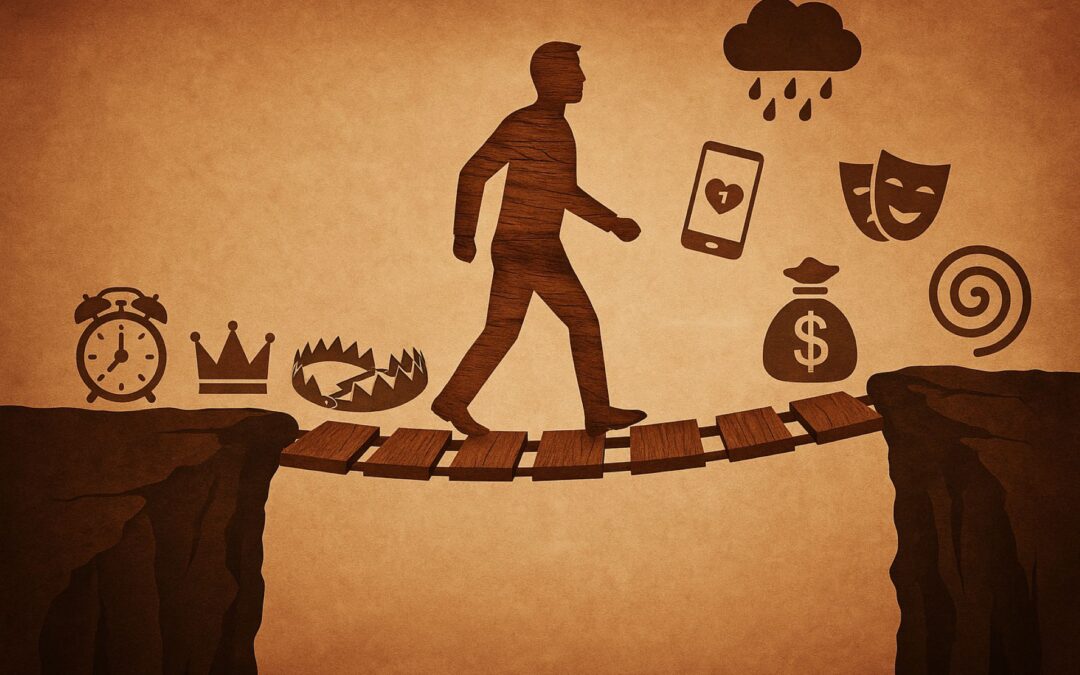
Life is a grand tapestry woven together by the choices we make – from the trivial to the monumental, they shape our existence in ways profound and intricate. Whether it’s opting for junk food or deciding on a career move, our choices reverberate throughout our life’s narrative, sculpting the reality we ultimately inhabit. Welcome back, dear Aluxer, as we embark on a journey to uncover 15 traps that can ensnare us in unproductive mindsets and habits. More importantly, we’ll explore how to evade these traps and forge a path toward a more enriching and fulfilling life.
1. Procrastination: A Thief of Opportunity
Procrastination, that ever-so-subtle adversary, has a knack for slipping into our lives unannounced, often lurking in the shadows. It’s a behavior we’re all familiar with, and its consequences are profound. Procrastination doesn’t just delay tasks; it delays progress, sidelines aspirations, and can even hold your potential hostage.
Imagine procrastination as a crafty pickpocket, robbing you of precious opportunities. When we succumb to this habit, we fall into a cycle of avoidance, driven by a fear of failure or the overwhelming weight of our goals. But what’s even more insidious is the toll it takes on our mental and physical well-being.
Procrastination is akin to knowing there’s a task that needs completion but actively avoiding it, creating a constant source of anxiety that gnaws at your mental and physical health. The awareness of unfinished business lingers like a persistent cloud, casting a shadow over your daily life.
So how can one combat this thief of time and opportunity? The solution lies in breaking down your tasks into smaller, manageable steps. Picture it as dissecting a complex puzzle into bite-sized pieces. Set achievable goals and realistic deadlines. Incentivize yourself with rewards and bask in the satisfaction of completing each step.
The first step in overcoming procrastination is acknowledging its detrimental effects. Recognize that it’s not just a harmless delay but a formidable obstacle that hinders progress and stifles your true potential. Don’t allow procrastination to be the architect of your life’s regrets; seize your tasks and grasp your opportunities.
2. Pride: Navigating the Ego’s Waters
Pride is a double-edged sword in the arsenal of human emotions. In moderation, it’s a robust force that bolsters our self-esteem, enabling us to tackle life’s challenges with confidence. However, like any powerful tool, it can become a hindrance when wielded excessively.
Think of pride as a majestic sailboat navigating the waters of life. When properly managed, it propels you forward, steering you through life’s storms with grace and resilience. Your achievements become the wind in your sails, pushing you toward success. However, when pride becomes unchecked, it’s akin to hoisting too much sail during a fierce gale; the once-mighty vessel now teeters on the brink of capsizing.
Excessive pride can be blinding. When you’re too proud, it’s challenging to admit your flaws, to see that you don’t have all the answers, or to accept constructive criticism. This reluctance to acknowledge areas where you need improvement can hinder your personal growth and development.
Balancing pride with humility is the key. It’s about recognizing your accomplishments and capabilities while remaining open to the idea that there’s always room for improvement. Think of it as sailing a ship with both the mainsail and jib perfectly trimmed, harnessing the winds of success while staying agile and adaptable.
By humbling yourself and accepting that you’re not infallible, you create space for personal growth. You become open to constructive criticism and feedback, viewing them as stepping stones toward self-improvement rather than as threats to your pride.
In essence, striking a harmonious balance between pride in your achievements and the humility to acknowledge your flaws paves the path to a more successful and fulfilling life. Celebrate your accomplishments, but don’t forget to keep the sails trimmed for self-improvement as you navigate the vast sea of life.
3. Exploring All the Options: Crafting a Life of Deliberation
Life resembles a grand tapestry interwoven with choices—some apparent, others subtly hidden beneath the surface. Each choice, irrespective of its magnitude, contributes to the unique narrative of your existence. It’s akin to perusing a diverse menu when dining out; the decision-making process is an art that should be savored and not rushed.
Why is this art of exploration essential? Firstly, it safeguards you against hasty decisions that may haunt you later. Much like avoiding an ill-fated culinary choice at a restaurant, taking a moment to consider your options prevents regret in the long run. Secondly, it grants you insight into the potential consequences of your choices, allowing you to make informed decisions. Lastly, it empowers you with a sense of control over your life—a feeling that you’re steering your destiny rather than drifting aimlessly.
When confronted with a decision, resist the urge to rush. Instead, savor the opportunity to explore your options thoroughly. Delve into the nuances of each choice, contemplate the possible outcomes, and feel the empowerment that comes from being the architect of your own destiny.
Making informed choices is akin to concocting your own recipe for happiness. It’s about selecting the finest ingredients from the menu of life to create a dish uniquely satisfying and meaningful to you. Remember, in the grand mosaic of existence, every choice is a brushstroke, and you are the artist shaping your masterpiece.
4. Materialism: Finding Peace in Simplicity
In a world dominated by material possessions and consumerism, financial worries often lurk just around the corner. This is what we call materialism—a relentless pursuit of things, often at the expense of financial stability and peace of mind. Imagine your income as a jar; the marbles represent your expenses. Overfilling the jar with more marbles than it can hold leads to disaster, akin to excessive spending beyond your means.
The solution to financial peace lies in a simple principle: live within your means. This means spending your money judiciously, avoiding the temptation to acquire things you can’t afford, and diligently saving for the future. Living within your means isn’t about austerity; it’s about financial wisdom and responsible stewardship of your resources.
By adhering to this principle, you regain control over your finances, alleviating the stress of overwhelming debt and financial woes. It ensures that your jar remains intact, capable of weathering life’s unexpected storms without shattering. Financial peace, much like a well-tended garden, requires regular nurturing and prudent management.
Living within your means isn’t a restriction; it’s liberation. It liberates you from the chains of financial burden, allowing you to live a more peaceful and harmonious life. It provides the foundation for financial stability, enabling you to focus on what truly matters—the pursuit of your dreams and the cultivation of a fulfilling existence.
5. Listening to Your Mind and Body: The Symphony of Well-being
Imagine your body and mind as the instruments of a grand orchestra, and the signals they send are the notes in a symphony. Just as a maestro listens intently to every note played, it’s vital to pay attention to what your body and mind are telling you.
When your body signals fatigue, it’s akin to a violin’s plaintive cry. You wouldn’t push a musician to play endlessly; similarly, you shouldn’t force yourself to soldier on without rest. When stress reverberates through your thoughts, imagine it as a discordant chord in the symphony of your life. Just as you wouldn’t let dissonance persist in a musical performance, address your stress.
Nourishing your body with healthy food and regular exercise is akin to providing your instrument with the finest strings and keeping it finely tuned. Just as you wouldn’t neglect an instrument, don’t disregard your physical well-being. When you listen to the cues your body and mind provide, you’re essentially conducting a harmonious symphony of well-being.
This attentive listening isn’t just a matter of physical health; it extends to your mental and emotional well-being as well. By heeding these signals, you can prevent serious health issues and enjoy a life filled with happiness and vitality.
In essence, life is a symphony, and you are both the conductor and the musician. Pay attention to the music of your body and mind, conduct it with care, and create a harmonious melody that resonates with well-being and vitality.
6. Credit Wisdom: Balancing Financial Freedom
Credit, when used judiciously, is akin to a versatile tool in your financial toolbox. It can be a lifeline, allowing you to make purchases when cash is scarce. However, just as a tool can be mishandled, credit must be wielded with care. Picture credit as a favorite treat, like ice cream. Enjoyed occasionally, it’s delightful; but indulged in excessively, it can lead to an upset stomach.
Credit is a useful financial tool when employed for necessary expenses. It can help you bridge gaps in your budget, whether it’s purchasing a home, starting a business, or investing in education. However, using credit impulsively for non-essential items is akin to overindulging in sweets; it can lead to financial indigestion.
Excessive debt is like a heavy backpack you’re forced to carry. It burdens you with stress and restricts your ability to explore new horizons and enjoy life’s adventures. To avoid the weighty burden of debt, exercise restraint in your spending habits, be judicious with your use of credit and treat it as a tool for financial freedom rather than a source of financial stress.
Credit, when wielded wisely, can be a powerful ally, enabling you to achieve your financial goals and aspirations. It’s a bridge to realizing your dreams when cash flow might be limited. However, much like a responsible chef who uses just the right amount of seasoning to enhance a dish, use credit judiciously to enhance your financial journey without overwhelming it.
7. Seizing the Moment: Embracing the Journey
Life is akin to a speeding train that never waits for passengers. It relentlessly forges ahead, regardless of who’s on board or who’s left behind. In this journey, there’s one fundamental truth: time waits for no one. It’s a train that departs without delay, and you must choose whether to embark or let it pass by.
Imagine life as an exhilarating journey on a fast-moving train. The train doesn’t pause and wait for you to hop on; it continues on its path, regardless of your readiness. If you miss your chance to board, you may find yourself watching as the train speeds toward destinations unknown, leaving you behind.
This analogy serves as a stark reminder that life is unpredictable and ever-moving. It emphasizes the importance of acting swiftly when opportunities present themselves. Delaying your dreams, much like missing the train, can lead to regrets and a sense of missed potential.
Life is full of surprises, but one thing remains constant: time keeps moving forward. This underscores the significance of not postponing your dreams and aspirations. It emphasizes the need to seize the moment and make the most of the time you have. Today is the best time to embark on your journey, for tomorrow is uncertain.
Don’t let the fast-paced nature of life deter you from taking action. Embrace each moment, chase your dreams with unwavering determination, and create a life filled with meaningful experiences and accomplishments. Remember, the train of life keeps moving; ensure you’re on board, steering it toward your desired destinations.
8. Self-Reliance vs. Dependency: A Balancing Act
Imagine learning to ride a bicycle—an endeavor that requires guidance and support. In this scenario, having someone to assist you is immensely beneficial. However, over-reliance on that support can lead to a precarious situation. It’s essential to strike a balance between self-reliance and the comfort of knowing you have a support system to lean on.
Think of learning to ride a bicycle as a metaphor for life. While it’s advantageous to have someone guiding you initially, excessively leaning on them can inhibit your personal growth. If you rely entirely on external support, you risk stumbling when that support is unavailable.
Achieving a healthy equilibrium between self-reliance and the availability of a support system is pivotal. Self-reliance signifies your ability to handle tasks and navigate challenges independently. It’s akin to mastering the art of balancing on a bicycle—a skill you carry with you throughout life.
Simultaneously, having a robust support system means you have individuals you can turn to when assistance or guidance is needed. These individuals serve as your safety net, ensuring you have a reliable source of help when facing life’s challenges.
Finding the balance between self-reliance and dependence on a support system is akin to maintaining the equilibrium of a bicycle. You remain agile and steady, capable of navigating various terrains with confidence. By cultivating self-reliance and fostering a strong support system, you embark on a journey toward a fulfilling and less disappointing life.
9. Honesty: The Pillar of Trust and Integrity
Trust, delicate as glass, shatters when falsehoods enter the equation. Honesty, on the other hand, safeguards trust and bolsters the foundation of integrity. Trust is akin to a beautiful glass sculpture—a work of art that, once shattered, is nearly impossible to restore. Honesty is the steady hand that protects this delicate masterpiece.
When you choose honesty, you’re treating that glass sculpture with the utmost care, ensuring it remains whole and unblemished. Honesty is the bedrock of trust and integrity in your relationships. It signifies reliability, as people can depend on your words and actions.
Dishonesty, on the contrary, is like handling the glass sculpture carelessly, causing it to splinter into countless fragments. Lies weaken the bonds you share with others, erode trust, and cast shadows over the once-gleaming sculpture of trust and integrity.
In essence, honesty serves as a guardian of trust and integrity. It forms the cornerstone upon which strong and lasting connections are built. By choosing honesty over deceit, you nurture the bonds that define your relationships, ensuring that they remain resilient and unbreakable.
10. Lifestyle Inflation: The Quest for Contentment
In the pursuit of more—more possessions, bigger achievements, grander experiences—we often overlook the profound contentment that lies in appreciating what we already have. Life, when viewed through the lens of perpetual growth and accumulation, becomes a relentless treadmill, where progress remains elusive.
Imagine your life as a puzzle, with each piece representing something valuable—your family, friends, personal accomplishments, and cherished moments. When you appreciate these pieces, you begin to perceive the larger picture of your life. However, relentlessly chasing additional puzzle pieces leaves you with a sense of incompleteness, forever searching for that elusive final piece.
Learning to appreciate what you have doesn’t negate the pursuit of improvement. Rather, it encourages you to find contentment in your present circumstances while striving toward your goals. This delicate equilibrium cultivates a profound sense of fulfillment and satisfaction in your life.
So, resist the endless chase for more and take a moment to cherish the pieces that compose your life’s puzzle. In doing so, you’ll uncover the profound truth that happiness often resides in the simple act of being grateful for what you possess.
11. Digital Balance: Navigating the Social Media Landscape
The digital age has ushered in an era of unprecedented connectivity, but with it comes a double-edged sword: the pervasive allure of social media. These platforms, while invaluable for connecting with others and sharing thoughts, can also become consuming forces that overshadow our real-life experiences.
Picture social media as a virtual garden—a delightful space to visit and enjoy. However, losing yourself entirely within its confines is akin to neglecting the beauty of your tangible, real-life garden. Scrolling through endless posts and measuring your life against others’ highlight reels can create feelings of inadequacy and affect your overall happiness.
Maintaining a healthy equilibrium between social media and real-life experiences is essential for your well-being. Much like a balanced diet, where each component contributes to your overall health, striking the right balance between the digital and tangible worlds enhances your quality of life.
So, while social media can serve as a valuable tool for connection and expression, don’t let it overshadow the richness of your day-to-day existence. Find that equilibrium, and you’ll discover a more fulfilling and enriching way to engage with the world around you.
12. Victim Mindset: Embracing Responsibility
Consider life as a journey filled with challenges and obstacles, akin to a hiker navigating a rugged trail. In this journey, adopting a victim mindset can be likened to viewing these challenges as insurmountable barriers, as if you’re at the mercy of external forces.
Rather than succumbing to the role of a victim, view personal growth as an ongoing journey—a path laden with challenges and difficulties. This perspective places you in an active role, equipped to confront challenges head-on, learn from them, and continue growing.
Taking responsibility for your actions empowers you to overcome obstacles, fostering personal growth and a heightened ability to problem-solve. When you hold yourself accountable, you shift your mindset from dwelling on the problem to seeking solutions—a transformative shift that can shape the trajectory of your life.
In essence, embracing responsibility is akin to assuming the role of an active participant in your life’s journey. It enables you to navigate challenges with resilience, adaptability, and unwavering determination. By doing so, you unlock your true potential and sculpt a future filled with personal growth and self-realization.
13. Lifelong Learning: Nurturing Growth
Education, represented as the foundation of a grand building, is the initial step in a lifelong journey of growth and learning. However, it’s vital to understand that learning should never cease upon completing formal education. Education is akin to laying the foundation of a building; while crucial, it’s only the beginning of the construction process.
Consider your education as the cornerstone of your intellectual edifice. It provides you with essential knowledge and skills, similar to how the foundation supports the entire structure. However, just as a building is incomplete with just a foundation, your journey of learning and growth extends far beyond your educational years.
The world is in a perpetual state of flux, continually evolving and presenting new challenges and opportunities. Relying solely on past accomplishments stifles your progress and leaves you ill-equipped to navigate the ever-changing landscape of life.
Think of lifelong learning as adding new floors to your building, making it taller, more impressive, and better suited to withstand the test of time. Stay curious and open to new knowledge, and you’ll not only enhance your skills but also remain relevant in your field.
Remember, your past accomplishments are valuable chapters in your life’s story, but they are not the final pages. Embrace the concept of lifelong learning, and you’ll embark on a journey characterized by continuous growth and fulfillment.
14. Authenticity: Shining in Your True Light
Authenticity is a rare gem that outshines deliberate acts designed solely to garner attention. When you remain true to yourself, your uniqueness naturally draws the spotlight. Authenticity is akin to a gentle breath of fresh air amidst a world where many strive to be something they’re not.
When you intentionally seek attention through contrived actions, it’s akin to trying to seize a spotlight forcibly. While it may seem as though you’re in the spotlight, it’s not your true self that’s illuminated. Authenticity, on the other hand, has a lasting impact. When people recognize that you’re being real and authentic, it forges a genuine connection.
Seeking attention through deliberate acts might provide a fleeting moment in the spotlight, but it often casts a long shadow. Authenticity, however, is a beacon that radiates a lasting glow, forging deeper connections based on trust and genuine camaraderie.
In essence, authenticity is about being yourself, unapologetically and proudly. It’s a magnetic force that draws people toward you, celebrating your uniqueness rather than conforming to external expectations. Shine in your true light, and you’ll discover that authenticity is the true path to lasting connections and fulfillment.
15. Comparison: Nurturing Your Unique Journey
Imagine life as a unique path, winding through a dense forest of experiences, twists, and turns. Each person’s journey is akin to a trail, distinctly their own, filled with its own joys and challenges. Constantly comparing your journey to someone else’s is akin to straying off your path to walk on theirs.
When you fixate on another’s journey, it’s like neglecting your own garden to admire someone else’s. In doing so, you miss out on the beauty and richness of your own unique terrain. Comparison invariably leads to feelings of inadequacy, frustration, and an erroneous sense of your own progress.
Instead of diverting your gaze to others’ paths, cultivate an appreciation for your journey. Embrace your unique experiences and lessons as they shape the remarkable person you are becoming. Celebrate your achievements and setbacks, for they are integral to your personal growth.
Remember that comparisons often arise from a skewed perspective, as you’re only privy to a fraction of someone else’s journey. In reality, each person faces their share of challenges and triumphs, even if they are not immediately visible.
In summary, relish the path you’re on, knowing that it’s uniquely yours. Celebrate your achievements, learn from your setbacks, and nurture your personal growth. Comparison can be a thief of joy; choose instead to cherish the beauty of your individual journey.
Bonus – Resilience: The Art of Bouncing Back
Life, like a turbulent sea, can often toss us about with unforeseen waves of adversity. However, much like a well-anchored ship, resilience is the anchor that keeps us steady in the face of these challenges. It’s the art of not just enduring hardship but emerging from it stronger, like a phoenix rising from the ashes.
Think of resilience as a sturdy tree in a storm, bending and swaying with the winds of adversity but never breaking. It’s the ability to adapt, learn, and grow in the face of adversity, much like the roots of a tree that seek nourishment and stability even in the harshest of conditions.
Resilience is a quality that can be nurtured and developed. It’s about maintaining a positive mindset, seeking solutions in the face of obstacles, and viewing challenges as opportunities for growth. When life’s storms rage, resilience is the beacon that guides you through, illuminating the path forward.
In essence, resilience is the art of bouncing back from life’s challenges with grace and strength. It’s the belief that no matter how hard life may push you, you have the inner fortitude to bounce back, stronger and wiser than before. Cultivate resilience, and you’ll find that it’s the key to navigating life’s turbulent waters with confidence and resilience.
Conclusion
Steering clear of these pitfalls is akin to constructing a bridge toward a life characterized by balance, truthfulness, and fulfillment. Life is a journey of continuous learning, and being mindful of these traps empowers you to make wiser choices, guiding you toward a future brimming with happiness, success, and self-awareness. Balance is your compass; every choice is a step closer to your desired destination. These lessons etch valuable markers on your life’s roadmap, ushering you toward a life enriched by accomplishments and joy.