
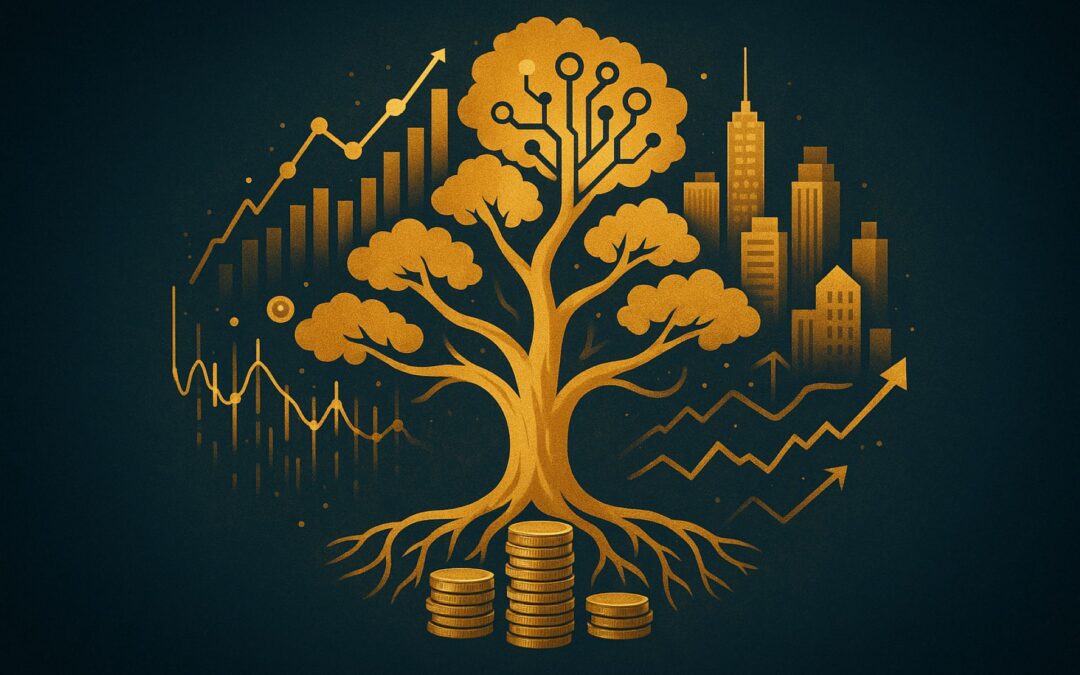
There are countless ways to earn money, but only a handful of assets have proven—again and again—to create lasting wealth. Generational fortunes aren’t built on lucky breaks or fleeting trends. They’re built on foundations that compound, preserve, and expand over time.
From the stock market to real estate, from revolutionary technologies to passive income machines and timeless stores of value, these are the engines that turn ambition into empires. If you can master even one of them, you’ll never have to worry about money again. Master several, and you step into the league of the world’s wealthiest.
Investing in Stocks: From Retail Losses to Billionaire Playbooks
The stock market is often seen as the great equalizer—anyone can participate, anyone can own a piece of the world’s biggest companies. But here’s the inconvenient truth: the stock market doesn’t treat everyone equally. The rules are the same, yet the results couldn’t be more different. Roughly 62% of Americans invest in stocks, but only a small minority ever get rich from them. The majority lose money and become what Wall Street insiders call capital donors—people whose losses feed the gains of the disciplined few.
Why Most People Lose
Retail investors often enter the market with excitement but without education. They chase hype on social media, buy into meme stocks, or attempt day trading without understanding the mathematics stacked against them. They buy high when the buzz is deafening and sell low when fear grips the market. This emotional cycle is why 75% of individual investors lose money over the long term. They gamble, rather than invest.
Imagine someone buying Tesla at its peak in 2021 because Twitter was flooded with euphoria. When the inevitable correction hit, panic selling locked in losses. That pattern—buying the top, selling the dip—is repeated across millions of portfolios. The irony is that the market itself is designed to reward patience, not panic.
The Power of Blue-Chip Stocks
The first step toward breaking this cycle is learning to invest in blue-chip stocks—giant corporations with strong balance sheets, global presence, and the ability to endure recessions. Think Apple, Microsoft, Johnson & Johnson, or Coca-Cola. They may not double overnight, but over decades they quietly multiply wealth.
For example, Apple’s stock price has more than doubled in just the last five years. If you had simply bought and held—ignoring the noise—you’d have watched your money compound without lifting a finger. Add in dividends (regular cash payouts from profits), and these stocks become wealth machines that run in the background.
The real advantage of blue chips isn’t excitement—it’s reliability. While speculative bets collapse in crises, blue chips endure. They may dip temporarily, but history shows they recover and reach new heights.
Index Funds and ETFs: The Everyday Investor’s Secret Weapon
Owning individual companies carries risk. Even giants can stumble—remember when Enron collapsed or when Nokia was left behind by smartphones? To avoid betting your future on a single horse, wealthy investors recommend index funds and ETFs (exchange-traded funds).
These bundles contain hundreds, sometimes thousands, of stocks. An S&P 500 index fund, for example, gives you exposure to 500 of America’s largest companies in one purchase. You don’t need to guess winners and losers—the fund already balances them. Historically, the S&P 500 has delivered an average annual return of about 10%.
Better still, when these funds are paired with retirement accounts like 401(k)s or Roth IRAs, they gain additional tax advantages. Your money grows untaxed for years, compounding far faster than in a taxable brokerage account.
Diversification: Insurance for Your Portfolio
Even index funds can be concentrated in one economy or sector. That’s why diversification is key. Smart investors spread their money across different industries, geographies, and asset classes. Some U.S. stocks, some international, maybe bonds, maybe a REIT (real estate investment trust).
Diversification is less about chasing higher returns and more about reducing risk. If tech stocks tumble, healthcare might hold steady. If U.S. markets falter, emerging markets might surge. The goal is balance—ensuring that no single event can wipe out your future.
How Millionaires Invest in Stocks
Here’s where things get interesting. The wealthy often begin where retail investors fail: picking individual stocks. But their approach is night-and-day different. They don’t scroll Reddit threads for hot tips—they analyze fundamentals. They study earnings reports, debt ratios, and market trends. They look for undervalued companies or those positioned for explosive growth.
Some follow the value investing philosophy of Warren Buffett, buying strong companies when they’re temporarily undervalued. Others hunt for early-stage growth giants—the next Amazon, Tesla, or Nvidia. Their secret isn’t luck; it’s discipline, data, and patience.
But even the best stock pickers know they can’t predict the future. That’s why the wealthy lean heavily on hedging strategies. Mark Cuban famously used an options collar in 1999 after selling his company to Yahoo. By buying put options (the right to sell at a set price) and selling call options (the obligation to sell if prices rise too high), he effectively locked in his fortune. When the dot-com bubble burst, Cuban walked away unscathed.
Hedge Funds and Quant Strategies
At a higher level, millionaires and billionaires often pool money into hedge funds—private investment firms that deploy advanced strategies ordinary investors can’t. Some specialize in event-driven plays (like profiting from mergers), while others take macro bets (like predicting global interest rate moves).
The most powerful hedge funds, like Renaissance Technologies, use quantitative trading. Algorithms scour terabytes of data, spotting patterns invisible to the human eye. These models execute thousands of trades a day, profiting from tiny inefficiencies. Renaissance’s Medallion Fund has returned over 60% annually before fees, making it one of the most successful funds in history.
Family Offices: Billionaire-Level Investing
Beyond hedge funds lies the family office, the billionaire’s ultimate wealth vehicle. A family office is like a personal financial empire—teams of analysts, tax strategists, estate planners, and lawyers working exclusively for a single family. Their goal isn’t just making money; it’s preserving wealth for generations.
Family offices invest in private equity, use tax-loss harvesting to minimize capital gains, and employ strategies like buy, borrow, die—borrowing against stock holdings instead of selling them to avoid taxes, then passing them tax-free to heirs. This is how dynasties like the Rockefellers and Waltons maintain generational wealth.
The Big Picture
From retail investors fumbling on meme stocks to billionaires wielding complex family offices, the stock market illustrates one truth: the same playground produces very different results depending on how you play the game. For the average person, index funds, ETFs, and patience can build quiet wealth. For the wealthy, advanced strategies turn the stock market into an empire-building machine.
Real Estate: The Oldest Millionaire Maker
Real estate is not just an asset class—it’s the bedrock of wealth for centuries. Long before stock markets, crypto exchanges, or hedge funds, kings, landlords, and dynasties built their fortunes on land. The reason is simple: they’re not making any more of it. Real estate combines tangibility, utility, and scarcity in a way few other assets can. That’s why it has produced more millionaires than any other wealth vehicle in history. And unlike hedge funds or complex financial instruments, real estate is accessible. You can start small, even with little to no money down, and climb your way up the wealth ladder.
Let’s break it down step by step, from the beginner moves to the empire-building strategies.
Level 1: House Hacking — Turning Your Home into an Asset
For most people, housing is their biggest expense. Rent or mortgage payments eat up a massive share of income. But with house hacking, you flip that liability into an asset.
Picture this: you buy a small duplex, live in one unit, and rent out the other. The rent covers your mortgage, maybe even more. Overnight, you’re living for free while building equity. This strategy doesn’t require skyscrapers or huge sums of money. It’s often the accidental first step for many real estate millionaires. The beauty? Every month, you’re paying down a loan on a property that belongs to you—not to your landlord. That loan repayment and the property’s appreciation both feed your net worth.
Level 2: Becoming a Landlord — Passive Income in Your Sleep
Once you’ve outgrown house hacking, the next logical move is buying and holding rental properties. You purchase single-family homes, duplexes, or small apartment buildings, then lease them to tenants. Each month, rental payments roll in, covering your mortgage and leaving profit in your pocket.
It’s not glamorous—you’ll deal with leaky faucets, late rent, and tenant complaints. But the long-term upside is powerful: consistent cash flow, appreciation over time, and tax benefits like mortgage interest deductions and depreciation. You literally make money while you sleep. Many people stop here, content with steady rental checks. But those who push further unlock much bigger opportunities.
Level 3: Short-Term Rentals — Multiplying Income with Airbnb
Traditional renting gives you predictable monthly checks. But in high-demand cities, short-term rentals can triple that income. Platforms like Airbnb or Vrbo let you charge by the night instead of by the month.
Furnish the property, take great photos, and suddenly your weekends are booked out months in advance. The margins are massive. Of course, there’s more work—cleaning, managing check-ins, fielding late-night calls about Wi-Fi passwords. But the extra income can be life-changing. According to AirDNA, properties in hotspots like Miami, Lisbon, and Austin earn two to three times more than standard rentals. With the right location and setup, your property turns into a money-printing machine.
Level 4: BRRRR Strategy — Scaling Fast
House hacking and renting will get you started, but they’re slow. If you want to scale quickly, you need the BRRRR method: Buy, Renovate, Rent, Refinance, Repeat.
Here’s how it works. You buy a distressed property at a discount. You renovate it, increasing its value and rental income potential. Then you rent it out. Once the property is stabilized, you refinance it at its new, higher valuation. That cash-out refinance gives you back most—or sometimes all—of your original investment. Then you take that money and do it again.
This strategy turns one property into a portfolio, without needing to save a new down payment each time. It’s how regular investors go from one rental to 10 in a few years. You’re not just collecting rent—you’re creating equity out of thin air and using it to build a snowball of wealth.
Level 5: Commercial Real Estate — Bigger Deals, Bigger Paydays
Residential properties are great, but they come with headaches. Commercial real estate is a different beast. Instead of renting to families, you rent to businesses. Think office buildings, warehouses, or retail strips.
Businesses sign multi-year leases—sometimes five or 10 years—with built-in rent escalations. That means predictable, rising cash flow. Even better, many commercial leases are structured so tenants cover property taxes, insurance, and maintenance. It’s called a triple-net lease—and it means fewer headaches, higher margins, and more stable income.
Commercial real estate also tends to scale faster. Owning a single small office building can bring in the same income as five or 10 houses—but with fewer tenants to manage.
Level 6: Specialty Investments — The Hidden Goldmines
This is where the smart money goes when they realize wealth doesn’t always look like luxury towers. Niche assets like mobile home parks, self-storage units, billboards, or farmland can be far more profitable.
Mobile home parks have incredibly sticky tenants—residents own their homes, but rent the land. That makes turnover low and cash flow steady. Self-storage units are famously simple—no tenants, no plumbing, no fuss. The self-storage industry has delivered average annual returns north of 16% over 25 years. And farmland? It produces income and appreciates while feeding the world. Bill Gates is now the largest private farmland owner in the U.S.—that should tell you something.
These assets may lack glamour, but they provide high cash flow and stability. They’re wealth engines hiding in plain sight.
Level 7: Syndication and Joint Ventures — Scaling Beyond Your Wallet
At some point, you hit a wall—you can only buy so many properties with your own money. That’s where syndications and partnerships come in.
Here’s the model: you find a big property—a $10 million apartment complex, for example. You pool funds from multiple investors to buy it. As the sponsor, you handle acquisition, financing, and management. The investors simply put in their money and receive returns. You get paid in multiple ways—management fees, a share of profits, and ownership equity—without funding the entire deal yourself.
This is how investors graduate from being small landlords to controlling massive portfolios. Real estate becomes a team sport.
Level 8: Development — Creating Wealth from Nothing
Buying property is one thing. Creating it is another. Developers build wealth by taking raw land and turning it into something valuable: apartment complexes, malls, hotels, stadiums.
It’s riskier—permits, planning, and construction delays can ruin projects. But the upside is immense. Buy land on the edge of a growing city, wait for infrastructure to catch up, then build at the perfect time. A vacant lot can 10x in value once it holds a completed project.
The richest real estate moguls—Donald Bren, Stephen Ross, Harry Triguboff—made fortunes by developing properties, not just renting them. Development is where real estate stops being about passive income and starts being about empires.
Level 9: Institutional Power — Too Big to Fail
At the very top, real estate stops being about cash flow. It becomes about control. Institutional players like BlackRock or Vanguard buy thousands of homes at once, sometimes entire neighborhoods. They’re not worried about a single mortgage—they move markets.
If the real estate bubble bursts, they know governments will bail them out because they’re too big to fail. It’s a different game entirely. To regular people, it looks like a housing shortage. To these institutions, it’s a strategy.
At this level, real estate is no longer just an investment—it’s leverage over entire economies.
The Bottom Line
Real estate offers a ladder. You can start at the very bottom with a roommate and end at the top controlling billions in assets. At every step, your income grows more passive, your scale gets larger, and your wealth compounds faster. That’s why it’s called the oldest millionaire maker—because no matter the generation, those who own the land own the wealth.
Technology: Riding the Wave of Revolutions
Throughout history, technology has been the fastest escalator to wealth. Each great leap—the printing press, the steam engine, electricity, the computer, the internet—minted a new class of rich. Those who spotted the wave early, rode it, and built on top of it often became household names. Today, we are living through the next seismic shift: artificial intelligence. And unlike past revolutions that played out over decades, AI is compounding at breakneck speed. This isn’t just another technological upgrade; it’s a gold rush that is already reshaping industries and fortunes at every level.
Here’s how wealth is being created step by step, from everyday workers to trillion-dollar giants.
Level 1: Workers Leveraging AI — Surviving the New Baseline
For the average worker, AI isn’t about getting rich—it’s about staying relevant. A marketing assistant who once spent days drafting campaigns now uses AI to generate them in minutes. A lawyer automates contract drafts. A teacher personalizes lesson plans with AI tools.
The result? Productivity leaps. But here’s the catch: this isn’t optional anymore. If you’re not using AI, you’re already lagging behind. The baseline has shifted. Employees who integrate AI into their workflows keep their jobs. Those who don’t risk replacement. At this level, AI is less about wealth creation and more about survival in the modern economy.
Level 2: Freelancers and Solopreneurs — Multiplying Output
Independent workers—designers, developers, consultants—stand to gain even more. A web developer who once managed two clients can now handle ten. AI tools like GitHub Copilot write and debug code instantly. Designers use AI to generate logos, marketing materials, and prototypes in seconds.
For freelancers, time equals money. By compressing work that once took days into hours, AI lets them serve more clients, deliver more value, and multiply income without adding staff. For the nimble self-employed, this is the first true wealth-building tier of AI adoption.
Level 3: The One-Person Business — Automation Empires
Here is where AI gets transformative. Imagine a fitness coach who once juggled clients, emails, content creation, and progress tracking. With AI, that same coach automates client onboarding, generates personalized workout plans, writes newsletters, edits videos, and manages follow-ups—all at once.
Suddenly, one person can operate a business that looks and feels like a 10-person company. This model—one founder, 10 automations, infinite reach—is already producing million-dollar solo businesses. Entrepreneurs no longer need teams, offices, or even investors. Stacking the right AI tools creates leverage once reserved for corporations.
Level 4: Builders of AI Tools — Selling the Shovels
In any gold rush, the real winners are often the ones selling shovels. With AI, the shovels are tools. Developers are building apps that solve hyper-specific problems: auto-transcribing and clipping YouTube videos, generating legal templates, creating AI tutors, or managing marketing calendars.
What’s revolutionary is how easy it has become to build these products. Thanks to no-code and vibe coding platforms like Cursor or Lovable, a single builder can create software in days without knowing how to code. These tools run on existing AI models but serve niche audiences. They’re simple, automated, and highly profitable. Many are built by solopreneurs who never raise a dime of venture capital.
Level 5: Startups Built on AI — Reinventing Entire Industries
Beyond small tools are startups whose entire products are AI-powered. Think Runway, which lets creators generate visual effects from text prompts, or Rewind, which records and organizes everything you do on your computer for instant recall—Google for your life.
These companies aren’t just using AI—they are AI. They train models, collect unique datasets, and build products that rewire workflows from the ground up. Investors are flooding these startups with billions because they represent the next wave of category-defining companies. Some will fail, but the winners will become the Amazons and Apples of tomorrow.
Level 6: Core AI Model Builders — Owning the Infrastructure
If AI is the new electricity, then companies like Google (Gemini), OpenAI (ChatGPT), and Anthropic (Claude) are the power plants. They don’t build small tools or apps. They create the general-purpose intelligence that powers everything else.
Their models serve as platforms—millions of businesses plug into them to build their own products. Whoever controls the model controls the ecosystem. That’s why these companies are valued in the tens or hundreds of billions. Their scale is astronomical: building and training models requires vast amounts of data, compute power, and capital. But the payoff is equally massive—licensing fees, enterprise integrations, and global adoption.
Level 7: The Hidden Giants — ASML, TSMC, Nvidia
Behind even the model builders are the infrastructure kings—companies that quietly enable the AI revolution.
- ASML makes the $200 million extreme ultraviolet lithography machines that etch chips at the atomic level. Without them, modern AI chips couldn’t exist. They have a monopoly on this process. No ASML, no AI.
- TSMC (Taiwan Semiconductor Manufacturing Company) mass-produces the most advanced chips for Apple, Nvidia, Google, and others. They are the irreplaceable factory of the AI era.
- Nvidia dominates the GPU market, with chips like the H100 powering the training of every major AI model. Their market cap has surpassed $3 trillion, driven not by video games but by their absolute chokehold on AI compute.
These companies don’t just sell shovels—they own the mines, the land, and the water supply of the AI gold rush.
Level 8: Institutional Investors — Betting on Global AI Waves
At the very top, hedge funds and sovereign wealth funds are pouring capital into AI infrastructure plays. They’re not interested in running a startup or coding an app. They want exposure to the entire ecosystem—chips, data centers, model builders, and cloud providers.
Bridgewater Associates, SoftBank, and the Saudi Public Investment Fund are all making sweeping bets. Their scale ensures that no matter which AI startup rises or falls, they profit from the overall boom. In many ways, they represent the final tier of wealth capture in technology: not building, not innovating, but owning the tide itself.
The Big Picture
The AI gold rush mirrors every technological revolution before it—but compressed into years instead of decades. Workers use it to survive, freelancers to multiply, solopreneurs to scale, builders to innovate, giants to control, and institutions to dominate.
At every level, the pattern is clear: those who adopt early, think strategically, and play at scale capture the lion’s share of wealth. AI isn’t just the next big thing—it’s the biggest thing happening right now. The only real risk is being left behind.
Passive Income: Getting Paid Forever
If active income is a treadmill—run and get paid, stop and the money dries up—then passive income is a flywheel. You build it once, set it spinning, and it keeps generating wealth long after your direct involvement ends. This is the mindset shift that separates the merely comfortable from the truly wealthy. Passive income doesn’t mean “no work ever.” It means the heavy lifting is front-loaded, while the payoff endures indefinitely. The rich understand this better than anyone. They engineer systems, assets, and rights that ensure money flows even when they’re asleep.
Let’s walk through the many layers of passive income, from the creative to the corporate to the generational.
Level 1: Patents — Monetizing Ideas, Not Labor
Invention is only half the story. The other half is protection. A patent is a government-issued monopoly over an idea, allowing the inventor to profit while blocking competitors.
Take James Dyson, who became frustrated with vacuum cleaners losing suction over time. After thousands of prototypes, he perfected the cyclone vacuum system. But he didn’t just sell vacuums—he patented the technology. That meant any competitor wanting to use his design had to pay him. Dyson became a billionaire not by selling millions of units himself, but by owning the rights to the idea.
Patents can last decades, providing a steady income stream every time the idea is licensed, manufactured, or sold. For inventors, it’s the ultimate form of “build once, get paid forever.”
Level 2: Royalties — Creating Once, Collecting Forever
Royalties are the lifeblood of artists, authors, and musicians. They allow creators to earn each time their work is used, played, or sold—without lifting another finger.
Mariah Carey recorded All I Want for Christmas Is You in 1994. Today, three decades later, it pays her around $2.5 million every holiday season. That’s the power of royalties. Every time the song is played on the radio, streamed on Spotify, or featured in a film, she collects. One piece of work becomes an annuity.
Royalties extend beyond music. Authors earn them from book sales, screenwriters from scripts, and even photographers when their images are licensed. In every case, the creator exchanges effort once for indefinite paychecks.
Level 3: Digital Products — The Scalable Passive Asset
Technology has made royalties accessible to anyone. With digital products—eBooks, courses, templates, or software—you don’t need a publisher, label, or studio. You create once, upload, and let the internet distribute infinitely.
Russell Brunson launched his empire with a short eBook he sold online. It cost almost nothing to produce, but it kept selling year after year, generating pure profit. Digital products have virtually no overhead, no inventory, and no shipping. They scale instantly, reaching thousands of buyers without additional effort.
This is why entrepreneurs love them—they’re infinitely replicable, with near 100% profit margins after the initial build.
Level 4: Trademarks — Owning Words, Phrases, and Brands
Sometimes, wealth isn’t tied to a product at all—it’s tied to a word. Michael Buffer, the legendary sports announcer, trademarked the phrase “Let’s get ready to rumble!” Every time it’s used in films, commercials, or sports events, he gets paid. To date, that trademark has earned him over $400 million.
Trademarks protect brand identity—logos, slogans, even colors. When others want to use them, they must pay. Trademarks are low-maintenance and can endure as long as they remain active. In the right context, a handful of words can be worth more than a lifetime of labor.
Level 5: Licensing — Building Empires of Imagination
Trademarks are powerful, but licensing expands the idea tenfold. George Lucas’s Star Wars franchise is the ultimate example. Lucas created a cinematic universe, but the real money came not from ticket sales, but from licensing characters, logos, and stories to toy makers, video game studios, and merch manufacturers.
To date, Star Wars merchandise has generated nearly $30 billion—double what the films themselves earned. Lucas didn’t have to build factories or sell toys; he just licensed the rights. Others did the work, and he collected a cut.
Licensing turns ideas into ecosystems, making them profitable across industries and generations.
Level 6: Franchising — Scaling Business Systems
While licensing monetizes creative worlds, franchising monetizes business systems. Ray Kroc didn’t invent the burger or the french fry. What he did was package McDonald’s into a repeatable model—menu, branding, processes—and let thousands of entrepreneurs buy the rights to replicate it.
McDonald’s Corporation collects franchise fees and royalties on every burger sold across more than 38,000 locations worldwide. It doesn’t run the stores; it owns the system.
This structure scales income globally without requiring the corporation to manage day-to-day operations. It’s why franchising has created vast fortunes in industries ranging from fast food to gyms to tutoring centers.
Level 7: Real Estate Rentals — The Timeless Passive Stream
Perhaps the oldest form of passive income: rent. Buy property, let someone else use it, and collect monthly payments. McDonald’s famously owns much of the land under its restaurants, making it both a franchise empire and a real estate empire. Franchisees pay not just royalties, but rent to the corporation.
Rental income is simple, consistent, and as passive as you make it. With property managers, landlords can detach almost entirely. It’s not glamorous, but it’s steady, and it compounds over time through appreciation.
Level 8: Dividend Stocks — Cashing In Without Selling
Dividend stocks are the stock market’s version of rental properties. Instead of hoping a stock rises so you can sell, you get paid regularly just for holding.
Warren Buffett built a fortune this way. His investment in Coca-Cola alone pays him over $700 million annually in dividends. He hasn’t sold a share in decades—he just collects checks. Dividend investing is one of the cleanest, laziest ways to build passive wealth: own, hold, and let the cash roll in.
Level 9: Private Equity and Angel Investing — Passive Stakes in Businesses
For the ultra-rich, passive income scales through ownership stakes in private companies. Peter Thiel’s $500,000 angel investment in Facebook turned into over $1 billion. Shaquille O’Neal quietly made more money from early stakes in Five Guys and Krispy Kreme than from basketball.
These investors don’t run the companies. They provide capital, sometimes advice, and let the founders do the work. Their role is passive, but their rewards can be staggering.
Level 10: Referrals and Networks — Monetizing Connections
Even introductions can be monetized. Wealthy individuals often broker deals between professionals, businesses, or investors—taking a referral fee or equity slice for connecting the right people. In industries like real estate, consulting, or publishing, referral fees alone can snowball into six or seven figures.
This is why people say, your network is your net worth. Passive income isn’t always about assets—it’s about being the gatekeeper to opportunities others can’t access.
The Big Picture
Passive income isn’t one thing—it’s a spectrum. It ranges from patents and royalties that pay on ideas, to digital products that scale infinitely, to dividends and real estate that quietly compound, to multi-billion-dollar licensing empires. What unites them is leverage: creating once, earning forever.
The wealthy don’t trade time for money. They trade ideas, systems, and assets for endless streams of wealth.
Stores of Value: Preserving Wealth Across Centuries
Making money is exciting. Keeping it is where the real game begins. History is littered with stories of fortunes made and lost within a generation. One study suggests that nearly 70% of wealthy families lose their wealth by the second generation, and 90% by the third. Yet some dynasties—think the Rockefellers, Rothschilds, or modern tech barons—manage to preserve and even amplify wealth across centuries. Their secret? Stores of value.
A store of value is an asset that resists erosion. It holds worth regardless of political upheaval, inflation, or even the collapse of entire empires. These assets don’t just keep money safe—they compound quietly over time, building intergenerational wealth. Let’s break them down.
Level 1: Real Estate — Scarcity You Can Touch
Real estate is the quintessential store of value. It’s tangible, finite, and universally needed. You can live in it, lease it, farm it, or build on it. Governments can print more currency, but they cannot print more prime land.
Bill Gates, best known for Microsoft, is now the largest private owner of farmland in the United States—over 270,000 acres across 19 states. Why? Because farmland produces two things: income (through crops and leases) and appreciation. As the global population rises, demand for food and land climbs, making farmland nearly bulletproof.
Real estate also hedges against inflation. As prices rise, so does rent, meaning income adjusts with the economy. That’s why the wealthy diversify their holdings across residential estates, commercial towers, luxury penthouses, and agricultural land. For them, property is not just shelter—it’s a fortress of wealth.
Level 2: Blue-Chip Stocks — Businesses That Outlive Crises
Stocks might feel fragile when markets crash, but the right companies have outlasted wars, recessions, and revolutions. Blue-chip stocks—think Coca-Cola, Johnson & Johnson, Apple, or American Express—are institutions. They survive downturns, adapt to change, and continue generating profits.
Warren Buffett embodies this philosophy. He doesn’t speculate on short-term winners; he holds businesses he believes will be used “forever.” His stake in Coca-Cola, untouched for decades, now pays him over $700 million in annual dividends. That’s not speculation—it’s preservation.
Blue chips aren’t just investments; they’re claims on businesses so ingrained in everyday life that their disappearance is nearly unthinkable. For the wealthy, these stocks are compounding machines that double as long-term vaults of value.
Level 3: Education — The Indestructible Asset
Unlike land or stocks, education isn’t tangible—but it may be the most reliable store of all. Knowledge cannot be confiscated, taxed away, or devalued by inflation. If everything collapses—your home burns down, your bank fails, your currency crashes—your skills and wisdom remain.
That’s why the wealthy invest so heavily in personal education and mentorship. They know fortunes can be lost, but the ability to rebuild them is eternal. From financial literacy to negotiation skills to deep domain expertise, education compounds across lifetimes and empowers every other asset.
This is why self-investment—through books, courses, and networks—often yields the highest return. It’s the only asset you carry everywhere and forever.
Level 4: Precious Metals — Five Thousand Years of Trust
For over 5,000 years, gold and silver have anchored human wealth. Empires have risen and fallen, currencies have been created and destroyed, but gold has remained constant. It doesn’t rust, corrode, or expire. Its supply is limited, mining is difficult, and it is universally recognized.
When fiat currencies collapse, people flee to metals. That’s why central banks still hoard gold reserves. It’s wealth insurance. Unlike real estate, metals are portable—you can carry immense value in a single bar. Unlike stocks, they aren’t tied to corporate profits. Unlike cash, they don’t lose value when governments print recklessly.
Gold and silver aren’t designed to make you rich. They’re designed to prevent you from becoming poor when everything else goes wrong.
Level 5: Government Bonds — Stability in Chaos
While metals provide safety through scarcity, bonds provide stability through obligation. When you buy a government bond, you’re essentially lending money to a nation in exchange for guaranteed interest payments and eventual repayment of the principal.
During World War II, when Europe was ablaze and currencies were collapsing, Swiss government bonds became a financial safe haven. They offered a predictable, safe place to park wealth while the world burned.
For today’s ultra-wealthy, U.S. Treasuries, German bunds, or Japanese government bonds provide a similar “financial bunker.” They aren’t glamorous or high-yield, but they balance portfolios. When stocks crash, bonds often hold steady—or even rise. Their role isn’t to build empires but to keep dynasties intact during turmoil.
Level 6: Fine Art & Collectibles — Scarcity with Status
When you have more money than you can spend, collectibles become an attractive store of value. Paintings, rare watches, vintage cars, even rare wine collections—all combine scarcity with prestige.
Hedge fund billionaire Steve Cohen has poured over a billion dollars into art. Why? Because there’s only one Picasso or Warhol. Wealthy collectors compete for these scarce treasures, driving prices into the tens or hundreds of millions.
Art is non-correlated to traditional markets. It doesn’t depend on interest rates or earnings reports. Its value stems from rarity and cultural cachet. Similarly, collectibles like Rolex watches, Ferraris, or even vintage Pokémon cards behave like portable vaults. They’re assets that tell stories—and those stories carry immense resale value.
Level 7: Cryptocurrency — The Digital Store of Value
Love it or hate it, Bitcoin has forced its way into the store-of-value conversation. With a hard cap of 21 million coins, it mirrors gold’s scarcity—except it’s digital, portable, and decentralized. Billionaires like Michael Saylor call it “digital gold” because it’s resistant to seizure, immune to central bank policies, and accessible globally.
Unlike bonds or real estate, Bitcoin doesn’t rely on governments or institutions. Its value is derived from code-enforced scarcity and network adoption. While volatile in the short term, it appeals to those seeking wealth preservation outside traditional systems. Hedge funds, sovereign wealth funds, and even nations are allocating small percentages of their portfolios to crypto as insurance against systemic risk.
It’s risky, yes. But ignoring it entirely is becoming riskier still.
The Big Picture
Stores of value aren’t about getting rich quickly—they’re about staying rich forever. Real estate provides scarcity and income. Blue-chip stocks offer compounding. Education ensures resilience. Metals and bonds shield against collapse. Art, collectibles, and crypto diversify across new frontiers.
The wealthy don’t rely on one—they spread across all. Each plays a role in preserving not just money, but power. That’s why families like the Rothschilds and Rockefellers are still wealthy centuries later. They understood the simple truth: wealth isn’t just made. It must be protected, fortified, and passed down.
Conclusion
Wealth is never an accident. It’s the result of deliberate choices, disciplined strategies, and a keen eye for assets that endure. Stocks reward patience. Real estate builds cash flow and equity. Technology creates tidal waves of opportunity. Passive income ensures you get paid forever. And stores of value preserve it all for future generations.
The path may differ for each person, but the principles remain the same: invest in what grows, protect what you’ve earned, and think in decades, not days. At the end of the journey, it isn’t just about being rich—it’s about building wealth that outlives you.