
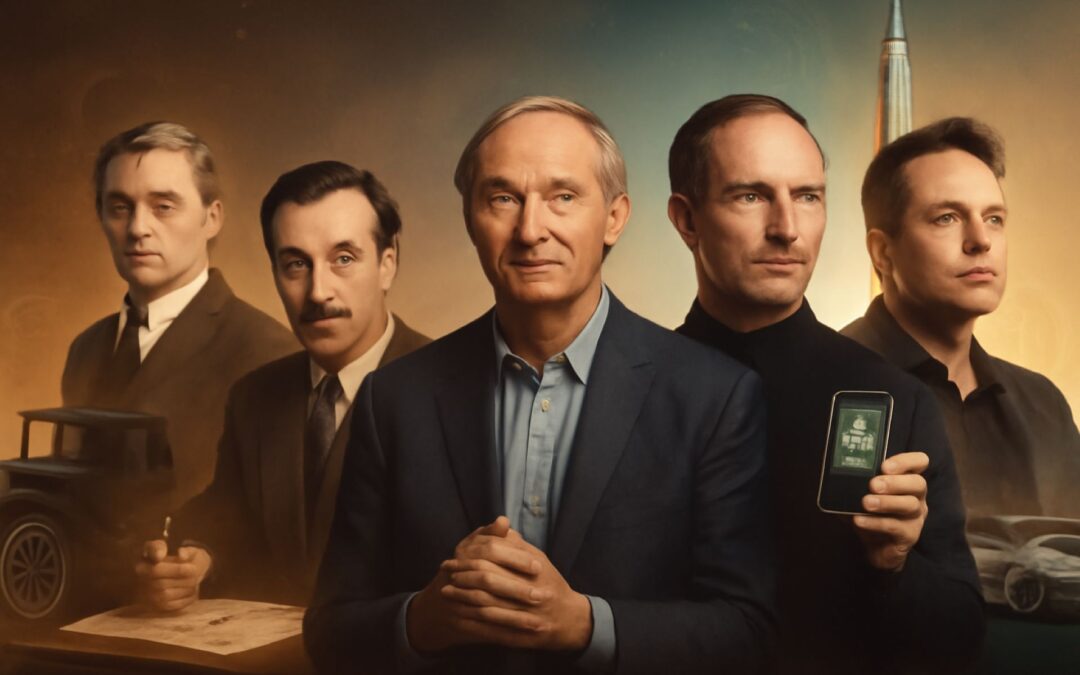
In the world of business, setbacks are often seen as obstacles that can bring even the most promising ventures to a halt. Yet for some of the most successful entrepreneurs, failure has been the catalyst for their greatest achievements. These business titans have faced immense challenges, risking everything they had, only to come back stronger than before.
From Henry Ford’s revolution of the automotive industry to Elon Musk’s vision of space exploration, their stories are a testament to the power of resilience, vision, and the ability to learn from failure. In this article, we examine the remarkable comebacks of five business giants who lost everything, only to rise again and transform the world.
1. Henry Ford: A Vision of the People, by the People
Henry Ford’s rise to prominence in the automotive industry was not an easy or straightforward journey. His path was marked by failures, financial setbacks, and several moments of self-doubt, but his vision for accessible automobiles and the ability to adapt ultimately led him to revolutionize the auto industry and change the world. Ford’s story is a testament to the power of perseverance and the importance of aligning oneself with the right people to bring a vision to life.
The Early Years: A Vision Born from the Masses
Ford’s journey into the world of automobiles began with a simple but ambitious vision: to build an affordable, high-quality car that the average person could afford. At a time when cars were considered luxury items reserved only for the rich, Ford believed that the automobile could and should be accessible to the working class. But bringing that vision to life required more than just a good idea; it required financial support, resources, and a team of people who shared his goals.
In 1899, Ford founded the Detroit Automobile Company with the backing of several investors. However, from the start, Ford’s vision was at odds with that of his investors. While Ford wanted to create a single, affordable car model for the general public, his investors had different ideas. They wanted to produce a variety of vehicles targeted at wealthy buyers, which led to the production of luxury cars. Unfortunately, this strategy proved to be problematic. Because Ford had to rush production to meet the demands of investors, the quality of the vehicles was compromised. As a result, the company lost customers quickly, and the Detroit Automobile Company folded in less than two years.
This first failure was a crushing blow for Ford. He found himself out of a job, with his dreams of revolutionizing the automotive industry seemingly dashed. But instead of giving up, Ford chose to learn from his mistakes and refine his craft. His journey wasn’t over; it was just beginning.
Racing Fame and the Road to Redemption
After the collapse of the Detroit Automobile Company, Ford didn’t retreat into obscurity. He chose to focus on racing, a burgeoning industry where he could showcase his engineering skills. Racing cars, known for their speed and precision, provided Ford with the perfect platform to demonstrate his technical expertise. He quickly became renowned for building fast, powerful cars that could dominate the track.
This newfound fame as a skilled mechanic and racer helped Ford rebuild his reputation and attract new investors. The attention he garnered through his racing victories caught the eye of financiers who were willing to back his next venture. With this new set of investors, Ford embarked on his second attempt to build a car company—this time, however, he would face a new challenge.
A Second Setback: Misaligned Visions
In 1901, Ford founded the Henry Ford Company, but once again, his vision did not align with that of his investors. While Ford wanted to focus on building high-performance racing cars, the investors were more interested in producing luxury vehicles for the rich. The conflict over the company’s direction escalated, leading to a breakdown in communication. Ford was ultimately fired from his own company just months after its founding.
This second failure could have easily ended Ford’s dream of revolutionizing the automobile industry, but instead, it taught him a valuable lesson. Ford realized the importance of aligning himself with investors who shared his long-term vision. He also understood that success in business required not just skill and technical expertise, but a cohesive, aligned team that was united in a single goal.
The Ford Motor Company: Aligning Visions and Revolutionizing the Industry
In 1903, with these lessons in mind, Ford established the Ford Motor Company. This time, Ford ensured that his investors shared his goal of producing affordable cars for the general public. His first product, the Model A, was introduced at a price of $750—relatively affordable compared to other vehicles on the market. But it was Ford’s commitment to efficiency and quality that would truly set his company apart.
In 1908, Ford introduced the Model T, a car that was specifically designed for the middle class. Priced at just $850, the Model T was built to be reliable, easy to maintain, and affordable. However, it was the introduction of the assembly line in 1913 that truly revolutionized the industry. By using assembly lines, Ford was able to drastically reduce production costs and, in turn, lower the price of the Model T to just $260. This made the car accessible to an even broader audience and allowed Ford to produce millions of units.
The Model T became an international success, with more than 15 million units sold over the next two decades. At one point, more than half of the cars in the world were Model Ts. Ford’s vision of an automobile for the masses had become a reality. But Ford’s impact went beyond just selling cars. His use of the assembly line transformed manufacturing, changing industries across the globe. The principles of mass production that Ford pioneered would go on to shape the way countless other products were made, from household goods to electronics.
Legacy: Revolutionizing an Industry
Ford’s story is more than just a tale of business success. It is a reflection of how failure can serve as a valuable teacher. Ford’s early missteps taught him crucial lessons about the importance of aligning vision with action and the need to surround oneself with like-minded people. His failures didn’t break him; instead, they strengthened his resolve to succeed and gave him the insight he needed to build a lasting company.
Today, the Ford Motor Company is one of the most iconic brands in the world, and Ford himself is remembered not just as an inventor, but as a visionary entrepreneur who transformed society. He showed the world that business success is not just about the products you create, but about the systems you build to bring those products to market. Ford’s ability to learn from his failures and adapt his approach is a key reason why he became one of the most successful business figures in history.
Ford’s legacy lives on in the millions of vehicles on the road today and in the very fabric of the modern manufacturing process. His journey from failure to triumph is a timeless reminder that resilience, vision, and the willingness to learn from mistakes can lead to monumental success.
2. Walt Disney: From Bankruptcy to Iconic Legacy
Walt Disney’s path to creating one of the most iconic entertainment empires in the world was anything but a smooth ride. The tale of his rise from bankruptcy, misfortune, and failure is a profound example of resilience, creativity, and an unwavering belief in one’s vision. Disney’s journey was defined by countless setbacks, but each challenge pushed him closer to realizing his dreams, forever changing the landscape of animation and entertainment.
The Early Struggles: A Dream for Animation
Walt Disney’s story begins in the 1920s, when the animation industry was still in its infancy. At that time, animated cartoons were seen as novelty items that accompanied live-action films as short features before the main attraction. Disney, however, saw the potential of animation as a serious art form, capable of telling full-length stories and captivating audiences in new ways. He believed that animation could rival live-action films, and he was determined to prove that a cartoon could be more than just a side attraction—it could be the main event.
His first major project was Alice’s Wonderland, a unique blend of live-action and animation based on the famous story of Alice in Wonderland. The show was ambitious and imaginative, but Disney faced significant hurdles. The company financing the show imposed tight deadlines and financial constraints, forcing Disney to rush the production. The result was a show that didn’t meet his standards of quality, and it suffered from low production values.
Despite the setbacks, Alice’s Wonderland managed to gain some attention and led to Disney making over 60 episodes of the show. However, Disney’s success was short-lived. The company financing the show gave him a harsh ultimatum: meet their deadlines or lose the rights to Alice’s Wonderland. Unfortunately for Disney, he had signed over the rights, leaving him with nothing but a failed project and a shattered sense of self-worth.
A Fresh Start: Moving to California and Creating Mickey Mouse
Faced with bankruptcy and no creative rights to his own work, Disney moved to California, leaving behind the ruins of his previous efforts. But he did not abandon his vision. As he traveled on the train to California, a moment of inspiration struck. While doodling away in his notebook, he sketched a character that would become the cornerstone of his legacy: Mickey Mouse.
Mickey was different from anything Disney had created before. He was lovable, mischievous, and full of personality. Disney realized that Mickey could become a symbol of joy and happiness, someone audiences could connect with on a deeper level. When he returned to California, he wasted no time in bringing Mickey to life in the first-ever synchronized sound cartoon, Steamboat Willie. This film became a sensation, marking the birth of one of the most beloved characters in history.
But Disney didn’t rest on his laurels. He was determined to push animation even further and solidify Mickey Mouse’s place in the entertainment world. Steamboat Willie was just the beginning. Disney’s ability to blend sound and animation paved the way for a new era of cartoons. As the popularity of Mickey Mouse skyrocketed, Disney continued to experiment with new techniques, pushing the boundaries of what animation could achieve.
The Big Gamble: Snow White and the Seven Dwarfs
By the late 1930s, Walt Disney’s vision had evolved. He believed that animation could become more than just entertainment—it could be an art form that could capture the magic of storytelling and transport audiences to fantastical worlds. But to achieve this, Disney had to do something that no one in the industry had ever done before: create the first-ever full-length animated feature film.
This idea was seen as madness by many of Disney’s colleagues and peers. The financial risk was enormous. The production of a feature-length film would take years and millions of dollars to complete. Some even thought it was a fool’s errand, arguing that audiences would never sit through an entire animated film. But Disney was undeterred. He believed in the power of his vision and the ability of animation to tell a compelling story. He invested his own money and poured all of his energy into Snow White and the Seven Dwarfs, a project that would take over three years to complete.
The film was a massive undertaking—unprecedented in scope, animation quality, and storytelling. The production required hundreds of animators, artists, and technicians working tirelessly to create each frame. As the deadline approached, the pressure mounted, and Disney’s own team began to worry about the feasibility of the project. Some even abandoned the team, fearing that Snow White would never come together. But Disney remained resolute, convinced that the film would be a masterpiece.
When Snow White premiered in 1937, it was a groundbreaking success. The film shattered all expectations, earning millions of dollars and cementing Disney’s place as a visionary in the entertainment industry. It was more than just a financial triumph—it changed the world’s perception of animation, proving that animated films could be just as impactful and important as live-action films. Snow White became a cultural phenomenon and opened the door for Disney to create more feature-length animated films.
Building the Disney Empire: From Setbacks to Success
Although Snow White secured Disney’s place in history, his success didn’t come without its challenges. After the massive success of Snow White, Disney’s next few projects—such as Pinocchio and Fantasia—were financial flops. The pressures of keeping up with expectations and continually innovating weighed heavily on Disney. He poured everything into his next big project: Disneyland.
Despite the challenges, Disney continued to innovate, determined to create more magical experiences for his audience. He understood that in order to stay ahead, he needed to create experiences that engaged audiences on a deeper level. Disneyland, which opened in 1955, was his vision for a new kind of theme park—one that could transport visitors to new worlds and provide them with unforgettable experiences. While the opening of Disneyland was rocky, it eventually grew into a global empire, with Disney theme parks now operating around the world.
Legacy: The Power of Perseverance and Belief in One’s Vision
Walt Disney’s comeback story is a testament to the power of persistence, the value of creative risk-taking, and the importance of believing in your own vision—even when others doubt you. Disney faced countless setbacks, from bankruptcies to failed projects, but each failure only fueled his determination to keep going. His story is proof that success doesn’t come without struggle, and that the most impactful innovations often come from those who are willing to push through adversity and never lose sight of their dreams.
Today, the Disney brand is synonymous with innovation, creativity, and imagination. It is one of the most valuable entertainment companies in the world, touching the lives of millions through movies, TV shows, theme parks, and merchandise. Disney’s legacy extends far beyond just his films; it is embedded in the very fabric of modern pop culture. Walt Disney’s story is not just about achieving financial success—it is about transforming an entire industry and leaving an indelible mark on the world.
Disney’s journey serves as a powerful reminder that failure is not the end, but rather a stepping stone on the road to greatness. His life is a lesson in the importance of resilience, creativity, and the unshakable belief that dreams, no matter how impossible they may seem, are worth pursuing.
3. Ray Dalio: The Hedge Fund Giant Who Rebuilt from Humiliation
Ray Dalio’s journey from the brink of collapse to becoming one of the world’s most influential hedge fund managers is a striking example of how failure, when approached with humility and introspection, can serve as the catalyst for extraordinary success. Dalio’s career has been defined by his ability to adapt, learn from mistakes, and build a culture that empowers critical thinking and transparency. His story is one of redemption and growth, demonstrating that even the most high-stakes setbacks can be overcome with the right mindset.
The Birth of Bridgewater: A Bold Vision for the Future
Dalio’s entrepreneurial journey began in 1975 when he founded Bridgewater Associates, a hedge fund that would eventually become the world’s largest. His approach was unconventional from the start. Dalio didn’t simply rely on traditional investment strategies—he sought to develop a system based on a deep understanding of economic patterns and market cycles. He believed that by analyzing vast amounts of data and understanding macroeconomic forces, he could predict market movements with accuracy and precision.
Bridgewater quickly garnered a reputation for its ability to deliver impressive returns. Dalio’s analytical approach attracted clients from around the world, including some of the largest institutional investors. His innovative approach to managing money and risk made Bridgewater one of the most respected hedge funds on Wall Street. In the early years, Dalio’s focus was on identifying patterns in economic behavior and using those patterns to predict how markets would respond. His research-driven methods were a departure from the typical fund management strategies, and they allowed Bridgewater to thrive.
However, Dalio’s early success was not without its share of challenges. As Bridgewater grew, Dalio began to face the complexities of managing a larger organization. The stakes were higher, and the pressures of running a global hedge fund started to take their toll. Dalio’s decision-making process was tested in ways he had not anticipated, and the mistakes he made would eventually lead to one of the most significant setbacks of his career.
The Big Mistake: A Miscalculated Recession Prediction
In 1982, Dalio made a bold and public prediction: the United States economy was on the verge of entering a major recession. Dalio’s analysis of the economic landscape led him to believe that a significant downturn was imminent, and he structured Bridgewater’s portfolio to capitalize on this expected recession. He was so confident in his prediction that he bet almost everything on it.
Unfortunately, Dalio’s prediction did not come to pass. Instead of a recession, the U.S. economy experienced a period of rapid growth, resulting in one of the longest and most robust economic expansions in history. The markets soared, and Bridgewater’s portfolio, which had been positioned to profit from a downturn, suffered significant losses. The firm was hit hard by its miscalculation, and Dalio found himself facing a financial and reputational crisis.
The consequences were immediate. Dalio lost much of the trust of his clients, who withdrew their investments in Bridgewater. The hedge fund’s reputation was tarnished, and Dalio’s ego took a significant blow. He was forced to lay off employees and restructure the company to survive. At one point, Dalio had to ask his father for a loan to keep Bridgewater afloat, a humbling moment that forced him to confront the reality of his failure.
The Turning Point: A Radical Shift in Approach
Dalio’s response to his failure was a pivotal moment in his career. Rather than retreating into frustration or resignation, he chose to view the setback as an opportunity to learn and grow. He realized that his biggest mistake had been an unwillingness to challenge his own assumptions and a lack of willingness to listen to differing viewpoints. At Bridgewater, the company culture had been one where Dalio’s ideas were rarely questioned, which led to blind spots in his decision-making process.
Determined to rebuild Bridgewater and ensure that it never again faced such a catastrophic failure, Dalio made the decision to radically alter the company’s culture. He created a new environment at Bridgewater—one that emphasized “radical transparency.” This meant that every employee, regardless of their rank, had the right to challenge ideas and voice their opinions openly. Dalio encouraged a culture where feedback was not only welcomed but required, and where decisions were based on logic and the quality of ideas, rather than hierarchy or authority.
This shift in culture was revolutionary. It was not just about ensuring that ideas were challenged; it was about creating an environment where employees felt empowered to speak up and make their voices heard. Dalio understood that the best decisions come from diverse perspectives and open debate, and he made it a priority to ensure that Bridgewater was a place where differing opinions could be voiced and considered.
Rebuilding Bridgewater: A New Approach to Decision-Making
As Dalio worked to rebuild Bridgewater, he also revisited the way he approached investment strategies. Instead of making big, bold bets based on his own predictions, Dalio adopted a more collaborative approach, gathering as many perspectives as possible before making decisions. He built a system that would allow Bridgewater to make decisions based on the strength of the idea rather than the individual making the decision.
Dalio introduced a process called “believability-weighted decision-making.” This process gave more weight to the opinions of individuals who had demonstrated expertise in a particular area, ensuring that the best ideas rose to the top. This system allowed for more rigorous decision-making and reduced the risks associated with making decisions based on one person’s judgment alone.
As Bridgewater restructured its decision-making process, Dalio also focused on building trust within the company. He understood that trust was the foundation for creating an environment where people could share ideas without fear of judgment. By fostering a culture of transparency and mutual respect, Dalio was able to rebuild Bridgewater’s reputation and ensure that the company was better equipped to navigate the challenges of the global financial markets.
The Comeback: A Resilient Hedge Fund Giant
Dalio’s efforts paid off. By 2002, Bridgewater had not only recovered from its early setbacks but had also grown significantly. The company’s new approach to decision-making and its focus on transparency and collaboration helped Bridgewater outperform its competitors, even during times of market volatility. In 2002, when the market was down by 22%, Bridgewater’s performance was only slightly affected. This demonstrated the effectiveness of the new strategy, and it cemented Bridgewater’s position as one of the leading hedge funds in the world.
In the years that followed, Bridgewater’s assets under management grew exponentially. The firm began to attract some of the largest institutional clients in the world, including pension funds, endowments, and sovereign wealth funds. By the mid-2000s, Bridgewater had become the largest hedge fund in the world, managing over $160 billion in assets. Dalio’s reputation as one of the most insightful investors of his generation was firmly established.
Dalio’s story is not just about financial success—it’s about personal growth and the willingness to learn from mistakes. His willingness to confront his failures head-on and build a company culture centered around radical transparency and trust was a game-changer. It allowed Bridgewater to adapt, innovate, and thrive in a rapidly changing financial landscape.
Legacy: A New Standard for Business Culture
Today, Ray Dalio is regarded as one of the most influential investors in the world. His books, particularly Principles: Life and Work, have had a profound impact on how business leaders and entrepreneurs think about decision-making, company culture, and personal growth. Dalio’s commitment to radical transparency and his belief in the power of diverse perspectives have shaped not only Bridgewater’s success but also the broader business community.
Dalio’s journey teaches us an invaluable lesson: success isn’t defined by never failing, but by how we respond to failure. His ability to learn from mistakes, adapt, and create a culture of transparency has not only transformed his business but has also set a new standard for corporate leadership. By embracing failure as a learning opportunity and focusing on building a culture of trust, Dalio was able to turn Bridgewater’s early struggles into a foundation for long-term success.
4. Steve Jobs: The Founder Who Was Kicked Out and Came Back Stronger
Steve Jobs’ story is one of the most well-known and dramatic comebacks in business history. His journey from being ousted from the company he founded to returning and transforming it into one of the most valuable corporations in the world is a testament to resilience, vision, and the ability to learn from failure. Jobs’ career was not without its challenges, and his story serves as a powerful reminder that success often comes from navigating setbacks and evolving into a better leader.
The Early Days: The Birth of Apple
Steve Jobs co-founded Apple in 1976, alongside his friends Steve Wozniak and Ronald Wayne. The trio had a vision to create user-friendly personal computers at a time when the market was dominated by complex and expensive machines. Jobs and Wozniak developed the Apple I and later the Apple II, which became one of the first commercially successful personal computers. Apple’s early success quickly caught the attention of investors, and in 1980, the company went public, turning Jobs into a multimillionaire at the age of 25.
Despite the initial success, Jobs was not content with just building personal computers. He had a vision for a product that could change the world—an all-in-one device that would revolutionize consumer electronics. This vision eventually led to the creation of the Macintosh, Apple’s first graphical user interface-based computer. The Mac was designed to be intuitive and accessible, making personal computing more user-friendly for the masses. However, despite the innovation and hype, the Mac was not an immediate success. It was expensive to produce, and its software was still underdeveloped compared to competing systems, leading to slower-than-expected sales.
Tensions Rise: The Conflict with John Sculley
In the mid-1980s, Apple faced growing pains. The company had expanded rapidly, and its internal dynamics began to shift. Jobs, known for his intense personality and perfectionist tendencies, had an often tumultuous relationship with Apple’s board of directors and CEO, John Sculley. Sculley had been hired from Pepsi in 1983, and while he initially seemed like a good fit for the company, tensions began to rise between him and Jobs.
Jobs, who was the creative visionary behind Apple, wanted to push the company into uncharted territories with the Macintosh, but Sculley, focused on profit margins and short-term results, clashed with Jobs’ long-term vision. As Apple’s sales for the Macintosh continued to lag behind expectations, Jobs became more frustrated, pushing his team and the company’s resources to the limit. The pressure was mounting on Apple to produce a product that would recoup the company’s losses.
By 1985, the tension between Jobs and Sculley reached a breaking point. Jobs, in his usual bold fashion, attempted to have Sculley removed from his position. However, the board sided with Sculley and made the decision to remove Jobs from his leadership role. At just 30 years old, Jobs found himself ousted from the company he had co-founded. This was a deeply humiliating moment for Jobs. He had built Apple from the ground up, and now he was being forced out of the very company that bore his name. For many, this would have been the end of the road, but for Jobs, it was just the beginning of a new chapter in his life.
A New Beginning: NeXT and Pixar
Rather than retreating into defeat, Jobs used this setback as an opportunity to start fresh. He founded NeXT, a new computer company focused on creating high-end workstations for educational institutions and businesses. NeXT’s computers were groundbreaking in terms of their design and technical specifications, but they were prohibitively expensive, and the market was not ready for such high-end technology. NeXT did not achieve the commercial success that Jobs had hoped for, but it was an important learning experience.
During his time at NeXT, Jobs also made a key acquisition that would change the course of his life. In 1986, he purchased a small computer animation company from George Lucas, which would later become Pixar. Initially, Pixar was focused on creating computer hardware for the animation industry, but under Jobs’ leadership, the company pivoted toward creating animated films. Pixar’s big break came with the release of Toy Story in 1995, the world’s first full-length computer-animated feature film. Toy Story was a massive success, both commercially and critically, and Pixar became a household name. Jobs, who owned a large stake in Pixar, became a billionaire when Pixar went public in 1995.
Though NeXT didn’t achieve the success Jobs had hoped for, the experience gave him invaluable insights into business management, product development, and leadership. Meanwhile, Pixar’s success provided Jobs with a platform to re-enter the tech world, and in 1996, Apple acquired NeXT for $427 million, bringing Jobs back to the company he had founded.
The Return to Apple: A New Vision for Success
When Jobs returned to Apple in 1997, the company was struggling. Its product line was stale, its finances were in disarray, and it was on the brink of bankruptcy. The company’s market share was shrinking, and its once-innovative products were being outpaced by competitors like Microsoft and Dell. Apple’s leadership was in turmoil, and it was clear that a major overhaul was necessary.
Jobs took charge once again, but this time, he had a new approach. He didn’t just want to improve Apple’s products; he wanted to redefine what the company stood for. He made a decisive move to focus on a smaller, more focused product line, eliminating many of the underperforming projects that had bogged down the company. One of his first moves was to streamline Apple’s offerings, focusing on the Macintosh, iPod, iPhone, and iPad—products that would go on to become some of the most revolutionary consumer electronics ever created.
Jobs was also determined to re-establish Apple’s reputation as an innovator. He introduced the iMac, a stylish and user-friendly desktop computer that was unlike anything on the market. The iMac’s design, with its colorful casing and simple interface, was a statement about Apple’s new direction: innovation, simplicity, and aesthetic appeal. The success of the iMac helped to turn Apple’s fortunes around and marked the beginning of the company’s resurgence.
Revolutionizing the Tech Industry: iPod, iPhone, iPad
Jobs’ return to Apple marked the beginning of a period of unprecedented innovation. The launch of the iPod in 2001 transformed the music industry, allowing people to carry their entire music libraries in their pockets. The iTunes store, which Jobs launched alongside the iPod, revolutionized how people purchased and listened to music, creating a digital marketplace that would later extend to apps, movies, and books.
But Jobs’ most significant contribution to Apple—and the world—came with the launch of the iPhone in 2007. The iPhone wasn’t just a phone; it was a device that combined the functionality of a phone, music player, and computer into one sleek, intuitive package. The iPhone revolutionized not only the smartphone industry but also the way people interacted with technology. It introduced the world to the concept of apps, touchscreens, and mobile computing, paving the way for the app economy and the mobile-first world we live in today.
In 2010, Apple introduced the iPad, further cementing the company’s position as a leader in consumer technology. With the iPad, Apple created a new category of device—an oversized phone that bridged the gap between smartphones and laptops. It provided users with a new way to interact with digital content, from reading books to watching videos to browsing the web.
Under Jobs’ leadership, Apple became the most valuable company in the world, and its products became cultural icons. The iPhone, in particular, changed the way people communicated, consumed media, and even worked. Apple’s innovations not only disrupted industries but also shaped the future of technology.
The Legacy: A Visionary Who Changed the World
Steve Jobs passed away in 2011, but his legacy continues to shape the world today. He transformed not only the tech industry but also the broader cultural landscape. Apple’s success under Jobs revolutionized the way we interact with technology, from the personal computer to the mobile phone to the tablet. Jobs’ ability to anticipate trends, focus on design and usability, and push the boundaries of what was possible has made Apple a company that continues to set the standard for innovation.
Jobs’ story is not just about building great products; it is about the power of resilience, learning from failure, and having the courage to return to the drawing board after being knocked down. His comeback after being ousted from Apple is one of the most inspiring in business history, demonstrating that setbacks don’t have to be the end—they can be the foundation for even greater success.
5. Elon Musk: Betting Everything to Transform the Future
Elon Musk is a name synonymous with ambition, innovation, and risk-taking. His journey to becoming one of the most influential entrepreneurs of the 21st century has been filled with extreme highs and lows, all of which reflect his relentless drive to push humanity forward. Musk’s ventures, including Tesla and SpaceX, have revolutionized industries, from electric cars to space exploration. Yet, behind these groundbreaking achievements lie incredible personal and professional struggles, moments where Musk risked everything to pursue his audacious goals. His story is a remarkable tale of resilience, calculated risks, and an unyielding belief in his vision for the future.
The Early Days: Building Wealth and a Vision for the Future
Before Musk became a household name with Tesla and SpaceX, he had already tasted entrepreneurial success. In the late 1990s, Musk co-founded Zip2, an online city guide software company. The company was eventually sold to Compaq for nearly $300 million in 1999. Musk’s next venture, X.com, an online payment company, would later become PayPal after a merger. PayPal’s sale to eBay for $1.5 billion in 2002 gave Musk a substantial financial windfall—approximately $165 million—which he could use to pursue his long-held goals of changing the world.
With his newfound wealth, Musk could have comfortably retired, but his vision was far from over. Unlike many entrepreneurs who would settle for financial comfort, Musk had two overarching goals: to reduce the cost of space travel and to accelerate the world’s transition to sustainable energy. These ambitions were audacious, and they would require every ounce of his determination and the willingness to risk everything he had earned.
The Birth of SpaceX: A Vision for Mars
Musk’s passion for space exploration and his belief that humanity’s future lay in becoming a multi-planetary species led to the creation of SpaceX in 2002. The company’s primary objective was to develop rockets that were reusable and could dramatically reduce the cost of space travel. Musk’s ultimate goal was to send humans to Mars and, in the long run, colonize the planet. At the time, the space industry was dominated by government agencies like NASA and a few established private companies, and the idea of a private enterprise competing in space exploration seemed almost ludicrous to many.
SpaceX’s early years were fraught with challenges. Musk invested $100 million of his own money into the company and faced numerous setbacks. The first three launches of the Falcon 1 rocket, SpaceX’s first attempt at reaching orbit, ended in failure. The rockets exploded either shortly after launch or failed to reach their destination. The early failures put an immense amount of pressure on Musk and his team. With his personal fortune rapidly dwindling, Musk was forced to make a critical decision: continue pouring money into SpaceX or walk away.
In 2008, SpaceX’s fourth launch was its last chance for survival. If the Falcon 1 failed again, SpaceX would likely be out of business. But Musk’s persistence paid off—this time, the launch was a success. The Falcon 1 reached orbit, and SpaceX had finally proven that a private company could successfully enter the realm of space exploration. This success was a major turning point for Musk, as it opened the door to lucrative contracts with NASA and other private clients, providing the company with the financial stability it needed to grow.
Tesla: The Struggles of Revolutionizing the Auto Industry
While Musk was building SpaceX, he was also focused on a mission to revolutionize the automotive industry. In 2004, he joined Tesla Motors (now Tesla, Inc.), a company founded by Martin Eberhard and Marc Tarpenning, with the goal of creating an electric vehicle (EV) that could compete with gasoline-powered cars. Musk became the company’s largest investor and took on the role of CEO and product architect. His goal was not just to create a luxury electric car, but to prove that electric vehicles could be mainstream, affordable, and desirable.
But like SpaceX, Tesla’s early years were filled with financial peril and technological challenges. Tesla’s first product, the Roadster, was a high-performance electric sports car, but it was also prohibitively expensive, with a price tag of around $100,000. While the Roadster garnered attention from early adopters and investors, it wasn’t enough to sustain Tesla financially. The company burned through cash quickly, and by 2008, Tesla was on the brink of bankruptcy.
During this time, Musk personally invested much of his own wealth into Tesla, even though the company was struggling. At one point, Tesla was just days away from running out of money, and Musk had to make a decision: continue investing in Tesla or walk away. He chose to double down, investing $40 million of his own money to keep the company afloat. At the same time, the U.S. government granted Tesla a loan of $465 million to help with the development of the Model S, an all-electric luxury sedan. Musk’s gamble paid off when the Model S was released in 2012 to critical acclaim, and it marked a turning point for Tesla.
Despite the company’s early financial struggles, Tesla had become a symbol of innovation, and it was on its way to reshaping the automotive industry. Tesla’s success with the Model S led to the development of more affordable models, like the Model 3, which made electric cars more accessible to the average consumer. Tesla also became a leader in battery technology, with its Gigafactories producing lithium-ion batteries at a scale that had never been seen before.
The 2008 Financial Crisis: A Defining Moment
The year 2008 was a pivotal one for both SpaceX and Tesla, and it nearly marked the end of Musk’s ambitious vision. The global financial crisis was in full swing, and investors were pulling back from riskier ventures. Musk found himself juggling the demands of both companies, and with SpaceX and Tesla on the brink of collapse, Musk was forced to make one of the hardest decisions of his career.
SpaceX had just barely survived its fourth launch, and Tesla was hemorrhaging money. Musk had to divide his limited resources between the two companies, knowing that the likelihood of both surviving was slim. In a move that would define his resilience, Musk personally invested the last of his money to keep both companies alive. He put $40 million into Tesla and secured a crucial $20 million investment for SpaceX, allowing both companies to stay afloat just long enough to secure larger, more substantial contracts.
Musk’s gamble paid off. SpaceX secured a $1.6 billion contract from NASA to transport cargo to the International Space Station, marking the company’s first major government contract. Meanwhile, Tesla’s Model S became a commercial success, and the company began to attract more investors. By 2013, Tesla was profitable, and its stock price began to soar.
A Remarkable Resurgence: Dominating Space and the Automotive Industry
Musk’s resilience has led to extraordinary achievements. SpaceX has revolutionized space travel with the development of reusable rockets, reducing the cost of launching satellites and cargo into space. In 2015, SpaceX successfully landed its first Falcon 9 rocket back on Earth, an unprecedented achievement that set the stage for the company’s future success. Since then, SpaceX has continued to innovate, successfully launching missions to the International Space Station, and in 2020, it became the first private company to send astronauts into space.
Tesla, on the other hand, has transformed the automotive industry. With the introduction of the Model 3, Tesla has made electric vehicles mainstream, and it is now the world’s most valuable automaker by market capitalization. The company has also pushed the boundaries of autonomous driving and energy storage, with Tesla’s vehicles leading the way in electric driving range and performance.
Musk’s other ventures, such as the Boring Company (focused on building underground transportation systems) and Neuralink (focused on developing brain-computer interfaces), further illustrate his relentless pursuit of ambitious, world-changing ideas. His vision for sustainable energy, space exploration, and advanced technology continues to drive his work, positioning him as one of the most influential innovators of his generation.
The Legacy of Elon Musk: A Testament to Risk and Resilience
Elon Musk’s story is a powerful testament to the power of resilience and the willingness to risk everything for a vision. Through countless failures, financial crises, and setbacks, Musk’s ability to persevere has led him to change the course of entire industries. His story demonstrates that true innovation often requires not just a great idea, but the courage to risk everything in the pursuit of that idea. Musk’s achievements with Tesla and SpaceX are not just about creating successful companies—they are about challenging the status quo and reshaping the future of humanity.
Conclusion
The stories of these five business titans highlight an invaluable truth: setbacks are not the end of the road but the beginning of something greater. Whether it’s the collapse of a company, a failed prediction, or a personal defeat, these entrepreneurs proved that resilience, learning from mistakes, and staying true to one’s vision can lead to even greater success. Their ability to embrace failure and use it as a stepping stone for growth is a powerful reminder that the path to greatness is rarely linear. For aspiring entrepreneurs, their journeys offer a blueprint for overcoming adversity and turning challenges into opportunities.