
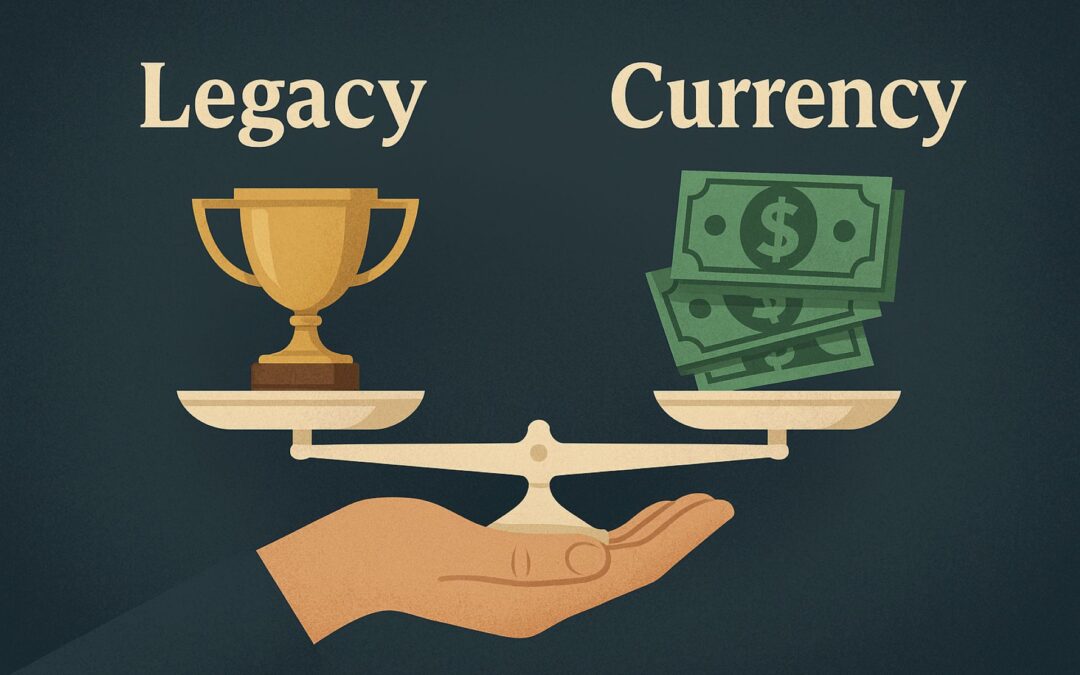
Every decision you make tells a story. Every word you post, every deal you close, every customer you serve—or ignore—adds another brushstroke to the portrait of who you are. In today’s hyperconnected world, you don’t need to be a celebrity to live under the spotlight. We all do. Every email, tweet, and upload is a line in the public record of our character.
For Gary Vaynerchuk, this reality isn’t a burden—it’s a call to consciousness. He believes that how you build something matters far more than what you build. Because at the end of the day, success measured only in currency is hollow. True success is measured in legacy—in the impact you leave, the culture you create, and the respect you earn by staying authentic in a world addicted to appearances.
This is the philosophy that underpins everything he’s ever done: Legacy is greater than currency.
Think Long-Term, Always
Short-term thinking is intoxicating. It seduces with instant feedback, quick applause, and the illusion of momentum. You post something that goes viral, land a lucrative deal, or close a sale that makes you feel like you’re winning—but those are sugar highs. They spike fast and crash hard. Long-term thinking, on the other hand, is discipline disguised as vision. It’s the ability to ignore the noise of the moment and play for something that will still matter ten, twenty, even fifty years from now.
The entrepreneurs who truly last—who build empires instead of moments—operate with a kind of mental patience that most people can’t comprehend. They aren’t moved by today’s headlines or the latest trend on social media. They think like chess masters, not poker players. Every move has purpose. Every decision is made with the understanding that the board will keep changing, and so must their strategy.
Gary Vaynerchuk learned this early in his career. While everyone around him was chasing short-term profit—cutting corners, overpromising, playing to optics—he doubled down on relationships, reputation, and brand. He passed on opportunities that could have made him rich quickly because he understood that every easy win carried an invisible cost. Short-term greed erodes long-term trust. And trust, once lost, is almost impossible to buy back.
Thinking long-term doesn’t mean playing slow—it means playing smart. It’s about perspective. You don’t need to win every day; you need to position yourself to keep winning for decades. It’s the difference between hustling for attention and building authority. Between chasing hype and creating heritage.
In the business world, the temptation to think small is constant. A CEO inflates quarterly earnings to please investors. A creator posts controversy to grow faster. A startup cuts ethical corners to ship sooner. These decisions look brilliant in the moment—and catastrophic in hindsight. They might give you a spike of relevance, but relevance fades faster than integrity recovers.
When you think long-term, you start to see differently. You stop asking, “What will this do for me today?” and start asking, “What will this say about me tomorrow?” You realize that every decision—no matter how small—is a reputation investment. Each email you send, each collaboration you sign, each product you launch, each person you hire—they’re all threads in the story of who you are and what you stand for.
The irony is that long-term thinking often leads to better short-term results anyway. Because consistency compounds. Trust compounds. Patience compounds. The people who resist the urge to sprint end up owning the marathon.
The question isn’t how fast you can build something. It’s whether it will still stand when the spotlight moves on.
Legacy Over Currency
Money is seductive because it feels measurable. You can count it, stack it, flaunt it. But legacy? Legacy is intangible. It’s measured in impact, not income. It’s the sum of the lives you’ve touched, the values you’ve defended, and the reputation you’ve earned when no one was watching.
For Gary Vaynerchuk, this isn’t a motivational slogan—it’s the filter through which every decision passes. He’s unapologetically ambitious, but never at the expense of integrity. When an opportunity arises, he runs it through two questions:
- Will this make me money?
- Will I be proud of how I made it?
If either answer doesn’t feel right, the deal dies immediately. Because profit without pride is poison.
This principle—legacy over currency—isn’t anti-money. It’s pro-meaning. It’s about understanding that how you earn matters more than how much you earn. The world is full of people with fat bank accounts and empty legacies—CEOs who cut corners, influencers who sold out, entrepreneurs who played dirty. Their names trend, but they don’t last. Because money buys comfort; legacy buys respect.
The business graveyard is littered with companies that optimized for revenue and ignored reputation. They scaled too fast, neglected their people, misled their customers, or sacrificed authenticity for growth. In the short term, they looked unstoppable. In the long term, they vanished. Consumers forget ads, but they never forget how a brand made them feel.
Legacy is built in the details. It’s built when you choose transparency over spin, when you do right by a customer even if it costs you, when you apologize before you’re forced to. It’s built in the quiet decisions no one sees—the ones that define your character more than your balance sheet.
For Vaynerchuk, the obsession with legacy stems from a deep awareness of permanence. Every video, tweet, blog post, or deal leaves a digital footprint. Every word and action becomes part of your public record. One day, your grandchildren will Google you. What will they find? Did you create value, or noise? Did you build, or exploit? Did you stand for something, or just sell something?
That’s the real test of success—not how much money you made, but how much good your money made possible. Because wealth fades, markets crash, algorithms change—but decency, empathy, and generosity never go out of style.
Choosing legacy over currency doesn’t slow you down—it sharpens your focus. It forces you to operate with intention, to say no to easy wins that don’t align with your values. It gives your work moral gravity, and that gravity pulls people toward you—customers, partners, and communities who believe what you believe.
In the end, the pursuit of money is finite; it ends when you stop earning. The pursuit of legacy is infinite; it continues long after you’re gone.
The Human Connection
We live in a paradoxical age—an era of infinite connection and growing isolation. Technology has given us the ability to reach thousands, even millions, with a single post. Yet, genuine connection—the kind that builds loyalty and trust—has never been rarer. The irony? People don’t crave perfection anymore. They crave presence. They want to feel seen, heard, and valued in a world that treats them like data points.
Gary Vaynerchuk understood this long before “community” became a buzzword. When he started Wine Library TV, he made a promise to himself: no message goes unanswered. Every email, every tweet, every comment received his attention. It wasn’t a marketing tactic—it was a philosophy. He believed that if someone took the time to reach out, that person deserved acknowledgment.
In the early days, it was manageable. He’d reply within hours, engaging one-on-one with his audience late into the night. But as his following exploded, the volume became relentless—hundreds, then thousands, of messages flooding in daily. Still, he refused to delegate it away. While others automated responses or hired assistants to “manage engagement,” Gary kept it personal.
When travel or business demands caused delays, he didn’t disappear. He filmed short videos explaining why he was behind and promised to respond as soon as possible. That small act—communicating the truth, showing vulnerability, and respecting his audience’s time—was more powerful than any polished PR statement could ever be.
People don’t fall in love with brands; they fall in love with the humans behind them. And when they feel acknowledged, they become advocates. That’s why Gary’s community didn’t just grow—it deepened. Followers became fans. Fans became customers. Customers became evangelists.
The lesson is simple but profound: no matter how big you get, never get too big to care. Accessibility is the ultimate differentiator in the digital age. When you answer someone personally, even briefly, you’re not just responding—you’re building equity in their heart.
And yes, it’s exhausting. It takes time, energy, and emotional bandwidth. But the ROI is unmatched. Because every single interaction, every thoughtful reply, every moment of human kindness becomes another brick in the wall of your legacy.
Automation can handle logistics. Empathy builds empires.
The truth is, people will forget what you said or sold—but they’ll never forget how you made them feel.
The Case of the White Zinfandel
Some lessons in business can’t be taught in a boardroom; they’re learned in the snow.
Years ago, Gary Vaynerchuk received a customer complaint at Wine Library. It was December 22, the peak of the holiday rush, and a shipment of White Zinfandel hadn’t arrived in time for Christmas. The customer lived three hours away in Westchester, New York. The order was small. She wasn’t a regular. The logical move would’ve been to apologize, issue a refund, and move on. After all, it was the busiest time of year—every hour mattered.
But logic wasn’t the point. Legacy was.
Gary loaded a case of wine into his car and drove through a blinding snowstorm to deliver it himself. No camera crew. No publicity stunt. Just a business owner doing what felt right. He didn’t do it to gain a customer. He did it to set a tone.
That single act became the foundation of the Wine Library culture—a symbol of what the brand stood for. It sent a message to his team: We don’t measure value in transactions. We measure it in trust.
That drive, through sleet and snow, was worth more than any marketing campaign could ever buy. Because people don’t talk about commercials—they talk about moments. They tell stories. And that woman’s story—the one about the guy who drove three hours through the snow to make it right—spread further than any ad budget ever could.
That’s how legacy is built: one decision, one act of decency at a time.
Business schools teach efficiency, but legacy rewards empathy. Gary could have spent those six hours making far more money in the store. Instead, he invested those hours into something far more valuable—his reputation. That day, Wine Library stopped being just a store. It became a story.
And that’s the power of doing the right thing even when no one’s watching. It’s unscalable, inconvenient, and often unnoticed—but it defines you. It sets the cultural DNA for everyone who works with you and everyone who buys from you.
Decades later, Gary still tells that story. Not because it flatters him—but because it’s proof that legacy is built on small, inconvenient, human choices. It’s built in the moments when you could have taken the easy way out and didn’t.
Legacy isn’t loud. It’s quiet. It’s the sound of tires crunching on snow as you drive through the night to make good on a promise.
Build What Will Outlast You
Every empire eventually faces decay. The buildings crumble, the markets evolve, the names fade from memory. But what endures—what truly outlasts the noise of time—is legacy. It’s the invisible architecture of every great life and brand: the values, actions, and principles that continue to shape others long after you’re gone.
When Gary Vaynerchuk says legacy is greater than currency, he’s not being poetic—he’s being precise. Currency is transactional; it moves from one hand to another, fleeting and finite. Legacy is transformational; it moves from one generation to the next, accumulating meaning with each retelling. Currency fills a bank account. Legacy fills a life.
Building something that outlasts you requires a different kind of mindset—one grounded in patience, empathy, and self-awareness. It’s not about optimizing for speed or scale; it’s about optimizing for significance. It’s about ensuring that what you create continues to matter even when you’re no longer there to maintain it.
Gary runs every major decision through a single filter: Will I be proud of this fifty years from now? Not “Will this make me rich?” or “Will this trend well?” but “Will this reflect the person I want my grandchildren to believe I was?” That kind of clarity changes everything. It removes the temptation of shortcuts. It eliminates the noise of comparison. It forces you to build not for virality—but for virtue.
A reputation built on integrity doesn’t need defending. It defends itself. When people know your principles, when they trust your word, when they believe you act with intention—they give you something no amount of marketing can buy: permanence.
Look at the most enduring brands and people in history. They didn’t just sell products—they stood for something. Walt Disney stood for imagination. Steve Jobs stood for craftsmanship and rebellion. Oprah stands for empathy and empowerment. Gary Vaynerchuk stands for hustle with heart. Each of them built legacies because their work wasn’t transactional—it was personal. It came from a place of service, conviction, and purpose.
Legacy-building also requires brutal consistency. You can’t claim to value honesty and then hide behind half-truths when things go wrong. You can’t preach gratitude while dismissing the people who made you. Legacy isn’t a mission statement—it’s a record of behavior. Every interaction, every compromise, every word spoken in frustration or kindness adds to the story people will tell about you.
And here’s the truth few admit: legacy is slow. It doesn’t trend. It doesn’t announce itself with fanfare. It’s built in obscurity, through years of repetitive, thankless work. It’s the result of a thousand small, good decisions that, when compounded, create something monumental.
In a culture obsessed with visibility, it’s easy to mistake being known for being remembered. But the two are not the same. Fame is fragile; it evaporates with attention. Legacy deepens with time. Fame lives in headlines; legacy lives in hearts.
To build what will outlast you, think in decades, not days. Focus on contribution, not applause. Surround yourself with people who challenge your ego, not feed it. Leave your industry better than you found it. And when faced with a choice between what’s easy and what’s right, choose right—even when it costs you. Especially when it costs you.
Because someday, the money will be spent. The followers will move on. The spotlight will dim. But your legacy—the tone you set, the culture you built, the lives you touched—will keep working long after you’re gone.
That’s the ultimate ROI: knowing that your impact echoes beyond your lifetime. That you didn’t just build a business—you built something immortal.
Conclusion
When all is said and done, money stops counting. The zeros fade. The followers move on. The headlines get rewritten. What remains—what truly endures—is the story of how you showed up. The reputation you built. The lives you touched.
Gary Vaynerchuk’s career is proof that doing business with humanity and humility isn’t just moral—it’s magnetic. People remember those who cared, who delivered when they didn’t have to, who treated others like human beings instead of transactions.
That’s the essence of legacy. It’s not written in profit statements or follower counts. It’s written in gratitude, in integrity, in the small, unseen moments when you choose to do what’s right instead of what’s easy.
In the end, the goal isn’t to die rich—it’s to live remembered. Because while currency fades with time, legacy compounds forever.