
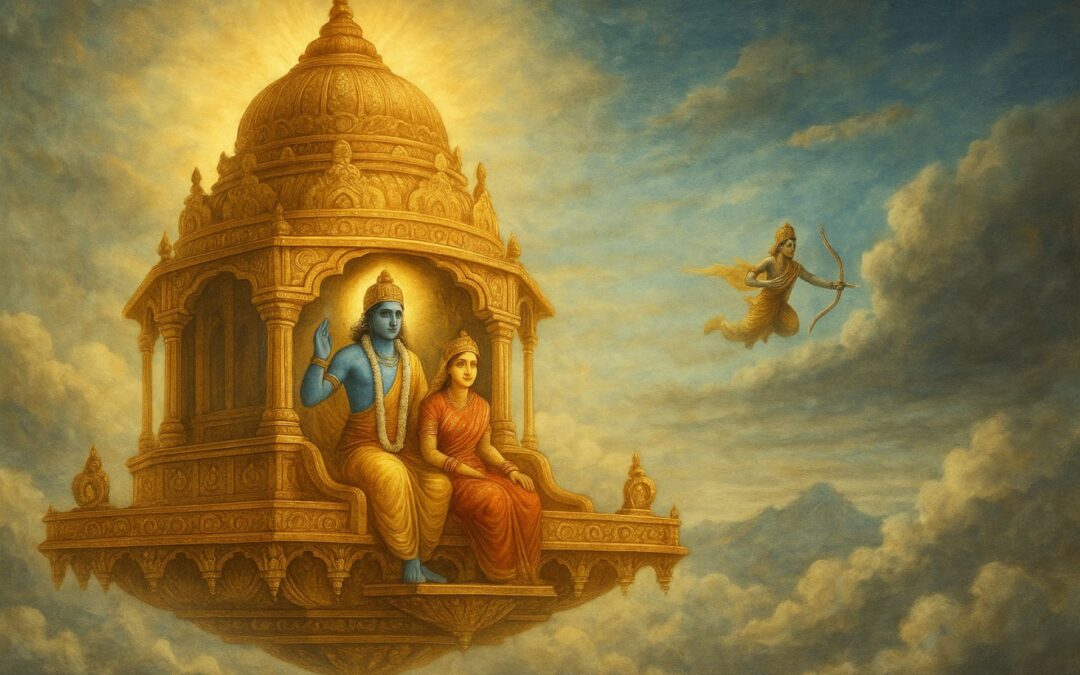
In the ancient texts of Hinduism, particularly the Ramayana and Mahabharata, we encounter descriptions of magnificent flying chariots called “Vimanas.” These vehicles were no mere transportation devices; they were described as flying palaces, radiant like the sun, and capable of traversing great distances with the mere will of their masters.
Such vehicles were said to be a testament to divine power, with their ability to change shape, shine brightly, and take to the sky in the blink of an eye. But what exactly were these Vimanas, and could they have been more than just symbols of divine might? Were they advanced machines, or merely metaphors woven into tales of gods and heroes?
The Mythical Vimanas: A Glimpse Into the Divine
In the rich tapestry of Hindu mythology, Vimanas stand out as one of the most captivating elements. These flying vehicles, often described as divine chariots or celestial palaces, are first introduced in ancient Hindu scriptures like the Ramayana and the Mahabharata. These texts are filled with stories that bridge the earthly and divine realms, and the Vimanas are among the most fascinating symbols of this connection.
The Pushpaka Vimana holds a special place in these stories. Crafted by Vishwakarma, the divine architect who was said to possess unparalleled skill in creating celestial objects, this Vimana was made for Lord Brahma, the creator of the universe. Descriptions from the Ramayana paint a vivid picture of this flying palace: rooms, windows, ornate decorations, and an ever-shining glow that lit up the skies. Far beyond a simple mode of transportation, it was a majestic vessel capable of flying at the will of its master—whether that master was a god or a mortal.
Initially, the Pushpaka Vimana was gifted to Ravana, the demon king who ruled over Lanka, and it became one of his greatest treasures. It was during the kidnapping of Sita, Rama’s wife, that Ravana used the Vimana to carry her away. The vehicle’s magical ability to fly at great speeds and travel vast distances effortlessly added to the mythological drama. However, after Rama’s victory over Ravana, the Pushpaka Vimana was reclaimed by the hero, who used it to return to his kingdom, Ayodhya, after rescuing Sita.
The Vimana’s descriptions evoke grandeur and awe. The ability to shine like the sun, change shape, and move across the heavens in an instant encapsulates the boundless power and divine authority of the gods. This powerful imagery leaves a lasting impression, showcasing a vision of divine technology and a glimpse into the cosmic realm that the gods inhabited. The beauty of these Vimanas was not just in their appearance, but in their ability to transcend the physical limitations of the world, representing the gods’ dominion over the universe itself.
In the Mahabharata, Vimanas also appear in battles and adventures. The hero Arjuna, part of the Pandava brothers, is said to have encountered Vimanas in his own battles. These flying machines were not only used for travel but also played a key role in warfare, offering strategic advantages during battles. The warriors, riding in these Vimanas, would soar above the battlefield, casting a divine aura over the conflict. Their mere presence elevated these battles into something cosmically significant, symbolizing the divine will in action.
The Vimanas, through their repeated appearance in these epics, function as potent symbols of celestial power, representing the unity of gods and men, and highlighting the interconnection between the earthly and divine worlds.
The Vimana Shastra: Ancient Blueprints for Flight?
As the tales of Vimanas captivated minds across generations, some sought to understand them in more practical terms, questioning whether these machines could have been based on actual technology. The Vaimanika Shastra, a Sanskrit text that claims to describe the construction of Vimanas, became the focal point of these speculations. This ancient treatise, though shrouded in mystery and controversy, provides detailed descriptions of Vimanas, covering everything from materials to design to the engines that powered these celestial vehicles.
One of the most intriguing aspects of the Vaimanika Shastra is its description of the mercury vortex engine. According to the text, Vimanas could lift off the ground using swirling mercury as a power source. The idea of harnessing mercury’s energetic properties to generate lift sounds futuristic and, to many, suggests a highly advanced understanding of energy and mechanical systems far beyond what ancient civilizations were thought to have possessed.
In modern times, comparisons have been drawn between these descriptions and modern space propulsion technologies. Some researchers have even seen parallels between the mercury vortex engine described in the Vaimanika Shastra and ion propulsion systems used by NASA in spacecraft.
Ion engines, which expel charged particles at high speeds to generate thrust, represent a cutting-edge technology today, making the ancient description of a mercury-based energy system seem surprisingly contemporary. The idea that ancient engineers could have conceived of such propulsion methods fuels the belief that these texts may indeed contain remnants of lost knowledge.
However, the scientific community remains skeptical. When the technical aspects of the Vaimanika Shastra are subjected to rigorous analysis through the lens of modern physics, they largely fail to align with our understanding of aerodynamics, materials science, and energy conservation. For example, the types of metals and materials mentioned in the Vaimanika Shastra do not possess the structural integrity needed to withstand the forces involved in flight. Furthermore, the supposed mercury vortex engine does not adhere to the basic principles of physics as we understand them today.
These discrepancies have led many to conclude that the Vimanas described in the ancient texts may be metaphorical rather than technical manuals. Despite the captivating details, the texts are often seen as mythological artifacts rather than instructions for building real machines. Yet, the tantalizing idea that the Vimanas might hold secrets of an ancient, advanced civilization still lingers in the imaginations of many.
Ancient Technology or Metaphorical Imagery?
The debate over whether the Vimanas were real flying machines or merely symbols of divine power is a central point of intrigue. The vivid descriptions of Vimanas—capable of flying at will, shifting their shape, and glowing like the sun—seem to hint at an advanced technology, one that could only be the product of a highly sophisticated civilization. But was this civilization technologically advanced in the way we understand today, or did the Vimanas serve a more symbolic purpose within the mythology?
On one side of the debate, some suggest that the Vimanas are simply mythical devices meant to represent the divine powers of the gods. In ancient cultures, gods were often depicted with supernatural abilities—flight being one of the most common. The Vimanas, then, could be metaphors for the gods’ abilities to transcend earthly limitations, much like the heavens themselves could not be bound by the laws of nature. Just as gods could perform miracles and move mountains, so too could they soar above the earth, defying the physical constraints that bound humans.
The Vimanas, in this sense, could be viewed as symbolic vehicles designed to convey divine dominion, emphasizing the gods’ control over not only the earth but also the celestial spheres. These mythical devices would then represent the power of creation, the ability to move freely between the heavens and earth, and the unrestrained creative force that exists in the world. The idea of the gods moving effortlessly across the skies serves as a visual metaphor for their power and agency in the universe.
On the other hand, the detailed descriptions and technical specifications in texts like the Vaimanika Shastra have led some to believe that these Vimanas may not be entirely metaphorical. What if these ancient texts are records of a lost technology, detailing the mechanics of actual flying machines?
There are numerous examples in human history of technologies that were once forgotten or lost, only to be rediscovered later. Could the Vimanas be part of that lost history, evidence of an ancient civilization’s technological prowess? The notion that we have yet to uncover all the secrets of the past, that there may have been ancient engineers who understood advanced energy systems and flight mechanisms, adds another layer of mystery.
While most experts favor the view that the Vimanas were mythological constructs, the fact that they are so intricately described in ancient texts leaves some wondering if there is more to the story. Were these flying machines the products of divine intervention, or could they represent human ingenuity that has been long forgotten? The debate continues, with both sides presenting compelling arguments for why these descriptions should be understood either as artistic expressions or as historical records.
A Universal Desire: The Dream of Flight
The allure of flight is a theme that stretches far beyond the Hindu scriptures, appearing in many cultures and mythologies around the world. In ancient Egypt, there are stories of gods using chariots that soared through the sky. Similarly, Native American folklore speaks of birds that could fly higher than any earthly creature, often representing spiritual elevation and the desire to transcend the limits of human existence. Across time and space, the concept of flight as a symbol of freedom and transcendence is universal.
In the ancient world, the sky was a vast and unexplored mystery—a domain of the gods, far removed from the constraints of earthly existence. For ancient people, the idea of flight symbolized a connection to the divine, the ability to break free from the mundane and touch the cosmic realm. Just as the gods were depicted as having the ability to fly and traverse great distances, so too did humanity yearn for the same freedom.
The Vimanas, in this context, were likely a manifestation of this universal human desire to transcend the limitations of the physical world and connect with the divine. The concept of gods flying above the earth reinforced the idea that spiritual elevation and liberation were achievable through connection with the divine forces at work in the universe.
Even in modern times, our desire to soar into the heavens has not diminished. We now have airplanes, helicopters, and spacecraft that carry us into the sky and beyond. However, the longing to escape the bonds of gravity and reach for the stars was not just a practical one for ancient cultures—it was deeply symbolic. Today, we can fly as the gods once did, but back then, such a possibility existed only in the realm of imagination and myth. The Vimanas captured this mystical yearning, offering a visual representation of the ultimate human dream: freedom from the earthbound limitations of life.
The Enduring Mystery of the Vimanas
In conclusion, the Vimanas are a fascinating and enduring mystery. Were they real vehicles built by ancient civilizations, or are they mere metaphors for divine power and human creativity? The mystery continues to captivate imaginations, sparking questions about lost technologies, ancient wisdom, and the dreams of our ancestors.
Whether real or symbolic, the Vimanas remind us that human ingenuity knows no bounds. They represent the desire to transcend earthly limitations and explore the unknown, a theme that continues to resonate with us today.
As we look to the stars, perhaps the Vimanas are more than just stories of the past. They are reminders that every great adventure begins with a question, a desire to reach higher and further than we thought possible. And just maybe, the answers are out there, waiting to be discovered, both in the heavens above and in the untapped recesses of our imagination.