
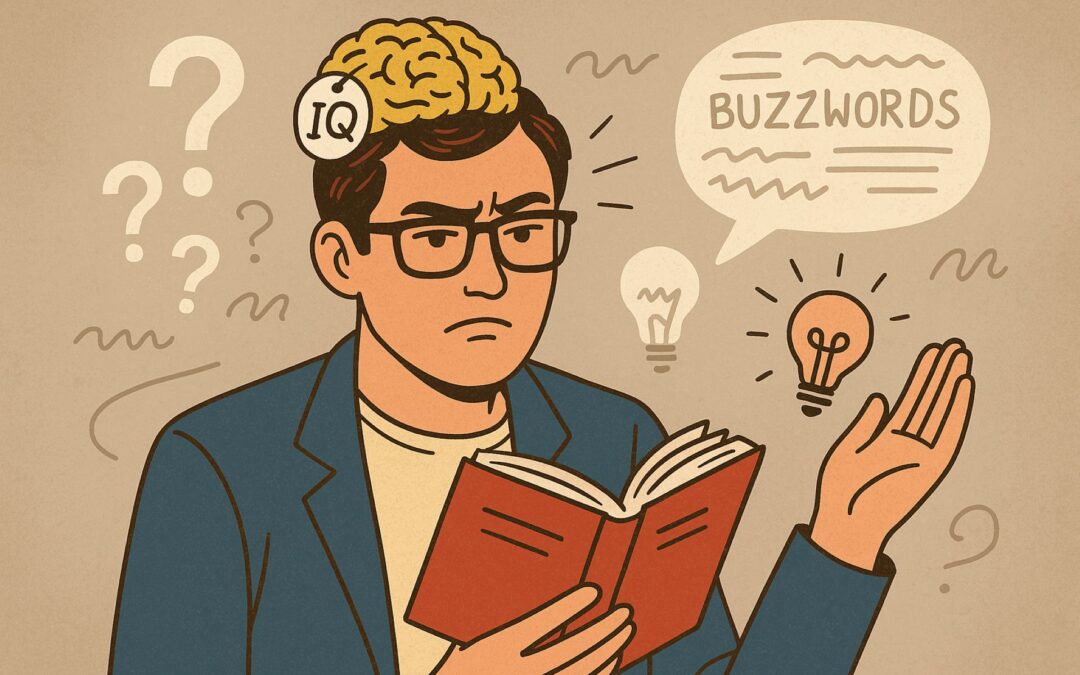
Ever met someone who seems like they’re the next Einstein, but something just doesn’t add up? You might be dealing with a classic case of “fake smart.” These individuals love to flaunt their so-called brilliance, but often their intelligence is more smoke and mirrors than substance. Whether it’s name-dropping obscure theories or using jargon to impress, they’ve got tricks up their sleeves to make you think they’re geniuses.
But here’s the kicker: there are clear signs that can reveal their true intellectual depth. Want to spot the fakes and see through the façade? Let’s dive right in and uncover the 15 telltale signs of someone who’s all show and no go.
1. They Tell You Their IQ
The need to constantly announce one’s IQ is a glaring sign of someone trying to establish intellectual dominance. IQ, a measurement of cognitive ability, is often seen by many as the ultimate indicator of intelligence. However, this belief is misleading. Real intelligence is multifaceted, encompassing emotional, social, and creative intelligence, all of which can’t be captured by a number. For fake smart individuals, though, boasting about their IQ becomes a shortcut to credibility.
When someone repeatedly mentions their IQ—especially in unrelated conversations—it’s a sign they’re trying to demonstrate superiority. They believe that their cognitive ability, as reflected by their IQ score, is the sole measure of their worth and intellect. They might casually drop their IQ into a conversation, as if it’s a trivial detail, but it’s clear they’re hoping for recognition or validation. In doing so, they are trying to leverage the prestige associated with high IQs to place themselves above others.
What these individuals fail to realize is that the true value of a person’s intelligence isn’t in how high their IQ is, but in how they apply it. Intelligence isn’t just about knowing facts or solving problems—it’s about thinking critically, being adaptable, and continually seeking to learn. Announcing one’s IQ as if it’s a trump card, without offering substantial insight or wisdom, only exposes a lack of true intellectual depth. In fact, such self-proclaimed intelligence often reveals a fragile ego that requires constant validation.
Moreover, the overemphasis on IQ as a definitive measure of worth ignores the broader spectrum of abilities that contribute to success and fulfillment. Emotional intelligence, for instance, plays a crucial role in personal and professional relationships, and it’s rarely tied to an IQ score. By constantly boasting about their IQ, fake smart individuals reduce the complexity of intelligence to a number, missing the broader, more nuanced understanding of what it means to be truly intelligent.
2. They Use Buzzwords and Jargon
Buzzwords and jargon are the weapons of choice for fake smart people looking to mask their lack of depth and genuine understanding. These individuals often pepper their conversations with complex terms, technical language, and industry-specific phrases, not because they understand them fully, but because they believe that using such terms will make them sound more knowledgeable. The goal isn’t to communicate clearly, but to establish an intellectual façade that others will assume is indicative of intelligence.
For example, instead of saying something simple like “It’s raining outside,” a fake smart person might say, “Due to the current precipitation event exhibiting characteristics consistent with liquid precipitation, it’s advisable to utilize a portable device designed to provide protection such as an umbrella.” In reality, this is an overcomplication of a basic statement. The use of such jargon serves no real purpose other than to confuse the listener and create the illusion of superior knowledge.
Fake smart people often deploy buzzwords or jargon when they’re not confident in their own understanding of the subject at hand. It’s a way of covering up the fact that they may not know as much as they let on. They hide behind complicated terminology to make themselves seem smarter than they actually are. But the irony is that in doing so, they alienate others and often diminish the clarity of communication. True intelligence is about explaining complex ideas in simple terms that others can understand, not using jargon to obscure meaning.
When no one seems to understand the jargon, they often try to simplify it, but only to an absurd extent, further illustrating the gap between what they say and what they actually understand. Rather than engaging in a meaningful exchange of ideas, they rely on jargon to avoid explaining themselves clearly. Real intellectuals, on the other hand, are comfortable explaining complex concepts in ways that are accessible to anyone, regardless of their background or level of expertise.
3. They Give Overcomplicated Explanations to Simple Questions
One of the clearest indicators of someone faking intelligence is their tendency to give overcomplicated explanations to simple questions. Fake smart people are often reluctant to offer a straightforward answer, feeling the need to make even the most mundane topics sound complex and convoluted. Whether it’s explaining the brand of coffee they like or the reason they prefer a particular TV show, they can’t resist the urge to turn a simple question into a lengthy, often nonsensical response.
This overcomplication is not driven by a genuine desire to explain or inform, but by a need to demonstrate how intellectual they are. They want others to believe that they’re operating on a different level, that they possess a deeper understanding of the world than anyone else. The irony, however, is that these drawn-out answers often end up confusing people rather than enlightening them.
In conversations with fake smart individuals, you’ll often notice that their answers are littered with unnecessary details, obscure references, and unrelated tangents. They might reference complex theories or offer analogies that, while seemingly impressive, don’t actually add value to the conversation. The result is that the listener is left feeling disoriented and frustrated, rather than informed. In their minds, this is a sign of their intellectual superiority—they believe that if no one else can follow their explanation, it proves that they’re on a higher intellectual plane.
This tendency to overcomplicate things stems from their deep insecurity. They believe that if they speak plainly, they’ll be seen as ordinary or lacking intelligence. So, they go to great lengths to turn everyday conversations into intellectual exercises, even when it’s entirely unnecessary. Real intellectuals, however, don’t feel the need to overcomplicate matters. They are capable of breaking down complex ideas in a way that’s digestible and accessible to everyone, regardless of their background or expertise.
4. They Can’t Relate to People Below Them
A pervasive sense of superiority marks many fake smart people. They often view themselves as part of an intellectual elite, separate from those they consider less intelligent. This inflated sense of self-importance causes them to believe that they are above the “common people,” and as a result, they struggle to relate to those who don’t share their perceived level of intellect.
For these individuals, talking to someone they perceive as “beneath” them is a chore, rather than a meaningful interaction. They assume that anyone outside their intellectual circle is unworthy of their time or attention, and they may even make these feelings known through dismissive comments or condescending behavior. This sense of superiority is often rooted in insecurity—a way of compensating for the fear that they might not actually be as intelligent as they want others to think.
When they interact with people they consider less intellectually advanced, fake smart individuals may exhibit patronizing behavior, interrupting and talking over others, dismissing their opinions without explanation, or belittling them. They often consider these interactions beneath them, treating them as unimportant or even irritating. This attitude reflects their lack of empathy and emotional intelligence, two crucial components of true intellectual strength.
The ability to relate to people from different walks of life and intellectual levels is a hallmark of genuine intelligence. Fake smart people, however, tend to isolate themselves in their own intellectual bubble, believing that those who don’t share their views or knowledge are somehow inferior. In doing so, they miss out on the richness that comes from learning from others, regardless of their background or expertise. True intelligence is not about shutting others down; it’s about engaging in conversations that broaden your understanding, not just reinforcing your own biases.
5. They’re Experts in Everything
Fake smart people often present themselves as experts in every field, regardless of their actual knowledge or experience. This behavior arises from their insecurity and desire to be seen as all-knowing, rather than a reflection of their actual understanding. In many cases, they don’t take the time to thoroughly research or explore topics in-depth; instead, they skim headlines, read surface-level articles, or watch quick summaries of complex topics. This limited understanding is then paraded as expertise, as they confidently make sweeping statements about anything and everything.
Their “expertise” is based on a few key points they’ve picked up here and there, often from sources that provide shallow information. For example, they may briefly read about quantum physics or artificial intelligence and then start offering opinions on the latest advancements in those fields without ever delving deeply enough to understand the underlying principles. They believe that having a surface-level understanding of a subject is enough to present themselves as an authority.
The problem with this approach is that true expertise requires more than just knowing the basics. It demands a deeper understanding, one that’s refined through experience and critical thought. Real experts don’t just regurgitate information—they analyze it, critique it, and build upon it. Fake smart people, on the other hand, rely on what they can recall from articles or popular media, and they often dismiss anyone with more nuanced or in-depth knowledge.
In conversations, these individuals tend to dominate discussions, confidently sharing their “expert opinions” with anyone who will listen. If someone challenges their views or provides a more informed perspective, they quickly become defensive. Their inability to engage in deeper discussions is exposed, and their lack of real expertise becomes apparent. But by that point, they’ve already established their dominance and “won” the conversation in their minds. The ironic thing is that true experts never stop learning and acknowledge the limitations of their knowledge—fake smart people, however, think they have everything figured out after a quick Google search.
6. They Get Defensive When Challenged
Fake smart people tend to crumble when their intellectual superiority is challenged. This defensiveness is rooted in insecurity and an overinflated ego. They go to great lengths to create an image of intellectual invulnerability, and when this image is questioned, they respond with hostility or avoidance. Unlike genuinely intelligent individuals who are open to healthy debate and critique, fake smart people will defend their positions at all costs, often resorting to tactics that avoid engaging in a constructive discussion.
When confronted with opposing viewpoints or facts that contradict their assertions, these individuals may attempt to shut down the conversation entirely. They might use phrases like “Let’s agree to disagree,” “I don’t have time for this,” or “You just don’t understand,” all in an attempt to deflect attention from the inadequacy of their arguments. The goal here isn’t to learn or grow from the conversation—it’s to protect their fragile sense of intellectual superiority.
This behavior is often rooted in a fear of being exposed. Fake smart people know deep down that their intellectual status is built on shaky ground, so they try to avoid situations where they might be proven wrong. Being proven wrong would shatter the illusion they’ve worked so hard to create, and so they resort to avoiding or sidestepping real discussions.
Furthermore, their defensiveness often stems from the belief that being “right” is more important than being open to new ideas. They may feel that admitting they were wrong is a sign of weakness or a threat to their reputation. Real intelligence, however, is marked by an openness to change, the willingness to accept when one is wrong, and the courage to adjust one’s views based on new information. Fake smart individuals, by contrast, live in a bubble of self-validation, afraid to acknowledge any flaws in their thinking.
7. They Annoy You When They Can’t Win an Argument
Fake smart people have a tendency to resort to childish tactics when they realize they can’t win an argument. Instead of engaging in thoughtful discourse or reconsidering their position when confronted with counterarguments, they will often try to wear you down emotionally. Their goal is to exhaust you to the point where you abandon the conversation, which they then interpret as a victory.
One of the most common strategies they employ is to become increasingly annoying. They might repeat the same points over and over, even after it’s clear that they’re not convincing anyone. They may resort to mocking or belittling you, making condescending remarks, or even changing the subject entirely. Their goal is to distract you from the topic at hand and shift the focus to your emotions, especially if you start getting frustrated.
If you show signs of irritation, fake smart people will often turn the conversation back to your emotions, asking questions like “Why are you getting so upset?” or “Why are you so mad about this?” This is a manipulation tactic that shifts the conversation away from the subject and onto your emotional reaction. In their eyes, if they can get you to lose your cool, it means they’ve won the argument, even if they haven’t actually presented a compelling argument of their own.
This strategy of annoying the opponent into submission is common among those who feel intellectually insecure. Rather than engaging in thoughtful and respectful discussion, they resort to underhanded tactics to “win” by default. This behavior often leads to frustration on the part of those trying to engage in a meaningful debate, leaving them wondering whether it’s even worth the effort to continue arguing. Real intellectuals, by contrast, are willing to admit when they’re wrong or when they don’t know something, and they respect the views of others, even when they disagree.
8. They Correct Others Over Trivial Mistakes
Correcting others over trivial mistakes is one of the most obnoxious traits of fake smart people. Whether it’s pointing out a small grammatical error, a minor factual slip, or even something as inconsequential as a misspelling in a social media post, these individuals seize every opportunity to make others feel inferior. They often interrupt conversations to highlight the slightest inaccuracies, whether or not they add anything of value to the discussion.
This behavior is driven by a need to establish their intellectual authority. By pointing out even the most irrelevant mistakes, fake smart people feel that they are reinforcing their status as the “smartest” in the room. The irony is that these corrections rarely contribute to the conversation at all. In fact, they usually derail the flow of communication, serving only to make others feel uncomfortable or self-conscious. These corrections are often made in a patronizing tone, and they’re usually followed by a smug smile or a condescending remark, further reinforcing the sense of superiority that fake smart people derive from such moments.
What’s worse is that these same individuals often overlook their own flaws or mistakes. They might be quick to judge others for minor errors, but they fail to recognize or admit their own imperfections. They may, for example, criticize someone for an occasional slip of the tongue while themselves being completely unaware of their own frequent use of incorrect terminology. This double standard reveals the fragility of their intellectual ego and their reliance on small, insignificant mistakes to validate their sense of superiority.
The worst part about this behavior is that it rarely has any constructive purpose. Real intellectuals understand that perfection is an illusion and that making mistakes is a part of the learning process. Instead of pointing out every minor slip-up, they focus on the bigger picture and engage in discussions that promote understanding and growth. Fake smart people, however, take pride in exposing the smallest errors, all in an effort to make themselves seem more knowledgeable. This constant need to correct others over trivial issues exposes a lack of empathy and a deep insecurity about their own intelligence.
9. They’re Impossible to Argue With
A hallmark of the fake smart person is their inability to engage in a productive argument. For them, an argument is not an exchange of ideas or an opportunity to grow intellectually. Instead, it’s a battleground where their primary goal is to “win” at all costs. This often results in conversations that are frustrating and futile, as they refuse to consider any viewpoints other than their own.
Fake smart people don’t argue to understand—they argue to assert their dominance. When confronted with a well-constructed counterpoint, they don’t engage thoughtfully or acknowledge the validity of the other perspective. Instead, they use a variety of tactics to shut down the conversation. They might respond with phrases like “You’re just not getting it” or “This is a waste of time,” essentially refusing to entertain any ideas that challenge their own.
Their arguments are often filled with logical fallacies and weak reasoning, but they refuse to acknowledge these flaws. They may use tactics such as diversion, straw man arguments, or even emotional appeals to distract from the lack of substance in their position. When presented with evidence that contradicts their claims, they may ignore it, misinterpret it, or dismiss it outright without addressing it directly.
These individuals are also known for repeating the same arguments over and over, as if the mere act of repetition will somehow make their point more valid. Real debates require an open mind, where both sides are willing to listen, consider, and evolve based on the information presented. Fake smart people, however, often reach a point where the conversation becomes more about their ego and pride than the actual topic at hand. This makes it almost impossible to have a meaningful exchange with them, as they’re more concerned with “winning” than understanding.
The inability to argue constructively is a significant sign of intellectual immaturity. True intelligence thrives on a willingness to entertain new ideas, to adjust one’s views when presented with compelling evidence, and to engage in discussions with the goal of gaining deeper insight. Fake smart people, however, prefer to shut down any opposition, often resulting in arguments that are more about ego than intellectual growth.
10. They Critique What They Don’t Understand
One of the most frustrating behaviors exhibited by fake smart individuals is their tendency to critique things they don’t fully understand. Rather than taking the time to learn about something unfamiliar, they immediately judge it as unworthy or inferior. This is especially true when it comes to new technologies, trends, or complex ideas that challenge their existing worldview.
When faced with something they don’t understand, fake smart people often default to a dismissive attitude. For instance, when a new piece of technology comes out, such as a groundbreaking gadget or app, they might declare it “useless” or “a waste of time” without ever taking the time to explore how it works or its potential benefits. Their initial reaction is to reject it because it doesn’t fit into their limited understanding, not because they’ve thoroughly examined it and found it lacking. They don’t see the value in the unknown—they see it as a threat to their sense of intellectual superiority.
This behavior is a clear indicator of intellectual arrogance. Instead of taking a moment to learn, ask questions, or engage with new information, fake smart people automatically assume they already know enough to form an opinion. They might criticize a new scientific theory or a business trend, not because they’ve done the research to understand it, but because it doesn’t fit neatly into their current mental framework.
The irony of this is that true intelligence involves being curious and open-minded, especially when it comes to things that are new or unfamiliar. Real thinkers embrace the unknown and take the time to understand it, knowing that every new idea or innovation holds the potential to expand their knowledge. Fake smart people, however, resist change and cling to their narrow worldview, rejecting anything that challenges their existing beliefs.
11. They Downplay the Importance of Things They’re Not Aware Of
Fake smart individuals often exhibit a tendency to dismiss or downplay the importance of things they don’t know or understand. If a topic, concept, or event hasn’t come up on their radar or isn’t part of their usual interests, they often dismiss it as irrelevant. This behavior reflects a closed mindset and a reluctance to step outside their own comfort zone.
For example, if someone mentions a new cultural trend, technological development, or important current event that hasn’t caught their attention, a fake smart person might respond with something like, “Oh, I don’t bother with that” or “That doesn’t matter to me.” They act as though their lack of knowledge or awareness is a sign of intellectual superiority, as though avoiding something unfamiliar automatically makes it unimportant.
This behavior is often a defense mechanism. If someone doesn’t know something or hasn’t engaged with a particular issue, rather than admit ignorance or show curiosity, fake smart people dismiss it. It’s easier for them to pretend that things outside their knowledge are unimportant than to admit they haven’t encountered them before. This attitude limits their personal and intellectual growth, as they miss out on opportunities to learn and broaden their perspectives.
Real intelligence, on the other hand, is marked by a willingness to acknowledge what you don’t know and to seek out new information and experiences. True intellectuals understand that learning is a lifelong journey, and they approach unfamiliar topics with openness and curiosity. Fake smart people, however, shut themselves off from new ideas and perspectives, believing that their current knowledge is sufficient to navigate the world. This results in a stagnant worldview that prevents growth and understanding.
12. They Can’t Explain Their Thinking Process
Perhaps one of the clearest signs of someone pretending to be smart is their inability to explain their own thinking process. When asked how they arrived at a conclusion or decision, fake smart people often struggle to articulate their reasoning. This is because their ideas are typically regurgitations of other people’s opinions or poorly understood concepts, rather than original or deeply considered thoughts.
Rather than offering a clear explanation of how they came to a particular conclusion, these individuals might rely on vague, non-committal statements like “It just makes sense” or “I just know that it’s right.” The lack of a clear, logical progression in their thinking is a sign that their ideas are not fully formed or original. They often take credit for insights that belong to others but fail to comprehend the underlying reasoning.
When someone is genuinely intelligent, they are able to break down their thought process and explain how they arrived at their conclusions. They can trace their steps, present evidence, and articulate the logic behind their ideas. Fake smart people, on the other hand, don’t have this capacity because they are simply parroting the views of others without fully understanding them. They may rely on the ideas of experts or thought leaders they admire, but they can’t explain the nuances or rationale behind those ideas in their own words.
This inability to explain their thinking process highlights a lack of intellectual depth and critical thinking skills. True intelligence is rooted in self-awareness and the ability to reflect on one’s own reasoning. Fake smart people, however, don’t possess these qualities. They simply mimic others’ ideas and present them as their own without understanding or being able to explain the logic behind them.
13. They Can’t Change Their Mind
One of the most defining traits of fake smart people is their rigid, unyielding belief system. When they commit to an idea or a viewpoint, they rarely, if ever, entertain the possibility that they could be wrong. This inability to change their mind is not rooted in a strong, evidence-based conviction but in a fear of being exposed. For fake smart people, admitting they’re wrong is akin to shattering their carefully constructed image of intellectual superiority. Changing their mind would require them to confront their own intellectual flaws—something they are unwilling to do.
Fake smart people cling to their beliefs, even when presented with new information that contradicts their position. They may refuse to acknowledge that they’ve made mistakes or that their views are based on outdated or incorrect facts. Instead, they will double down, becoming more entrenched in their original stance. Their resistance to change may even manifest in phrases like “Nothing you say will change my mind” or “I’ve made up my mind,” shutting down any further discussion.
The irony is that the inability to change one’s mind often leads to intellectual stagnation. Without the willingness to evolve based on new evidence or perspectives, a person’s knowledge remains limited and outdated. In contrast, truly intelligent individuals are comfortable revising their views when confronted with compelling counterarguments or evidence. They understand that intellectual growth involves questioning one’s assumptions and being open to learning from others.
For fake smart people, however, their sense of intellectual pride is too fragile to allow for such flexibility. This inability to adapt prevents them from genuinely evolving and improving their understanding of the world. It’s a sign of intellectual insecurity—a need to maintain the illusion of infallibility at the expense of personal growth.
14. They Have Huge Egos
An oversized ego is one of the most obvious signs of someone faking intelligence. Fake smart people often rely on their perceived intellectual superiority to navigate social and professional situations. They need to feel like the smartest person in the room, and they go to great lengths to make sure others see them that way as well. This inflated sense of self-importance often manifests as arrogance, self-absorption, and an inability to accept feedback or criticism.
Their ego becomes a barrier to authentic communication and meaningful relationships. Fake smart people often feel entitled to respect and admiration simply because of their self-perceived intelligence. They might dominate conversations, interrupt others, and belittle anyone who challenges their ideas, all in an effort to maintain their sense of superiority. In extreme cases, they may even demand special treatment or recognition based solely on their intellectual status, believing that their intelligence entitles them to privileges.
This kind of behavior is a direct reflection of insecurity. Deep down, fake smart individuals fear that they aren’t as intelligent as they project. To cover up this fear, they inflate their ego to compensate. Their arrogance acts as a defense mechanism to prevent others from seeing their vulnerabilities. In reality, their egos are fragile, and their intellectual posturing is a way to avoid confronting the possibility that they might not know as much as they pretend.
True intellectuals, on the other hand, tend to be humble. They understand that knowledge is vast and that no one knows everything. They’re comfortable with their own limitations and are open to learning from others. Fake smart people, in contrast, see knowledge as a competition and work tirelessly to maintain the upper hand, often at the expense of collaboration, personal growth, and meaningful connections.
15. They Hold Grudges
Fake smart people tend to hold onto past offenses for a long time, often harboring resentment toward anyone who has challenged or embarrassed them. Whether it’s a colleague who pointed out an error in their reasoning or a friend who corrected them in front of others, fake smart individuals have a tendency to nurse grudges and seek retribution. They view these moments of perceived humiliation or loss of face as deeply personal attacks, and they are reluctant to let them go.
The act of holding a grudge is rooted in their inflated ego and fragile sense of self-worth. When someone challenges their ideas or makes them look foolish, they take it as a direct affront to their intelligence and self-image. This emotional reaction is often magnified by their inability to accept that being wrong is a natural part of learning and growth. Instead of acknowledging their mistake or learning from the experience, they focus on getting even, plotting ways to “punish” those who made them feel small.
This tendency to hold grudges not only affects their relationships but also keeps them trapped in the past. Fake smart people spend an inordinate amount of time thinking about past wrongs, revisiting every detail of the offense, and plotting how to get back at those who “wronged” them. This emotional baggage prevents them from moving forward and focusing on more important matters. Their inability to forgive and let go of past conflicts means that they remain stuck in a cycle of bitterness, resentment, and pettiness.
In contrast, emotionally intelligent individuals recognize that holding grudges only harms their own well-being. They understand that forgiveness is an essential component of personal growth, and they are able to move past conflicts without letting them affect their future interactions. Real intellectuals understand that being wrong or facing criticism is a part of the journey toward wisdom, and they don’t let past mistakes define their future. Fake smart people, however, are consumed by their need to “get even,” which ultimately keeps them from growing or learning from their experiences.
Bonus: They Always Want to Be the Smartest in the Room
Fake smart individuals are incredibly sensitive to any threat to their intellectual supremacy. When they find themselves in a room full of people who are more knowledgeable or articulate than they are, they become anxious and uncomfortable. To protect their fragile ego, they may resort to avoiding situations where they’re not the most intelligent person present. They prefer environments where they can dominate conversations and impress others with their “superior” knowledge.
This desire to always be the smartest person in the room often leads them to seek out social circles that reinforce their self-image. They surround themselves with individuals who are either less knowledgeable or too passive to challenge their ideas. In such settings, they can bask in the glory of being seen as the intellectual leader, without fear of being exposed as a fraud. When they encounter someone who might challenge their intellectual status, they tend to retreat or disengage, unable to cope with the discomfort of being outshone.
This tendency to avoid intellectually challenging situations comes from a fear of being exposed. Fake smart people don’t know how to handle being around people who are genuinely smarter or more informed than they are. Instead of adopting a learner’s mentality, they retreat into environments where they can maintain the illusion of intellectual superiority. The result is that they miss out on opportunities for growth, learning, and collaboration.
True intellectuals, however, seek out environments where they can be challenged and learn from others. They are not threatened by smarter people; instead, they welcome the opportunity to engage with those who can expand their knowledge and offer fresh perspectives. Fake smart individuals, on the other hand, are so focused on maintaining their perceived status that they miss the opportunity to grow and develop their understanding of the world. By surrounding themselves with people who affirm their intellectual superiority, they remain stagnant and closed off to the possibility of real learning.
Conclusion
Spotting someone faking their intelligence can be challenging, but these 15 signs can serve as a guide. Remember, true intelligence doesn’t need to be flaunted or defended. It shines naturally through one’s actions and humility.
If you’ve encountered someone displaying these signs, share your experiences in the comments. And for those who recognize their own behavior in this list, it might be time for some introspection and personal growth.