
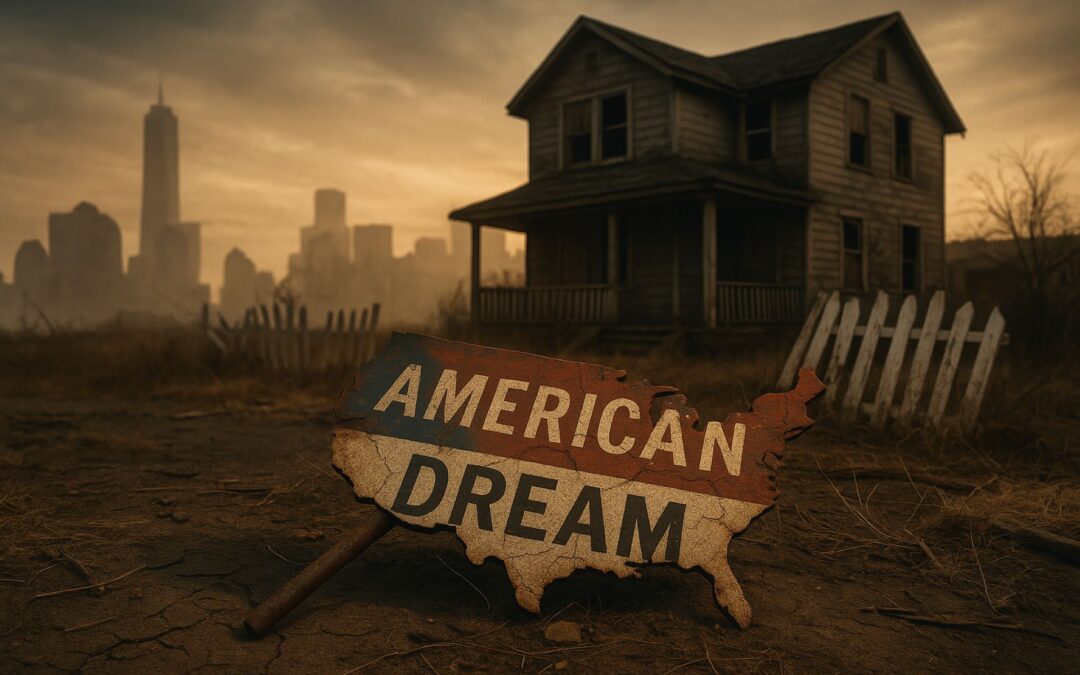
The concept of the American Dream has been a central pillar of American identity for generations, embodying the belief that anyone, regardless of their background, could achieve prosperity through hard work and determination.
But over the years, the dream has evolved, shifted, and in many ways, disappeared, leaving many wondering if it is still a realistic aspiration. The reality today starkly contrasts with the vision of success many were raised to believe in.
This article will explore the rise and fall of the American Dream, examining how it began, how it evolved, and why its continued existence might be more elusive than ever.
The Birth of the American Dream
The birth of the American Dream can be traced to the historical context of a nation on the cusp of transformation. Although the ideals it embodies have roots that extend back to the earliest days of American history, the specific term “American Dream” was only coined in 1931 by historian James Truslow Adams in his book The Epic of America. Adams’ vision was a radically hopeful one, distinct from the rigid class structures that defined Europe at the time. In his words, the American Dream was “that dream of a land in which life should be better, richer, and fuller for everyone, with opportunity for each according to ability or achievement.” This was more than just an optimistic sentiment—it represented the belief that anyone, regardless of birth or social class, could achieve success through sheer effort and ability.
At its essence, the American Dream promised opportunity. It suggested that, regardless of the background one came from, anyone could rise up through hard work and perseverance. This was especially significant at the time, as the world was recovering from the Great Depression. The economy was in shambles, and the social order had been shaken to its core. The dream wasn’t just a call for individual prosperity—it was a hope for social mobility and fairness. It signified a rejection of aristocracy and the idea that one’s fate was sealed by the family into which they were born. Instead, it presented a meritocratic society where success was defined by individual capability, not by inherited wealth or title.
The Great Depression itself played a significant role in giving the American Dream its emotional and practical weight. As the U.S. faced staggering unemployment, plummeting wages, and widespread poverty, millions of Americans found themselves struggling to survive. In the face of such overwhelming adversity, the promise of the American Dream became even more crucial—a beacon of hope for the future. People yearned for the basic assurances of life: stability, opportunity, and the chance to rebuild their lives. The Dream became less about luxuries and more about reclaiming essential elements of a dignified life—things like a steady job, a safe place to live, and the ability to provide for one’s family.
In this period, the pillars of the American Dream were fundamentally practical: stability through steady employment, the security of homeownership, the transformative power of education, and the opportunity for upward mobility. These weren’t grand aspirations—they were the foundation for survival and growth. The American Dream was about reaching for something attainable—creating a life that was better than the one you inherited. It wasn’t about unfettered wealth or fame but rather about reclaiming control over one’s destiny and securing the future for one’s family.
What made this vision so revolutionary was its emphasis on the ability of anyone—regardless of social status or background—to transcend their circumstances. During a time when global economic structures seemed immovable, the American Dream offered an alternative: that change and success were not only possible but achievable by anyone willing to put in the work.
The Golden Age: Post-WWII Prosperity
After World War II, the United States entered what is often referred to as the “Golden Age” of the American Dream. This was a period of unparalleled growth, optimism, and prosperity. The war had left the U.S. as the only global superpower with a functioning economy, and as soldiers returned home, they found a thriving job market and an economy eager to expand. This period, roughly from the late 1940s to the early 1970s, saw the American Dream reach new heights, as the middle class expanded and the promises of upward mobility became more attainable for millions.
The immediate post-war years marked a shift from wartime austerity to consumer-driven growth. The government took proactive steps to ensure veterans had access to homeownership, education, and steady employment, notably through the GI Bill. This program was instrumental in allowing millions of veterans to purchase homes, further cementing homeownership as one of the central pillars of the American Dream. This wasn’t just about acquiring property—it was about securing the stability and future of one’s family. The idea of owning a home was seen as an essential marker of success and prosperity, a place where families could grow and live securely.
This period also marked the growth of the middle class, as industries boomed and new, well-paying jobs became more accessible. The prosperity of the 1950s and 1960s made the notion of a “comfortable life” a reality for millions of Americans. The rise of factory work, the automobile industry, and the post-war consumer boom allowed families to live more comfortably, even luxuriously, compared to previous generations. For many, the dream wasn’t just about having a job—it was about having a job that provided enough to own a home, send children to college, and save for the future. In fact, the growing accessibility of higher education meant that more children of working-class families could attend college and achieve the upward mobility that their parents could only dream of.
The image of the American Dream during this time was iconic. The typical American family was depicted in suburban homes with white picket fences, owning cars, and enjoying family dinners at home. It was an era defined by stability, security, and an optimistic belief that things could only improve. There was a prevailing sense of confidence in the future, driven by the belief that hard work, combined with the right opportunities, would guarantee success. The idea that you could start from humble beginnings and work your way into the middle class—or even beyond—became a defining feature of American identity.
This golden age was also marked by the establishment of a strong social fabric. People were deeply connected to their communities. Neighbors knew each other’s names, families spent time together, and there was a general sense of shared purpose. The American Dream wasn’t just about individual success—it was about the collective well-being of society. The notion of upward mobility wasn’t just about personal gain; it was seen as a social responsibility to better the future for the next generation.
The optimism of this era, however, would not last. As the decades went on, the American Dream began to evolve, and not necessarily in the ways many had hoped. While the golden age promised upward mobility for many, the structural changes in the economy and society would soon begin to challenge the very foundation of that dream. However, for a time, the post-WWII era represented the pinnacle of the American Dream, where possibility seemed endless, and the dream of prosperity was within everyone’s reach.
The Shift: Materialism and Debt
By the time the 1980s rolled around, the landscape of the American Dream had undergone a profound shift. The optimism and stability of the post-World War II period began to fade as a new era of consumerism, materialism, and economic complexity took its place. While the American Dream had once centered on modesty, stability, and upward mobility through hard work, it gradually transformed into something more focused on appearance, consumption, and status.
This transformation was propelled by several cultural and economic changes. The 1980s saw the rise of the “yuppie” (young urban professional), a new breed of consumer who flaunted wealth through visible displays of success—luxury cars, expensive clothing, large homes, and foreign vacations. Material goods became symbols of achievement. It wasn’t just about having a steady job anymore; success was now measured by what one owned, where one lived, and the exclusivity of the experiences one could afford. In many ways, the pursuit of happiness was replaced by the pursuit of possessions.
The cultural shift was matched by a seismic change in economic behavior. In previous decades, families had saved for big purchases like homes or cars. By the 1980s, however, credit was much more accessible. Banks and lending institutions began offering loans with ease, making it possible for individuals to purchase items well beyond their immediate means. Mortgages, car loans, and credit cards were now commonplace, and consumer debt started to spiral. Families that once lived within their means now found themselves living on borrowed money, hoping that future earnings would be enough to cover the interest.
Homeownership, which had once been a secure path to building wealth, became increasingly tied to risk. Mortgages grew larger as housing prices rose, and the dream of owning a home became more synonymous with being deeply in debt. Even in the midst of growing consumer debt, people continued to live by the adage of “keeping up with the Joneses,” buying more than they could afford simply to appear successful. The notion of living beyond one’s means wasn’t just widespread—it became normalized.
This era marked the beginning of a fundamental change in the nature of wealth and success in America. Rather than stability and prudence, the goal now seemed to be excess, and the definition of the American Dream had shifted to include the idea that more was always better. With the increasing availability of credit, people believed they could achieve an idealized lifestyle without the foundation of financial security. But this shift came at a cost. The newfound wealth people were displaying wasn’t always earned; it was often financed through debt. While this created an illusion of prosperity, the long-term impact was destabilizing for many families.
As the decade progressed, the economic pressures of the 1980s began to take a toll. The wealth gap began to widen, and for the first time, middle-class families were often struggling just to maintain the lifestyle they had worked so hard to achieve. The pursuit of status, fueled by debt, began to overshadow the core values of hard work, family, and upward mobility. While the rich were getting richer, the middle class found itself increasingly burdened by financial instability, leading to a growing sense of insecurity and fear about the future.
Moreover, the growing reliance on credit created a culture where consumption was often prioritized over savings. This shift in priorities laid the groundwork for future economic crises, as the reliance on borrowed money became unsustainable. When the economy faltered, it exposed the fragility of the financial system that had been built on credit and debt, which would soon unravel in the coming decades.
The Crash: 2008 and the Erosion of Trust
The 2008 financial crisis was the catastrophic event that fully revealed the fragility of the American Dream. After decades of economic growth, fueled by debt and a culture of consumption, the U.S. economy finally collapsed under the weight of its own instability. The housing market, which had been the cornerstone of the middle-class American Dream, was at the heart of the crisis. Homeownership, once the ultimate symbol of financial success, became the primary vehicle for debt accumulation and economic collapse.
In the years leading up to 2008, banks and financial institutions had been handing out subprime mortgages to individuals who couldn’t afford them, under the assumption that home prices would continue to rise and homeowners would be able to refinance or sell at a profit. But when home prices began to drop, millions of homeowners found themselves with mortgages they couldn’t repay and homes that were worth less than their loans. This set off a chain reaction that led to the bursting of the housing bubble.
The collapse of the housing market wasn’t just about homes—it exposed deeper issues within the financial system. Financial institutions had been packaging bad loans into securities, which were sold to investors around the world. When the value of these securities began to fall, it triggered a global financial meltdown. Banks failed, stock markets plummeted, and retirement savings evaporated. The crisis affected everyone, from Wall Street to Main Street, and it shattered the trust in the financial system that had been the bedrock of the American economy.
For many Americans, the dream of homeownership turned into a nightmare. Millions of families lost their homes to foreclosure, and those who managed to keep their homes often saw their values plummet, leaving them underwater in their mortgages. At the same time, college graduates were entering a job market that had become increasingly bleak. The promise of upward mobility through education seemed hollow as many found themselves unable to land jobs that would allow them to repay their student loans. The financial crisis revealed how deeply intertwined the American Dream had become with a broken financial system, one built on risky investments, unsustainable debt, and speculative bubbles.
The government’s response to the crisis, which included the bailout of banks and the implementation of quantitative easing (essentially printing trillions of dollars to inject into the economy), prevented a complete collapse but did little to address the underlying causes of the crisis. In the short term, the economy stabilized, and financial markets rebounded. However, the long-term consequences were profound. The financial system had been fundamentally altered, and the trust that many had in the American Dream began to erode.
Quantitative easing, while saving the economy from a total collapse, created inflationary pressures that would have lasting effects. By flooding the economy with more money, the government devalued the dollar, making everyday goods and services more expensive. For the wealthy, who owned assets like stocks and real estate, this was a boon. The value of their investments skyrocketed, and they emerged from the crisis wealthier than ever. But for the middle class and the poor, the effects were devastating. The cost of living increased, while wages remained stagnant. The promise of upward mobility that had been central to the American Dream was slowly disappearing.
The crash of 2008 didn’t just mark an economic downturn—it marked the collapse of the system that had supported the American Dream for decades. The dream of owning a home, achieving financial security, and securing a better life for one’s children had become an elusive goal for many Americans. Trust in the American financial system, in banks, and in the institutions that had once provided stability began to crumble. The very foundation of the American Dream was shaken, leaving many to question whether it was still attainable in the modern age.
The Disappearance of the Middle Class
The collapse of the financial system in 2008 marked the beginning of a long and painful erosion of the American middle class, once the bedrock of the American Dream. In the wake of the crisis, it became clear that the dream of upward mobility, achievable through hard work and dedication, was no longer as accessible as it once was. For decades, the middle class had been the standard by which the American Dream was measured: owning a home, providing a quality education for children, and securing a comfortable retirement. However, as the U.S. economy shifted, the foundation of the middle class began to erode.
One of the most significant changes during this time was the stagnation of wages. In the years following the 2008 crisis, the cost of living increased dramatically, but wages for the majority of workers remained largely stagnant. While inflation caused prices to climb for basic goods, housing, healthcare, and education, the average wage for the bottom 90% of earners barely budged. This made it increasingly difficult for middle-class families to keep up with the rising costs of everyday life. The dream of a comfortable life through hard work was being replaced by the harsh reality that many were just barely managing to survive.
Homeownership, long seen as a symbol of success and financial security, became increasingly out of reach. The 2008 crash had already devastated the housing market, and while the market began to recover in the following years, the rising costs of homes made it nearly impossible for young families to enter the market. In many urban areas, home prices surged, leaving many potential homeowners priced out. Rent prices also skyrocketed, further compounding the problem. For a generation, owning a home had been a central tenet of the American Dream, but now it seemed like an unattainable fantasy for many people.
The education system, once seen as the key to upward mobility, also became a significant barrier for many Americans. College tuition costs skyrocketed, and student loan debt reached unprecedented levels. The belief that a college degree would ensure a better future was shattered as millions of graduates entered a job market that was increasingly uncertain and underpaid. The crushing weight of student loans, combined with limited job prospects, made it difficult for many young people to achieve the financial independence that was once expected. The cost of education, once an investment in a better future, now became a burden that many couldn’t escape.
As a result, the middle class began to shrink. The promise that anyone, regardless of their background, could rise through hard work and perseverance was no longer a realistic goal for millions. The wealth gap widened, with the top 1% of income earners accumulating more wealth than ever before, while the majority of Americans struggled to keep up. The middle class, which had once been a cornerstone of the American Dream, was disappearing, leaving behind a nation divided between the wealthy elite and an increasingly impoverished population.
This phenomenon was not unique to the United States. Globally, many countries saw similar trends of rising wealth inequality, stagnant wages, and the decline of the middle class. The global economic system became increasingly concentrated in the hands of the wealthy, leaving fewer opportunities for those at the bottom to rise. The promise of upward mobility, so central to the American Dream, had been replaced by a system where wealth was concentrated in fewer hands, and the ability to rise above one’s circumstances seemed more elusive than ever before.
What’s Next: The Future of the American Dream
The decline of the middle class and the erosion of the American Dream leave us grappling with an important question: what comes next? While the traditional version of the American Dream—defined by stable jobs, homeownership, and upward mobility—seems increasingly out of reach, it is essential to recognize that the future of success does not lie in clinging to outdated notions. Instead, the path forward requires a dramatic shift in how we approach personal finance, work, and opportunity.
In the post-crisis world, the traditional markers of success no longer hold the same weight. Homeownership is no longer a guarantee of financial security, and a college degree is no longer a surefire ticket to a well-paying job. In fact, many people are realizing that the systems that once defined success—the idea of working hard for 40 years at a single job, owning a home, sending your children to college—may no longer be realistic or necessary for building a prosperous future. Instead, the future requires adaptability, innovation, and an understanding that wealth can no longer be accumulated by following a prescribed, linear path.
The traditional ladder of success, where each rung led higher to financial freedom, has become increasingly unstable. Instead, individuals today are being called to create their own paths. The rise of the gig economy, remote work, and entrepreneurial ventures provides new opportunities for financial success outside of the traditional corporate structure. However, these opportunities also require a different skill set. The ability to adapt to new technologies, the willingness to embrace uncertainty, and a proactive approach to financial management are essential for success in this new world.
Moreover, as wealth inequality continues to grow, it’s crucial to acknowledge that the path to prosperity will not look the same for everyone. The wealthy elite continue to benefit from their control over assets, while the rest of the population faces rising costs and diminishing opportunities. For many, the reality is that the dream of becoming wealthy through traditional means has become out of reach. Instead, individuals need to focus on building resilience, developing new sources of income, and learning how to thrive in an economy that is no longer designed to benefit the many, but the few.
In this new landscape, personal responsibility is key. Rather than relying on the systems that have failed many, individuals need to take control of their own financial futures. This involves making smart financial decisions, learning how to invest, and finding ways to generate passive income streams. It also means rethinking what success truly looks like. Success today is less about the accumulation of wealth and more about building a life that is secure, fulfilling, and sustainable. It’s about taking responsibility for your future and understanding that financial security requires continuous learning and adaptation.
The American Dream, as it was once understood, is in decline. But that doesn’t mean that success is impossible. It simply means that we must redefine what success looks like and how we get there. The future of success requires flexibility, innovation, and the ability to create opportunities in an increasingly complex world. Those who are willing to adapt and take control of their financial futures will still have the chance to live fulfilling lives, but it will no longer come from following a predetermined path. The future belongs to those who are willing to carve their own way forward.
Conclusion: The American Dream May Be Dead, But Success Is Still Possible
While the traditional American Dream may be fading, it doesn’t mean that success is out of reach. The key is to shift the focus from past ideals to today’s realities. Success now requires a proactive approach, personal responsibility, and an understanding that the rules have changed.
The journey to financial security and prosperity isn’t about waiting for things to improve—it’s about taking control, learning the necessary skills, and adapting to the ever-changing landscape.
The American Dream may no longer be what it once was, but building wealth and achieving personal success is still possible for those who are willing to do the work.