
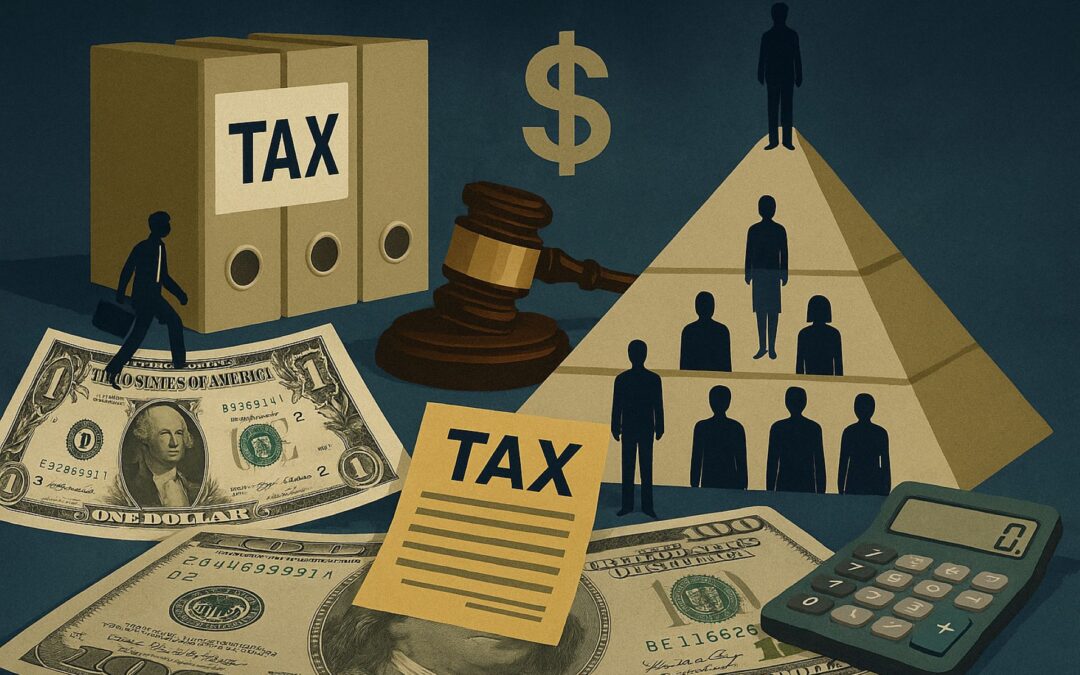
The US tax system is intricate, layered, and often perplexing to those who don’t spend time unraveling it. While Benjamin Franklin’s assertion that death and taxes are certain might still hold true, how much individuals pay in taxes is far from fixed. In fact, the tax burden is incredibly variable depending on one’s financial situation, and understanding how it works can make a huge difference in how much you owe at the end of the year.
This breakdown aims to explore who pays the most, who pays the least, and where the loopholes lie—starting with employees and moving through business owners, corporations, and the ultra-wealthy. So let’s dive into the layers of the tax pyramid, unravel the complexities, and explore some of the strategies that allow certain individuals and corporations to pay far less than what most would expect.
The Struggle of Employees: Paying the Price for the System
Employees are the primary contributors to the US tax system, yet they are often the ones who feel the most burdened. Whether you’re living in a state like New York with high income tax rates, or in a state like Texas that has no state income tax, employees across the nation are taxed by the federal government based on a progressive income tax system. This system is designed to ensure that individuals with higher incomes pay a higher percentage of their earnings in taxes, creating a tiered structure of tax brackets.
The progressive system works by taxing portions of your income at increasing rates. For instance, the first portion of your income is taxed at a relatively low rate, but as your income grows, each additional dollar you earn is taxed at a higher rate. In 2023, the tax brackets in the US start with a 10% rate for income up to $9,875. If your income falls between $9,876 and $40,125, you’ll pay 12% on that portion, and as your earnings continue to increase, so too does the tax rate—22% kicks in for income between $40,126 and $85,525, and 24% for income between $85,526 and $163,300. The tax rates keep rising, hitting 32% for income between $163,301 and $207,350, 35% between $207,351 and $518,400, and 37% for income over $518,400.
The idea behind this structure is that wealthier individuals are better able to bear a heavier tax burden, which is why they face higher rates as their income increases. In fact, the top 10% of earners in the US contribute approximately 76% of the total federal income taxes. This creates a perception of fairness, as those who earn more are expected to contribute more. However, for most employees, this structure can feel disproportionately punishing.
To make matters worse, employees face additional taxes on their earnings beyond just the income tax. In addition to federal taxes, employees must also pay for Social Security and Medicare taxes, which are 6.2% and 1.45% of their income, respectively, up to certain thresholds. These deductions are automatically taken from an employee’s paycheck, meaning that the amount they take home is often significantly lower than their gross earnings. And for high-income earners, such as a Wall Street investment banker making $1 million a year, the situation becomes even more painful. After paying federal income taxes, state taxes (in states like New York, the state income tax rate can exceed 8%), and contributions to Medicare and Social Security, these individuals often see more than 40% of their income taken before they ever get a chance to spend it.
The reality for many employees is that their tax burden can feel suffocating. While tax brackets ensure that the wealthiest pay a higher percentage, employees rarely see the benefits of these contributions, and their financial situation can be heavily impacted by the sheer volume of taxes taken from their paycheck. The lack of flexibility for employees to offset their tax liabilities through deductions or credits, as compared to business owners or corporations, only adds to the frustration. The complexity and scale of tax obligations make it clear why many feel as though they are carrying the weight of the system on their shoulders, with few options to reduce the amount they owe.
The Advantage of Business Owners: A Different Tax Game
In contrast to employees, business owners have access to a different set of rules within the US tax system, offering them significant advantages and opportunities to minimize their tax burden. While they still have to pay taxes, the system is designed in such a way that business owners can take advantage of numerous tax-saving strategies that employees do not have access to. One of the most significant differences between employees and business owners is that business owners are taxed on their net income, not their gross income. This means that business owners can reduce their taxable income by deducting legitimate business expenses, a benefit that employees do not enjoy.
The net income calculation allows business owners to deduct a wide variety of expenses associated with running their business, from office rent and utilities to employee wages, advertising costs, and equipment. For example, a small business owner who operates from a home office can deduct a portion of their rent or mortgage, utilities, and even the internet bill if it’s used for business purposes. If the business owner uses a vehicle for business, they can deduct expenses like fuel, maintenance, insurance, and depreciation. These deductions significantly lower the amount of income that is subject to taxation, reducing the overall tax liability.
Furthermore, business owners can write off the costs of expanding or upgrading their businesses. If a business buys new equipment, the depreciation of that equipment over time can be deducted from taxable profits, which reduces the overall tax liability in the short term. This is an advantage that employees don’t have access to, as their income is taxed directly without any possibility of reducing the taxable amount based on personal expenses.
Another powerful tool for business owners is the ability to invest in tax-deferred retirement plans, such as a 401(k) or a Simplified Employee Pension (SEP) IRA. Contributions to these retirement accounts can be made pre-tax, which lowers the business owner’s taxable income for the year. By doing so, business owners can delay paying taxes on their income while simultaneously saving for their future.
Despite these advantages, being a business owner comes with its own challenges. One of the most significant burdens is self-employment tax, which essentially makes business owners responsible for both the employee and employer portions of Social Security and Medicare taxes. In total, self-employed individuals must pay 15.3% of their income for Social Security and Medicare, compared to the 7.65% that employees pay. However, this can be mitigated by utilizing various deductions and tax strategies that reduce the net income on which the tax is assessed.
Moreover, business owners who operate successfully are able to use their earnings to reinvest into their businesses, creating additional avenues for tax deductions. Smart business owners use these opportunities to legally minimize their tax burden while continuing to grow their businesses. The flexibility in how a business owner can structure their finances means that they can often pay less in taxes compared to an employee earning the same amount, despite the double taxation of self-employment.
Overall, while the tax code is complex and requires significant planning, business owners have a distinct advantage over employees. They are able to reduce their taxable income by taking advantage of deductions, credits, and other tax-saving strategies that employees simply cannot access. By understanding and leveraging the tax system, business owners can significantly reduce their tax liabilities and retain more of their income, which ultimately helps them build and sustain their businesses more effectively.
Corporations and the Tax Loophole Advantage
When it comes to large corporations, the tax system becomes even more complex, with immense advantages that only a select few can leverage. While corporations are taxed at a flat federal rate of 21% on their profits, the real opportunities for tax minimization come into play with strategies that take full advantage of loopholes, deductions, and tax credits. This enables corporations to reduce their effective tax rates to much lower levels—sometimes even down to zero.
One of the key advantages that corporations enjoy is their ability to deduct business expenses, but the scale at which they can do so is staggering compared to small businesses or individuals. Corporations can deduct anything from research and development costs to employee benefits, advertising, office space, and equipment purchases. For instance, if a corporation purchases a building or machinery, they can depreciate the value of that asset over time, meaning they can deduct a portion of the cost each year. This depreciation significantly lowers taxable income.
Let’s consider a hypothetical situation: A company like a regional coffee chain, which makes $10 million in annual profits, could potentially reduce its taxable income by millions of dollars through deductions like the depreciation of equipment, employee salaries, and even rent for the office space. If the company invests in environmentally friendly practices, like sustainable farming or green energy solutions, they might also qualify for special tax credits that further reduce their tax bill. This strategy of reducing taxable profits through legitimate deductions and credits allows corporations to save millions, making their tax payments much smaller than one might expect for a company generating such significant revenue.
Moreover, large corporations can take advantage of international tax laws and establish subsidiaries in countries with favorable tax regimes. This practice, known as “profit-shifting,” involves moving profits to jurisdictions with lower tax rates, thereby reducing the total tax burden in the US. Multinational corporations use this technique extensively, which is why companies like Apple, Google, and Amazon have reported massive revenues but have paid a fraction of what an average small business owner would owe in taxes.
A classic example of this can be seen with Amazon. In 2018, despite reporting over $10 billion in profits, Amazon paid zero dollars in federal taxes. How? Through the strategic use of tax credits, deductions, and even special tax laws designed to incentivize certain business activities like investing in renewable energy or making capital investments in low-tax jurisdictions. Amazon was able to reduce its taxable income so much through these mechanisms that not only did it not owe taxes, but the company actually received a rebate from the government. This tax avoidance strategy, while entirely legal, highlights the vast disparity between how corporations and small businesses—or individual taxpayers—are taxed.
The tax loopholes available to corporations are a huge reason why many large companies can report profits that seem absurdly high while paying an incredibly low tax rate. While small businesses and individual taxpayers struggle to find similar advantages, the rules of the game are vastly different for corporations, which often have entire teams of accountants and tax experts dedicated to ensuring they maximize every available deduction and credit.
The Ultra-Wealthy: Mastering Tax Avoidance
The ultra-wealthy, who often possess fortunes that can reach billions of dollars, have perfected the art of tax avoidance—a legal method of reducing tax liabilities by taking advantage of existing loopholes and strategies within the tax code. Unlike tax evasion, which is illegal and involves deliberately concealing income or providing false information to the IRS, tax avoidance is the strategic use of legal methods to minimize taxes. For the ultra-wealthy, this process is not just a tactic; it’s a way of life, one that allows them to keep an even greater share of their wealth.
One of the primary methods the ultra-wealthy use is to invest in capital assets such as stocks, real estate, and private equity. These investments appreciate in value over time, but the key point is that these assets are unrealized gains—meaning they are not taxed until they are sold. In the case of someone like Elon Musk, a billionaire whose wealth is largely tied to Tesla stock, his vast fortune is not considered taxable income until he sells a portion of his shares. This means that much of his wealth is not taxed on an annual basis. Instead, his wealth grows exponentially, untaxed, until he chooses to cash out.
In addition, the ultra-wealthy often use loans to access cash without triggering taxes. Instead of selling shares or other assets to generate liquid wealth, many billionaires will take out loans using their assets as collateral. This is precisely how Musk operates—by taking loans against his Tesla shares, he can access billions of dollars without having to sell any of his stock or pay the resulting capital gains tax. The IRS does not consider loans as income, which is why these loans do not trigger tax liabilities. This strategy allows the ultra-wealthy to continue living lavish lifestyles funded by borrowed money, without paying taxes on it.
For example, Musk may take out a multi-billion-dollar loan from a bank, secured by his Tesla stock, and use the funds for various personal investments or expenses. Because loans are not considered taxable income, Musk does not pay any taxes on the money he borrows. Furthermore, if he sells just enough stock to pay back the loan, the tax impact will be much smaller than if he had sold all of his shares to access the same amount of money. As long as he can make his loan payments on time, he doesn’t have to pay taxes on the wealth he controls.
Additionally, dividends—payments made by corporations to their shareholders—are also a tool in the ultra-wealthy’s tax strategy. Dividends are taxed at a lower rate than ordinary income, but they still come with tax liabilities. However, many ultra-wealthy individuals hold onto their investments long-term and receive dividends, while managing to lower their effective tax rates through various loopholes. The longer they hold the stock, the lower the tax rate on the capital gains.
In extreme cases, such as that of Musk, much of his wealth may be tied up in unrealized gains, which means he avoids any capital gains taxes altogether. Rather than selling Tesla shares to raise cash, he can continue to build his fortune without paying taxes on those assets. If he does need to access cash, he borrows it using his shares as collateral, avoiding taxes on both the capital gains and the interest-free loans.
This strategy of borrowing against assets rather than selling them, combined with a long-term holding approach to stocks, allows the ultra-wealthy to effectively live tax-free without ever triggering significant tax liabilities. For the average American, such tax strategies may seem out of reach, but they are a regular part of life for the wealthiest individuals, who use a combination of legal tax avoidance methods, professional advisors, and a well-structured portfolio of investments to minimize their taxes while maximizing their wealth.
The ability to borrow without paying taxes and hold assets for long periods without realizing gains underscores the immense wealth-building power of tax avoidance. While these strategies may appear unfair to many, they remain legal under current tax laws. The ultra-wealthy are simply leveraging their resources in ways that maximize their wealth while minimizing the amount they owe in taxes, and this is one of the key reasons why they can accumulate such vast fortunes over time.
Conclusion: The Tax Game is About Strategy, Not Just Earning
At the end of the day, the US tax system is complex and filled with opportunities for those who know how to play the game. Employees get taxed heavily, while business owners and corporations have access to deductions and credits that allow them to minimize their tax burdens. The ultra-wealthy, meanwhile, use sophisticated strategies to avoid paying taxes altogether, often with the help of legal experts who understand the intricacies of the tax code.
Understanding how the system works and exploring the loopholes can help anyone reduce their tax liability, but it’s the business owners, corporations, and the ultra-wealthy who truly reap the benefits of the current system. Whether you’re an employee looking for ways to optimize your taxes or a business owner aiming to leverage deductions, the key takeaway is clear: taxes are a game, and like any game, success comes from knowing the rules and using them to your advantage.