
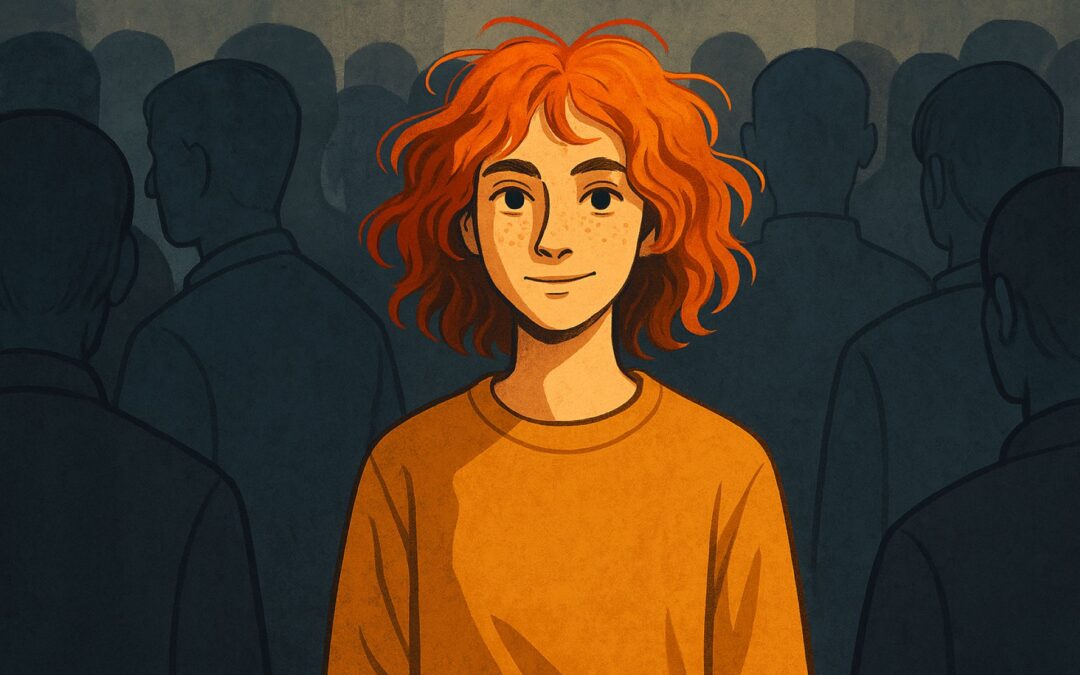
In a world that often celebrates conformity and uniformity, embracing what makes you different can feel like a radical act. Yet, it’s precisely that uniqueness—the quirks, the oddities, and the unconventional ways of thinking—that has the power to drive you toward success and greatness.
“The most courageous act is still to think for yourself.”
— Coco Chanel
Think about the masters who have shaped history: Steve Jobs, Warren Buffett, and Albert Einstein. None of them achieved their level of success by blending in or following the crowd. They thrived because they embraced their weirdness, choosing to stand apart from the norm and chart their own paths.
The key to mastering your own life and work lies in accepting and amplifying what sets you apart. This article explores why leaning into your uniqueness isn’t just a choice—it’s a necessity for creating something remarkable.
Daily Law: Always stick to what makes you weird, odd, strange, different. That’s your source of power.
From Podcast Interview. Curious with Josh Peck . December 4, 2018
The Price of Standing Out
There’s an invisible toll that comes with being different. It’s not paid in money, but in misunderstanding, isolation, and resistance. Society, by design, rewards conformity. It thrives on systems—economic, educational, cultural—that depend on predictability. Anything or anyone that disrupts this equilibrium is treated as a threat. So when you choose to think independently, create unconventionally, or live differently, you’re stepping outside the comfort zone of the collective. And that comes at a cost.
The first price you pay is misunderstanding. People often fear what they can’t categorize. When your ideas don’t fit into existing boxes, others label them as impractical or “too much.” They question your methods, your sanity, even your motives. This is not new. Every original mind has endured it. When the Impressionists first displayed their work, critics dismissed their paintings as unfinished, childish. When Galileo proposed that Earth revolved around the sun, he was condemned as heretical. When Elon Musk began talking about colonizing Mars, he was ridiculed. The pattern repeats through history—rejection first, reverence later.
The second price is isolation. To walk your own path means to leave the well-trodden one. Friends, peers, even family may not understand your drive. You’ll have fewer people to validate your choices. You’ll second-guess yourself. And yet, it’s in this solitude that real originality begins to bloom. The silence allows ideas to form without interference. Innovation doesn’t come from echo chambers—it comes from friction, from standing at the edge of what’s known.
The third price is resistance. Systems defend themselves. Institutions, industries, and traditions all have gatekeepers whose job is to maintain the status quo. When you present something new, you unsettle those who profit from the old. That’s exactly what Robert Greene faced with The 48 Laws of Power. The structure defied convention. The pages were asymmetrical, the sections fragmented, the design intentionally disruptive. His publisher panicked, urging him to make it “look like other books.” But Greene understood that the very strangeness of his approach—the layering of text, the sharp contrast, the moral ambiguity—was what made it alive. He refused to conform.
And because he refused, the book didn’t just succeed; it shifted the culture. Its layout became iconic, its tone unmistakable. The same elements that frightened the publisher became the foundation of Greene’s identity as a writer. His weirdness—once a liability—became a legacy.
That’s the paradox of standing out: the world will first resist your difference, then imitate it. What feels like rejection is often a sign that you’re ahead. But to endure that early friction requires conviction. You must be willing to look foolish in the short term to be unforgettable in the long term. You must trust your instincts when no one else does.
Because being different isn’t free—it’s earned through doubt, defiance, and persistence. It’s the price of standing out. But it’s also the only path that leads to mastery.
The Courage to Be Uncomfortable
The pursuit of originality is not a romantic journey—it is a brutal one. To embrace your difference, you must first accept discomfort as a lifelong companion. The moment you decide to think for yourself, you alienate yourself from the safety of approval. And that’s the hardest part—because human beings are wired to belong. From childhood, we’re conditioned to seek validation: gold stars, grades, promotions, applause. Yet, the moment you choose authenticity over acceptance, you step beyond the boundary of that comfort.
True courage, then, is not about dramatic acts of defiance; it’s about enduring the quiet unease of being misunderstood. It’s about trusting your vision when it looks nothing like anyone else’s. It’s about creating something that even you can’t fully explain yet—but knowing that it feels right. That kind of conviction can’t be taught; it must be lived.
Most people confuse comfort with peace. But comfort is a trap—it seduces you into complacency. It whispers that it’s safer to follow what’s been done before, to imitate success rather than invent it. It rewards predictability and punishes risk. Comfort is conformity disguised as stability. And yet, everything extraordinary—every invention, every revolution, every work of art—was born from someone’s willingness to sit in discomfort.
Look at the lives of the great innovators. Einstein, whose mind refused to accept the limits of Newtonian physics, spent years isolated in thought before his theories were recognized. Van Gogh painted in poverty and obscurity, mocked by critics, ignored by the art world—only to later redefine it. Steve Jobs faced ridicule for caring about design at a time when tech was supposed to be purely functional. Each of them endured ridicule, rejection, and doubt. But they kept going, not because it was easy—but because the discomfort was a sign they were on the right track.
Discomfort, in truth, is a compass. When you feel that tightening in your gut, that friction between what you believe and what the world expects—it means you’re doing something real. You’re not repeating; you’re redefining. You’re breaking patterns that others are too afraid to challenge. And like any great sculptor, you must chip away at what’s false until your truth takes form.
But courage doesn’t mean fearlessness. It means moving forward with fear—creating, speaking, acting even as your voice trembles. It means rejecting the illusion that you must have everything figured out before you begin. The courage to be uncomfortable is the courage to be unfinished, to live in the uncertainty between idea and recognition.
Because every true original walks that lonely stretch of road before others join them. The applause always comes later—if it comes at all. But those who persist through the silence find something more enduring than validation: they find freedom. Freedom from imitation, from external opinion, from the endless chase to be accepted.
To be truly free is to be comfortable being uncomfortable. It’s to wake each day and say, “I would rather be misunderstood for who I am than praised for who I’m not.” That’s the price and the privilege of authenticity.
Your Weirdness Is Your Weapon
What most people call “weird” is often a glimpse of unfiltered authenticity—a raw, unedited version of who you are before the world taught you to conform. It’s the peculiar way your mind connects ideas, the odd fascinations that draw your curiosity, the unconventional rhythms of how you work, think, or create. But because the world idolizes sameness, we’re trained to mute those peculiarities. We sand down our edges so we can fit neatly into systems that reward predictability. Yet, those very edges are where brilliance resides.
We live in a culture that celebrates individuality in theory but punishes it in practice. Schools grade creativity into submission. Workplaces enforce structure over originality. Social media rewards mimicry, not mastery. And yet, every groundbreaking idea, every cultural shift, every innovation has emerged from someone who refused to edit out their strangeness. The lesson is simple but uncomfortable: if you want to be irreplaceable, you must first be incomparable.
Consider Nikola Tesla. His obsessions bordered on madness—he spoke of wireless energy when people barely understood electricity. He visualized entire inventions in his mind, running them like simulations before touching a tool. Society saw him as eccentric, unstable. Yet today, his “weirdness” fuels the modern world—from alternating current to wireless communication. Frida Kahlo, too, painted her pain and her identity in ways considered shocking for her time. Her work was too raw, too personal. But decades later, her unapologetic individuality defines artistic authenticity itself.
Their weirdness was not ornamental—it was instrumental. It wasn’t something they performed; it was something they protected. Because weirdness, when cultivated instead of concealed, becomes your fingerprint. It’s the one thing no one can replicate. You can copy someone’s methods, but you can’t copy their strangeness. That’s what makes it powerful.
But this power is often dormant, buried under layers of social conditioning. Most people suppress their weirdness out of fear—fear of rejection, of ridicule, of being seen as “too much.” They trade originality for acceptance. Yet, in doing so, they abandon their leverage. The paradox is that the more you hide your difference, the more ordinary you become; and the more you expose it, the more extraordinary your life begins to feel.
Your weirdness is not chaos—it’s a pattern only you can see. It’s the private logic of your creativity. Maybe it’s your fascination with obscure history, your obsession with systems, your love of silence, your strange sense of humor, or your preference for solitude. Whatever it is, it’s not random—it’s a clue. Follow it. That’s where your advantage lies.
When you start building around your weirdness instead of hiding it, you attract what aligns with it. The right opportunities, collaborators, and audiences emerge naturally. You stop chasing belonging because you start creating belonging. People are magnetized not by perfection, but by authenticity. They don’t remember what’s flawless—they remember what’s real.
In a world drowning in replicas, your weirdness becomes your signature. It gives your work depth, your presence texture, and your life integrity. Don’t dilute it. Don’t disguise it. Refine it until it becomes art.
Because the truth is this: the most powerful thing you can ever be is unmistakably yourself.
Conclusion
To embrace your weirdness is to reclaim your freedom. It’s to stop seeking validation and start creating from instinct. The world may resist your difference at first—it always does. But over time, what makes you strange becomes what makes you strong.
The masters we admire—artists, scientists, thinkers, entrepreneurs—were all once labeled odd, difficult, or delusional. They simply refused to mute themselves. They turned their peculiarities into philosophies, their eccentricities into innovations, their contradictions into power.
That’s the essence of greatness: not imitation, but individuality. The courage to build from within, to stand alone when no one understands, to keep shaping your vision until it shapes the world.
Because in the end, your weirdness isn’t something to fix. It’s something to follow. It’s not your flaw—it’s your fingerprint.
This article is a part of the Reflections on The Daily Laws Series based on Robert Greene’s book.