
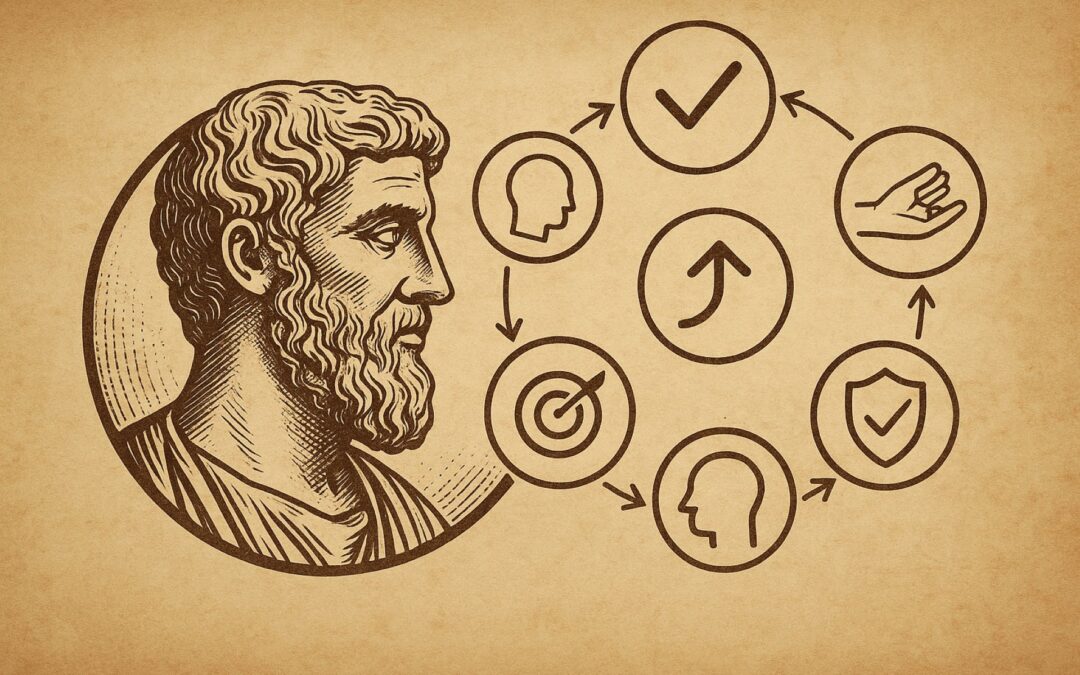
The human mind is both a sanctuary and a battlefield. It can elevate us to wisdom or ensnare us in chaos—all depending on how we use it. The Stoic philosopher Epictetus believed that the mind has a proper function, a natural rhythm that must be honored. It is not meant to chase every impulse or absorb every emotion, but to exercise its distinct powers with precision and purpose.
He defined seven essential operations of the mind: choice, refusal, yearning, repulsion, preparation, purpose, and assent. Each represents a form of discipline, a tool for navigating life’s turbulence with reason rather than reaction. When these functions work in unison, the mind becomes clear, steady, and self-governing. When neglected, it becomes corrupted by confusion, impulse, and illusion.
What follows is not abstract philosophy—it’s a guide to mental sovereignty. A reminder that your peace, strength, and direction depend not on the world outside you, but on the order within.
“The proper work of the mind is the exercise of choice, refusal, yearning, repulsion, preparation, purpose, and assent. What then can pollute and clog the mind’s proper functioning? Nothing but its own corrupt decisions.”
— Epictetus, Discourses, 4.11.6–7
Choice — To Do and Think Right
Everything that defines a person—character, destiny, reputation—flows from one faculty: the power to choose. Every virtue begins with a decision, and every downfall with the neglect of one. The Stoics understood that while we cannot govern what happens to us, we always retain the authority to choose how we respond.
Choice is the hinge upon which moral life turns. It’s not simply about deciding between options, but discerning between what is good and what merely appears good. The world dazzles us with the latter—comfort, pleasure, status, distraction. But the Stoic, guided by reason, learns to look deeper. What aligns with virtue—justice, courage, wisdom, temperance—is the right choice, no matter how inconvenient or unpopular it may be.
To choose rightly, the mind must first be clear. You cannot make sound decisions from a place of chaos. That’s why the Stoic practices mental stillness—to pause before acting, to strip emotion from judgment, to ask: Is this within my principles? Will this make me stronger or weaker? In that pause lies power. It’s what separates instinct from intention.
Think of Marcus Aurelius, the emperor-philosopher, who faced betrayal, plague, and war, yet wrote to himself nightly about choosing virtue over vengeance, patience over passion. His empire was vast, but the only kingdom he sought to rule was his mind.
Each day presents countless crossroads—some grand, most ordinary. Do you speak truth when a lie would be easier? Do you prioritize long-term growth over short-term pleasure? Do you let anger decide your tone or reason your words? The Stoic knows that greatness is not built on rare heroic acts but on the consistent practice of right choice, moment after moment.
Choice, then, is more than freedom—it is responsibility. To choose rightly is to act as a rational being, aware that every decision sculpts the self. Your mind is a craftsman; your choices, the tools; your life, the finished work. The quality of one determines the beauty of the other.
Refusal — Of Temptation
If choice is the mind’s ability to act, refusal is its ability to withhold. The Stoics saw refusal not as denial, but as strength—the power to say no to the impulses that would enslave you. For what good is freedom if you cannot command yourself?
Temptation wears many faces. Some are obvious—greed, lust, pride. Others are disguised—comfort, approval, distraction. The latter are more dangerous because they look harmless, even virtuous. A bit more pleasure, a little more recognition, one more indulgence “for balance.” Slowly, subtly, the line between what serves you and what enslaves you begins to blur.
Refusal restores that line. It is the assertion of sovereignty over desire. When Epictetus said, “No man is free who is not master of himself,” he was describing this exact battle—the daily negotiation between reason and craving.
Refusal is not about rejecting life’s joys; it’s about resisting enslavement to them. The Stoic does not hate pleasure, but refuses to depend on it. He does not reject success, but refuses to lose his soul pursuing it. The discipline lies not in abstinence, but in detachment—enjoying what fate allows without needing it to feel whole.
Temptation does not always announce itself loudly. It can arrive as comfort—a morning snooze instead of rising early, the soft lie of “I’ll do it tomorrow,” the gentle surrender to mediocrity. Each act of refusal in these moments strengthens the will. It sharpens the edge of discipline. Like a muscle, resistance grows stronger with use.
The Stoics practiced deliberate discomfort to build this strength. Seneca slept on hard floors. Cato wore simple garments. These acts were not ascetic theatrics; they were training—the tempering of the soul. If you can refuse luxury when it’s offered, you won’t collapse when it’s taken away.
In the modern world, temptation is omnipresent—algorithmic, personalized, relentless. It lives in the scroll, the impulse buy, the validation loop. Refusal today means reclaiming attention, protecting inner peace, and saying no to anything that trades long-term clarity for short-term stimulation.
Every act of refusal is a declaration: I am not ruled by desire. I am ruled by reason.
And in that moment, the mind stands uncorrupted—untouched by the noise of temptation, anchored in its own command.
Yearning — To Be Better
There is a hunger within every conscious mind—a quiet, persistent ache to rise above mediocrity. This yearning is not about wealth or applause; it’s the internal pull toward growth. The Stoics saw this yearning as the noblest function of the mind, the divine impulse that keeps a person from spiritual decay.
To yearn to be better is to recognize that the self is not static. You are a work in progress—unfinished, evolving, refining with every thought and decision. This yearning isn’t about perfection but progress, about moving one step closer each day to wisdom, integrity, and peace. Marcus Aurelius, the most powerful man in the world, still wrote nightly reminders to himself like a humble student: “Waste no more time arguing what a good man should be. Be one.”
This yearning requires humility—the recognition that no matter how much you know, there’s still more to learn. The arrogant mind believes it has arrived; the Stoic mind knows it is always arriving. Such humility transforms criticism into instruction, failure into feedback, and discomfort into development.
True yearning is inward-facing. It’s not about competing with others, but contending with the person you were yesterday. The external world distracts with comparison—status, possessions, validation—but the Stoic sees those as false measures. Real progress is invisible. It’s in how you manage your temper, how you treat others, how you recover from setbacks.
Yet yearning alone is not enough—it must be disciplined. Many dream of becoming better but never do the work. They admire virtue the way spectators admire athletes: from a distance. The Stoic, however, trains the mind daily. Reading philosophy, reflecting on choices, practicing stillness—these are not hobbies but acts of devotion to self-mastery.
This yearning also carries responsibility. To want to be better is to accept that the world deserves a better version of you. The mind that yearns does not isolate itself in pursuit of private perfection—it seeks to serve, to contribute, to elevate the collective good through its own refinement.
Every day, the Stoic mind wakes with a question: How can I be wiser today? Kinder? Calmer? That is yearning in motion—not a fleeting desire, but a lifelong calling. For the one who stops yearning to improve has already begun to decay.
Repulsion — Of Negativity and Falsehood
If yearning draws the mind toward virtue, repulsion defends it from corruption. It is the mental immune system, the inner sentinel that guards against falsehood, cynicism, and moral decay. For what use is aspiration if the soil of the mind is polluted?
Repulsion is not about avoiding discomfort or dissent—it’s about rejecting what distorts truth and poisons perspective. The Stoics knew that external circumstances cannot harm you, but the wrong thoughts about them can. That’s why they practiced constant vigilance over their perceptions. The moment anger, envy, or bitterness entered, they didn’t entertain it; they expelled it.
To repulse negativity is not to live in denial—it’s to refuse to grant destructive emotions citizenship in your mind. Marcus Aurelius wrote, “The things you think about determine the quality of your mind.” The Stoic guards that quality as a sacred duty. He repels gossip, because it corrupts compassion. He rejects resentment, because it corrodes reason. He distances himself from complainers, flatterers, and fearmongers, because the mind becomes what it consumes.
Falsehood, too, is a subtle toxin. It enters not only through lies but through self-deception—when pride blinds you, when fear distorts your vision, when wishful thinking replaces clear-eyed observation. The Stoic mind practices epoche—the suspension of premature judgment. It asks: Is this true? Or does it merely feel true because I want it to be? Only when a perception passes this test does the mind give its assent.
Repulsion also applies to external influences. The media you absorb, the company you keep, the conversations you engage in—all either nourish or infect your mind. Just as you would guard your body against disease, so too must you guard your psyche against contamination.
But the Stoic’s repulsion is never rooted in hatred—it’s rooted in discipline. They don’t condemn the negative; they simply refuse to host it. This distinction matters. To fight darkness with anger only deepens it. To reject it calmly, without malice, is true strength.
Epictetus taught that your mind is your temple. Repulsion, then, is the act of purification—sweeping out the dust of false beliefs, clearing the air of destructive emotions, keeping the sacred space within you fit for reason and virtue to dwell.
Negativity will always knock. Falsehood will always whisper. The Stoic doesn’t panic; he simply refuses entry. Because clarity cannot coexist with contamination. And the uncorrupted mind—calm, discerning, untouched by deceit—is the only mind capable of wisdom.
Preparation — For What Lies Ahead
The Stoics did not believe in surprise. Not because life isn’t unpredictable—but because the wise expect unpredictability as the rule, not the exception. To them, preparation was not paranoia; it was peace through foresight. It meant training the mind to meet uncertainty with composure, not complaint.
When Epictetus advised students to rehearse adversity in their minds, he wasn’t teaching pessimism—he was teaching resilience through rehearsal. This practice, known as premeditatio malorum (the premeditation of evils), involved envisioning potential misfortunes—loss, rejection, illness, betrayal—and preparing mentally for them. The goal wasn’t to dwell in dread but to rob adversity of its surprise. A prepared mind cannot be ambushed by fate.
Preparation is the Stoic’s armor. Before entering the day, one imagines the insults, the delays, the frustrations that might arise. Marcus Aurelius wrote each morning, “When you wake up, tell yourself: today you will meet the meddling, the ungrateful, the arrogant, the deceitful.” Not to become bitter, but to remain steady when they inevitably appear.
This mental readiness transforms obstacles into training. The prepared mind says: I knew this would come. I’ve met it before—in thought, in reflection, in acceptance. That familiarity grants poise. Instead of reacting emotionally, you respond rationally. You don’t collapse under pressure because you’ve already carried its weight in practice.
But preparation goes beyond anticipating hardship—it extends to cultivating inner strength for when hardship arrives. A Stoic trains like an athlete for life’s unseen battles. He practices restraint, gratitude, patience, and endurance not when it’s easy, but precisely when it’s inconvenient. That is the rehearsal of virtue.
The modern world mistakes preparation for control. People obsess over planning every outcome, believing that perfection in prediction guarantees peace. The Stoic rejects this illusion. True preparation is not controlling what happens—it’s conditioning yourself to remain calm no matter what happens. It’s less about forecasting the storm and more about fortifying the mind that must weather it.
Preparation also includes recognizing that good fortune can be as dangerous as bad. Success can make you complacent, praise can inflate the ego, and comfort can dull vigilance. The Stoic therefore prepares not only for adversity but also for prosperity—training the soul to remain level through both abundance and loss.
When the untrained mind meets chaos, it fractures. The prepared mind bends but does not break. It meets fortune and misfortune with the same inner dialogue: I am ready.
Purpose — Our Guiding Principle
If preparation steadies the mind, purpose directs it. Without a guiding principle, the mind becomes restless—full of motion, but devoid of meaning. Purpose is what gives form to thought, structure to effort, and moral gravity to existence.
The Stoics defined purpose as living “according to nature.” Not in the sense of forests and rivers, but in harmony with your rational, moral nature—your highest self. To act with purpose is to align your will with virtue, to make every choice serve something greater than impulse or ego.
Purpose transforms daily routine into deliberate practice. A Stoic doesn’t wake simply to survive the day; he wakes to fulfill his duty—to himself, to others, to the order of the universe. Marcus Aurelius reminded himself each dawn: “You have work to do—as a human being.” His work was not the empire, but the exercise of justice, wisdom, and restraint.
Purpose begins with clarity. You must know what you stand for before life tests it. Without this, you drift—chasing what’s shiny instead of what’s meaningful. The world will constantly try to hijack your focus with trivial pursuits: money, approval, applause. Purpose filters these distractions. It whispers, Not this. Not yet. Not at the cost of your peace.
But purpose is not rigid—it evolves with understanding. What you serve at twenty may not sustain you at forty. The Stoic therefore revisits his purpose often, refining it as wisdom deepens. This adaptability ensures direction without dogmatism.
Living with purpose also means embracing duty. The Stoic doesn’t see his work as burden but as contribution. Whether leading an army, teaching a child, or sweeping a floor, the value lies not in the task but in the intention behind it. As Epictetus said, “Whatever you do, do it with all your soul.” That is purpose in action—showing up fully, regardless of circumstance.
Purpose also fortifies against despair. When misfortune strikes, the purposeless mind collapses under the question Why me? The purposeful mind answers, Because this too is part of my role. When guided by purpose, suffering is not senseless—it becomes fuel for refinement, proof of endurance, a test of alignment.
Purpose makes the mind immune to distraction and the soul resistant to drift. It allows you to endure monotony, overcome adversity, and sacrifice comfort—because you understand why you’re doing it. Without purpose, effort feels like punishment. With it, every struggle feels sacred.
In the end, purpose is not found—it’s forged. It’s the quiet decision to live intentionally, to turn existence into expression, to ensure that your days—however many or few—are spent not just surviving, but serving.
Assent — To Accept Reality
The mind’s final and most delicate function is assent—the ability to see things as they truly are and to align one’s judgments with reality. In Stoic philosophy, assent is the moment between perception and belief, the space where impressions are either accepted as true or dismissed as false. It is here, in this subtle and often invisible instant, that peace or torment begins.
Epictetus described impressions as messengers—they arrive uninvited, presenting their version of reality. An insult appears, a loss occurs, a desire arises. The impression whispers, This is bad. This is unfair. This is unbearable. But the wise mind does not immediately agree. It pauses. It examines. It asks, Is this really true? Only after scrutiny does it grant assent.
This process of disciplined discernment is the essence of Stoic strength. Most people live in reflex—they accept every impression as fact, confusing emotion for evidence. A delay feels like disaster. A setback feels like failure. A stranger’s judgment feels like truth. But the Stoic learns to suspend immediate agreement, to hold reality in neutral observation until reason has rendered its verdict.
Assent is not the same as passivity. It does not mean submitting helplessly to fate; it means understanding the boundary between control and chaos. When something lies beyond your power—another’s actions, the past, the outcome of chance—the Stoic mind does not resist it, because resistance to what is immovable breeds only misery. Acceptance, on the other hand, transforms suffering into serenity.
To assent rightly is to live without illusion. It is the recognition that nature follows its own order, indifferent to personal preference. The sun rises whether you approve or not. People betray, storms destroy, fortune shifts—and yet life moves, unbothered by your discontent. The Stoic sees this and does not curse the flow of things; he flows with it.
Marcus Aurelius often wrote reminders to himself: “Do not demand that events happen as you wish, but wish them to happen as they do.” This is assent in practice—not resignation, but reconciliation. It is the inner nod that says, Yes, this is the way of things—and I will act within it with reason and grace.
There is a profound freedom in this kind of acceptance. When you stop fighting reality, your energy returns to what you can influence—your thoughts, your effort, your integrity. You no longer exhaust yourself trying to reorder the universe to match your comfort. You adapt, adjust, and remain unshaken.
The untrained mind resists, rages, denies. The trained mind observes, understands, assents. And in that assent lies the Stoic’s calm—the quiet mastery of living in harmony with the truth.
The Mind’s Proper Work
When all seven functions—choice, refusal, yearning, repulsion, preparation, purpose, and assent—operate in harmony, the mind becomes what nature intended: an instrument of reason, a vessel of virtue, and a fortress of peace. Each function serves a distinct role, yet together they form a complete system of self-governance—the architecture of a wise life.
Choice initiates integrity. Refusal guards it. Yearning deepens it. Repulsion protects it. Preparation strengthens it. Purpose directs it. And assent completes it—anchoring the mind in truth. When one function falters, the entire system begins to wobble. To neglect choice is to drift. To abandon refusal is to fall into temptation. To lose yearning is to decay. To ignore repulsion is to invite corruption. To neglect preparation is to collapse under stress. To forget purpose is to lose direction. And to withhold assent from reality is to live in delusion.
Epictetus warned that nothing can truly pollute the mind except its own corrupt decisions. External misfortunes cannot do it; they only reveal whether the inner mechanisms are functioning properly. A clear, disciplined mind can walk through chaos untouched. But when these functions are ignored—when choice gives way to impulse, refusal to indulgence, yearning to apathy, repulsion to cynicism, preparation to panic, purpose to confusion, and assent to denial—the mind becomes its own saboteur.
The Stoic’s task, then, is maintenance—daily inspection and refinement of these seven functions. Just as an athlete trains his body, the philosopher trains his mind. Every situation, from the mundane to the catastrophic, becomes a test of this internal machinery. Did I choose rightly? Did I refuse temptation? Did I yearn for virtue? Did I repel falsehood? Was I prepared? Did I act with purpose? Did I assent to reality?
This is the work of a lifetime: to keep the mind pure, clear, and disciplined. Not sterile, not emotionless, but balanced—capable of feeling without drowning, acting without attachment, striving without desperation.
The untrained seek to control the world. The Stoic seeks to control the self. Because once the mind performs its proper work—making wise choices, refusing corruption, aspiring toward virtue, rejecting vice, anticipating life’s blows, acting with purpose, and accepting reality—then and only then does freedom emerge.
That is the mind’s highest calling: not to conquer the external, but to master the internal. To become an instrument of truth, tuned finely enough to play in harmony with the rhythm of life itself.
Conclusion
The mind, when properly governed, is the only true fortress against chaos. It requires neither walls nor wealth—only awareness, vigilance, and discipline. Through choice, we steer our lives by reason. Through refusal, we guard our integrity. Through yearning, we grow. Through repulsion, we protect our clarity. Through preparation, we build resilience. Through purpose, we find direction. And through assent, we make peace with reality.
This is the Stoic ideal: a mind uncorrupted by illusion, unmoved by impulse, and unbroken by circumstance. A mind that neither denies the world nor submits to it, but meets it on equal terms—calm, lucid, and free.
When the mind performs its proper work, life aligns. The storms still come, but they no longer sink the ship. For a person who has mastered their mind has, in truth, mastered everything.
This article is part of The Daily Stoic Series based on Ryan Holiday’s book.