
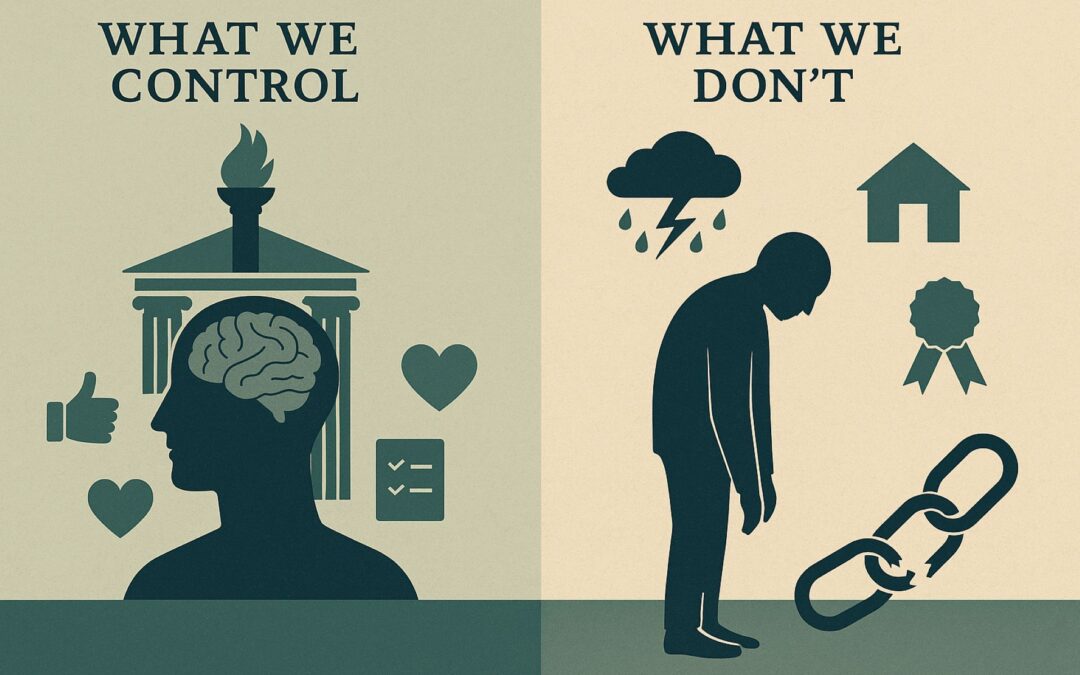
Every day, we wrestle with the same quiet frustration—the world refuses to obey us. Plans fall apart, people disappoint, outcomes defy effort. We tighten our grip, believing that if we just plan better or push harder, we can bend reality to our will. Yet the more we try to control everything, the less peace we have.
The Stoics understood this centuries ago. They saw that most human suffering comes not from what happens, but from our refusal to accept that much of life lies beyond our reach. What matters isn’t the event—it’s the interpretation. You can’t stop the waves, but you can learn to surf them. You can’t dictate fortune, but you can master your response.
This philosophy—clear, uncompromising, liberating—reminds us that freedom doesn’t come from power over the world, but from power over ourselves. The following reflections explore that timeless truth: what we control, and what we don’t.
“Some things are in our control, while others are not. We control our opinion, choice, desire, aversion, and, in a word, everything of our own doing. We don’t control our body, property, reputation, position, and, in a word, everything not of our own doing. Even more, the things in our control are by nature free, unhindered, and unobstructed, while those not in our control are weak, slavish, can be hindered, and are not our own.”
— Epictetus, Enchiridion, 1.1–2
The Boundaries of Control
Every human being, no matter how powerful or privileged, must live within a certain set of limits. You don’t command the weather, the economy, or the opinions of others. You don’t decide whether your body ages or whether someone keeps their promises. And yet, people live as though they could—planning, worrying, and agonizing over variables that never belonged to them in the first place. This is the great paradox of existence: we are obsessed with control, yet control itself is far rarer than we believe.
The Stoics understood this long before the language of psychology or neuroscience existed. They saw that the human experience could be divided cleanly in two—things we control, and things we don’t. That distinction was not meant to be philosophical abstraction; it was survival strategy. Because when you fail to make that separation, you end up fighting battles that can’t be won and neglecting the only arena where victory is possible: your own mind.
Look closely and you’ll see how the confusion plays out. Someone insults you, and you feel wounded—as if their words had the power to define your worth. A promotion goes to someone else, and you feel cheated—as if fairness were something guaranteed by the universe. Your plans fall apart, and you panic—as if certainty were a right rather than a privilege. But in each of these moments, the true source of distress isn’t the event itself—it’s your attachment to how it should have been.
That’s where Stoic wisdom cuts through like a blade. It tells you: you don’t control outcomes; you control orientation. You can’t stop the storm from coming, but you can choose whether to curse it or dance in the rain. You can’t dictate the sequence of life’s events, but you can decide how to interpret their meaning. Between stimulus and response, between cause and consequence, there exists a sacred gap—a pause where freedom lives.
When you learn to dwell in that gap, everything changes. You stop being a puppet of circumstance and start becoming a participant in your own composure. You begin to live intentionally rather than reactively. Anger becomes curiosity. Fear becomes focus. Pain becomes fuel. That’s not denial; it’s discipline. It’s the understanding that while the world may move without your consent, your mind never should.
And here lies the quiet power of the Stoic mindset—it doesn’t promise control over life; it promises control over yourself. And that, in the end, is the only kind that ever lasts.
The Trap of External Control
Modern life is engineered to make you forget what Epictetus taught. From a young age, you’re conditioned to measure your worth in outcomes: grades, followers, salaries, titles, applause. You’re told that if you just work harder, plan smarter, or want it more than others, you can control your destiny. It’s an intoxicating idea—until reality reminds you that no one escapes unpredictability.
You can have the perfect résumé and still lose the job to office politics. You can love someone deeply and still watch them leave. You can save for decades and lose it all in a market crash. The delusion of control shatters the moment life dares to be life. And when it does, you feel betrayed—angry not because something bad happened, but because it wasn’t supposed to.
This is the psychological trap the Stoics warned against: the belief that your peace depends on perfect conditions. When you anchor happiness to externals, you create a life built on sand. Every disappointment shakes your foundations because you’ve tied your stability to forces that shift by the hour. You become emotionally bankrupt, not from lack of fortune, but from your dependence on it.
Epictetus called this dependence “slavery.” Because to be owned by what you can’t command is to forfeit freedom entirely. It’s why he advised detachment not as indifference, but as independence. You can still pursue success, love, wealth, and recognition—but never confuse possession with peace. You can own things, but they should never own you.
Consider how much of your stress is self-inflicted by this illusion. You check your phone for messages you can’t make appear. You replay arguments in your head, wishing the other person had responded differently. You obsess over outcomes, even after you’ve done all you could. This is the mind trying to control what is inherently uncontrollable—a fire consuming itself for warmth.
The remedy is awareness. To pause and ask: Is this within my control or not? If it is, act with all your energy and virtue. If it isn’t, release it instantly and without resentment. That single question—repeated daily—can transform your mental landscape. It turns chaos into clarity, anxiety into acceptance.
The truth is, the more you try to grip the world, the more it slips through your fingers. Control is not found in tightening your hold but in loosening it—learning to meet life with a steady hand instead of a clenched fist. When you stop fighting the current, you discover you were never drowning—you were just resisting the flow.
The Power Within
The Stoics didn’t ask us to retreat from the world—they asked us to reclaim it, from the inside out. For them, the battlefield was never the marketplace or the throne room, but the human mind. Within that small space lies the entire architecture of power. Because no matter what happens externally, the mind is the one domain that remains truly sovereign.
Epictetus, born a slave, understood this better than most. Though his body was owned by another man, his mind was his own. They could chain his legs, but not his will. They could command his labor, but not his opinion. That’s what he meant when he said, “No man is free who is not master of himself.” Freedom, then, isn’t a political state—it’s a psychological one.
When you realize that interpretation is stronger than circumstance, the world becomes less intimidating. Misfortune doesn’t end your peace; it merely invites you to reinterpret what peace means. Failure stops being a verdict and becomes a lesson. Insults lose their sting because you recognize that offense is not given—it’s taken. The moment you stop giving away that power, you stop being at the mercy of others.
But self-mastery doesn’t happen by accident. It’s cultivated through constant vigilance. You must learn to observe your own thoughts with the same precision a sculptor gives to marble—carving away distortion, exaggeration, and self-pity. Every thought is a chisel stroke shaping the person you become. Marcus Aurelius, surrounded by war and betrayal, wrote daily reminders to himself not because he was weak but because he understood that the mind, if left unattended, turns wild.
That is the essence of Stoic power—it’s not about dominance over others but dominion over self. You may never control the external world, but you can always command the narrative inside your head. And once you master that narrative, no event, person, or fortune can dictate your emotional state. You cease to be reactive and become intentional. You stop living by accident and start living by design.
In a world addicted to external validation, this kind of inner strength is rare—and revolutionary. It’s the difference between being driven by noise and being guided by principle. Between chasing control and embodying it. Between existing and living.
The Freedom of Acceptance
To most people, the idea of “acceptance” sounds like resignation—a quiet defeat, a giving up. But the Stoics saw it as the ultimate expression of courage. It takes far more strength to look at life as it is than to waste energy wishing it were different. Acceptance, in its purest form, is not weakness—it is wisdom refined through humility.
The Stoics believed that everything in life has two components: what happens and how you perceive what happens. The first is fate; the second is freedom. When you resist the first, you suffer twice—once from the event itself, and once from your refusal to accept it. When you accept it, you reclaim your energy to focus on what’s next, rather than what’s lost.
Imagine a sailor cursing the direction of the wind. The wind doesn’t change. The sailor can either exhaust himself in fury or learn to adjust his sails. The difference is not in circumstance but in mindset. Acceptance is the act of setting those sails—not because you like the direction, but because you understand it’s the only way to move forward.
This kind of acceptance doesn’t mean indifference to injustice or passivity in the face of difficulty. It means recognizing what part of the situation belongs to you and what part belongs to the universe. You still act, still strive, still push forward—but without the arrogance of believing you control the tide. You play your role fully, then surrender the outcome.
And in that surrender, something profound happens—you find peace. The kind of peace that doesn’t depend on success, comfort, or external validation. The peace of someone who has nothing to prove, nothing to chase, and nothing to fear. Acceptance is not the end of ambition; it’s the beginning of serenity.
To accept reality is to stop fighting the inevitable and start flowing with it. The Stoics didn’t teach passive compliance—they taught active cooperation with the laws of life. Because when you align with the nature of things, you no longer waste your will on resistance. You become like water—adaptive, enduring, unstoppable.
The Discipline of Inner Work
The hardest and most essential work a human can undertake is the mastery of their own mind. Everything else—wealth, power, success—is secondary to that inner discipline. Without it, the richest person can be miserable, and the most talented can be undone by emotion. The Stoics knew that the mind is not a fixed state but a muscle—it must be trained daily, with intention and endurance.
Inner work begins with awareness. Awareness of your triggers, your patterns, your reactions. It’s not glamorous or easy. It means catching yourself in moments of irritation and choosing calm instead. It means noticing when you’re judging others and turning that gaze inward. It means taking responsibility for the stories you tell yourself—the ones that inflate your fears or feed your pride.
Seneca wrote that “we suffer more often in imagination than in reality.” Most of what torments us exists only in our heads—what might happen, what others might think, what we might lose. Inner discipline dismantles that false theater. It separates fact from fiction, sensation from story. You stop being a prisoner of hypothetical suffering and return to the present moment, where control actually exists.
This is not an overnight transformation but a lifelong apprenticeship to the self. Every setback becomes a test, every annoyance a classroom, every moment an opportunity to refine your character. Did someone insult you? There’s your lesson in restraint. Did a plan collapse? There’s your lesson in adaptability. Did you fail? There’s your lesson in humility. Life keeps teaching until you stop reacting and start learning.
Over time, this discipline turns inward mastery into outward grace. You become less disturbed by change, less consumed by fear, less addicted to control. You begin to live with a quiet steadiness that others can feel. The storms don’t stop—but you stop being moved by them.
This is the Stoic ideal—not a person without feeling, but a person without fragility. Someone whose composure comes not from ignorance of life’s chaos, but from understanding it completely. When you master your inner world, you stop being a product of the outer one. And that, in the end, is what true control looks like—not the power to move the world, but the power to remain unmoved by it.
Conclusion
The difference between peace and chaos is not found in circumstance—it’s found in perspective. The Stoics never promised a calm life; they promised a calm mind. When you understand the boundaries of control, frustration turns into focus, and resistance turns into resilience.
You stop trying to control people, outcomes, or reputation, and start mastering your thoughts, choices, and actions. You realize that the only true possession you’ll ever have is your own judgment. The rest—fortune, praise, time itself—is on loan from the universe.
So, when the day begins to unravel, remember this: you don’t control the world, but you do control the meaning you give to it. And in that meaning lies your freedom, your strength, and your peace.
This article is part of The Daily Stoic Series based on Ryan Holiday’s book.