
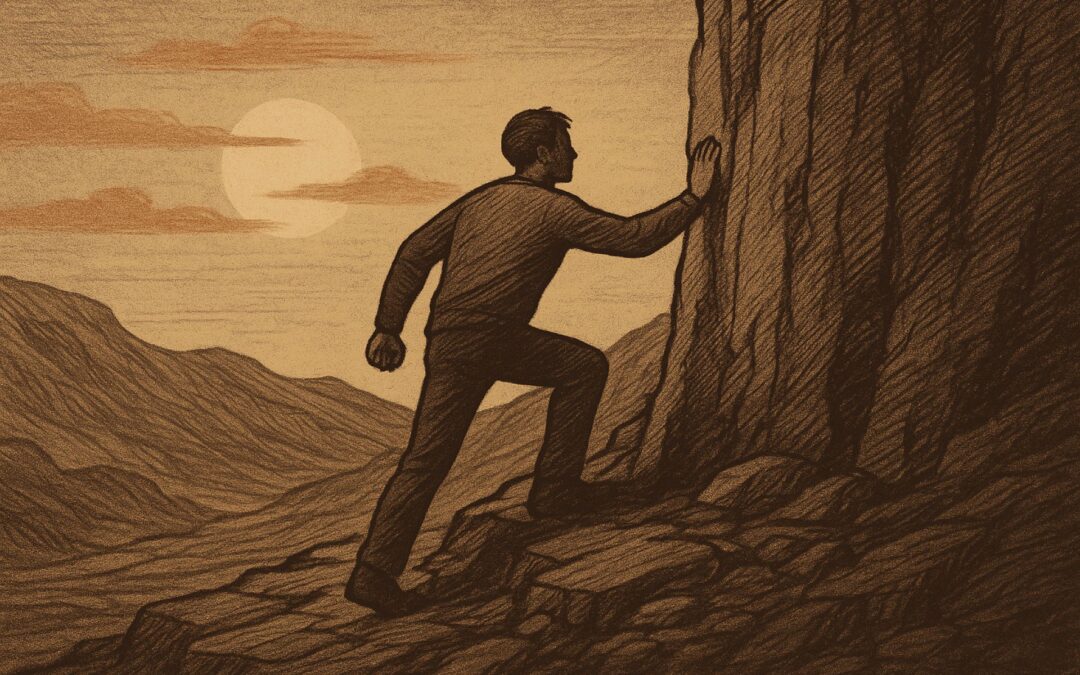
Every great life begins with friction. Not inspiration, not confidence—friction. The moment when the world seems to push back, when nothing comes easily, when your very being feels misaligned with what others call “normal.” Most people spend their lives trying to escape that discomfort, searching for smoother paths, easier roles, clearer answers. But what if the struggle itself was the signal? What if the obstacle wasn’t the thing blocking the way, but the way itself?
Life doesn’t hand everyone an early calling. For some, the first gift it offers is limitation. That constraint—if faced honestly—becomes the seed of transformation. Because it’s only when we collide with difficulty that we’re forced to look deeper, to invent, to become original. The story of Temple Grandin, who turned a diagnosis once seen as a sentence into a life of purpose, stands as proof that our greatest breakthroughs often come disguised as barriers.
Daily Law: Confront one of your limitations—one of the obstructions in your path—today. Break beyond it, climb over it, think your way around it. Don’t run from it. It was created for you.
— Mastery, I: Discover Your Calling — The Life’s Task
The Discovery of Limits
Some people arrive in life seemingly preloaded with direction. They take to things effortlessly—the piano keys obey, equations unfold with ease, social interactions glide. For them, talent feels like gravity: invisible, natural, and constant. But others step into the same world and feel disoriented. What comes naturally to everyone else feels like deciphering a language without an alphabet. They watch, they imitate, they try, and yet something always feels slightly offbeat.
Their first discovery of “self” is not through ability but through inability. They realize they don’t fit neatly into the molds the world provides. The classroom that rewards speed punishes their slowness. The playground that values coordination exposes their clumsiness. The conversations that depend on unspoken social rhythm leave them stranded in silence. And so, early on, they internalize the message that something about them is broken.
In a society that equates ease with intelligence and difficulty with deficiency, this realization can be devastating. The subtle humiliations pile up—poor grades, pitying glances, whispered comparisons. Adults tell them to “try harder,” peers mock what they don’t understand, and slowly a narrative takes root: I am behind. I am not enough. It’s a cruel trick of perception, because difficulty often conceals depth. Those who learn easily rarely need to explore. Those who struggle are forced to look longer, question harder, and build their own methods of comprehension.
The person who doesn’t find answers ready-made must invent them. And invention, though born of frustration, becomes the seed of mastery. Obstacles sharpen attention. They teach persistence. They make observation a habit, not a choice. While others rely on instinct, the struggler develops awareness. They begin to notice patterns—how people respond, how systems fail, how the world moves.
Ironically, the pain of not fitting in becomes the portal to uniqueness. The child who can’t memorize learns to visualize. The one who can’t compete physically cultivates strategy. The person who can’t find belonging learns to build it. Their weakness becomes their workshop.
In this light, limitation is not a curse—it’s a hidden apprenticeship. It forces you to craft an unconventional relationship with the world. It pushes you toward depth, originality, and empathy. And though you might not recognize it at the time, those early bruises are training you for something extraordinary: the ability to create from constraint.
The Story of Temple Grandin
Few lives illustrate this alchemy better than that of Temple Grandin. Born in 1947, she entered a world profoundly unprepared to understand minds like hers. By the age of three, her parents sensed something unusual. She spoke little, recoiled from touch, and reacted intensely to sounds and textures others barely noticed. A doctor diagnosed her with autism—then a misunderstood condition—and advised institutionalization. It was the polite term for lifelong abandonment.
But her mother refused to accept that verdict. She believed her daughter’s silence hid intelligence, not absence. Through early intervention with speech therapists and unyielding patience, Temple began to form words. Progress was slow and halting, but it was progress nonetheless. She was eventually able to attend regular school, though she often felt alien among her peers—confused by sarcasm, baffled by unwritten social codes, and isolated by her difference.
Yet that difference carried within it a distinct kind of perception. Temple saw patterns where others saw noise. She processed the world through images—vivid, spatial, cinematic. Her mind operated like a camera, storing every angle, every detail, every motion. What others dismissed as distraction was, in her case, an instrument of precision.
Animals, in particular, drew her focus. They made sense to her in a way humans didn’t. Their reactions were honest, their emotions unmasked. She noticed how cattle balked at shadows, how they responded to light, sound, and movement. Where others saw brute creatures, she saw sensitivity. This fascination deepened into purpose.
Temple studied animal behavior, earning degrees in psychology and animal science. Her autism, once seen as a handicap, became her gateway to empathy—an empathy of design rather than sentiment. She revolutionized livestock handling by creating systems that mimicked the calm, circular patterns animals naturally follow. Her innovations not only reduced stress in millions of animals but reshaped the ethics and efficiency of an entire industry.
But Temple’s impact extended beyond agriculture. Through her books and lectures, she offered an insider’s account of autism—explaining what it feels like from the inside. Her ability to translate the autistic experience into comprehensible language has given hope to countless families and redefined the conversation around neurodiversity.
What once looked like a lifetime sentence of limitation became her signature strength. Her mind, unconventional and unfiltered, allowed her to see what others couldn’t. She didn’t triumph by erasing her difference; she triumphed by harnessing it.
Temple Grandin’s story dismantles the illusion that genius always wears a familiar face. It reminds us that the very traits that alienate us may be the keys to our highest contribution. That what seems like obstruction from one angle is often the doorway to originality from another.
Her life stands as a testament to one eternal truth: your obstacle is not the end of your path—it is the path.
The Hidden Power of Confronting Obstacles
Every person, at some point, collides with resistance—the moment when progress halts and the path ahead seems impassable. The instinctive reaction is retreat. We call the problem unfair, blame circumstance, or look for shortcuts. But this impulse, though natural, robs us of the very energy that obstacles are designed to awaken. Resistance is not punishment. It is provocation.
The act of confronting difficulty forces a transformation. It engages parts of the mind that comfort never touches—ingenuity, patience, courage, adaptability. When life denies you ease, it’s inviting you to create alternatives. This is the essence of human progress: every advancement, every invention, every masterpiece emerged because someone met an obstruction and refused to bow.
Temple Grandin is a vivid embodiment of this principle. She didn’t cure her autism or outrun it—she conversed with it. She learned to use its structure to decode the behavior of animals, to visualize mechanisms others could only describe abstractly. Her struggle refined her attention. Her difference trained her perception. In the process, her supposed weakness became her working instrument.
This is what happens when you turn toward an obstacle instead of away from it. You begin to see that limits have structure. They are not brick walls but complex puzzles. When you investigate them—when you observe, analyze, and experiment—you often discover hidden routes. What looked like restriction becomes a channel for invention.
History is filled with people who transformed hardship into design. Ludwig van Beethoven composed his greatest works after losing his hearing; his silence forced him inward, where music became architecture. Frida Kahlo’s chronic pain birthed a visual language of suffering and defiance. Stephen Hawking’s paralysis sharpened his intellect into one of the most powerful scientific instruments in history. They didn’t conquer their obstacles in the literal sense—they absorbed them. Their challenges became part of their creative ecosystem.
Confronting an obstacle also changes your relationship with fear. Fear thrives on avoidance. The more you flee from discomfort, the larger it grows in imagination. But when you face it—when you touch the edge of what terrifies you—it often dissolves into clarity. You realize the wall was mostly shadow, not substance. Every step forward through resistance reduces the grip of anxiety and increases your tolerance for uncertainty.
Obstacles are not interruptions to your path. They are the path. They hold the raw material for resilience and originality. They strip away illusion and leave behind only what’s essential: your capacity to adapt, to persist, to create under constraint. To those who run, obstacles appear cruel. To those who stay, they reveal themselves as catalysts for mastery.
The Invitation to Overcome
Every life contains a unique configuration of tests. They arrive disguised as frustrations, limitations, and delays. The Stoics believed these are not random misfortunes, but deliberate opportunities—tailored precisely to one’s temperament and potential. Your obstacle is custom-made. It exists to bring forth qualities that comfort never could.
To overcome does not always mean to defeat. Sometimes it means to collaborate, to reimagine the challenge as a partner in your development. If the mountain cannot be climbed, perhaps it can be tunneled through. If the door remains locked, perhaps a window can be fashioned. There’s always another angle, another rhythm, another strategy. The obstacle invites not only persistence but also imagination.
Each difficulty, if examined, contains its own set of instructions. Financial struggle might teach resourcefulness. Rejection might sharpen your sense of worth. Loneliness might reveal where your self-respect begins. Failure, when dissected honestly, maps the anatomy of success. These experiences are not detours—they are refinements.
The invitation is to engage fully. To look directly at the limitation that defines your discomfort and ask: what is it trying to build in me? Discipline? Humility? Empathy? Courage? The answer, when it arrives, will change the way you move through life. Because once you understand that the obstacle is not against you but for you, resistance loses its sting.
Temple Grandin’s story illustrates this with striking clarity. The world tried to tell her she didn’t belong, that her differences were liabilities. But she chose to see those differences as design features. Instead of seeking normalcy, she sought usefulness. She turned inward, studied her nature, and used it as a compass. That is the essence of overcoming—not erasing your constraint, but mastering it until it becomes indistinguishable from strength.
Each day offers a new test, often disguised as inconvenience. A delay, a rejection, a mistake—all tiny opportunities to rehearse greatness. The question is not why these obstacles appear, but what will you do with them? Will you flee into complaint, or forge something from the resistance?
As the Daily Law reminds us:
“Confront one of your limitations—one of the obstructions in your path—today. Break beyond it, climb over it, think your way around it. Don’t run from it. It was created for you.”
There’s a strange beauty in realizing that the universe conspires to strengthen you. Every setback, every difficulty, every unanswered question is a deliberate shaping force. If you engage with it, patiently and creatively, it transforms you from victim to vessel—from one who suffers the world to one who shapes it.
The obstacle does not merely test who you are—it teaches you who you could become.
Conclusion
Every person carries a private burden—an obstacle that seems uniquely unfair. Yet, hidden within that struggle is a quiet instruction: this is the way forward. The barrier is not random; it’s tailored to draw out the qualities you most need—strength, patience, perspective, creativity. When you meet resistance, the goal is not to erase it or curse it, but to engage with it fully, to learn from its architecture until it reshapes you.
Temple Grandin didn’t overcome her autism by pretending it didn’t exist. She built a bridge through it. Likewise, our limitations are not detours—they are invitations. They ask us to think, adapt, and expand until what once felt impossible becomes inevitable.
So the next time you meet an obstruction, don’t shrink. Don’t retreat. Approach it like an old teacher, one that speaks in riddles and silence. Because if you stay with it long enough, you’ll find the truth every master eventually learns: the obstacle isn’t in the way. The obstacle is the way.
This article is a part of The Daily Laws Series based on Robert Greene’s book.