
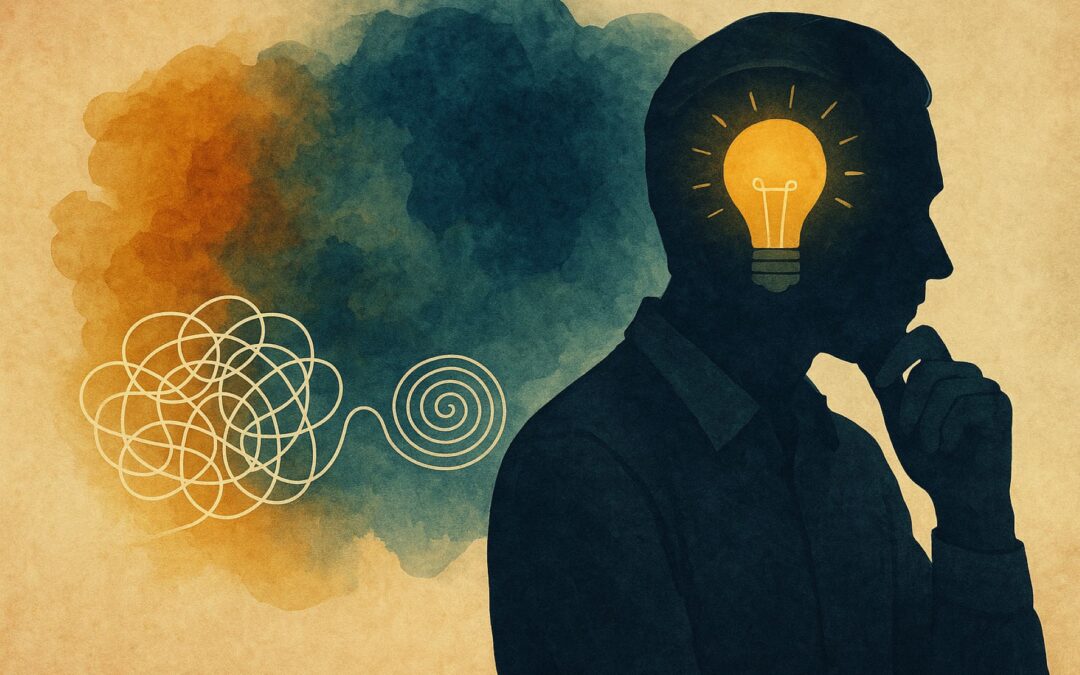
We tend to romanticize creativity—as if it’s a lightning strike of genius reserved for a chosen few. We picture the artist seized by inspiration, the inventor struck by sudden insight, the writer possessed by a mysterious muse. Yet this image is a distortion. True creativity isn’t magic; it’s metamorphosis. It doesn’t emerge from flashes of brilliance but from the steady, unseen labor of the whole self—mind, heart, and will working in concert.
Creativity is not an intellectual game played in isolation. It’s the full expression of your being engaging with the world. It demands patience when inspiration fades, faith when results don’t appear, and emotional alignment with the problems you choose to solve. It is not about novelty for its own sake, but about connection—between your ideas and your essence, between your effort and the larger human story.
What follows is an exploration of creativity stripped of its glamour and revealed in its true light: a discipline of devotion, endurance, and alignment—a process that transforms not just what you make, but who you become.
Daily Law: Work at what connects to you emotionally and ideas will come to you.
— Mastery, V: Awaken the Dimensional Mind—The Creative-Active
Creativity Is Not Merely Intellectual
To understand creativity as something purely intellectual is to misunderstand its essence entirely. The intellect is precise, analytical, and structured—but creativity is fluid, dynamic, and deeply human. It does not reside only in the mind; it courses through the veins of your entire being. The most transformative ideas in history have not been born out of sterile analysis, but from a collision of emotion, intuition, and reason.
The creative process is not simply a matter of thinking harder or smarter—it’s about feeling deeper. A scientist does not make a discovery by logic alone; they feel their way through uncertainty, guided by instinct as much as intellect. The painter who finds the right stroke, the composer who hears a melody before the first note, or the entrepreneur who senses a need no one else has noticed—all rely on a form of intelligence that transcends the rational.
This is why the most creative individuals often seem irrational or restless to others. They are not bound by pure reasoning; they are moved by something visceral—a pulse that tells them when something feels right, even when they can’t yet explain why. The mind then follows, organizing this raw energy into form. The intellect becomes the sculptor, but emotion provides the clay.
Creativity, then, is not a single act of the brain but a harmony of forces within the self. The intellect refines, but emotion initiates. Energy sustains, and character directs. You cannot separate these components without destroying the whole. The person who tries to think their way to originality without emotional investment produces only imitation. Conversely, the person who feels deeply but never shapes those feelings into thought remains perpetually unfinished.
True creativity lives in the tension between logic and longing. It asks you to think with your heart and feel with your mind—to merge clarity with chaos. Only when the two work together can something truly new emerge.
The Hidden Cost of Creation
The world worships the moment of triumph—the unveiling of a masterpiece, the birth of an invention, the breakthrough that changes everything. But what the world rarely sees is the labyrinth of struggle that precedes it. Creativity demands payment in time, energy, and often suffering. It is not a gift handed down by inspiration—it is a debt repaid through persistence.
Behind every “stroke of genius” lies an unromantic truth: countless failed attempts, long hours of isolation, and an ongoing battle with self-doubt. The creative journey is littered with abandoned projects and invisible labor. Each failure feels personal because creation is personal—it carries the weight of your identity, your hopes, and your fear of insignificance.
This is the part that breaks most people. They imagine that if they were truly talented, the process would feel easier, smoother, more natural. But the opposite is true. The more original your pursuit, the harder the struggle. You are forging a path through unmapped territory, without guarantee of arrival. The creative life is not about comfort—it is about endurance.
The great creators endure because they have learned to love the process, not the applause. They understand that progress is invisible until it isn’t. The painter who spends a week mixing colors before a single stroke, the scientist who tests a thousand hypotheses to find one that holds, the writer who rewrites a paragraph twenty times—each is paying the necessary price of excellence.
Failure, in this world, is not a verdict—it is a rehearsal. Each attempt reveals something about your craft, your limits, and your own mind. Every wrong note teaches you how to hear the right one. Every rejection forces refinement. What looks like stagnation is often quiet evolution.
Those who cannot bear the cost, who seek shortcuts or external validation, remain trapped in imitation. But those who persevere through the grind—who accept the hidden cost as sacred—find that their failures begin to compound in their favor. Over time, frustration becomes intuition. Struggle becomes style.
The path to mastery, then, is paved not with brilliance but with resilience. The creator’s reward is not immediate success, but transformation—an internal strengthening that allows them to keep going long after lesser wills have broken. Only through that long apprenticeship in failure does the creative act reveal its true form: not an explosion of inspiration, but the quiet triumph of perseverance.
The Role of Patience and Faith
Patience and faith are not merely virtues in creative work—they are the lifeblood that keeps it alive through long winters of doubt. The process of creation rarely moves in a straight line. There are seasons when ideas pour out effortlessly, and others when the mind feels barren, every effort collapsing into frustration. The immature creator interprets this barrenness as failure and abandons the pursuit. The mature one understands it differently: the field must lie fallow before it can bloom again.
Patience is not passive endurance—it is disciplined waiting. It’s the art of remaining steady while your efforts appear fruitless. It’s continuing to show up to your work when every part of you wants to quit. This form of patience has nothing to do with sluggishness; it’s an active trust in time. You begin to see that creation follows its own tempo, its own mysterious logic, and that forcing progress too soon can strangle what is still taking shape beneath the surface.
Faith, meanwhile, is the inner conviction that what you are doing matters—even when you have no proof. It’s the quiet voice that whispers keep going when silence surrounds you. Every creator must face the long night of obscurity, when no one cares, no one understands, and the only validation comes from within. Those who endure that night emerge transformed. Their faith becomes a weapon against despair, a reminder that meaning often reveals itself only after the struggle.
This is why patience and faith are not abstract spiritual ideals—they are practical tools. They shield you from premature judgment, from the temptation to abandon your calling for quicker rewards. They remind you that creative breakthroughs are accumulative: built one attempt, one failure, one insight at a time. Greatness is rarely visible in the moment—it’s only recognized in retrospect.
The most powerful works in history—Beethoven’s symphonies, Van Gogh’s paintings, Darwin’s theories—were born of long isolation and relentless perseverance. Their creators endured ridicule, obscurity, and immense self-doubt, yet they kept their faith intact. They understood that genius doesn’t unfold on demand; it unfolds on time. And that time rewards those who stay.
Choosing the Right Problem
Even the most brilliant mind will falter if its energy is misdirected. Creativity is not just about generating ideas—it’s about aiming them toward the right pursuit. Many people fail not because they lack intelligence, but because they commit to problems that don’t resonate with their deeper instincts. They follow trends, external expectations, or prestige, mistaking visibility for value. The result is burnout—a slow depletion of energy that ends in cynicism or indifference.
The right problem, on the other hand, electrifies you. It keeps you awake at night, not out of anxiety, but fascination. You can’t stop thinking about it. You return to it instinctively, even after failure. This is not coincidence—it’s alignment. When your curiosity and your craft converge, your energy becomes inexhaustible.
To find that alignment, you must first listen—to yourself, to your inner signals, to the quiet magnetism that draws your attention again and again to certain ideas or themes. These are clues to your life’s task, the deep pattern that shapes your creative destiny. Ignore them, and you may spend years perfecting something that leaves you empty. Follow them, and even the hardest labor will feel meaningful.
Choosing the right problem also requires courage, because the problems that truly matter are rarely fashionable. They may not promise quick success or recognition. They may seem too big, too obscure, too uncertain. But they are the ones that connect to your essence—the problems that make you feel alive in their pursuit. The greatest inventors, artists, and thinkers were rarely following the market; they were following obsession.
Think of Einstein refusing to chase academic prestige while obsessing over the nature of light. Or Jane Austen writing novels about domestic life in an era that valued male adventure. Their genius was not simply intellectual—it was directional. They pointed their gifts toward something deeply personal, and in doing so, struck something universal.
When you choose the wrong problem, your mind may sparkle, but your heart won’t follow. And without emotional involvement, the creative fire cannot sustain itself. But when you find the right pursuit—the one that challenges, absorbs, and excites you—your work gains momentum. You stop needing external motivation because the work itself becomes the reward.
The Union of Emotion and Idea
Every great creation is an act of synthesis—a merging of emotion and intellect into something neither could produce alone. Emotion gives warmth; intellect gives form. One without the other leads to imbalance: pure intellect becomes mechanical, and pure emotion becomes chaotic. Creativity reaches its highest power when both forces move in harmony, like two wings of the same bird.
Emotion is what gives creation its pulse. It’s what turns a sequence of words into poetry, a sketch into art, a theory into a vision. When you pour authentic emotion into your work, you create resonance. People may not understand your logic, but they will feel your sincerity. That feeling becomes the bridge between your inner world and theirs. It transforms your creation from a private act into a shared experience.
But emotion alone is not enough. Without the discipline of intellect, emotion burns too hot—it loses clarity, form, and direction. Intellect acts as the cooling structure that allows passion to endure. It refines the raw emotion, giving it coherence and shape. The sculptor who feels the marble’s life must still master the chisel; the writer who burns with inspiration must still wrestle with syntax.
In this way, creativity becomes a dialogue between fire and architecture. Emotion supplies the spark, intellect builds the vessel to contain it. The best works—whether a symphony, a startup, or a speech—are not spontaneous eruptions of feeling but carefully distilled expressions of it.
This union also transforms the creator. It integrates two aspects of being that the modern world often keeps separate: the thinker and the feeler, the rational and the intuitive. When they unite, you become not just more creative, but more complete. You begin to see patterns others miss, because you are operating from both head and heart.
The result is work that transcends mere cleverness. It becomes alive—capable of moving, inspiring, and enduring. This is why the most powerful creations are never coldly calculated or purely emotional; they are felt ideas. They carry within them the balance of mind and soul, reason and rhythm.
When you create from that place, you stop chasing originality—it emerges naturally. You are no longer trying to impress; you are trying to express. And that, ultimately, is what gives creativity its timeless power: it allows one human spirit to speak to another, across time, through the language of feeling shaped by thought.
Conclusion
The myth of creativity has always been that it’s a matter of intellect or inspiration—that some people are simply born with it while others must watch from the sidelines. The truth is far more profound and far more empowering. Creativity belongs to anyone willing to bring their entire self into their work—to think deeply, feel intensely, and persevere faithfully.
The mind may guide, but it is the heart that fuels. The process may frustrate, but it is the struggle that refines. To create is to enter into partnership with uncertainty, to labor not for applause but for truth, and to let your emotions give shape to your intelligence.
When creativity ceases to be about cleverness and becomes an act of wholeness, something extraordinary happens: your work begins to carry a pulse of life, something unmistakably yours. And in that moment, you stop merely producing—you begin to participate in creation itself.
This article is a part of The Daily Laws Series based on Robert Greene’s book.