
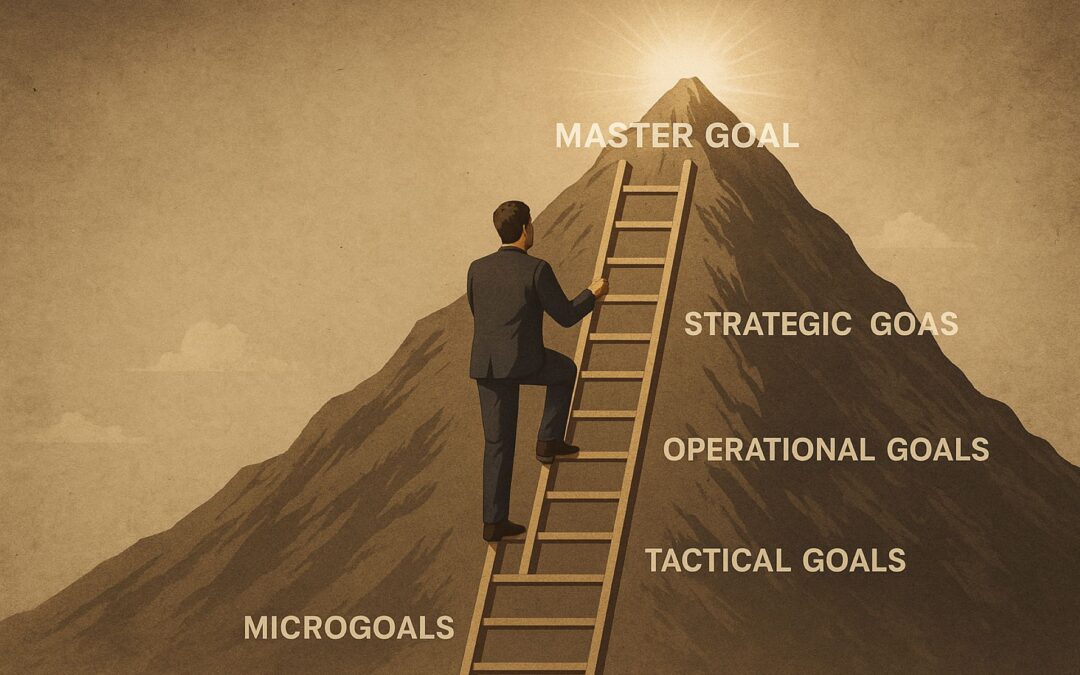
Every grand achievement begins with a single spark—a vision of what life could become. But between the spark and the summit lies a vast, intimidating distance. Most people never cross it. They dream vividly yet move vaguely, lost between desire and direction. The mind, overwhelmed by the sheer scale of the goal, either freezes or drifts toward distractions that feel productive but lead nowhere.
The secret isn’t to think smaller—it’s to think structurally. True progress demands more than inspiration; it requires architecture. You need a ladder—one built of descending goals, each step translating your ambition into action. It’s how great thinkers, artists, and builders have always worked: not by conquering mountains in a single bound, but by constructing the means to climb them, one rung at a time.
The following is a framework for doing precisely that—transforming the grand into the graspable, and the impossible into the inevitable.
Daily Law: Remember that what you are after is a series of practical results and accomplishments, not a list of unrealized dreams and aborted projects. Working with smaller, embedded goals will keep you moving in such a direction.
— The Laws of Human Nature, 13: Advance with a Sense of Purpose — The Law of Aimlessness
The Power of Long-Term Vision
Every meaningful life requires an anchor—something vast enough to challenge you and significant enough to sustain you. That anchor is your long-term vision. It’s more than a dream; it’s a blueprint for becoming. It gives form to your ambition, direction to your energy, and coherence to your choices. Without it, you move reactively—responding to circumstances rather than shaping them. Days pass in motion but not in progress.
A long-term goal operates like a distant lighthouse—it doesn’t move, but it guides. It reminds you that there’s a horizon worth reaching, even when the waters get rough. It might be to build a thriving company, achieve financial independence, write a book that outlives you, or master an art form so deeply that it becomes your second nature. Whatever form it takes, it must carry emotional gravity—it should stir something deep within you.
Yet this very magnitude is what breeds tension. When you think about the years required, the obstacles ahead, and the gap between your present self and the future ideal, anxiety takes root. The mind starts spinning with doubts: What if I fail? What if I’m not capable? What if it’s already too late? This is the natural friction between vision and reality. Most people interpret this friction as a signal to stop. In truth, it’s proof that the goal is worthy—it’s supposed to feel impossible at first.
But without a structure to contain it, even the most noble vision becomes a burden. The weight of “everything that must be done” can crush momentum before it begins. You lose days to planning, overthinking, and measuring yourself against an imagined perfection. The result isn’t progress—it’s paralysis disguised as preparation.
That’s why vision alone is not enough. It must be supported by a design—a system that converts imagination into motion. The great builders, artists, and innovators of history didn’t merely dream; they engineered their dreams into steps. They knew that without a framework, a long-term vision decays into fantasy. The first element of that framework is the ladder.
The Ladder Principle
The ladder of descending goals is the antidote to overwhelm. It translates grandeur into granularity—taking a distant summit and breaking it into reachable stages. It allows you to start not from where the dream ends, but from where you stand.
Picture the ladder as a vertical hierarchy of intention. At the very top rests your master goal—your overarching purpose. It’s broad and inspirational, like building a business that changes lives, mastering a craft, or reaching financial freedom. This is your “why.” It doesn’t change easily because it represents the long arc of your life’s work.
The rungs below this are your strategic goals. These define the major phases or achievements that will bring your vision closer to reality. For example, if your master goal is to become a bestselling author, a strategic goal might be to complete your first manuscript or secure a publishing deal. If your long-term goal is to grow a company, a strategic goal might be to reach your first hundred customers or achieve product-market fit. These are medium-term in nature—spanning months or years.
Descending further, we encounter the tactical layer. This is where the abstract becomes practical. Tactical goals define the “how.” They’re action-driven—researching your target market, developing a prototype, refining your pitch, or writing every morning before work. These are often measurable and time-bound, designed to transform vision into movement.
Then come the operational goals—weekly or monthly milestones that quantify progress. These are checkpoints, not destinations. They provide feedback, letting you see what’s working and what’s not. They keep the journey alive by translating effort into visible progress.
At the very base of the ladder lie your microgoals. These are the smallest, most immediate steps—so manageable that failure becomes almost impossible. Making one phone call. Writing one page. Saving one percent more this month. These are the sparks that keep the fire burning.
Each rung has a dual purpose—it pulls you upward while anchoring you downward. You’re constantly reminded of where you’re going, but never paralyzed by how far you have left. This structure converts chaos into clarity. It gives your ambition a rhythm: big-picture dreaming followed by small, deliberate action.
When designed properly, this ladder becomes self-reinforcing. Every completed step generates momentum, and momentum, in turn, reinforces belief. That belief fuels even greater consistency, which produces results that spiral upward. You no longer rely on motivation—you rely on movement.
The genius of the ladder lies in its simplicity: you’re never working on the whole dream at once, only on the next rung within reach.
The Psychology of Microgoals
If the ladder provides the structure, microgoals provide the heartbeat. They are the smallest units of progress—the atomic habits that, compounded over time, produce extraordinary transformation.
The human brain is reward-oriented. It’s not built to thrive on delayed gratification alone. If you constantly chase a distant reward, motivation fades under the weight of waiting. Microgoals solve this by creating immediate wins. They allow your mind to experience closure and accomplishment daily, even while working toward something that might take years.
Neuroscience supports this. Each time you complete a task, however small, your brain releases dopamine—a neurotransmitter that reinforces behavior and drives repetition. That’s why checking off a to-do list feels satisfying. Microgoals weaponize this biological mechanism, turning progress into an addictive loop. Instead of needing willpower, you develop momentum through chemistry.
But the power of microgoals isn’t just neurological—it’s psychological. Large goals create abstraction; microgoals create tangibility. “Write a book” is abstract. “Write 300 words today” is concrete. “Start a business” is vague. “Validate one idea this week” is actionable. Tangibility creates confidence. You stop daydreaming about results and start executing processes.
Microgoals also strip away excuses. You can’t rationalize not doing something that takes ten minutes. They make consistency attainable for everyone, regardless of mood, time, or circumstance. You don’t need to feel inspired to take one small action—you just need to move.
And there’s another hidden virtue: microgoals create momentum through visible progress. Humans thrive on forward motion; it builds self-trust. Each completed microgoal whispers, I can do this. Each day of progress, no matter how small, is a deposit into your reservoir of discipline. Over time, these deposits compound—not just in results, but in identity. You begin to see yourself not as someone chasing success, but as someone who builds it brick by brick.
Eventually, what was once unimaginable becomes routine. The large goal that seemed intimidating shrinks in the face of accumulated action. Microgoals don’t just change your schedule—they change your psychology. They transform ambition from something you think about into something you live.
Guarding the Vision
As you progress down the ladder of goals, there’s a subtle but dangerous trap that many fall into: becoming so absorbed in the climb that you forget where you’re going. The very process that was designed to help you advance—routines, checklists, and metrics—can quietly transform into a cage of busyness. You start optimizing for activity instead of direction. You move faster but not necessarily closer to your purpose.
Guarding your vision means protecting the integrity of why you began in the first place. It’s about staying loyal to the essence of your long-term goal, even as the world tries to distract, dilute, or distort it. In a culture obsessed with short-term validation, the ability to hold a vision over years—sometimes decades—is a superpower.
To guard your vision, you must practice two forms of reflection: macro reflection and micro reflection.
- Macro reflection happens when you zoom out. You step away from the daily noise and re-engage with the big picture. You ask questions like: Is this still what I want to build? Has the meaning behind this goal evolved? This form of reflection realigns your compass when you feel lost or uninspired.
- Micro reflection, on the other hand, is built into your daily or weekly rhythm. It’s the quiet moment at the end of a day when you evaluate what moved you forward and what pulled you off track. It’s less about grand realizations and more about course correction.
Both practices are essential. Without macro reflection, you risk drifting so far from your original purpose that you wake up one day having climbed the wrong mountain. Without micro reflection, you risk losing weeks or months to unproductive effort before realizing it.
Guarding your vision also requires emotional discipline. Success, paradoxically, can be just as dangerous as failure—it tempts you to compromise. You start making decisions to protect your achievements rather than to pursue growth. You begin chasing applause instead of authenticity. The moment your vision becomes about pleasing others, it stops belonging to you.
This is why the most fulfilled people revisit their “why” constantly. They visualize their end goal in sensory detail: what it looks like, feels like, sounds like. This mental rehearsal reignites the emotional charge that first drew them to the pursuit. It transforms routine back into ritual.
In essence, guarding the vision is not about rigidity—it’s about remembrance. It’s about ensuring that every step you take, no matter how small, still leads toward something that genuinely matters.
Flexibility and Adaptation
Rigidity is the enemy of progress. Life doesn’t unfold in straight lines—it bends, twists, and loops. Markets shift. Passions evolve. Circumstances change. The ladder you built yesterday might not be the one you need tomorrow. Flexibility, then, becomes the silent strength behind sustained success.
To build flexibility into your process, you must embrace the mindset of a learner, not a controller. A controller resists change, clings to the original plan, and interprets deviation as failure. A learner welcomes new information, adjusts with curiosity, and views obstacles as feedback. The learner’s path is dynamic—it grows in response to experience.
Adaptation begins with regular assessment. Every few months, evaluate your ladder of goals. Ask yourself:
- Are my smaller goals still aligned with my larger vision?
- Have new insights revealed a better route?
- Am I growing, or just repeating?
When you treat your goals as living systems rather than static checklists, you grant yourself permission to evolve. Sometimes that means accelerating. Other times, it means pausing to refine your foundation.
Flexibility also demands emotional maturity. Changing direction can feel like betrayal to the ego—it interprets it as inconsistency. But true progress is rarely linear; it’s iterative. Great innovators, artists, and entrepreneurs all share this ability to pivot gracefully without losing their central purpose. They understand that success is not about stubbornly executing an outdated plan but about interpreting reality faster than others.
Adaptation is not surrender—it’s evolution. It doesn’t mean lowering your standards; it means raising your understanding. It’s the art of staying faithful to the outcome while reimagining the approach.
In practice, flexibility may look like adjusting timelines, redefining metrics, or even reinterpreting what success means as you grow. Sometimes it means letting go of ideas that once excited you but no longer serve the mission. It takes humility to dismantle a plan you worked hard to build—but wisdom lies in knowing that yesterday’s brilliance can become today’s limitation.
Flexibility turns the ladder from a rigid scaffold into a breathing organism—responsive, resilient, and alive. It allows your ambition to weather uncertainty, not by resisting it, but by flowing with it.
The Law of Practical Progress
In the end, all that truly matters is what gets done. Not what’s planned, not what’s dreamed, but what’s finished. The world is full of people with brilliant ideas and half-built empires—projects abandoned in the name of perfection or lost in the fog of overthinking. Progress that exists only on paper is no progress at all.
Practical progress means translating ideas into measurable accomplishments. It’s the discipline of finishing things, of bringing abstract ambition into tangible reality. Every rung of the ladder, no matter how small, must represent a result—a completed task, a learned skill, a delivered outcome. The pursuit of mastery is not a mental exercise; it’s an act of creation.
This law also redefines success itself. Instead of measuring progress by how far you have yet to go, you measure it by what you’ve already completed. You celebrate the small wins not as consolation prizes but as proof of consistency. The satisfaction of completion fuels the next step. Over time, these completions accumulate into something extraordinary—a portfolio, a body of work, a legacy.
Practical progress also acts as a safeguard against aimlessness. It keeps your goals grounded in reality. You stop confusing motion for momentum—planning, reading, or strategizing endlessly without executing. It’s easy to mistake intellectual engagement for productivity; practical progress dissolves that illusion. It insists on results.
The principle here is simple but transformative: break everything down into doable outputs. Instead of “learn a new language,” decide to “practice fifteen minutes a day.” Instead of “launch a business,” decide to “test one idea this week.” These small, concrete outcomes are what bridge the gap between intention and impact.
Those who honor this law become unstoppable—not because they move faster, but because they never stop moving. They accumulate progress in layers, like sediment, until one day the mountain that once seemed insurmountable is standing beneath their feet.
Practical progress is the antidote to dreamers who never deliver. It is the embodiment of action over aspiration, of grounded ambition over empty vision. It’s what transforms the ladder of descending goals from a metaphor into a machine.
Because in the end, success is not a moment—it’s a collection of completed steps, built one rung at a time.
Conclusion
A life without structure is a life lived in circles—always busy, rarely advancing. The ladder of descending goals transforms this chaos into coherence. It gives ambition a shape, turning lofty dreams into a sequence of deliberate steps. You no longer measure progress by how far you are from the finish line, but by the ground already gained.
Each rung becomes a reminder: movement matters more than magnitude. Each microgoal, however small, tightens the link between vision and execution. And through reflection, flexibility, and steady refinement, the climb itself becomes a teacher—showing you that mastery isn’t built in bursts of brilliance but in the quiet persistence of daily work.
Because in the end, success is not about reaching the summit—it’s about continuing the ascent, one well-placed step at a time.
This article is a part of The Daily Laws Series based on Robert Greene’s book.