
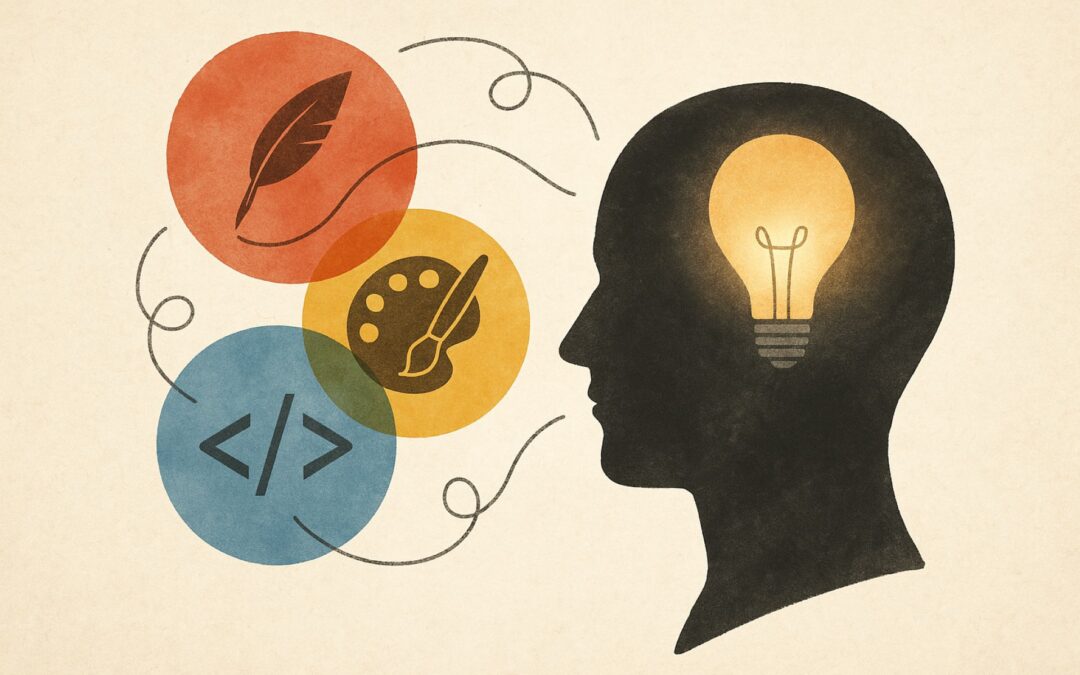
The search for purpose often feels like chasing a moving target. One year, you’re fascinated by design; the next, by technology, psychology, or storytelling. You’re told to “pick a lane,” to specialize early and stay the course. But what if your genius doesn’t live in one lane at all? What if your real calling lies in the intersection—where your interests collide, overlap, and evolve into something uniquely yours?
Your fascinations are not random. They are fragments of a larger pattern that life is helping you piece together. When you learn to combine them—when you stop separating your curiosities and start blending them—you begin to create work that feels authentic, alive, and irreplaceable. The path to mastery, then, is not about narrowing your focus too soon. It’s about learning how to let your fascinations speak to each other until they form a voice that’s unmistakably your own.
Daily Law: Keep in mind that your calling could be combining several fields that fascinate you. Keep the process open ended; your experience will instruct you as to the way.
—The Laws of Human Nature, 13: Advance with a Sense of Purpose—The Law of Aimlessness
Explore the Full Spectrum
In the early stages of your life or career, curiosity is not a distraction—it is your compass. This is the season to wander, to test the edges of your inclinations, to expose yourself to the broadest possible range of experience. You may feel uncertain, scattered, or impatient to “find your thing.” But this phase of experimentation is not a detour; it’s the foundation upon which mastery is built.
Think of it like laying down roots before a tree grows tall. Without a wide network of roots—of experiences, skills, and curiosities—the growth above ground will be fragile, easily toppled by the first strong wind. You need diversity early on. It’s what gives your eventual purpose both depth and resilience.
If you’re drawn to writing, explore every corner of the craft. Try long-form essays that stretch your analytical thinking. Write poetry to sharpen your sensitivity to rhythm and silence. Learn marketing copy to understand persuasion and the psychology of attention. Experiment with screenwriting to capture dialogue and scene dynamics. Each discipline reveals a unique layer of communication, and each one tests a different part of your creativity.
Beyond writing, absorb influences from the world around you. Study photography to learn composition. Read philosophy to sharpen clarity of thought. Watch comedians perform to understand timing and emotional pacing. The boundaries between fields are artificial—creativity thrives in the spaces where they blur. The best communicators, designers, or entrepreneurs are not those who stay in one lane, but those who roam widely and bring insights back home.
In this process, you are not merely collecting skills; you are building range. Range gives you adaptability, but it also deepens self-awareness. You begin to notice what absorbs your attention effortlessly and what drains it. You start to sense patterns in your fascinations—the recurring themes that ignite your curiosity no matter the context. These patterns are clues to your calling.
Exploration also reveals your thresholds. You learn the difference between something that fascinates you and something that defines you. You begin to understand which discomforts are worth enduring and which are not. The purpose of trying everything isn’t to become a generalist forever—it’s to give your intuition enough data to make informed, authentic choices later.
Every experience, even the seemingly irrelevant ones, enriches your creative reservoir. The future architect learns empathy from painting. The aspiring entrepreneur learns rhythm from music. The teacher learns storytelling from theater. These intersections may not make sense now, but they will—when your skills begin to merge and express themselves through a singular voice.
So don’t rush the process. Stay curious, stay restless, and trust that what feels scattered now is the groundwork for something cohesive later. Curiosity is never wasted. It’s the raw material from which genius is sculpted.
Adapt Experience Toward Your Calling
As time passes and your career evolves, the process of discovery transforms. You are no longer an explorer wandering through possibilities—you are a craftsman shaping direction. You’ve spent years developing expertise, learning from mistakes, refining instincts. The question now becomes: How do I take everything I’ve learned and channel it toward something that feels undeniably mine?
This is where synthesis begins. You start to view your past experiences not as random episodes but as interconnected threads. Each job, each project, each challenge carries lessons that reveal your personal themes. The skills you’ve acquired—organization, analysis, empathy, leadership—are not ends in themselves. They’re tools, waiting to be reassembled into a new configuration that better reflects your deeper interests and temperament.
Perhaps you’ve spent a decade in finance, mastering numbers, systems, and efficiency. But beneath that structure lies a fascination with human behavior. That fascination could evolve into teaching, consulting, or designing behavioral finance tools. Maybe you’ve been a designer for years but find yourself increasingly drawn to storytelling—your next evolution could be in branding, where visual art and narrative merge.
The pivot is rarely dramatic; it’s subtle, incremental, organic. You’re not abandoning your past—you’re repurposing it. Think of it like molten metal being poured into a new mold. The substance remains the same; only the shape changes. Every prior skill becomes a transferable asset when directed by clarity of purpose.
Reinvention at this stage also demands honesty. You must examine where your current work feels misaligned—where the spark has dimmed or the rhythm feels forced. These signals aren’t failures; they’re invitations to realign. The mind resists change because it confuses comfort with stability. But purpose isn’t about comfort—it’s about coherence. You feel at peace not when things are easy, but when they make sense.
To adapt your experience, begin by distilling your unique intersections. Ask yourself:
- What patterns run through everything I’ve enjoyed doing?
- What problems do I instinctively want to solve?
- What activities make time disappear for me?
- What kind of impact do I want my work to have?
The answers may surprise you. Often, your calling isn’t something new—it’s something you’ve already been doing in fragments, waiting to be unified.
Consider the seasoned professional who spent years in product design and developed an obsession with education. By merging the two, she creates learning tools that make complex ideas beautifully simple. Or the musician who later studies neuroscience, combining art and science to explore sound therapy. The bridge between your past and your calling is built not by abandoning your old fascinations, but by weaving them into something larger.
Adaptation is not about reinvention in the Hollywood sense—it’s about integration. You’re not starting from scratch; you’re building from substance. The sum of your experiences has been preparing you all along, shaping your eye, your judgment, your rhythm. When directed toward your true calling, everything you’ve done becomes relevant, even the mistakes.
That’s the beauty of this phase. Experience gives you the tools. Awareness gives you the direction. Purpose gives you the synthesis.
The Power of Fusion
Genius, when you look closely, is rarely about pure originality. It’s about integration—about taking what already exists in separate forms and fusing it into something entirely new. The most revolutionary ideas, inventions, and works of art often come from those who stood at the intersection of two or more disciplines and saw a connection that others missed.
Steve Jobs serves as a profound illustration of this. His two lifelong fascinations—technology and design—seemed unrelated when viewed through the conventional lens. Technology was seen as the domain of engineers: logical, rigid, functional. Design belonged to artists: aesthetic, emotional, intuitive. Jobs, however, perceived no such divide. He understood that beauty and function were not opposites but complements. A well-designed product wasn’t merely attractive—it was intuitive, humane, and joyful to use.
When he attended a calligraphy class in college, Jobs learned about spacing, proportion, and the subtle elegance of typography. At the time, it appeared to have no practical purpose. But years later, that aesthetic sensibility shaped the interface of Apple computers, transforming them from cold machines into living art. His interest in Zen philosophy and simplicity translated into Apple’s minimalist ethos—clean lines, effortless use, and clarity of experience.
That synthesis—the merging of logic and art, circuitry and emotion—was the source of his genius. Jobs didn’t invent either domain; he harmonized them. The result was not just innovation, but identity. The Apple brand became synonymous with a worldview: technology designed for humans, not engineers.
This kind of fusion is not limited to visionaries or billionaires. It’s a principle anyone can apply. Think of a scientist who studies storytelling to better communicate discoveries. A teacher who incorporates psychology to make learning more intuitive. A chef who combines chemistry and art to create multisensory cuisine. The collision of ideas across disciplines generates fresh possibilities that single-track expertise can never achieve.
Your own fascinations—no matter how disparate—contain the potential for this kind of alchemy. Maybe you love mathematics and music, or philosophy and entrepreneurship, or art and psychology. Don’t dismiss those combinations as impractical. Within them may lie the blueprint for something original that only you can create.
The world doesn’t need more specialists who know one thing deeply and nothing else. It needs synthesizers—people who can blend insight from multiple domains to see patterns others overlook. Leonardo da Vinci studied anatomy to paint lifelike portraits. Elon Musk combines physics with storytelling to make technology aspirational. Maya Angelou united poetry and activism to turn emotion into moral force.
Fusion multiplies creative power because it bridges imagination and execution, emotion and intellect, instinct and logic. The mind that can operate between those worlds sees farther. It builds bridges where others see walls.
So look at your interests not as a puzzle to solve but as a chemistry set. Mix them. Experiment. Let unexpected reactions occur. Sometimes the most groundbreaking work emerges from what seems at first like contradiction. What appears mismatched in isolation often becomes genius in combination.
Your uniqueness doesn’t lie in any one fascination—it lies in how you combine them. The blend itself becomes your signature.
Keep the Process Open-Ended
There’s a quiet danger that creeps in once you think you’ve “figured it out.” Certainty can become a prison. Once you name your identity too rigidly—writer, designer, entrepreneur—you begin to close the doors that once let your creativity breathe. The process of combining your fascinations is not a project with a deadline; it’s an evolving relationship with your own growth.
To keep it alive, you must remain curious, flexible, and humble enough to change direction when new insights emerge. Your calling isn’t static—it’s organic. It shifts as your understanding deepens, as your environment changes, as your sense of self refines. What began as one form may evolve into another entirely, yet remain true to the same inner current.
Consider Pablo Picasso. His early paintings were steeped in realism; later, he fragmented shapes and redefined form through cubism. He didn’t abandon his craft—he reinvented it. His mastery of traditional technique gave him the foundation to experiment freely. Or look at David Bowie, whose art constantly mutated through genres, personas, and eras. Reinvention wasn’t a betrayal of self—it was an act of fidelity to growth.
To keep your process open-ended means to remain a perpetual student. Keep exposing yourself to ideas that challenge you. Read outside your field. Collaborate with people who think differently. Attend lectures, learn new tools, and let discomfort become your teacher. Growth rarely feels graceful; it often feels like confusion before clarity. But confusion is a sign of expansion—it means your mind is reaching beyond its previous limits.
Another crucial part of openness is letting experience be your instructor. Too many people try to plan their purpose like a project plan, expecting linear milestones and predictable outcomes. But life doesn’t unfold in straight lines; it spirals. You circle around the same themes, returning with new eyes each time. That’s how depth develops—through repetition with awareness.
Your fascinations will evolve. Some will fade naturally, while others will grow roots and expand into full-blown callings. You must give them space to transform. The process should feel like an ongoing dialogue with life, not a checklist of goals. If you listen carefully, your experiences will show you the direction—just as water carves its own path through persistence rather than planning.
Don’t fear ambiguity; nurture it. Ambiguity is the soil from which innovation grows. When you keep your curiosity alive, you remain open to intersections no one else has noticed yet. The world rewards those who stay adaptable, who never mistake success for arrival.
The synthesis of your fascinations—whatever they may be—will always be in motion. It’s a lifelong act of creation. Your job is not to finalize it, but to keep refining it.
Conclusion
The art of combining your fascinations is, in truth, the art of becoming whole. Every interest, every experience, every detour adds a new layer to your creative identity. When you fuse them with intention, you stop imitating and start innovating. You become not a collection of borrowed ideas, but a creator of new possibilities.
Keep your process open-ended. Let your work breathe and evolve with you. The aim is not to “arrive” at a fixed purpose, but to continually refine one through curiosity, courage, and synthesis. Like Steve Jobs merging technology with design—or Leonardo blending art with science—you’ll find that your most powerful calling emerges not from choosing between your passions, but from uniting them.
The world doesn’t need more specialists who fit the mold. It needs visionaries who break it—those who dare to combine their fascinations and, in doing so, create something that never existed before.
This article is a part of The Daily Laws Series based on Robert Greene’s book.