
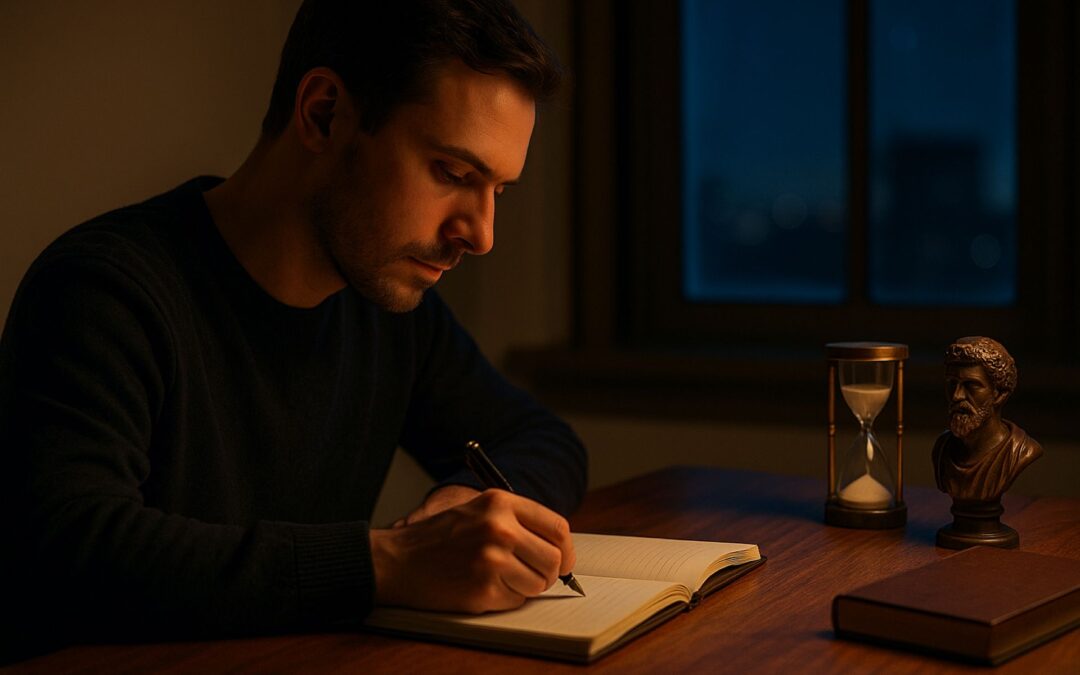
Each evening offers a quiet invitation — to pause, to turn inward, to examine the self that has lived another day. The Stoics treated this pause not as indulgence but as necessity. Seneca, in his Moral Letters, described the ritual of putting each day up for review — not to dwell on mistakes or glorify successes, but to understand the thread that connects one moment to the next. For how can we live wisely if we never stop to see how we have lived?
In a world driven by speed and noise, this practice of reflection feels almost subversive. To sit still, to question, to write — these are acts of rebellion against unconscious living. They transform the chaos of daily experience into coherence, turning ordinary days into lessons in character. The Stoics knew that the unexamined day leads to the unexamined life — and that self-awareness, practiced nightly, is the seed of mastery.
“I will keep constant watch over myself and—most usefully—will put each day up for review. For this is what makes us evil—that none of us looks back upon our own lives. We reflect upon only that which we are about to do. And yet our plans for the future descend from the past.”
— Seneca, Moral Letters, 83.2
The Mirror of the Day
Every evening, when the world grows quiet and the demands of the day recede, a sacred opportunity presents itself — the chance to turn inward. Seneca called this the moment of review: a calm, deliberate encounter with oneself. It was not designed for guilt or self-praise, but for understanding. For in the noise of living, we often lose sight of who we are becoming. Only in reflection do we recover that awareness.
Most people rush from one day to the next as though time were an endless current carrying them forward. They are swept along by obligations, anxieties, and ambitions, rarely pausing to consider how they actually lived. Yet Seneca insists that our plans for tomorrow are born from yesterday’s lessons. If we never examine the past, the same mistakes simply change their disguises — repeated impulsively, unrecognized, unchallenged.
To “keep constant watch” over oneself, as Seneca wrote, is to refuse this blindness. It is to treat each day as a text that must be read and annotated before turning the page. What did I do well? Where did I falter? Did I allow frustration to poison my tone? Did I speak truthfully? Did I act out of reason or reflex? In this interrogation lies freedom.
The Stoic mirror is not literal; it reflects no face, only the inner life. It shows the gap between intention and action, between what we claim to value and how we actually behave. This is the mirror that strips away illusion. It teaches humility by exposing the distance yet to be traveled. And yet it also teaches gratitude — for every small moment of restraint, every gentle word, every instance in which we lived by our principles despite pressure or fatigue.
In this nightly dialogue, the Stoic discovers that each day is a microcosm of a life. To waste a day is to waste a fragment of oneself. But to study it — to retrieve meaning from its successes and failures — is to live twice: once in action, and once in understanding. Reflection is thus not an accessory to life; it is life’s completion. It transforms fleeting experience into enduring wisdom, so that no hour, however ordinary, passes without leaving a trace of growth behind.
The Stoic Practice of Reflection
Seneca’s method was meticulous. In his Moral Letters, he recounts how, before sleeping, he would summon the events of the day as though presiding over a trial. His conscience served as both witness and judge. “When the light has been removed and my wife has fallen silent,” he wrote, “I examine my entire day and measure my deeds and words.” This nightly tribunal was his safeguard against moral decay — a self-audit of conduct and motive.
He would ask himself three questions: What bad habit did I curb today? How am I better? Were my actions just? In their simplicity lies profound power. The first invites awareness of weakness, the second demands evidence of progress, and the third tests one’s alignment with virtue. Together, they compel both honesty and accountability. They strip away self-satisfaction and force one to recognize that moral excellence is not a destination but a discipline.
Marcus Aurelius followed the same path in Meditations. His reflections — composed privately during the predawn hours — reveal a mind engaged in continual recalibration. He questioned his irritations, examined his judgments, and rehearsed the Stoic virtues of temperance, justice, courage, and wisdom. He treated every inner disturbance as a lesson, every temptation as a test. To Marcus, the mind was not a fixed entity but a garden that required daily tending.
This practice of reflection was not indulgent or self-absorbed. The Stoics saw it as a civic duty — for the well-governed mind governs others more wisely. How can one lead, teach, or serve, they reasoned, without first leading oneself? Each act of self-scrutiny was a step toward integrity, ensuring that philosophy remained a lived experience, not mere rhetoric.
The essence of this discipline lies in its constancy. Seneca did not review his life only when he erred gravely; he did so every day, precisely because he expected to err. In doing so, he transformed error into education. He built, one evening at a time, a habit of moral vigilance — an unbroken chain of awareness linking his past to his present, and his present to his future.
To practice reflection, then, is to take responsibility for one’s evolution. It is to refuse the ease of unconscious living. The Stoic does not seek perfection but refinement. He asks not to be faultless, but to be awake. For as Seneca reminds us, the examined day becomes the foundation of an examined life — and only such a life can be said to be truly one’s own.
The Modern Journal as a Spiritual Exercise
In our age of constant distraction, reflection has become an endangered act. The mind, inundated with noise, rarely finds the stillness necessary to discern meaning. Yet this is precisely why journaling — a practice as ancient as philosophy itself — remains one of the most transformative spiritual exercises we can adopt.
To the Stoics, writing was not a hobby. It was an instrument of moral clarity. Marcus Aurelius’s Meditations were not written for publication but as a private dialogue between his higher and lower selves. Each line was a negotiation between impulse and principle, an effort to realign the self with virtue. Seneca, Epictetus, and later thinkers like Montaigne and Emerson followed the same thread — they wrote to see.
Modern journaling, when approached with this intention, is no different. The page becomes a silent interlocutor — patient, honest, and unflinching. When we write about our anger, we begin to see its absurdity. When we recount our anxieties, they shrink under the light of articulation. When we describe moments of joy, we begin to understand what truly nourishes us. The act of writing externalizes confusion; it translates emotion into reason. It forces us to slow down, to clarify, and to witness ourselves as both subject and observer.
This is why the Stoic journal is not a diary of events but a ledger of virtue. It records not what happened, but how we responded. It distinguishes between what was within our control and what was not. Over time, patterns emerge — certain temptations, certain triumphs, certain lessons that repeat until learned.
The physical ritual matters too. To sit in quiet, pen in hand, with only one’s thoughts for company, is to reclaim sovereignty over the self. In an age of endless scrolling and invisible observers, this act of private reflection is profoundly radical. It is a return to the self before the world had its say. The Stoics would recognize in this simple habit the makings of wisdom — a daily re-centering of mind and spirit.
The Discipline of Honesty
There is a moment in every review where the pen hesitates. It hovers above the page, reluctant to name what it already knows. This is where Stoic honesty begins — at the threshold of discomfort.
To reflect truthfully requires bravery, for it means confronting not only what we did but why we did it. It means acknowledging the small deceptions we tell ourselves: that we were “too tired,” that “it wasn’t our fault,” that “we meant well.” Seneca called these the whispers of weakness. The Stoic silences them by answering with reason.
When one sits down to write — truly write — one begins to see the subtle ways pride disguises itself as principle, and fear poses as caution. The journal becomes a confessional, but without absolution. There is no external forgiveness here, only the liberating clarity of self-awareness. To admit a flaw is to weaken its hold; to name a weakness is to begin transforming it into strength.
This discipline is demanding precisely because it cannot be faked. To be honest once is easy; to be honest daily is a lifelong endeavor. It requires humility, restraint, and patience. It demands that we look upon our shortcomings with neither indulgence nor disgust, but with steady-eyed understanding. The Stoics taught that shame should be momentary — a spark that ignites correction, not a flame that consumes.
And yet honesty, in the Stoic sense, is not merely negative. It reveals our virtue as well. In the process of examining faults, we discover the quiet dignity of our better moments — the times we resisted anger, acted generously, or remained calm in adversity. Reflection allows these victories to take root in memory, strengthening our moral spine for the trials ahead.
To live honestly is to live freely. The person who can look at themselves without disguise no longer fears judgment. Their peace is not derived from being flawless, but from knowing that nothing within them is hidden from their own sight.
The Reward of Reflection
There is a subtle transformation that occurs when one practices this ritual consistently. What begins as a moral exercise becomes a way of being — a rhythm that structures the mind around awareness. Each day, through reflection, the Stoic grows lighter, calmer, and clearer. Mistakes lose their sting, for they are transmuted into lessons. Success loses its vanity, for it is recognized as temporary and instructive.
Over time, a pattern emerges — not just of actions, but of becoming. The journal reveals the trajectory of one’s character: how one’s impulses soften, one’s patience deepens, one’s priorities evolve. This is the true metric of progress — not wealth or recognition, but a mind increasingly aligned with virtue. The reward is not applause, but coherence — the sense that one’s thoughts, words, and deeds are finally in conversation rather than conflict.
Reflection also cultivates equanimity. By reviewing the day, we learn to separate what depends on us from what does not. We come to see that most of our suffering arises from resistance — from clinging to outcomes, from expecting fairness, from resenting imperfection. When viewed with detachment, even difficulty becomes instructive. Each frustration, each loss, each slight becomes material for inner growth.
And perhaps the greatest reward is peace. The Stoic who reviews the day sleeps well, not because life is free of turmoil, but because the conscience is unburdened. There is no need to run from one’s thoughts when they have already been examined, understood, and resolved. The mind, once restless, becomes still. The heart, once reactive, becomes steady.
In this way, reflection is both teacher and sanctuary. It guards against moral drift, nourishes wisdom, and anchors the soul amid the chaos of modern life. Through nightly review, the Stoic transforms the ordinary act of ending a day into a sacred rehearsal for virtue — and in that quiet closing of each evening, they build the architecture of an examined life.
Conclusion
Each day ends whether we reflect or not — but only reflection allows it to end meaningfully. The Stoic does not see the day as a unit of time, but as a cycle of learning. To review it is to reclaim it. To write is to understand. To understand is to grow.
When we make a habit of honest self-examination, the days stop blending into one another. They begin to stack like bricks — each one inspected, refined, and placed with intention. Over time, this simple ritual becomes a fortress of awareness, protecting the mind from drift and the heart from distraction.
The Stoic does not seek perfection, only progress — one evening at a time. And in that nightly reckoning, beneath the quiet lamp and the turning of the page, the soul finds its true rhythm: a life lived deliberately, examined, and at peace.
This article is part of The Daily Stoic Series based on Ryan Holiday’s book.