
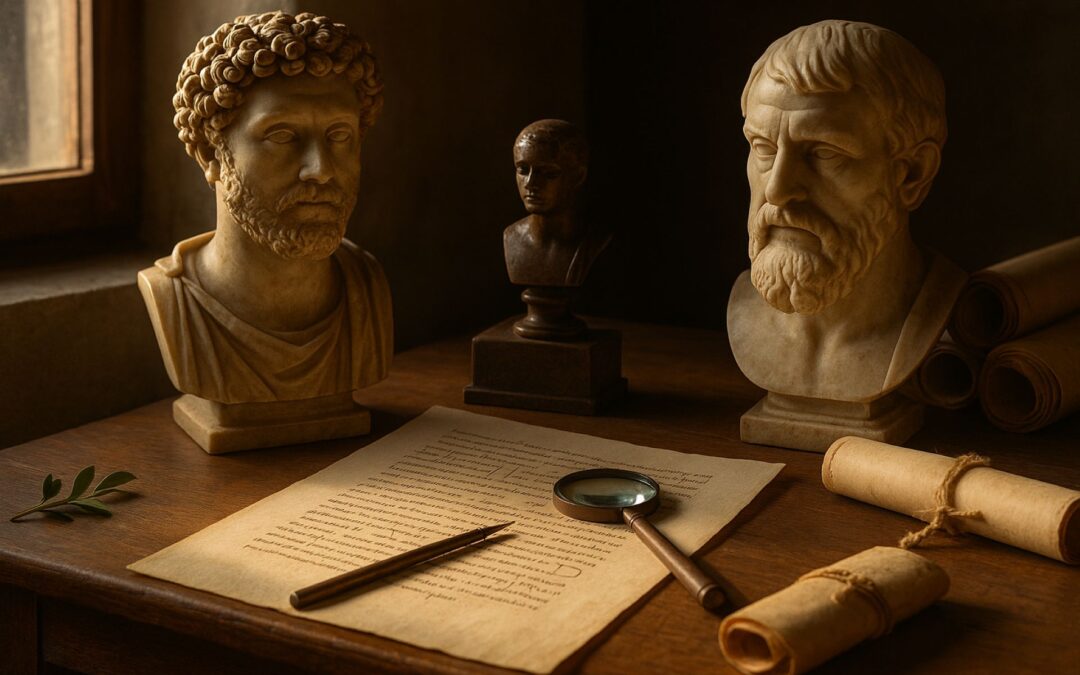
Marcus Aurelius opens his Meditations not with proclamations of power, but with gratitude. He thanks those who molded his mind—teachers, family, and friends who shaped his philosophy of life. Among them stands Rusticus, a mentor who taught him the discipline of careful thought. Rusticus’s lesson was simple yet profound: never settle for the surface. Read slowly. Question deeply. Understand fully.
In a world driven by haste, where opinions form faster than they are examined, this wisdom feels more relevant than ever. Marcus’s education under Rusticus reveals the timeless truth that knowledge must be earned through attention, not assumed through exposure. To truly learn is to wrestle with ideas until they shape our nature. This practice—slow, deliberate, transformative—is the essence of Stoic study.
“From Rusticus . . . I learned to read carefully and not be satisfied with a rough understanding of the whole, and not to agree too quickly with those who have a lot to say about something.”
—Marcus Aurelius, Meditations 1.7.3
The Lesson of Rusticus
When Marcus Aurelius looked back on the influences that shaped him, he placed Rusticus near the center of his gratitude. Unlike many teachers who prized eloquence or reputation, Rusticus modeled a quieter, more enduring virtue: intellectual rigor. He didn’t fill Marcus with answers; he trained him to ask better questions. His lessons weren’t about memorization or agreement—they were about awakening the mind to its own blind spots.
Rusticus taught Marcus to approach every subject with suspicion toward his own understanding. If something seemed too simple, he urged him to look again. The goal was not to appear clever or well-read, but to see reality clearly. This habit of careful reading extended beyond books; it became a way of interpreting the world. Marcus learned to pause before forming conclusions, to test impressions before believing them, to weigh each statement for truth rather than comfort.
That discipline forged the foundation of Stoic practice. The Stoics believed that philosophy should refine perception—the ability to distinguish what is true, what is useful, and what merely flatters the ego. Rusticus gave Marcus a living demonstration of this principle. Through his example, Marcus came to understand that to read carelessly is to think carelessly, and to think carelessly is to live carelessly. Each act of interpretation—whether of a book, a conversation, or an event—was a test of character.
To be the pupil of Rusticus was to learn that clarity demands humility. It requires admitting that one does not yet know. It asks for patience when confusion feels uncomfortable and curiosity when certainty feels tempting. Rusticus cultivated in Marcus not only a love of learning but a reverence for precision. In the emperor’s later writings, that spirit endures: every line of Meditations reflects the same patient pursuit of truth over appearance, essence over noise.
The Art of Reading Like a Philosopher
When Rusticus placed Epictetus’s lectures in Marcus’s hands, he wasn’t giving him a text to finish—he was handing him a challenge to confront. To read philosophy in the Stoic sense was never about passive absorption. It was a kind of mental sparring: the student wrestles with the teacher’s ideas, testing them against his own experience until they prove themselves in practice. Marcus approached those pages not as a collector of quotes but as an apprentice of the soul.
He read as a philosopher must read—actively, skeptically, and with full attention. Each maxim of Epictetus was held up against his own behavior. Each passage demanded a question: Do I live by this? He was not seeking entertainment or even education; he was seeking alignment between word and deed. The process was slow, deliberate, and sometimes uncomfortable. But in that discomfort, something transformative occurred.
This kind of reading is an act of resistance in any age. It refuses the modern impulse to skim, to summarize, to reduce. It insists on immersion. The philosopher reads as if every line contains a secret worth discovering—because it might. The text becomes a mirror in which the reader studies his own contradictions.
In Marcus’s case, this dialogue between thinker and text became the architecture of his later wisdom. The discipline of examining each principle before adopting it gave him the inner stability for which he is now remembered. His method was not to accept the brilliance of Epictetus on faith, but to earn it through understanding. He read with the full force of his mind, until comprehension became conviction, and conviction became conduct.
This, ultimately, is the art of reading like a philosopher: to engage with ideas so deeply that they cease to be external authorities and become internal laws. The reader who practices this is no longer just learning—he is remaking himself.
Depth Over Breadth
Modern culture rewards speed. We listen to books at double speed, skim articles in seconds, and scroll endlessly through fragments of thought. In this rush, depth becomes a casualty. We come to believe that knowing about something is the same as understanding it. But Marcus Aurelius, guided by Rusticus, understood the fallacy in this. Wisdom is not a product of accumulation—it is a product of digestion.
The Stoics practiced a form of intellectual fasting: consuming little, but absorbing deeply. They would rather meditate on a single line of philosophy than rush through an entire scroll. The goal was not to finish the book but to let the book finish its work within the mind. True comprehension requires silence after reading—a pause to reflect, to challenge, to integrate. Each idea must be tested against experience until it either holds or collapses.
This is the difference between information and insight. Information inflates the mind, while insight reshapes it. The former makes us appear knowledgeable; the latter makes us wise. The Stoics urged us to spend time living what we read, to turn principles into practice before seeking new ones. As Seneca said, “It is not the man who has too little, but the man who craves more, who is poor.” The same applies to learning. Those who crave more without understanding less are impoverished in mind.
In a distracted world, depth becomes rebellion. To linger with an idea is to declare that the inner life still matters more than external noise. When we read deeply, we don’t just process words—we meet ourselves in the mirror of thought. That meeting, slow and uncomfortable as it may be, is where growth begins.
Making Knowledge Part of Your Being
Marcus Aurelius did not wear philosophy like a garment to be put on in public and removed in private. It was woven into his very being. The lessons he learned from Epictetus and Rusticus weren’t intellectual trophies—they were tools for living. He didn’t cite them to sound profound; he practiced them to remain grounded. This integration of knowledge and character is the mark of true understanding.
To know something intellectually is easy. To embody it is rare. Embodied knowledge manifests not in what we can recite, but in how we respond when tested. When insulted, when afraid, when tempted—these are the moments that reveal whether our learning has sunk beneath the surface. For Marcus, Stoic philosophy was no longer theory. It was instinct. He had read until the lessons became reflex, until reason guided him even when emotion surged.
This transformation only happens through deep engagement. Every truth must be revisited, rehearsed, and reinforced until it alters our perception of the world. The Stoics believed repetition was sacred because it carved wisdom into the soul. Just as a sculptor refines marble through countless strokes, understanding is shaped by revisiting the same ideas from new angles. Each return reveals something previously unseen.
Knowledge that fails to transform us remains ornamental—a collection of impressive phrases without substance. The Stoic aim is not to sound wise, but to live wisely. That means allowing ideas to pass from the intellect into the bloodstream of behavior. Once knowledge becomes part of our being, it no longer requires effort to recall—it simply acts through us.
The Call to Deep Understanding
To pursue deep understanding is to choose the slower, harder road in an age that worships immediacy. It means resisting the dopamine rush of novelty and embracing the discipline of stillness. Marcus’s method—reading one line, one thought, one principle at a time—wasn’t about minimalism; it was about mastery. He knew that insight without application fades, while comprehension forged through reflection endures.
We are called to adopt the same rigor. To read a sentence not for entertainment but for enlightenment. To pause when something resonates and ask, Why? To close the book, look inward, and test whether the truth we’ve read has taken root. Each day offers such opportunities—to practice discernment in conversation, patience in disagreement, humility in correction.
The Stoics would remind us that philosophy is not a spectator sport. It is lived line by line, habit by habit. Deep understanding is not found in libraries but in the laboratory of one’s own life. To cultivate it, we must read with the same seriousness with which we act, and act with the same care with which we read.
The invitation is enduring and simple: slow down, look deeper, and make understanding your form of devotion. For in a world obsessed with appearing informed, there is quiet power in truly knowing.
Conclusion
The lesson from Rusticus echoes through the centuries: seek depth, not speed. Marcus Aurelius became who he was not by collecting ideas but by submitting himself to their refinement. He read with the intensity of one who believed that wisdom was a matter of life and death—because in many ways, it is.
We, too, live surrounded by endless words and voices clamoring for our attention. But only through stillness and careful thought can we separate the enduring from the ephemeral. If we learn, as Marcus did, to engage fully and think clearly, understanding becomes not a momentary insight but a lifelong companion.
To push for deep understanding, then, is more than an intellectual exercise—it is a moral one. It is how we come to see the world truthfully, live deliberately, and become the kind of people whose knowledge does not fade when life tests it.
This article is part of The Daily Stoic Series based on Ryan Holiday’s book.