
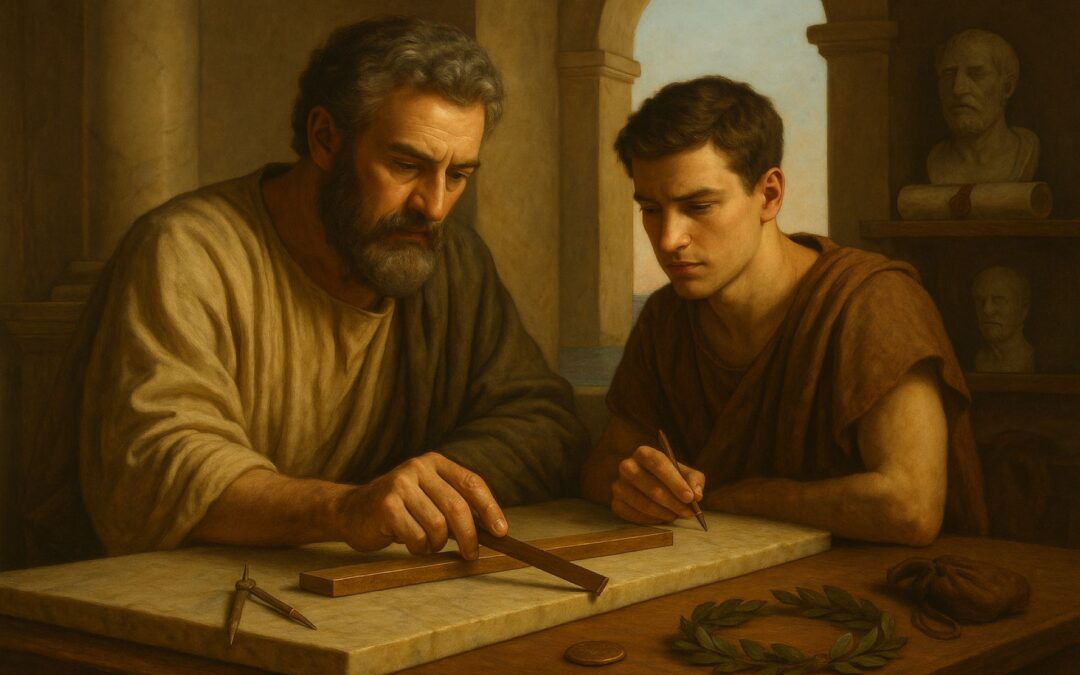
Every person needs a ruler — not the kind that governs by power, but the kind that measures truth. In the pursuit of wisdom, we need examples to hold our lives against, so we can see where we bend, where we break, and where we still have room to grow. Marcus Aurelius and Seneca both understood this deeply: that philosophy begins not in books but in people — in watching how the wise act, what they avoid, and what they quietly endure.
This isn’t imitation in the shallow sense; it’s apprenticeship. The wise live as living testaments to principle — rulers by which we straighten our own lives. To study them is to refine the self through the lens of another’s integrity. And over time, if we pay attention, the act of watching transforms into the art of becoming.
“Take a good hard look at people’s ruling principle, especially of the wise, what they run away from and what they seek out.”
— Marcus Aurelius, Meditations, 4.38
Learning by Observation
Philosophy, for all its brilliance, is powerless without embodiment. Words can illuminate the path, but only living examples make it visible. You cannot think your way into virtue — you have to see it lived. That’s why Marcus Aurelius, the philosopher-emperor, did not merely read Stoic texts; he watched. He studied the composure of Rusticus, the patience of Antoninus, the discipline of those who seemed unmoved by flattery or insult. Observation became his apprenticeship in wisdom.
This principle is timeless. From artists to athletes, the deepest lessons come not from theory but from presence. Watch a painter at work, and you’ll see that mastery lies in the pauses between strokes. Watch a surgeon, and you’ll understand that precision is born of rhythm, not haste. The same applies to moral excellence: you learn serenity by seeing someone remain calm under attack; you learn humility by watching someone great refuse to boast; you learn restraint by observing someone powerful who chooses silence over spectacle.
Observation is a kind of moral osmosis — a quiet transmission of principle from life to life. Yet most of us rush through the world half-blind, distracted by noise, mistaking movement for meaning. We read motivational quotes but rarely watch the people who live them. The Stoics would call this negligence of attention — the failure to study the patterns of virtue unfolding before our eyes.
To learn through observation, one must cultivate a double awareness: outward and inward. Outward — to notice the gestures, tone, and choices of the wise. Inward — to see how those observations stir, challenge, or humble your own instincts. The wise become a mirror, but only if you are willing to look into it honestly. Without this reflective awareness, observation remains superficial — you see the behavior but miss the principle that animates it.
When you truly watch the wise, you begin to discern subtleties invisible to casual eyes: how they conserve energy by not reacting to trivialities, how they maintain clarity under complexity, how their peace is not passivity but power under control. You start noticing not just what they do, but why they do it — and that why becomes the seed of your own transformation.
Observation, then, is the philosopher’s laboratory. Life itself becomes the experiment. The world around you — every conversation, conflict, and quiet moment — turns into a classroom of examples, each one silently revealing how a person ruled by reason behaves. The task is to remain awake enough to see it.
The Ruler and the Model
Seneca’s metaphor — “Without a ruler to do it against, you can’t make crooked straight” — captures a truth both humbling and liberating: left to ourselves, we can’t reliably judge our own alignment. Our perception is biased, softened by habit and self-flattery. We excuse our excesses, justify our impulses, and mistake comfort for correctness. But hold your life against the standard of the wise, and suddenly the deviations appear. Their clarity exposes your confusion. Their composure highlights your haste. Their generosity puts your selfishness in relief.
The “ruler” in Seneca’s image is not an authoritarian figure but a measuring stick — a stable point of reference amid moral uncertainty. Just as an architect checks each line against a straight edge, the student of virtue checks each action against the conduct of those who have already mastered themselves. The point is not to copy, but to compare — to reveal where our thoughts bend under pressure and where our intentions twist into self-interest.
The value of a model lies in its consistency. The wise live by principle, not by preference. Their choices form a visible pattern — a geometry of reason and restraint. When you hold your own behavior beside theirs, the distortions become impossible to ignore. You begin to notice how often your convictions waver with convenience, how easily your discipline dissolves when no one is watching. The ruler does not accuse you; it clarifies you.
This comparison, uncomfortable as it may be, is the birthplace of growth. You can’t correct what you can’t see. The model provides vision — a way to detect the unseen curves in your character. The very act of measuring yourself against someone better initiates improvement. It forces humility, which is the first ingredient of wisdom.
But there’s another side to this metaphor: the ruler does not bend to accommodate the crooked line. The standard must remain firm. In an age obsessed with relativity — “my truth,” “my way,” “my values” — the Stoics remind us that the pursuit of virtue requires something objective to aim at. You cannot straighten yourself by comparison with those equally lost. Seek those whose actions align with reason, whose words match their deeds, whose calm is not indifference but mastery. They become your ruler — not to dominate you, but to anchor you.
Through them, you learn the dimensions of integrity. You begin to feel where your own life lacks symmetry. And in that recognition — sometimes painful, always necessary — you find the first real opportunity to build yourself straight.
Choosing Your Example
Choosing whom to watch is one of the most important decisions in your pursuit of wisdom. The wrong model can distort your values; the right one can quietly reshape your life. In a world that celebrates fame over virtue, this act of selection demands discernment. The wise do not look for brilliance alone — they look for coherence. They ask: does this person’s outer life align with their inner principle? Do they live as they speak, or do they only speak well?
The Stoics would warn us against mistaking charisma for character. Some people appear admirable because they speak with conviction or confidence, but closer inspection reveals inconsistency — they are one person in public, another in private. A true model of wisdom is someone whose choices remain stable across conditions: calm in crisis, humble in victory, unshaken in loss. Their life has texture, not polish.
Your model does not need to be perfect. In fact, perfection is a poor teacher because it feels unreachable. Choose someone human — flawed but principled, vulnerable yet steadfast. Their struggles will teach you as much as their triumphs. You will see not just the end result of wisdom but the process — the hesitation before courage, the small acts of self-restraint that accumulate into integrity.
Sometimes your example will be close at hand — a mentor, a parent, a colleague who consistently does the right thing when it’s difficult. Other times, it might be someone long gone — a philosopher, a leader, or even a character in literature whose clarity of purpose speaks across centuries. What matters is not proximity, but resonance. Their life should serve as a compass, reminding you what “north” looks like when you start to drift.
And remember: part of watching the wise is noticing what they do not pursue. The Stoics observed that wisdom is revealed as much in aversion as in attraction. The wise often turn away from excess — they decline attention, ignore insults, avoid moral shortcuts. Their rejections are as instructive as their actions. When you notice what they refuse to engage in, you learn what truly matters.
In the end, your chosen example becomes both mirror and guide. Their existence sharpens your perception of virtue. By holding their conduct before your mind, you begin to see how a life ruled by reason feels — balanced, deliberate, free from the noise of ego. Watching them, you discover that wisdom is not an abstraction; it’s a way of walking through the world.
The Subtle Art of Watching
To watch the wise is not a passive act. It is not about admiration or imitation alone — it is an exercise in understanding. Observation, in the Stoic sense, is a discipline of perception: training yourself to see motives, not merely movements. You must look beneath behavior and into intention. When a wise person acts, ask yourself what principle governs that choice. When they remain silent, wonder what they are choosing to protect.
The difference between looking and watching lies in awareness. Looking is casual; watching is deliberate. Looking sees surfaces; watching notices patterns. The wise are rarely loud about their wisdom — it expresses itself in small, almost invisible gestures. The quiet patience before speaking. The soft refusal to gossip. The way they listen more than they interrupt. Each moment of restraint is a lesson in control, each act of kindness a demonstration of strength.
The art of watching also involves endurance. Sometimes you won’t immediately understand why the wise do what they do. Their restraint might seem weakness; their mercy might appear naive. But over time, you’ll begin to recognize a deeper order — an internal rhythm that guides them, independent of circumstance. The more you watch, the more you see that their actions are not reactions but responses — shaped by choice, not emotion.
Observation becomes transformative when it turns inward. You start to see your own behavior mirrored in theirs — or its absence reflected in your impatience, pride, or haste. When you notice yourself failing to act as they would, the realization cuts deep but clean. This is how self-awareness matures: not by judgment, but by contrast. The wise illuminate our hidden faults simply by existing near us.
Watching, then, is a form of apprenticeship without instruction. It teaches through example, repetition, and reflection. You begin by studying others and end by refining yourself. Every moment of calm you witness, every act of dignity you encounter, adds a subtle layer to your own conduct. Eventually, your reactions change — not because you forced them to, but because wisdom has seeped into your way of seeing.
To watch the wise is to practice the highest form of learning: silent, attentive, and continuous. It is not the absorption of facts but the cultivation of vision. What you see in others, you awaken in yourself.
Turning Admiration into Action
Admiration is a natural beginning but a poor ending. It can awaken desire for growth, yet without discipline, it dissolves into passivity. The Stoics were not interested in fans of virtue; they sought practitioners of it. To admire Marcus Aurelius is easy — to act like him, under pressure, is difficult. Admiration can become an emotional refuge, a way of feeling moral without doing the work. Action alone completes the circuit of learning.
The movement from admiration to action begins with humility. When you encounter a quality in someone that stirs you — calmness, courage, patience — resist the urge to say, “I wish I could be like that.” Instead, ask, “How can I practice that today, in my circumstances, with what I have?” Wisdom is not inherited; it is replicated through effort. The wise themselves were once imitators. They learned restraint by failing at it, clarity by questioning confusion, composure by enduring chaos.
To convert admiration into action, start small. Choose one behavior or principle from your model and apply it consciously in your day. If your example is a person who never rushes to judgment, practice pausing before reacting to others. If your model values simplicity, declutter your commitments and words. If they speak with kindness, measure the tone of your own conversations. These repetitions, humble as they seem, are how philosophy becomes habit.
At first, imitation may feel artificial. But imitation is how we all begin — from language to craftsmanship to moral character. You may feel as though you’re pretending to be calm, pretending to be generous, pretending to be disciplined. But with repetition, pretense ripens into authenticity. The act shapes the actor. You are not faking virtue; you are rehearsing it. The wise are not born serene — they train serenity into themselves, choice by choice.
What prevents most people from taking this step is pride. It’s easier to quote wisdom than to live it, easier to analyze the virtues of others than to embody them. The modern mind often confuses knowledge with transformation — as if understanding the Stoics were the same as becoming Stoic. But philosophy is not a set of opinions; it is a lifestyle. The question is not what you know, but what you practice when things fall apart.
Admiration should therefore serve as ignition, not insulation. Let it light a fire under your conduct, not just warm your intellect. Every time you witness someone act with principle, treat it as a challenge: Can I respond this way too? By turning admiration into action, you cease to be a spectator of wisdom and become its participant. That is how reverence matures into responsibility — through the daily, unglamorous act of practice.
Becoming the Example
There comes a point when the gaze turns outward — when you realize that you, too, are being watched. Maybe it’s a child studying how you handle frustration. Maybe it’s a coworker noticing your integrity when no one’s looking. Maybe it’s a friend quietly taking courage from your calm. The Stoics believed that virtue radiates; its influence extends far beyond words. Whether you intend it or not, you become a reference for someone else’s growth.
This awareness changes everything. You start to see that wisdom is not just a private pursuit; it’s a public trust. Each choice you make, each restraint you show, ripples outward as silent instruction. The goal is not perfection, but example — to live in such a way that your actions clarify the path for those still learning to walk it.
Being an example does not mean claiming authority or superiority. The wise never announce their wisdom. They lead by consistency, not display. Their steadiness under pressure becomes their credibility; their humility under praise becomes their teaching. The people who impact us most rarely try to — they simply embody what we aspire to become.
This stage of life — from watcher to model — is not marked by ceremony but by consciousness. You begin to measure your behavior not by how it benefits you, but by what it teaches others. How you speak in anger, how you respond to failure, how you treat those with less power — these are all lessons someone else is quietly learning through you. The wise live as though every action were a demonstration, because, in a way, it is.
There is also a profound symmetry here. Just as you once measured yourself against a ruler, now others measure themselves against you. The same responsibility that once guided you now continues through your example. In this sense, wisdom is not an individual possession but a living tradition — passed hand to hand, life to life, through observation and emulation.
This realization should not breed pride but gratitude. To be someone’s model is to participate in the continuity of virtue. You become part of the chain that keeps human character from decaying entirely into chaos. You stand, however imperfectly, as proof that integrity is still possible.
When you reach this point, the act of watching the wise comes full circle. The apprentice becomes the teacher, not through declaration but through being. You no longer chase examples; you become one. And that, perhaps, is the quietest and most enduring form of influence — to live so that wisdom can be seen, not merely spoken.
Conclusion
Wisdom has always moved through the world in silence — from master to apprentice, from friend to friend, from parent to child. It is not passed through words but through example. The Stoics knew this well: virtue is caught, not taught.
To watch the wise is to see philosophy in motion — patience made visible, integrity made tangible, discipline made human. And the longer we observe, the more we realize that wisdom is not a distant ideal but a living possibility. Each day offers a chance to embody what we admire, to turn watching into doing, and doing into being.
Eventually, others will watch you — and that is the quiet proof that the cycle continues. The student becomes the standard. The observer becomes the example. The ruler you once followed becomes the life you now live.
This article is part of The Daily Stoic Series based on Ryan Holiday’s book.