
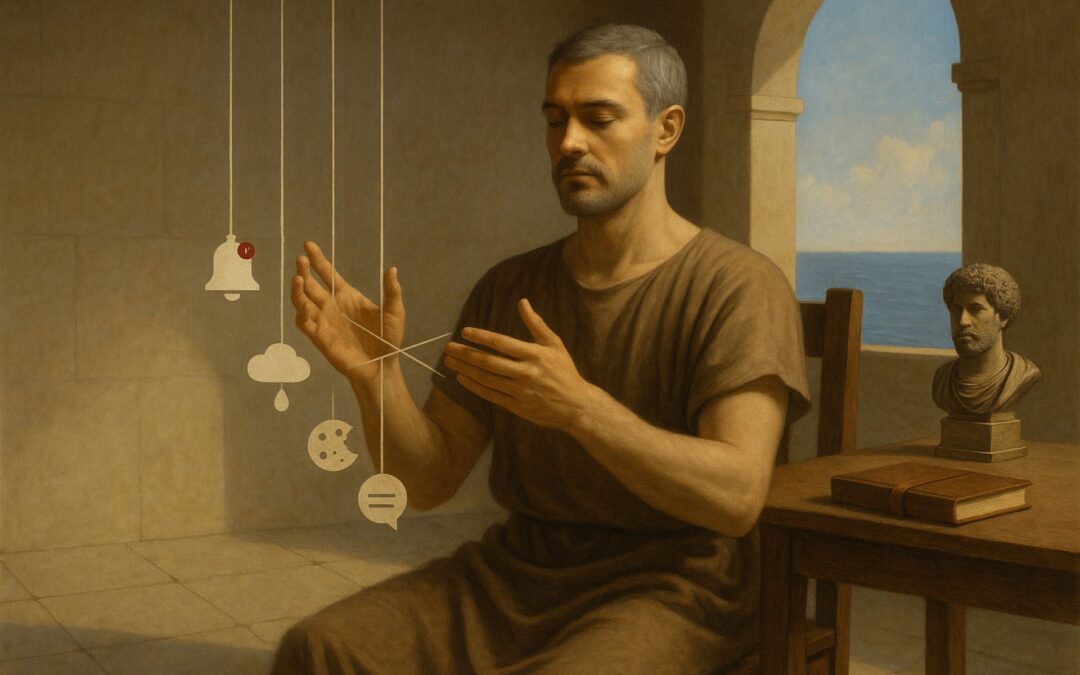
We like to believe we’re in control of our lives. We make our own choices, follow our own path, and answer to no one. Yet look closer, and you’ll see how easily a single emotion can hijack that supposed independence. One careless comment ruins a day. One craving derails our focus. One worry consumes the night. We’re not as free as we think—we’re puppets tugged by invisible strings.
Marcus Aurelius, in Meditations, offers a remedy both simple and profound: frame your thoughts properly. Imagine yourself as older, wiser, unwilling to be ruled by impulses any longer. See emotions for what they are—temporary visitors, not lifelong rulers. The moment we begin to think this way, we step out of emotional slavery and into genuine freedom—the kind that no one can take from us.
“Frame your thoughts like this—you are an old person, you won’t let yourself be enslaved by this any longer, no longer pulled like a puppet by every impulse, and you’ll stop complaining about your present fortune or dreading the future.”
— Marcus Aurelius, Meditations, 2.2
The Illusion of Independence
We spend much of our lives believing we are in charge. We take pride in our decisions, our careers, our relationships. We tell ourselves that no one controls us, that we live by our own design. Yet beneath this surface confidence lies a quiet contradiction—because though we resist external control, we yield constantly to internal command. A comment on social media changes our mood. A craving for approval makes us compromise our values. A flash of irritation shapes our tone before we’ve even thought. We are free citizens in public, but obedient subjects in private.
Marcus Aurelius, like many Stoics, saw this self-deception as the greatest obstacle to peace. The problem, he would say, isn’t the world’s attempt to control us—it’s our willingness to hand over control to our emotions. Anger, fear, greed, lust, envy—each one steps forward and seizes the throne of our mind when we are not watching. We call this “being human,” but to the Stoics, it was a form of servitude. Freedom without inner discipline was, to them, no freedom at all.
Consider how often the smallest external event changes your entire internal landscape. You wake up calm and centered. Then traffic delays your morning, and frustration floods in. A coworker’s comment stings, and you spend the next hour replaying it in your head. Later, an unexpected message excites you, lifting your spirits again. You think you are steering your day, but really, you are being steered—your emotions tugging you in every direction. The external world need not enslave you; your own reactions already do.
What Stoicism proposes is something radically different: to turn inward and reclaim authorship over your mental state. The truly free person is not the one who does whatever they want, but the one who can choose what they want. This means no longer being ruled by the whims of emotion, but guided by reason, understanding, and purpose. Freedom, then, begins not with rebellion but with recognition—with realizing that we are not as autonomous as we think, and that mastery of the self is the only real form of independence.
The Strings That Pull Us
If you were to watch yourself from a distance, you might notice how predictably you move. How a single tone of voice provokes you, how certain people draw out your defensiveness, how familiar temptations appear and, without much resistance, win. It’s almost mechanical. Marcus Aurelius likened it to being “pulled like a puppet by every impulse.” The metaphor is uncomfortably accurate—because most of us live as though someone else holds the strings.
Those strings are our impulses: desire, anger, fear, vanity, and pleasure. Each one pulls us toward an action before we’ve had a chance to reflect. The smell of food triggers hunger, not hunger triggers the decision to eat. The sound of criticism ignites defense before understanding. The sight of someone’s success awakens envy before gratitude. In every case, our emotions act first, and reason follows—often to justify what’s already been done.
These inner forces are not enemies; they are part of our nature. But when left untrained, they become masters instead of servants. The Stoics saw emotional impulses as raw data, information to be examined, not orders to be obeyed. Anger might signal that a boundary was crossed. Desire might point to something valuable but misdirected. Fear might warn of danger or remind us of carelessness. Each emotion, in its purest form, carries insight—but only if we stop long enough to interpret it before acting.
The tragedy is that we rarely do. Instead, we are jerked through our days like marionettes, our strings entangled in every fleeting reaction. We believe ourselves victims of circumstance—“he made me angry,” “it ruined my day,” “I couldn’t help it”—when in truth, it is our unexamined impulses that ruin our composure. Marcus’s challenge is simple but profound: stop dancing to unseen strings. See each emotion rise, pause, and ask, Who is pulling me right now? In that pause, we cut the first thread of control. And in cutting enough of them, we begin to move freely—not as puppets, but as conscious beings who choose their own rhythm.
Reframing the Self
When Marcus Aurelius instructs us to “frame your thoughts like this—you are an old person,” he is not encouraging a performance of age but a perspective of wisdom. To frame the mind, in Stoic practice, means to choose the lens through which reality will be interpreted. Just as a photograph changes meaning depending on how it’s cropped, our experiences change shape depending on how we think about them. Most of our suffering, the Stoics observed, arises not from what happens to us, but from how we frame what happens to us.
Imagine, then, what it means to think like someone who has lived long and seen much. The irritations of the present lose their edge. The slights of others feel small. The urgency of winning arguments fades, replaced by a quiet desire for peace. When you “frame your thoughts as an old person,” you invite that detachment before life forces it upon you. You remind yourself that you will not always have this day, this body, this chance to choose well—and suddenly the emotional noise of the moment becomes easier to dismiss.
This act of reframing is not denial; it is translation. It’s taking the language of emotion—anger, fear, excitement—and translating it into reason: What does this mean? What can I learn here? It shifts the center of gravity from reaction to reflection. You begin to live as though you’ve already learned the lessons time would otherwise teach you painfully. The habit of framing thoughts this way reshapes your relationship with events. You stop asking, “Why is this happening to me?” and start asking, “What can I make of this?” And in that single shift, the world ceases to rule you—you begin to rule your interpretation of it.
From Puppet to Philosopher
To live as a philosopher, in the Stoic sense, is not to withdraw from life but to participate in it consciously. The difference between a puppet and a philosopher lies in the space between impulse and action. The puppet feels and acts instantly, driven by unseen emotional mechanics. The philosopher feels just as deeply but waits—observes—chooses. They do not suppress emotion; they refine it into understanding.
That process begins with awareness. When anger arises, the philosopher names it: This is anger. Naming breaks the spell. When fear grips the chest, the philosopher observes: Something in me is afraid. Observation creates distance. Between that awareness and the reaction that would normally follow, freedom enters. Marcus Aurelius, Seneca, and Epictetus all wrote variations of this same truth: emotion is not the enemy—unexamined emotion is. We can use every reaction as a chance to study ourselves, to reveal what values and assumptions lie hidden beneath.
For example, anger may reveal wounded pride; envy may reveal insecurity; fear may reveal attachment to control. Each one, when examined, becomes a teacher. The Stoic learns from these teachers daily, cultivating a kind of emotional literacy that transforms automatic impulses into conscious choices. Gradually, life becomes less about defending comfort and more about practicing virtue. You stop being a puppet responding to invisible strings and start becoming the craftsman of your inner world. That transformation—from puppet to philosopher—is the very purpose of Stoic training: to make your mind an ally, not an adversary.
The Discipline of Freedom
Freedom, to the Stoics, was not an external condition but an internal discipline. The world will always pull at you—through praise and blame, pleasure and pain, gain and loss. What matters is not eliminating those forces but mastering your response to them. You cannot stop the waves, but you can learn to stand firm while they pass. This is the essence of Stoic freedom: self-command amid chaos.
Discipline in this context is not rigidity or repression—it is steadiness. It is the daily act of remembering that your peace depends only on your judgments, not on fortune’s whims. It is refusing to hand over your emotions to circumstance. When you are insulted, you decide whether it wounds. When plans collapse, you decide whether it’s a catastrophe or a redirection. When fortune favors you, you decide whether to become proud or grateful. The discipline lies in that decision point—the invisible moment where power returns to you.
This inner sovereignty does not emerge overnight. It must be trained, just as an athlete trains the body or a musician the ear. The Stoics practiced it through reflection, journaling, and deliberate pause. They began each morning reminding themselves of what they could not control and ended each night reviewing how they responded. Through such repetition, freedom becomes a reflex—one guided not by feeling but by reasoned choice.
And when the mind is trained in this way, no insult can disturb, no loss can devastate, and no pleasure can enslave. You walk through life not as someone untouched by emotion, but as someone untouched by enslavement to it. You act with composure, speak with intention, and think with clarity. This is what Marcus meant by “a proper frame of mind”: not a fixed mood, but a well-built foundation—one capable of bearing the full weight of life with quiet strength.
Conclusion
True freedom isn’t about resisting others; it’s about mastering ourselves. The Stoic doesn’t chase detachment or indifference but cultivates steadiness—the calm strength that remains when impulse has lost its power. Each moment of awareness, each act of restraint, each reframed thought is a small victory over chaos.
We can’t stop the world from pulling at us. But we can learn not to move unless we choose to. That’s what Marcus meant by a proper frame of mind—a posture of quiet control, where reason guides emotion and composure replaces compulsion. To live this way is to reclaim the greatest independence there is: sovereignty over one’s own soul.
This article is part of The Daily Stoic Series based on Ryan Holiday’s book.