
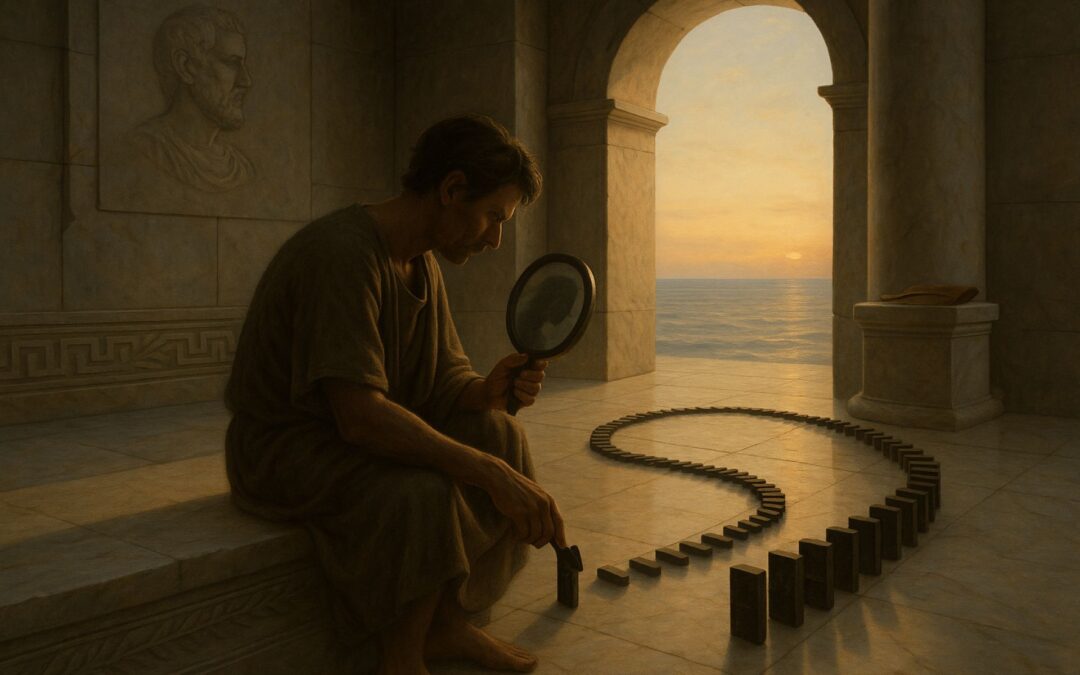
Fear is one of the mind’s cleverest illusions. It convinces us that by worrying, we’re somehow preparing; that by imagining disaster, we’re protecting ourselves from it. But more often, fear doesn’t save us — it sabotages us. It makes us tighten our grip until things slip away. It makes us overreact, mistrust, and micromanage. And in that desperate struggle for safety, we end up creating the very chaos we feared all along.
Seneca saw this pattern unfold in the most powerful halls of Rome and within the most ordinary human hearts. Fear, he realized, is not a shield — it’s a mirror. What we dread most, we often bring to life through our thoughts, words, and choices. The Stoic challenge, then, is not to suppress fear, but to master it — to stop letting it write the script of our fate.
“Many are harmed by fear itself, and many may have come to their fate while dreading fate.”
How Fear Builds Its Own Monsters
Fear is a master storyteller. It begins with a whisper — what if? — and before long, that whisper swells into an entire narrative of disaster. The mind fills in the blanks, weaving details so vivid they feel real. We start to see catastrophe around every corner, failure in every silence, judgment in every glance. The body tightens. The pulse quickens. We are already living the future we dread. And because we believe it so fully, we begin to act as if it’s true.
This is the subtle power of fear: it doesn’t need to be right to be effective. It just needs to be convincing. It hijacks imagination — that same mental faculty responsible for creativity, empathy, and problem-solving — and repurposes it for defense. We become architects of our own distress, constructing elaborate walls to guard against threats that exist only in thought. In trying to outmaneuver pain, we build elaborate mental traps that keep us stuck inside it.
Seneca, watching the turbulence of Rome’s political elite, understood this deeply. The people who feared downfall most — the generals, senators, and emperors — were often the ones who brought it upon themselves. Their anxiety over betrayal made them suspicious and ruthless. Their obsession with legacy made them tyrannical and insecure. Fear, unexamined, corrodes the very virtues that sustain stability: trust, patience, and reason.
In our time, the pattern continues. A business leader terrified of losing market share makes rash decisions that weaken the company. A person afraid of confrontation avoids it so long that resentment festers and explodes. A parent anxious about a child’s future overprotects them, stripping away resilience. Fear, at its core, is not protection — it’s possession. Once it grips us, it shapes our actions, our tone, even our identity. We become what we fear most: the source of our own undoing.
The Stoics didn’t deny fear’s presence. They accepted it as a natural impulse, but one that must be ruled by reason. For them, the true danger was never external — not war, not loss, not even death — but the ungoverned mind that panics before life’s uncertainty. It’s not the event that destroys us, Seneca reminds, but our emotional rehearsal for it.
The Paradox of Fear – Dreading the Very Thing We Cause
Fear, when left unchecked, transforms from a warning signal into a prophecy. It tells us to prepare, but its preparation is frantic, irrational, and self-defeating. The person who fears rejection starts to overthink every interaction, reading between lines that don’t exist. Their words become cautious, their gestures hesitant, their warmth replaced by calculation. The irony is cruel — the fear of seeming insecure makes them insecure; the fear of being unwanted makes them appear distant.
This is the essence of the self-fulfilling prophecy: expectation becomes creation. The mind, so focused on a feared outcome, unconsciously directs behavior toward it. We see what we expect to see. We act how we expect to act. And slowly, the imagined scenario hardens into reality. It’s not that fate conspires against us — it’s that fear narrows our choices until only the feared path remains.
Modern psychology agrees with Seneca’s wisdom. Studies on anxiety and cognitive bias reveal that fear sharpens our attention to threat cues, even when none exist. A neutral email feels like criticism. A friend’s silence feels like abandonment. We begin to interpret the world through the lens of danger, and so danger seems to multiply. Fear manufactures evidence for its own story.
This dynamic plays out not only in individuals but in cultures, organizations, and relationships. A company afraid of risk becomes so conservative that innovation dies. A government afraid of losing control clamps down so tightly that rebellion brews. A partner afraid of heartbreak smothers love until it cannot breathe. In every case, fear mistakes prevention for protection and ends up fulfilling its own prophecy.
The Stoics warned against this illusion. They taught that fear’s logic is inverted — by running from uncertainty, we invite it closer. The proper stance is not resistance but composure: to see fear, name it, and then act despite it. When we stop treating fear as prophecy and start treating it as data — information to be examined, not obeyed — we reclaim freedom of choice.
Seneca’s insight was not poetic exaggeration but psychological truth: the greater the fear, the tighter the grip — and the tighter the grip, the faster everything slips away.
When Power Meets Fear – Nero and the Leadership Trap
Seneca witnessed firsthand how fear corrodes power from the inside out. As Nero’s mentor, he once saw flashes of promise in the young emperor — intelligence, artistic ambition, even philosophical curiosity. But power, when mixed with insecurity, becomes volatile. Nero’s fear of being overthrown grew with his authority. Every whisper of dissent, every rival’s success, every rumor in the Senate became fuel for paranoia. Instead of ruling wisely, he ruled reactively. In his desperate attempt to eliminate threats, he created them.
Seneca tried to guide him with Stoic restraint: lead through reason, not impulse; trust virtue, not fear. But fear doesn’t listen — it only multiplies. Nero executed his rivals, alienated allies, and surrounded himself with flatterers who reinforced his delusions. The tragedy was predictable. The empire he feared losing eventually consumed him, and his terror of betrayal ended in self-destruction. The lesson is timeless: fear masquerades as vigilance, but its true nature is decay.
We see modern versions of Nero’s downfall everywhere. A CEO who fears being replaced becomes overly controlling, suffocating the creativity of their team. A leader afraid of criticism builds a culture of silence, where no one dares to speak the truth. A partner afraid of abandonment becomes possessive and demanding, pushing their loved one further away. Fear, left unchecked, turns influence into tyranny — even in the smallest domains of life.
The Stoics understood that power reveals character, and fear tests it. Leadership requires confidence in uncertainty, calm amid chaos. To lead effectively — whether a nation, a company, or a household — one must rule the inner world first. The leader who cannot master fear will inevitably project it onto others, mistaking control for stability, and suspicion for wisdom. As history shows, this rarely ends well.
Everyday Versions of the Same Cycle
You don’t need a throne to experience the tyranny of fear. It plays out quietly in daily life — in offices, relationships, and the conversations we have with ourselves. The pattern is always the same: we fear something, we act from that fear, and our reaction brings about the very outcome we hoped to avoid.
Take the fear of failure. It begins as an anxious thought: What if I’m not ready? What if I mess this up? So we wait, plan, and perfect. We delay action under the pretense of preparation, until the opportunity passes. The failure we dreaded arrives — not because we were incapable, but because fear convinced us to freeze.
Or consider the fear of loss. A person so terrified of losing their partner becomes possessive, constantly needing reassurance. The relationship becomes a cage built from insecurity. The partner, suffocated by suspicion, eventually leaves — confirming the fear that started it all.
Then there’s the fear of being disliked. It makes us agreeable to the point of invisibility, eager to please everyone but ourselves. Over time, resentment builds — both from others who sense our inauthenticity and from within, as we lose sight of who we are.
These cycles are exhausting, but they share one root: fear distorts perspective. It makes short-term safety feel like the highest good, when in truth, that safety is an illusion. Fear never delivers peace; it only postpones pain — and in doing so, compounds it.
To live Stoically is to recognize this loop and step outside it. Instead of reacting to fear, we must witness it. When we see fear as a thought — not a command — we stop feeding its logic. Life will always carry risk, loss, and uncertainty. The question is not how to eliminate fear, but how to live free from its control.
The Stoic Antidote – Control Your Mind Before It Controls You
For the Stoics, fear was not a monster to slay but a messenger to understand. It signals attachment — a place where we’ve tied our peace to something outside our control. When we fear failure, we’ve attached our worth to outcomes. When we fear rejection, we’ve attached it to others’ opinions. When we fear death, we’ve attached it to time itself. The Stoic path is not to harden against these fears, but to see them clearly and loosen the grip.
Epictetus said, “What upsets people is not things themselves, but their judgments about things.” Fear lives precisely in that gap — between event and interpretation. Once we learn to pause and examine the story fear is telling, we often find it built on assumption, exaggeration, or ego. The fear is not in the world; it’s in us.
Practically, the Stoic method for mastering fear begins with awareness. When anxiety rises, name it. Ask: What am I truly afraid of? Then, separate what is within your control (your effort, your response, your principles) from what is not (the outcome, others’ reactions, the future). That division alone weakens fear’s hold.
Next, take disciplined action. Marcus Aurelius reminded himself: “Do what is in front of you — well, and justly.” By focusing on right action, not right outcomes, the Stoic escapes the trap of worry. Fear thrives on imagination, but it dies in movement.
Finally, practice detachment. Detachment isn’t apathy; it’s freedom from compulsion. It’s the courage to say: If it happens, I will endure it. If it doesn’t, I will continue as before. In that space, fear loses its authority.
The Stoics never claimed that fear disappears. They claimed something far more powerful — that fear can exist without domination. You can feel it and still move forward. You can tremble and still act. The true victory is not fearlessness but sovereignty: the mind ruling itself, unshaken by the illusions it once served.
Conclusion
Fear’s greatest deception is that it feels useful. It masquerades as vigilance, whispering that if we just stay alert, stay worried, stay ready, we’ll be safe. But the truth is quieter and far less dramatic: we are safest when we’re calm, clearest when we’re still, and strongest when we trust our reason over our reactions.
Seneca’s warning remains timeless: many are harmed not by fate, but by their fear of it. The next time you feel anxiety tighten its hold, remember — the future is not your enemy, and fear is not your protector. If you can steady the mind, you can meet life as it comes, unshaken and unafraid.
This article is part of The Daily Stoic Series based on Ryan Holiday’s book.