
Every human being, no matter how disciplined, has known the pull of emotional eruption. The sharp words, the slammed door, the teary confession that feels like release — until it doesn’t. In those moments, we tell ourselves it’s necessary, even healthy, to “let it out.” But if we pause afterward, the question quietly arises: Did that really make me feel better?
Seneca asked this same question nearly two thousand years ago, not out of judgment but out of wisdom. He knew that while pain is inevitable, our reaction to it often multiplies our suffering. What we call relief is often just exhaustion — the stillness that follows chaos, not the peace that comes from clarity. Stoicism invites us to see beyond the drama of our emotions and to ask whether our responses serve us or enslave us.
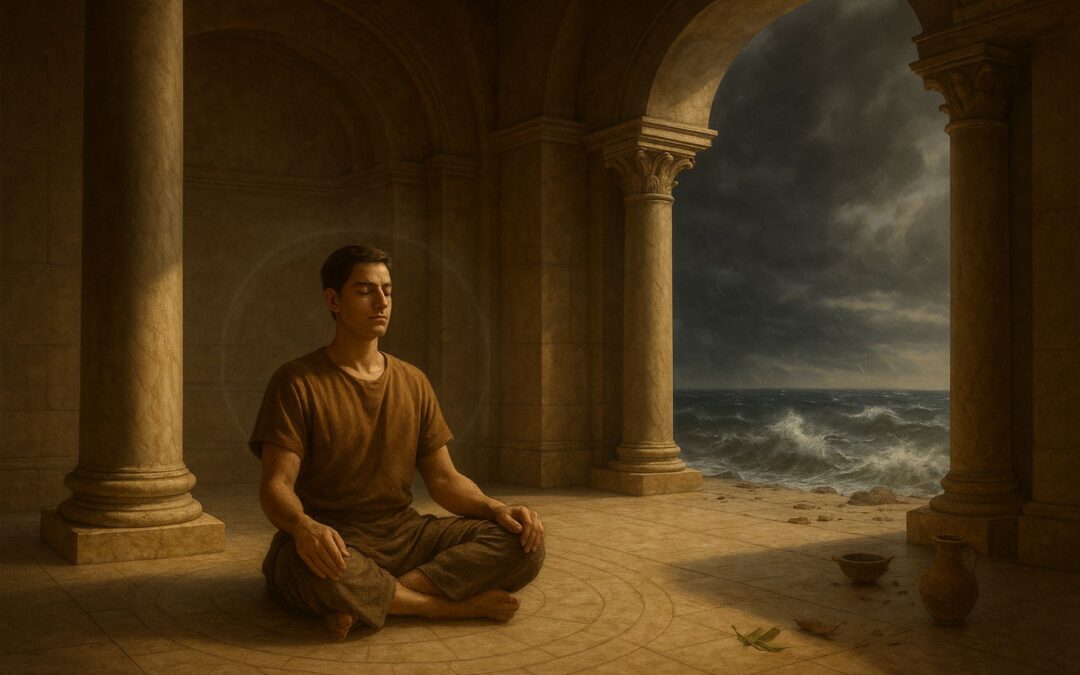
This reflection, then, isn’t about suppressing feelings; it’s about reclaiming agency. It’s about learning the rare art of sitting still within discomfort — of finding calm not after the storm, but inside it.
“You cry, ‘I’m suffering severe pain!’ Are you then relieved from feeling it, if you bear it in an unmanly way?”
— Seneca, Moral Letters, 78.17
When Emotion Feels Like Relief
Imagine a moment when anger or grief takes hold — your pulse quickens, your vision narrows, words tumble out faster than you can think. Maybe you slam the table, throw something across the room, or lash out at the nearest person. For a fleeting instant, you feel powerful. You’ve done something. You’ve released the tension. The mind whispers, Finally, I’ve let it out.
But then, the silence that follows is heavy. The heart still races. The ache remains. Often, guilt creeps in. You replay the scene in your head, wishing you had shown more restraint, wishing you hadn’t given away your composure so easily. The release wasn’t relief — it was the body’s short-term anesthesia, masking the wound it never treated.
Seneca’s question is deceptively simple: If you cry out in pain, does that reduce the pain itself? If you express your distress in a frantic, unmeasured way, do you actually suffer less — or more? He’s not scorning emotion; he’s challenging the illusion that reacting to pain somehow redeems it.
The Stoics observed that much of our suffering comes not from what happens to us, but from how we respond. The outburst feels like control — but in truth, it’s surrender. It’s the abdication of reason, the handing over of our will to the chaos of feeling. The temporary sensation of release deceives us because it mimics resolution. Yet when the dust settles, the problem remains untouched, and our inner state is weaker than before.
Stoicism doesn’t demand emotional numbness; it calls for mastery. To feel deeply but act wisely. To register the surge of emotion, but not mistake it for guidance. When we explode, we lose the distance needed to understand what truly hurts. When we pause, we gain perspective — and with it, the possibility of healing.
So when the next wave of emotion rises, try to stand within it instead of thrashing against it. Notice the pull, the urge to dramatize, to demand an audience. Ask quietly: Is this helping? Or am I just performing my pain? That simple act of awareness is the first step back toward calm — not the fleeting calm of exhaustion, but the grounded calm of understanding.
The Illusion of Catharsis
Our culture reveres expression. We tell ourselves that bottling emotions is dangerous, that “letting it out” is the only path to authenticity. From childhood, we’re taught to equate honesty with immediacy: if you feel it, say it; if you’re angry, show it; if you’re hurt, cry until the world notices. And yet, despite all this emotional transparency, very few people seem truly at peace.
The problem lies in what Seneca would call our false medicine. We confuse display with discharge. We think that yelling, venting, or posting about our struggles will purify us. But these actions often entrench the feeling rather than release it. They reward the emotion with attention — internal and external — which teaches the mind to summon it again the next time discomfort appears.
Modern psychology has validated much of what the Stoics already knew: habitual venting doesn’t relieve anger or sadness; it rehearses it. Each time you indulge the reaction, you reinforce the neural pathway that triggers it. You become better at getting angry, not calmer; better at complaining, not solving; better at dramatizing your distress, not dissolving it.
The illusion of catharsis thrives because it feels momentarily satisfying. That burst of emotion gives a sense of momentum — you’re “doing something.” But that “something” is noise, not progress. The emotional storm expends energy that could have gone toward understanding the cause. It’s like screaming at a wound instead of cleaning it.
Nowhere is this illusion clearer than in the modern digital landscape. We scroll through endless displays of outrage and heartbreak — rants, callouts, lamentations, “vent posts.” The world has given us a global stage for our emotions, but not the tools for discernment. Stoicism would view this as the height of confusion: mistaking expression for liberation. What we broadcast to others is often what we haven’t yet faced within ourselves.
Catharsis, in the Stoic sense, isn’t about release through reaction. It’s purification through reflection. It’s not the scream that heals; it’s the silence after, when reason returns and perspective expands. The moment we stop performing our pain, we can finally listen to what it’s been trying to tell us.
A Stoic Pause in the Storm
In the space between stimulus and response lies one of the most powerful human abilities — the ability to pause. The Stoics saw that gap as sacred ground, the threshold where chaos can either take over or dissolve. Most people never enter that space. They rush from emotion straight to reaction — a seamless chain of impulse masquerading as necessity. Someone insults them, and the retort flies out. Something goes wrong, and the complaint erupts. There’s no reflection, only reflex.
But imagine if, in that very moment, you stopped. You inhaled once, deeply, before answering the provocation or giving in to frustration. You asked yourself a single, grounding question: Is this reaction actually making me feel better? That pause doesn’t erase the emotion — it illuminates it. It allows awareness to rise before anger, before despair, before panic.
Marcus Aurelius practiced this discipline daily. He wrote that “the nearer a man comes to a calm mind, the closer he is to strength.” Calm is not passivity; it’s precision. When you pause, you gain the ability to see the emotion as separate from your identity — not “I am angry,” but “Anger is present.” That simple shift restores agency. The emotion is no longer the driver; you are.
Modern neuroscience supports what the Stoics intuited. The brain’s amygdala fires first — impulsively, emotionally. But when we pause, the prefrontal cortex engages, granting reason a foothold. A breath, a question, even a subtle physical shift — these are acts of rebellion against automatic living. They buy us clarity.
This is not suppression; it’s redirection. Stoicism doesn’t ask you to deny feeling but to engage with it wisely. To respond as if your emotions were signals, not masters. The pause is how you turn reaction into reflection, chaos into control, and pain into instruction.
Each moment of restraint is a quiet triumph — invisible to others but monumental within. Because every time you resist the pull to explode or despair, you’re rewiring your nature toward strength. The pause becomes a ritual of composure — a small, steady act of sovereignty over the self.
The Real Source of Relief
True relief doesn’t come from venting your suffering — it comes from transforming your relationship to it. You cannot always eliminate pain, but you can decide how to carry it. That’s where Stoic philosophy becomes not just an idea but a form of therapy.
Seneca’s question — “Are you relieved from feeling pain if you bear it in an unmanly way?” — is often misunderstood as a call to repress emotion. In reality, he’s urging dignity. He’s asking: What good is your outburst? Does it ease the pain, or does it compound it with regret? To “bear pain in a manly way” — or, more accurately, a noble way — means to endure it with grace, to resist the temptation of spectacle, to choose steadiness over self-pity.
The Stoics believed that all external suffering could be neutralized by internal strength. Epictetus put it plainly: “It’s not what happens to you, but how you react to it that matters.” The wound may remain, but the story you tell about it determines whether it becomes trauma or transformation. When you can stand before hardship and think, This too is within my power to endure, you are no longer its victim. You are its student.
Relief, then, is not an emotional release but a realignment of perception. It’s the moment you stop fighting what is and start responding to it with wisdom. It’s understanding that your peace is not held hostage by events, only by your interpretation of them.
When you master this, life changes shape. The insults don’t pierce as deeply. The disappointments don’t derail your purpose. The chaos of the world still surrounds you, but inside, a stillness forms — resilient, rational, enduring. That’s what Seneca meant by relief: not a fleeting sense of comfort, but an enduring sense of control.
Pain, loss, anger — these are inevitable. But the unshakable peace that comes from perspective? That’s earned. And it is the kind of relief that no outburst, no venting, no momentary catharsis can ever give you.
Conclusion
The next time you find yourself overwhelmed — by anger, grief, or fear — resist the temptation to dramatize it. Don’t rush to release it through noise or display. Instead, observe it. Ask the Stoic question: Is this reaction actually helping me?
That question is more than a mental trick; it’s a doorway to freedom. It shifts your awareness from the surface of emotion to its source. It reminds you that your peace of mind was never stolen — it was only surrendered.
Stoicism teaches that composure is not coldness but courage — the kind that allows you to endure pain without letting it define you. True relief, after all, doesn’t come from venting emotion but from understanding it. And when understanding dawns, suffering begins to dissolve on its own, leaving behind something stronger, quieter, and infinitely more enduring: mastery over the self.
This article is part of The Daily Stoic Series based on Ryan Holiday’s book.