
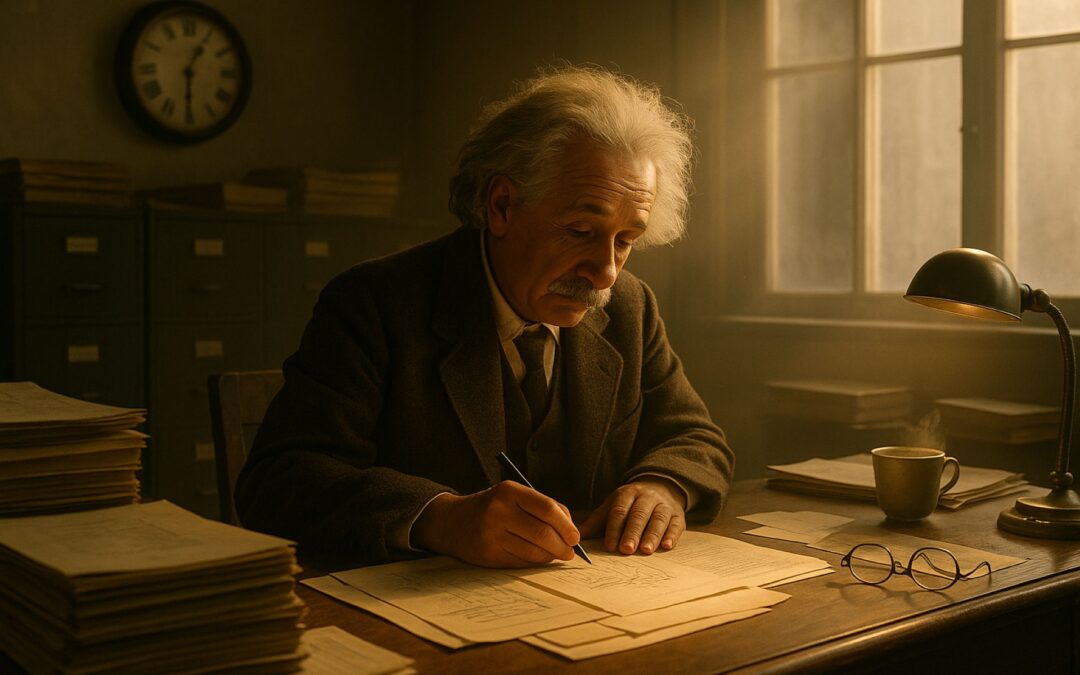
Albert Einstein’s story after graduation is not one of early triumph but of deliberate restraint. At twenty-one, facing rejection and limited prospects, he made a choice that few would understand—he traded prestige for peace of mind. While his peers pursued status and secure positions, he accepted a monotonous job at the Swiss Patent Office, a decision that looked like surrender but was, in truth, strategy. It was there, amid stacks of patent applications and the hum of bureaucracy, that Einstein learned the rarest art of all: the art of protecting his time.
The young physicist grasped what most people never do—that the path to mastery is not paved with more opportunities, but with fewer distractions. His days became a meditation in mental economy: finishing his work quickly, guarding his solitude, and using the remaining hours to cultivate thought. From that quiet discipline came one of history’s greatest revolutions in science. Einstein’s example stands as a timeless reminder that freedom is not the absence of structure but the intelligent shaping of it—and that time, once chosen wisely, can become the workshop of genius.
Daily Law: Time is the critical variable. Take one thing off your plate today to make more time for your Life’s Task.
— Mastery, II: Submit to Reality—The Ideal Apprenticeship
The Freedom Found in Constraint
When Albert Einstein walked out of Zurich Polytechnic in 1900, the world did not open its arms to him. He had barely passed his examinations, his professors regarded him with suspicion, and the respectable path of academia—lectureships, research positions, prestige—seemed closed. Yet what looked like failure was in fact the beginning of a deliberate apprenticeship. Einstein, stripped of institutional approval, found himself free to decide not just what to pursue, but how.
He was offered several opportunities, each promising comfort but demanding his time. His father’s dynamo business in Milan would have given him stability, but it would consume his mind with mechanical routine. A friend could secure him a lucrative role in an insurance company, yet Einstein saw the hidden cost: his curiosity would wither under bureaucracy. He chose instead the modest, unremarkable position at the Swiss Patent Office—a decision most would have dismissed as a waste of talent. But Einstein was not optimizing for income; he was optimizing for thought.
The Patent Office became, paradoxically, the laboratory of his imagination. Each day, he reviewed diagrams of machines and descriptions of inventions—ideas frozen on paper, awaiting analysis. His task was to decide whether they worked, whether they obeyed the laws of physics. It was a strange kind of work: neither manual nor creative, yet perfectly suited to his temperament. It demanded precision, but not passion; attention, but not obsession. He could think deeply while appearing industrious.
Within months, he mastered the art of efficiency. What once took him hours he could now complete in a fraction of the time. And with that efficiency came his most valuable resource—unclaimed hours. These became the secret workshop of his mind. At his desk, surrounded by patent drafts and mechanical sketches, Einstein began conducting his legendary Gedankenexperimente—thought experiments that would one day reshape our understanding of space, time, and light.
The beauty of Einstein’s choice lies in its inversion of ambition. While others sought to rise, he sought to clear space. His was a rebellion not of action but of omission. By lowering his external demands, he heightened his internal life. He realized that creative freedom does not require ideal conditions; it requires controlled conditions—a routine that protects the mind from distraction and the ego from excess.
Constraint, when chosen, is not imprisonment but power. It creates the container in which depth can form. Like a sculptor who carves by removing stone, Einstein sculpted his genius by eliminating all that was unnecessary. The Patent Office became the temple of his solitude, its steady rhythm the heartbeat of his becoming. In that quiet obscurity, the theory of relativity was not merely conceived—it was incubated, patiently, invisibly, through the disciplined stewardship of time.
Time as the True Apprenticeship
Einstein’s years in the Patent Office were not a pause in his career—they were the apprenticeship that shaped his genius. Yet this was an apprenticeship of an unconventional kind. There were no professors, no mentors guiding his hand, no laboratories filled with instruments. His tools were his mind, a notebook, and the patient flow of hours. While others were racing to publish, to network, to impress, Einstein was training in something rarer and infinitely harder to master—the ability to think deeply for long stretches of time.
He understood, perhaps instinctively, that the greatest discoveries do not come from frenzy but from focus. Every hour reclaimed from triviality became a workshop for imagination. The patent files he read each day—though mundane in appearance—were exercises in conceptual precision. Each one forced him to dissect the mechanics of thought: How does energy flow? How do forces interact? Could time itself behave like a variable rather than a constant? The office, with its repetitive rhythm, became a crucible of discipline. It honed his patience, sharpened his logic, and, most importantly, strengthened his endurance for solitude.
Einstein was apprenticing himself not to a man but to a method. He learned how to hold a question in his mind for months without losing faith in it. He learned that progress often hides beneath monotony, that inspiration requires incubation. His workday, confined by the routine of bureaucracy, provided the very scaffolding his intellect needed to climb. When others might have grown dull in such conditions, Einstein grew sharper. Routine became the metronome of his genius.
This quiet discipline culminated in his annus mirabilis—the miraculous year of 1905—when he published four revolutionary papers that redefined physics. Each idea had been germinating for years within those protected hours. The world called him a prodigy, but his brilliance was less about sudden flashes and more about sustained attention. Genius, as it turns out, is not a gift of lightning—it is a fire kept alive in stillness.
Einstein’s life at the Patent Office reveals a truth most overlook: time is not a passive ingredient in mastery—it is the apprenticeship itself. The hours you spend in contemplation, in quiet persistence, are not delays; they are the work. True mastery demands the courage to slow down, to create your own rhythm against the rush of the world. It asks you to treat time not as something to fill, but as something to cultivate.
We are taught to chase teachers, degrees, and titles. Yet the deepest lessons cannot be taught—they must be earned through patient repetition and self-directed curiosity. Einstein’s example reminds us that mastery is not bestowed by institutions; it is built in the unseen hours we dedicate to thinking, refining, and understanding. In that sense, every moment of solitude, every stretch of undistracted focus, is an apprenticeship under time itself—the one teacher that never flatters, never rushes, and never forgets to reward those who respect its pace.
The Modern Tragedy of Busyness
We live in an age that confuses momentum with meaning. Our calendars overflow, our inboxes never sleep, and our attention—once the seat of our intellect—has been divided into a thousand blinking fragments. The modern mind is rarely still enough to think, let alone to create. We have built an entire civilization that celebrates motion for its own sake, where the absence of movement feels like failure, and silence feels like guilt.
Busyness has become the new virtue. We wear exhaustion like a medal and treat burnout as proof of importance. Ask someone how they are, and their first answer is no longer emotional but logistical: “Busy.” It has become our collective identity, our shorthand for relevance. Yet beneath this constant motion lies a quiet despair—a fear that if we stop moving, our value will vanish.
In Einstein’s time, solitude was unavoidable; now, it must be defended. The problem is not merely that we are occupied, but that we are occupied by trivia. Our hours vanish into meetings that achieve nothing, conversations that go nowhere, notifications that summon us to the shallow end of thought. The result is intellectual malnutrition: a starvation of depth masked by the abundance of noise. We mistake the visible effort of work for the invisible discipline of reflection.
What makes this tragedy sharper is its self-reinforcing nature. The busier we become, the more we lose the capacity to discern what deserves our time. Decision fatigue erodes judgment; distraction masquerades as opportunity. We say “yes” to everything because saying “no” feels like losing ground. But each acceptance is a small surrender. We fill our days to avoid the discomfort of emptiness, unaware that it is precisely in emptiness that imagination begins to form.
The true casualty of busyness is not time—it is originality. Creativity requires stillness, the kind of unhurried attention that allows subtle connections to emerge. The mind cannot leap forward if it is constantly reacting. To think deeply is to resist the pressure to respond instantly. The modern worker, forever available, forever reachable, has been trained to confuse accessibility with contribution. But availability is not value; it is vulnerability—the open door through which meaning quietly escapes.
This addiction to activity also corrupts our sense of self. When every waking hour is consumed by external demands, we forget the internal dialogue that defines us. The ancient philosophers called this otium—the noble leisure in which a person turns inward to examine life. We have replaced it with negotium, the restless commerce of obligations. Our culture exalts the latter and despises the former, as though contemplation were laziness and presence were indulgence.
And so we sprint, even when the destination no longer matters. We work through meals, think in fragments, and sleep in deficits. We become technicians of efficiency rather than architects of purpose. Einstein’s quiet hours at his desk—once dismissed as unproductive—now stand as a quiet indictment of our busyness. His achievements were not born from multitasking but from the opposite: the radical act of undivided attention.
The tragedy of our time is that we have all the tools Einstein could have only dreamed of, yet none of his silence. We are surrounded by infinite knowledge, yet deprived of depth. We have mastered communication, yet lost communion—with our ideas, our craft, and ourselves. The modern tragedy of busyness is not simply that we are overworked, but that we are under-thought.
Reclaiming Time for Your Life’s Task
If busyness is the disease of the age, then conscious subtraction is its cure. To reclaim time is to reclaim sovereignty over your own existence. It begins not with grand gestures but with small, deliberate refusals—an email left unanswered, a meeting declined, an evening left open for reflection. Every act of resistance against unnecessary noise becomes a declaration of intent: my time serves my purpose, not the other way around.
Einstein understood this long before the world celebrated him. His genius was not born from excess activity but from what he chose not to do. He resisted the urge to chase prestige or recognition. He refused the glittering but mind-numbing paths offered to him. In doing so, he created what few people ever manage—a life designed around depth. His days had rhythm, not rush; direction, not distraction. Each morning, he entered his small office with its ticking clock and quiet air, knowing that time was his real instrument.
For most of us, time is something to spend or kill; for the master, it is something to sculpt. Reclaiming time requires a shift in consciousness—from seeing time as a stream that carries us along to recognizing it as clay that can be molded. You begin by asking one honest question: What do I wish to give the best hours of my life to? Until that question is answered, every hour risks being stolen by the trivial.
The art of subtraction is not a rejection of ambition but its refinement. To focus your time is to clarify your values. You discover, in the process, that most obligations are self-imposed, born of the fear of being forgotten or left behind. But time spent chasing approval is time withdrawn from creation. The one who learns to say “no” gracefully acquires something rarer than opportunity—clarity.
In reclaiming time, you will face discomfort. Stillness will at first feel wasteful; silence will seem unproductive. This is the mind’s withdrawal from its addiction to stimulation. But persistence transforms unease into strength. Over time, what once felt empty becomes sacred. You begin to see your hours as vessels for meaning rather than containers for tasks.
Design your day as Einstein did—with sacred boundaries around your creative energy. Structure your obligations to serve your purpose, not sabotage it. Let simplicity become your shield. Routine, far from being dull, becomes the architecture of freedom. In those protected hours, you build something no one else can see: your Life’s Task taking shape through patience and continuity.
The paradox of mastery is that it demands less, not more. It requires the courage to choose a single path and walk it deeply. In a world where attention is the rarest currency, the ability to preserve your focus is the highest form of wealth. Reclaiming time is not about doing nothing; it is about doing the right thing with complete awareness.
To serve your Life’s Task is to treat every hour as an investment in eternity. The work may not make you famous, but it will make you whole. For in the end, the measure of a life is not how much we have done, but how much of what we have done was ours.
Conclusion
Einstein’s life in the Patent Office offers a paradox that every modern thinker must confront: limitation can be liberation. By choosing simplicity, he uncovered the conditions for complexity. By narrowing his world, he expanded it beyond measure. His decision was not about renouncing ambition but about refining it—building a life in which thought, not noise, held dominion.
Our world runs on the opposite logic. We fill every moment, fearing the stillness in which our purpose might confront us. Yet to achieve anything of depth, we must learn what Einstein knew instinctively—that time is not something to possess, but something to protect. The hours we defend from the trivial are the hours that define us. When we choose time deliberately, we choose destiny itself.
This article is part of The Daily Laws Series based on Robert Greene’s book.