
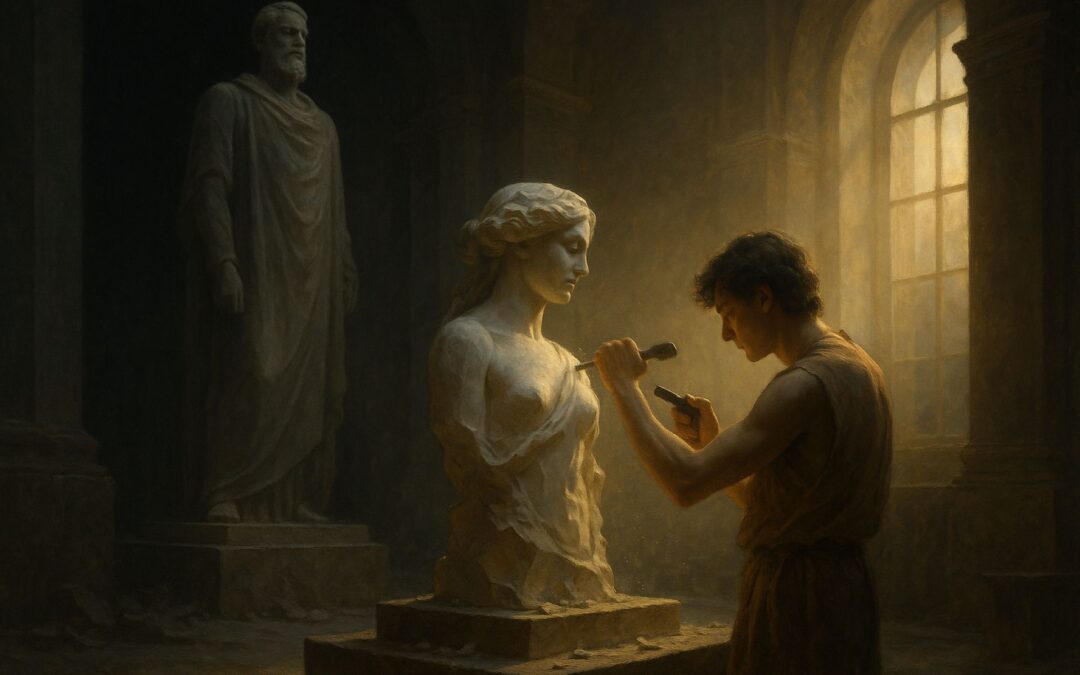
“Poor is the apprentice who does not surpass his Master.”
—Leonardo da Vinci
Every master begins as an apprentice — humbled, uncertain, and drawn to the brilliance of someone greater. But somewhere along that journey, the very guidance that once liberated begins to confine. The mentor’s voice grows louder than your own; their methods, once enlightening, start to dictate the limits of your imagination. This is the invisible threshold of mastery — the moment you must decide whether to remain a follower or to evolve into something beyond imitation.
To surpass your master is not arrogance. It is the final act of respect — to take what you have been given and refine it through your own struggle, insight, and transformation. Every great lineage in art, science, or philosophy survives because someone dared to extend its boundaries. The student who never surpasses the teacher ensures the death of the craft; the one who does keeps it alive.
Daily Law: Beware the illustrious mentor’s shadow. Try out their ideas but always transfigure them and differentiate yourself. Your goal is to surpass them.
—Mastery, III: Absorb the Master’s Power—The Mentor Dynamic
The Shadow of the Master
Every apprenticeship begins with reverence — that quiet, humbling sense of awe in the presence of someone who embodies everything you wish to become. To be near mastery is intoxicating. You study every gesture, every decision, hoping to absorb their power through proximity. The master’s brilliance feels like sunlight — warm, generous, illuminating. Yet as you stand beneath it, you may not notice the shadow it casts.
At first, imitation feels natural. You learn their systems, adopt their language, replicate their thinking. It’s an efficient way to accelerate understanding — but it’s also how identity begins to erode. The mentor’s worldview becomes a lens that filters your perception. Their methods become unquestioned truths. Their approval becomes your compass. Slowly, the line between learning and living in someone else’s image begins to blur.
The tragedy of many apprentices lies not in their lack of talent, but in their comfort with subordination. They learn to think like their masters, not beyond them. The brilliance that once inspired them becomes a boundary they dare not cross. And so they spend years refining the same techniques, perfecting the same formulas — mistaking repetition for mastery.
To remain under the shadow of the master is to mistake imitation for progress. Every insight you have is measured against theirs. Every instinct feels like heresy. The mind, once open and curious, becomes cautious and self-censoring. You learn to speak in another person’s voice — eloquently, convincingly — but never your own.
Escaping that shadow requires a rupture. A deliberate, internal rebellion. The apprentice must risk disappointment, even alienation, to discover what lies outside the safety of inherited wisdom. This is why so few truly grow — because independence feels like betrayal. But the paradox of mentorship is that the teacher’s greatest gift is not the transmission of knowledge, but the moment their student no longer needs them.
When you step beyond the master’s reach, you begin to see their lessons differently. What once felt like commandments now appear as tools — flexible, adaptable, imperfect. You learn to reinterpret rather than obey, to question rather than confirm. The light that once blinded you becomes the light you now carry. And from that moment onward, you are no longer a student — you are a maker.
The Art of Differentiation
To imitate well is to understand deeply, but to differentiate is to create. Every great artist, scientist, or thinker has walked this delicate bridge between learning and inventing. You begin with imitation because it is the most direct way to internalize mastery — to make another’s genius part of your muscle memory. But if imitation is never transcended, it becomes a gilded cage.
Differentiation begins the moment you feel friction — that quiet resistance between your intuition and your mentor’s instruction. It’s the subtle voice that whispers, “This doesn’t feel like me.” At first, you ignore it. You’ve been conditioned to trust the master’s authority over your own perception. But eventually, that voice grows insistent. It tugs at the edges of your conformity, urging you to alter, to twist, to make the familiar strange again.
Consider Glenn Gould, whose musical education under Alberto Guerrero was marked by total devotion. He practiced Guerrero’s exercises obsessively, imitating his precision, his phrasing, his logic. But as Gould matured, he began to distort these forms. He slowed passages that tradition demanded be brisk, emphasized silences others overlooked. Critics called it eccentric; history called it genius. What Gould did was simple yet radical — he metabolized his mentor’s method into something that could only come from him.
That is the essence of differentiation: you absorb, then transmute. Knowledge becomes intuition. Technique becomes personality. The mentor’s ideas dissolve, reconstituting themselves in the unique chemistry of your temperament. What remains is something neither entirely borrowed nor wholly original — it is the synthesis of both.
This process, however, demands courage. The act of divergence often feels like disloyalty. You fear that in altering the master’s wisdom, you might diminish it. But the truth is the opposite — only by reinterpreting greatness do you keep it alive. Every tradition, every discipline, survives because someone dared to modify it. Evolution depends on creative heresy.
Differentiation also requires restraint. Not every deviation is meaningful; not every rebellion is intelligent. The goal is not to reject the master’s teaching, but to reveal its hidden potential — the possibilities even they might have overlooked. True originality is not built in opposition, but in continuation. It is the same melody, carried into a new octave.
When you reach this point, imitation becomes invisible. You are no longer performing another’s brilliance; you are channeling your own. The master’s lessons remain in your hands, but their voice no longer echoes in your mind. What once guided you now lives within you — altered, refined, and reborn.
Transcendence Through Transformation
The moment you transcend your master is rarely dramatic. It does not arrive as a declaration of superiority but as a quiet realization — the realization that you no longer ask for permission. Your thinking begins to move beyond the boundaries of your teacher’s influence; your instincts, once uncertain, now lead you. What was once a conversation between you and the master becomes a monologue of your own making.
To transcend is not to discard what came before, but to remake it. The ideas, methods, and philosophies of your mentor become raw material — a living clay that you mold with the pressure of your individuality. This process of transformation is not rebellion for its own sake; it is continuity through renewal. You take what you have inherited and carry it further than its originator could have imagined.
Transformation is the essence of all progress. In art, it births new movements; in science, it leads to new paradigms; in life, it becomes self-realization. The Renaissance was built upon this principle — students who revered their teachers yet refused to remain their copies. Michelangelo studied under Ghirlandaio, absorbing the techniques of fresco and perspective, but soon surpassed his teacher by imbuing those forms with psychological depth and divine tension. What he inherited as instruction, he returned as revelation.
Every act of transcendence begins with an act of interpretation. The student asks: What did my teacher miss? What assumptions did they leave unquestioned? Where does their wisdom fail to see the full horizon? These questions are not insults — they are the final proofs of understanding. The master has done their work well when their ideas are not worshiped, but tested.
Yet transformation always carries risk. To step beyond the master’s framework is to enter uncertainty — to abandon the comfort of tested formulas and venture into the unlit territory of invention. It requires faith not in what you know, but in your ability to discover. The apprentice who hesitates here, who clings too tightly to the teacher’s scaffolding, becomes a caretaker of the past rather than a builder of the future.
True transcendence happens when imitation becomes invisible and gratitude becomes action. You no longer repeat your teacher’s methods; you embody their spirit of curiosity, their hunger to go further. You do not surpass the master by defeating them, but by fulfilling what they began. The lineage continues — not through repetition, but through reinvention.
To transcend, then, is to complete the cycle of learning: to begin with imitation, evolve through differentiation, and culminate in creation. It is the moment when the apprentice ceases to orbit another’s brilliance and begins to generate their own light.
The Cycle of Mastery
The cycle of mastery is eternal — a rhythm older than any craft or civilization. Every generation begins as the student and ends as the master, only to be surpassed again by those who follow. The wisdom of one era becomes the foundation of the next, but never its limit. Progress survives because humility and audacity take turns holding the reins.
A true master does not seek immortality through control. They understand that their teachings are not sacred texts but starting points. The master’s role is to ignite a lineage, not to protect a legacy. When their students outgrow them, the teacher’s influence deepens, because it has transcended ownership. In the act of being surpassed, the master becomes timeless.
But this requires the master to accept dissolution — to release attachment to being the final authority. Many cannot. They mistake reverence for relevance and cling to their status long after their insight has been inherited. The classroom, the workshop, the studio — all become shrines to the past. In doing so, they betray the very principle of mastery: that knowledge must move, evolve, and be reborn in new forms.
The cycle continues only when both sides play their part with integrity. The apprentice must dare to move beyond imitation, and the master must bless that rebellion. It is a relationship built not on dependence, but on mutual disappearance. The student sheds the master’s voice to find their own, while the master fades so that the student may be seen. Both acts require courage; both demand surrender.
When you, too, become the mentor, remember the humility of your own beginnings. Encourage your students to challenge, reinterpret, and improve upon you. Resist the temptation to preserve your wisdom untouched. For what you give life to, you must also let die — only then will it continue to grow.
The legacy of any great teacher lies not in the perfection of their disciples, but in their imperfection — the small cracks where innovation slips through. The Renaissance thrived not because its students were obedient, but because they were audacious. Philosophy advanced not through devotion, but through doubt. Every civilization renews itself through those who dare to question its founders.
The highest form of mastery is disappearance. To create something that no longer needs you. To teach so deeply that your influence becomes untraceable, absorbed into the progress of others. This is the silent triumph of every great lineage — when the student no longer bears the master’s name, yet everything they do carries its echo.
Conclusion
Mastery is not a static achievement but a living continuum — a cycle of learning, transforming, and letting go. The mentor gives shape to your beginnings, but your task is to give destiny to what they started. To remain forever in their image is to betray both your potential and their purpose.
When you finally step beyond their shadow, you do not abandon them; you fulfill them. You become proof that their wisdom was not fragile, but fertile. And when your own time comes — when new minds gather beneath your light — remember this law: that your greatness will not be measured by how long you are followed, but by how fearlessly you are surpassed.
This article is part of The Daily Laws Series based on Robert Greene’s book.