
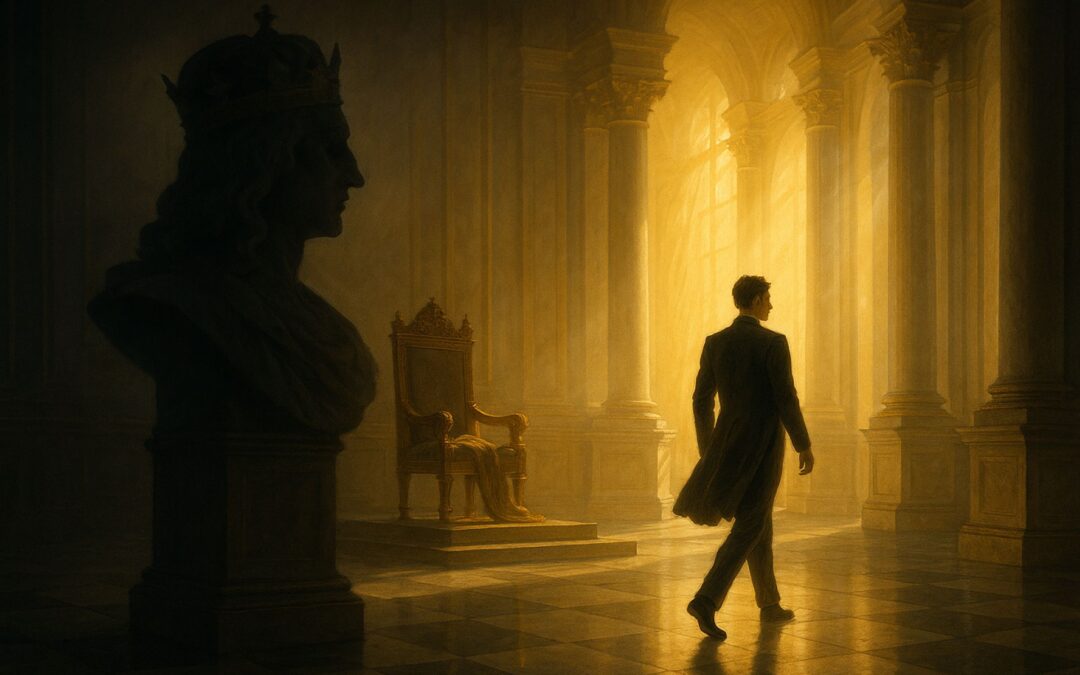
In every age, greatness begins with divergence. The moment you step beyond imitation — beyond the patterns laid by those before you — you begin to author your own myth. History remembers not the faithful followers but the daring innovators, the ones who dared to redefine the very stage they inherited. Louis XIV understood this with an almost divine instinct. He didn’t just reign differently — he appeared differently. He made style the language of sovereignty and turned his difference into doctrine.
This law of distinction has not faded with time. In a world overflowing with echoes, true influence still belongs to those who create their own sound — who turn their presence into a statement. To establish your own style is not vanity; it is necessity. It is the means by which individuality survives the gravitational pull of tradition.
Daily Law: Follow the master’s example, not his path. Demonstrate your difference. Establish your own style.
— The 48 Laws of Power, Law 41: Avoid Stepping into a Great Man’s Shoes
The Power of Symbolic Separation
Power is not inherited through succession — it is earned through reinvention. Every figure who has transcended the shadows of a predecessor has done so by creating visible, unmistakable separation. The human mind resists subtlety; it seeks symbols to understand meaning. Thus, if you wish to establish yourself, your transformation must be perceptible, almost theatrical. People do not recognize change through quiet competence alone — they must see it enacted.
This principle operates at every level of human enterprise — from kingdoms to corporations, from art to personal identity. The apprentice who rises to mastery must eventually break from imitation; the successor who wishes to rule must abandon the habits of those who came before. Continuity feels safe but is rarely respected. It signals deference, not dominance. You cannot redefine a space while still standing in the footprints of another.
Symbolic separation does not require arrogance — it requires intention. It is a declaration of self-definition, an act that says, “My rule begins here.” It can manifest as architecture, ritual, language, or even silence. A leader might restructure how meetings begin; an artist might strip away ornament to reveal essence; a thinker might abandon the jargon of their field to speak with startling simplicity. The key lies in the audacity to reframe what is considered normal.
Those who fail to distance themselves are consumed by legacy. They inherit the reputation, the expectations, and the limitations of what was built before them. People will compare endlessly — “He is like his mentor,” “She reminds me of the founder,” “This feels familiar.” These comparisons dilute individuality until the person becomes a replica, functioning within someone else’s myth. The most dangerous position is not to fail outright but to succeed under the shadow of another’s success.
To separate symbolically is therefore to claim authorship over your own narrative. It’s an act of sovereignty. Every empire, idea, or identity requires a moment of rupture — a clean break where one story ends and another begins. You cannot lead while borrowing someone else’s language; you cannot inspire while echoing another’s rhythm. The moment you decide to embody your own symbols — to stand apart and to be seen as distinct — you begin the true work of power: constructing reality on your own terms.
Louis XIV and the Architecture of Identity
Louis XIV understood this law as few ever have. When he ascended the throne, France was still bound to medieval images of kingship — dim halls, rigid ceremony, and power defined by ancestry. But Louis saw that lineage alone could no longer inspire awe. To rule absolutely, he needed not to resemble the kings of the past, but to eclipse them. He needed a symbol that could embody his divine right and personal supremacy in one enduring vision.
Versailles became that vision — a masterpiece of psychological and architectural genius. Built on what was once a swamp, the palace transformed emptiness into magnificence. Its endless galleries, radiant mirrors, and meticulously aligned gardens expressed not comfort, but control. The geometry of Versailles mirrored the geometry of the king’s will: every line, every reflection, every perspective converged toward a single center — the Sun King himself.
Louis’s rejection of old symbols was radical. No longer would the monarch wear a crown or hold a scepter, relics of medieval piety. Instead, he would rule through ritualized spectacle. Each day unfolded like theater: the lever (his morning rising), the coucher (his retiring), the procession through gilded halls — all carefully designed to turn living into legend. The nobles, once independent, became actors orbiting the king’s presence. Through ritual, Louis dissolved rivalry. Through style, he replaced fear with fascination.
But his true innovation lay not in decoration, but in direction. The palace was a philosophy carved into stone — that power, to be absolute, must be seen as inevitable. Versailles made the invisible visible: authority expressed through beauty, hierarchy disguised as harmony. By rejecting the ancestral architecture of power, Louis created an entirely new language of rule — one that every monarch, dictator, and visionary since has tried to imitate.
This transformation was not superficial. It was a study in identity creation. Louis XIV did not simply live in Versailles — he became Versailles. His image, his rituals, his style all fused into a myth so enduring that centuries later, the word “Versailles” itself still conjures the idea of grandeur. This is the secret of power through style: when your environment, behavior, and symbolism align perfectly, you cease to be a person and become a phenomenon.
Louis’s example is not about monarchy but mastery. He teaches that distinction is not found in rebellion, but in construction. To reject the past effectively, one must build something greater in its place — something that demands allegiance through admiration. The imitation of others may bring competence, but creation brings immortality.
The Psychology of Difference
The mind is a creature of contrast. It identifies meaning not in what is constant, but in what deviates from the pattern. This is why every true leader, artist, or innovator instinctively learns to differentiate themselves — not only through ability, but through perception. The first battle of influence is fought in the realm of visibility: what stands out, survives.
Imitation may bring safety, but it kills fascination. The world rarely rewards duplication; it rewards disruption. Even when an imitator performs with greater precision than the original, the audience subconsciously attributes mastery to the one who came first. The law of psychological recognition is cruelly simple — the mind clings to the source, not the successor.
This is why revolutions, artistic movements, and intellectual renaissances are born not from refinement, but from rebellion. The Impressionists shattered the formal rules of the Academy not because they despised beauty, but because they sought to see it differently. Picasso abandoned realism not from incapacity but from vision — he understood that distortion could reveal more truth than likeness ever could.
In the realm of power, this principle is equally merciless. The apprentice who mimics his mentor remains an apprentice in the public eye, no matter how competent he becomes. To ascend, he must fracture the line of continuity and carve his own form of expression. The act of divergence — when done with intent — rewires perception. It tells the world: “The story continues, but under new authorship.”
This, however, requires psychological fortitude. Standing apart often feels like standing alone. The familiar comforts of imitation must be abandoned for the uncertainty of originality. It is a spiritual exile of sorts — but all who seek mastery must endure it. For in that solitude, a person begins to sense their own gravitational field, the invisible force that bends others toward their orbit. Difference is not an accident; it is a discipline. It must be cultivated, guarded, and projected until it becomes indistinguishable from identity itself.
Establishing Your Own Modern Style
We live in an era that celebrates visibility yet confuses it with individuality. The world is full of imitation dressed as authenticity — recycled aesthetics, borrowed voices, derivative thinking passed off as originality. But power still follows the same principle it did in the age of kings: the one who defines the standard commands it; the one who copies it becomes invisible within it.
To establish your own modern style is to construct a coherent universe around your principles — a world where every element, from your work to your manner, speaks the same language. True style is not decoration; it is integration. It’s how every decision, visual or verbal, echoes your underlying philosophy. Steve Jobs’ black turtleneck was not fashion — it was narrative minimalism. Elon Musk’s humor and bluntness are not eccentricities — they are strategic dissonance, tools that unsettle and therefore captivate.
Your “Versailles” today could be anything — your digital footprint, your creative voice, your workspace, your communication rhythm. Each becomes a stage upon which your difference performs itself. The question is not “What do I do differently?” but “What does my difference feel like?” Those who can translate their internal code into an external atmosphere create a style that others recognize before they even speak.
The trap, however, lies in confusing novelty with substance. True differentiation is not random rebellion; it is consistency rooted in essence. Anyone can appear unconventional once. Sustaining it requires an organizing principle — a compass of values and intentions that guides every choice. The moment your outer presentation loses alignment with your inner conviction, your style collapses into spectacle.
To build modern style, begin with self-knowledge. Ask what you stand for, what you reject, what emotion you wish to evoke in others. Then translate that essence into form. Let your voice, your design, your tone, even your silence carry the same frequency. This is how distinction evolves into magnetism — not through noise, but through resonance.
Style as a Reflection of Inner Order
The world mistakes style for surface, but true style rises from structure — an invisible scaffolding of discipline and clarity. The person who knows who they are does not need to invent an image; their image emerges as a natural consequence of their order. You can sense it in their stillness, their precision, the way they move through uncertainty without appearing disoriented.
Superficial style is imitation without comprehension — a costume worn for attention. It depends on validation because it lacks foundation. But authentic style has depth; it is the external expression of an internal equilibrium. You see it in the calm of a monk, the composure of a leader, the understated confidence of a craftsman who has mastered his art. Their presence does not demand recognition; it commands it.
In a noisy world, inner order becomes a rare form of magnetism. The person whose actions, aesthetics, and words all align emanates authority without assertion. This is why the great philosophers, artists, and builders often seemed otherworldly — not because they sought to appear so, but because their coherence made them luminous against the disorder of the age.
To cultivate this kind of style, begin with silence. Remove what is not essential — in thought, in habit, in appearance. Every unnecessary element is noise that obscures signal. The goal is not minimalism for its own sake but clarity of presence. When the inner architecture is sound, everything external arranges itself around it with elegance and inevitability.
In the end, true style is a mirror polished from within. It reflects not vanity but virtue — discipline made visible, integrity made beautiful. Those who master it do not chase attention; they attract reverence. Their difference is not performed — it is lived.
Conclusion
To follow a master’s example is to understand his spirit, not to copy his form. The true act of inheritance is transformation. Style, when born of substance, becomes a signal of evolution — a reminder that every age demands its own language of power. Those who merely replicate what once worked become caretakers of the past; those who reinterpret it become architects of the future.
Your task is not to rebel aimlessly, but to redefine deliberately. Let your difference be visible. Let it speak before you do. For in the end, mastery is not found in perfection, but in distinction — the art of standing alone, yet belonging everywhere.
This article is part of The Daily Laws Series based on Robert Greene’s book.