
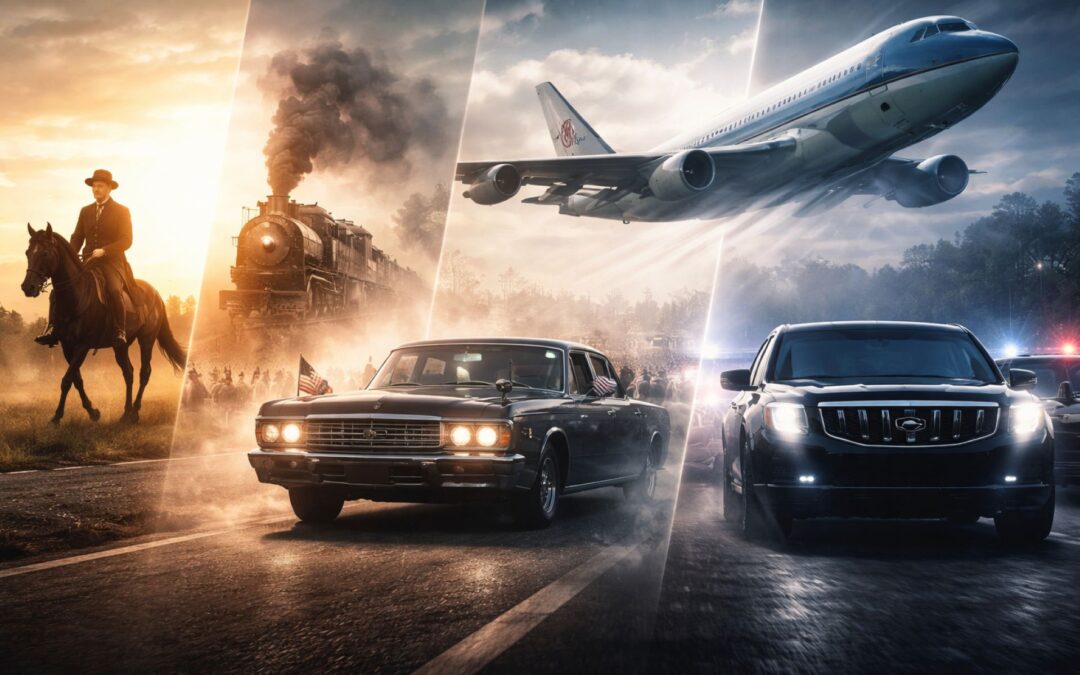
Introduction: The Journey That Built the Presidency
In 1789, a president could ride alone on horseback to his own inauguration.
Today, a president crosses continents in a flying command center equipped with missile defense systems, secure video links, aerial refueling capability, and a motorcade that resembles a military operation more than a commute.
The transformation of presidential travel is not just a story about better vehicles. It is the story of America itself.
Every upgrade—from horse to railroad, from steamship to airplane, from open-top convertible to armored fortress—reveals something deeper. It reflects how the presidency expanded from a relatively modest executive office into the center of a global superpower. It reveals how threats evolved, how technology reshaped politics, and how the modern state learned to project authority, mobility, and control.
In the early republic, the president traveled as a citizen-statesman, visible and accessible. By the 20th century, he traveled as a wartime commander. In the 21st century, he moves as a mobile institution—shielded, networked, and constantly prepared for crisis.
To understand how the presidency changed, follow how it moved.
From horseback to Air Force One, this is the evolution of presidential travel—and the making of the modern American state.
Horses, Humility, and the Early Republic
In the beginning, presidential travel was simple because the presidency itself was simple.
When George Washington took office, the young United States had no established traditions for executive spectacle. There were no armored carriages, no security details, no motorcades. The office had dignity—but not machinery.
Washington typically traveled by horseback, the most practical method of the era. For formal occasions, he arrived in a cream-colored carriage pulled by six matching horses, with a driver in full livery. It was refined and symbolic, but not extravagant by European royal standards. The message was careful: authority without monarchy.
His successors followed similar patterns. John Adams maintained formal carriage travel befitting the office. But Thomas Jefferson deliberately toned things down. For his inauguration, Jefferson rode alone on horseback to the Capitol, without entourage or ceremony. It was a political statement—republican modesty over aristocratic display.
In these early decades, presidential movement was slow, visible, and remarkably unsecured. There was no Secret Service. No coordinated protective detail. The president could ride through towns, stay in inns, and interact freely with citizens.
The risks were real, but the scale of threat was smaller. The nation was compact. The presidency was still defining itself. And the idea that the executive required a permanent security apparatus had not yet taken root.
Travel reflected that culture. It was personal rather than institutional.
But America was about to industrialize. And when steam and steel entered the picture, presidential travel would accelerate—along with the dangers that came with speed.
Steam, Railroads, and the Speed of a Growing Nation
By the early 19th century, America was transforming. The steam engine was shrinking distances, expanding markets, and knitting together a rapidly growing republic. Presidential travel would not remain untouched.
In 1817, James Monroe became the first president to travel by steamboat. It was a modest innovation, but symbolically powerful. The presidency was beginning to move with industry.
The real revolution came in 1833, when Andrew Jackson became the first sitting president to ride a train. What had once taken days by carriage could now be completed in hours. Railroads did not merely speed up travel; they expanded the reach of the presidency itself.
Soon, trains became the dominant method for long-distance presidential travel. Presidents such as Martin Van Buren, John Tyler, and James K. Polk embraced the rails. The president could now appear in distant towns, rally support, inspect infrastructure, and project national presence in ways that were previously impossible.
But speed came with danger.
In 1853, President-elect Franklin Pierce was traveling by train with his family when their railcar derailed. The accident killed his 11-year-old son. It was a devastating personal tragedy—and a public reminder that modern transportation was not only faster but more hazardous.
The rail era also made the president more visible. Public tours became major spectacles. When Rutherford B. Hayes crossed the Rockies on a transcontinental rail tour, Americans lined the tracks to glimpse the nation’s leader. Presidential movement was becoming a national event.
Yet security remained primitive.
There were no armored railcars. No systematic protective planning. The presidency was more mobile than ever—but also more exposed.
That exposure would soon collide with political violence. And the consequences would permanently change how America protected its leader.
Tragedy and the Birth of Presidential Protection
For much of the 19th century, presidential travel moved faster—but security barely moved at all.
That gap became deadly.
Even before formal systems existed, danger was creeping closer. In 1861, just before his inauguration, Abraham Lincoln was scheduled to pass through Baltimore by train. Detectives uncovered a plot to assassinate him as he stepped off the railcar. The solution was improvised but effective: Lincoln changed his schedule, traveled at night, and disguised himself in a soft felt hat and overcoat. He slipped through the city quietly.
The presidency had just encountered a new reality: mobility made it a moving target.
The Civil War intensified the stakes. Lincoln traveled extensively by train to rally troops and inspect battlefields. Each journey was both a political statement and a security risk. Yet no permanent federal protective unit existed to guard him.
After Lincoln’s assassination in 1865, the nation was forced to confront the vulnerability of its executive. Still, it would take decades—and more blood—before institutional protection became standard.
In 1901, William McKinley arrived at the Pan-American Exposition in Buffalo by train. During a public reception, he was shot and later died of his wounds. The assassination was a national shock. Once again, travel—public, visible, ceremonial—had created opportunity for violence.
This time, the response was structural.
When Theodore Roosevelt assumed office, he became the first president to receive full-time Secret Service protection. The shift was subtle but historic. For the first time, presidential movement was no longer treated as a personal matter—it was a federal security operation.
The presidency had crossed an invisible line.
It was no longer simply an office occupied by a man. It was a symbol, a target, and a national asset requiring permanent protection.
From this point forward, every new mode of transportation—cars, ships, planes—would be engineered not just for speed or prestige, but for survival.
Automobiles and the Mechanization of Power
If the railroad expanded the presidency across the continent, the automobile transformed how it appeared in public.
In 1901, the same year he was assassinated, William McKinley became the first president to ride in an automobile—a Stanley steam-powered car. At the time, it was more novelty than necessity. But the shift had begun.
The real automotive modernization came under William Howard Taft. Taft embraced the machine age. He converted the White House stables into a garage, assembled the first presidential motor fleet, and hired the first official White House chauffeur. The horse—once the symbol of executive dignity—was retired.
The presidency now moved on wheels powered by combustion rather than muscle.
Automobiles brought flexibility that trains never could. The president could move through cities, attend multiple events in a day, and appear more frequently before the public. But cars also increased exposure. A president in an open vehicle was highly visible—and highly vulnerable.
That vulnerability would be exposed with devastating clarity in 1963.
But before that turning point, the automobile era also reflected the growing spectacle of the presidency. Parades, motorcades, and public appearances became routine. Vehicles were customized, upgraded, and eventually armored. Under Harry S. Truman, armored Lincoln Cosmopolitans joined the fleet. The car was no longer just transportation—it was protection wrapped in symbolism.
As the 20th century progressed, the presidential limousine grew heavier, thicker, and more technologically advanced. What began as a motorcar evolved into a mobile shield.
The automobile did more than mechanize presidential travel. It mechanized presidential security.
And as America’s global responsibilities expanded, something even more transformative was about to take flight.
War, Flight, and the Rise of the Global Presidency
The airplane did not just change presidential travel. It changed the presidency itself.
For most of American history, presidents stayed largely within national borders. Crossing the Atlantic required weeks at sea. Foreign diplomacy happened slowly, through letters and ambassadors.
That changed during the 20th century—especially during war.
After Pearl Harbor, Franklin D. Roosevelt faced a new reality. The United States was fighting a global war. The commander-in-chief could no longer remain geographically confined.
In 1942, Roosevelt became the first sitting president to fly while in office. He boarded the Dixie Clipper, a flying boat that carried him across the Atlantic to meet Allied leaders in North Africa. It was a logistical risk, but a strategic necessity.
Soon after, the U.S. Army Air Forces commissioned a modified C-54 Skymaster known as the Sacred Cow. It featured a stateroom, secure communications equipment, and even an elevator for Roosevelt’s wheelchair. For the first time, the president had an aircraft designed specifically around his needs.
The presidency had taken to the air.
After World War II, presidential aviation accelerated. Harry S. Truman upgraded to a pressurized DC-6 named the Independence, allowing longer and higher-altitude travel. He even flew to Wake Island to meet General Douglas MacArthur—something that would have required weeks by ship only a generation earlier.
Then came Dwight D. Eisenhower, a former general who deeply understood mobility and command. Under his administration, confusion between a presidential aircraft and a commercial flight led to the creation of a unique call sign for the president’s plane: Air Force One.
The name was more than branding. It signaled a new doctrine. The president was no longer merely a traveler. He was a mobile command authority.
Eisenhower also introduced presidential helicopter transport, giving rise to Marine One. This allowed rapid movement without the visibility and disruption of large motorcades. The executive branch was becoming agile, responsive, and increasingly shielded.
By the mid-20th century, presidential travel had become inseparable from global power projection. The president could cross oceans in hours, negotiate face-to-face with foreign leaders, and return home within days.
Mobility expanded authority.
But while the skies offered speed and strategic reach, the ground still carried danger. And in 1963, that danger would force the most dramatic security transformation in presidential history.
Assassination, Armor, and the End of Vulnerability
On November 22, 1963, the illusion of presidential accessibility ended.
John F. Kennedy was riding through Dallas in an open-top Lincoln Continental, known internally as the X-100. The detachable roof panels had been removed to give crowds a clear view. The symbolism was deliberate: a confident, youthful president exposed to the public.
It was also fatally exposed to a rifle.
Kennedy’s assassination during that motorcade permanently altered the philosophy of presidential travel. The car that once symbolized openness became evidence of vulnerability. The Secret Service immediately overhauled it—installing a permanent bulletproof canopy, titanium armor plating, reinforced tires, and upgraded communications. What had been a convertible became a rolling fortress weighing nearly five tons.
The era of open-top presidential parades was over.
Security was no longer reactive. It became architectural.
When Lyndon B. Johnson assumed office, caution defined his movement. The skies felt safer than the streets. Johnson relied heavily on aircraft for travel and even flew into active war zones during the Vietnam conflict—becoming the first president since Lincoln to enter a theater of war while in office.
The presidency had become both commander and target.
The lesson of 1963 extended beyond the limousine. It reshaped how routes were planned, how crowds were managed, and how intelligence was gathered before any appearance. Visibility was now a calculated risk rather than a default posture.
By the time Richard Nixon expanded global travel—visiting Europe, the Soviet Union, and becoming the first U.S. president to visit China—the infrastructure of protection had grown sophisticated and layered. Air Force One evolved into a fully equipped airborne command center. Motorcades became tightly coordinated operations.
The presidency was no longer simply transported.
It was defended in motion.
And as the Cold War matured and the United States entered the late 20th century, that defense would scale to levels previously unimaginable.
Air Force One and the Flying White House
By the late 20th century, Air Force One was no longer just transportation. It was infrastructure.
After the close call in 1953 that led to the creation of the distinct presidential call sign, the aircraft itself evolved rapidly. Under Dwight D. Eisenhower, presidential aviation became formalized. But it was in the decades that followed that the plane transformed into a flying extension of the White House.
Under George H. W. Bush, the presidential fleet upgraded to modified Boeing 747 aircraft—the VC-25s that most Americans now recognize instantly. These were not ordinary jets repainted in patriotic colors. They were built to function as airborne command centers.
Inside, the aircraft included:
- A secure communications suite capable of encrypted global contact
- Conference rooms and briefing areas
- A medical facility
- Staff quarters
- Anti-missile countermeasure systems
- The ability to refuel midair
The logic was clear: in a nuclear age, the president could never be disconnected from command authority. If Washington were compromised, the presidency would remain operational at 40,000 feet.
Air Force One became a symbol of continuity of government.
After the attacks of September 11, 2001, that capability took on new urgency. George W. Bush spent hours airborne that day as security officials evaluated potential threats. The plane functioned as a temporary seat of executive power while the situation unfolded on the ground.
The modern Air Force One can operate under extreme conditions. It can refuel in flight, evade missile threats, and maintain secure communications across multiple networks simultaneously. It is less a plane and more a mobile nerve center.
The message it sends is unmistakable: the presidency does not stop moving.
But even as the skies became fortified, the ground evolved into something even more elaborate. Because while Air Force One represents mobility at altitude, the presidential motorcade represents controlled dominance at street level.
And that transformation would produce one of the most formidable vehicles on Earth.
The Motorcade State: The Beast, Decoys, and Security Formations
If Air Force One is the presidency in the sky, the motorcade is the presidency on display.
By the late 20th century, presidential ground travel had transformed into one of the most complex security operations in the world. The centerpiece of that system is the presidential limousine—known informally as “The Beast.”
Under Bill Clinton, the modern motorcade architecture took shape. The limousine grew larger, heavier, and more fortified. What looks like a luxury sedan is in reality a heavily armored vehicle built on a truck-grade chassis.
The Beast includes:
- Thick armor plating
- Bullet-resistant, multi-layer glass
- Sealed cabin protection against chemical threats
- Run-flat tires reinforced with Kevlar
- A secure communications system
- And reportedly, emergency medical supplies including blood matching the president’s type
It is not designed for elegance. It is designed for survival.
But the vehicle is only one piece of a layered formation.
A typical presidential motorcade includes:
- Lead and trail Secret Service SUVs
- Counterassault teams
- Local and federal law enforcement escorts
- Two identical decoy limousines
- An ambulance
- Communications vehicles
- Media vans
- Route clearance units
Two primary formations often define the arrangement:
The Box — SUVs wrap tightly around the limousine, minimizing exposure from all sides. Used in high-threat environments.
The Diamond — Vehicles spread into a wider pattern, allowing flexibility and faster movement while maintaining layered coverage.
Every route is mapped in advance. Alternate routes are prepared. Overpasses are monitored. Buildings are scanned. Coordination happens between federal agents, local police, and intelligence teams.
Presidential travel on the ground is no longer movement—it is choreography.
The spectacle remains visible to the public. Sirens, flashing lights, motorcycles clearing intersections. But beneath the visible surface lies a meticulously planned operation designed to eliminate unpredictability.
The motorcade reflects a broader truth: the presidency cannot afford vulnerability in public space.
And after the attacks of September 11, 2001, even that massive security apparatus would be upgraded again—integrating new technologies, new doctrines, and a new level of vigilance.
After 9/11: The Mobile Command Presidency
September 11, 2001 did not invent presidential security—but it permanently intensified it.
The attacks revealed how quickly modern threats could emerge and how essential continuity of government had become. From that moment forward, presidential travel was no longer just about protection from individuals. It was about resilience against coordinated, large-scale disruption.
On 9/11, George W. Bush was airborne for much of the day as security officials assessed risks. Air Force One became more than transport; it was a moving safe zone while uncertainty gripped Washington. The experience reshaped doctrine.
Air Force One gained enhanced missile defense countermeasures, improved encrypted communications, and the ability to refuel midair to extend operational range indefinitely. The president could remain airborne for extended periods if necessary, functioning as a remote command authority.
The motorcade evolved as well.
Under Barack Obama, the next-generation Beast debuted. It incorporated thicker armor, advanced night-vision capabilities, tear gas defense systems, and reinforced cabin sealing against chemical or biological threats. The vehicle doors were reportedly as heavy as those on commercial aircraft.
Additional innovations appeared on the ground. “Ground Force One,” a pair of heavily fortified buses, provided an alternative mode of travel for long domestic trips. Helicopter transport—Marine One—continued to offer rapid, flexible movement between secure locations without extended exposure to city streets.
Presidential travel had become multi-layered across air, ground, and sea, with redundancy built into every phase.
Even symbolism evolved. In 2019, Donald Trump reserved the call sign “Space Force One,” a nod to the growing militarization of new domains. While no presidential spacecraft exists, the gesture reflected the expansion of national defense into space—and the presidency’s symbolic association with it.
The 21st-century president does not merely travel.
He moves within a self-contained security ecosystem—protected by intelligence coordination, technological countermeasures, decoys, armored fleets, encrypted networks, and contingency plans layered upon contingency plans.
Presidential travel has evolved from a horse and rider into a mobile institution—capable of projecting authority across continents while remaining shielded from threats both visible and unseen.
Conclusion: How Presidential Travel Became a Moving Fortress
In 1789, a president could ride alone through a city street and stop to greet citizens without a security perimeter.
Today, presidential movement requires layered intelligence briefings, route simulations, armored fleets, encrypted communications, missile defense systems, and contingency planning that stretches across agencies and continents.
The transformation is not simply technological.
It reflects how the presidency itself expanded.
In the early republic, the president was a constitutional officer within a fragile experiment. Travel was personal, slow, and largely unsecured. As the nation industrialized, the presidency became more visible and more mobile. Railroads expanded reach. Automobiles expanded flexibility. Airplanes expanded global influence.
But with visibility came vulnerability.
Assassinations forced structural change. World wars required global mobility. The Cold War demanded continuity of command. Terrorism demanded redundancy. Each crisis hardened the system.
The open carriage became the armored limousine. The railcar became the flying command center. The motorcade became a moving shield.
Modern presidential travel is a paradox. It is highly visible—sirens, jets, helicopters, flags—yet deeply insulated. The president appears before crowds, but inside sealed cabins and controlled perimeters. He crosses oceans in hours but remains protected within a carefully engineered security bubble.
What began as transportation evolved into architecture.
Presidential travel now represents the scale, complexity, and permanence of the American state. It carries not just a person, but authority, continuity, and national command capability.
To trace how the president moves is to trace how America grew—from a republic carried on horseback to a global power traveling at 40,000 feet inside a flying fortress.
And wherever the presidency goes, the state moves with it.