
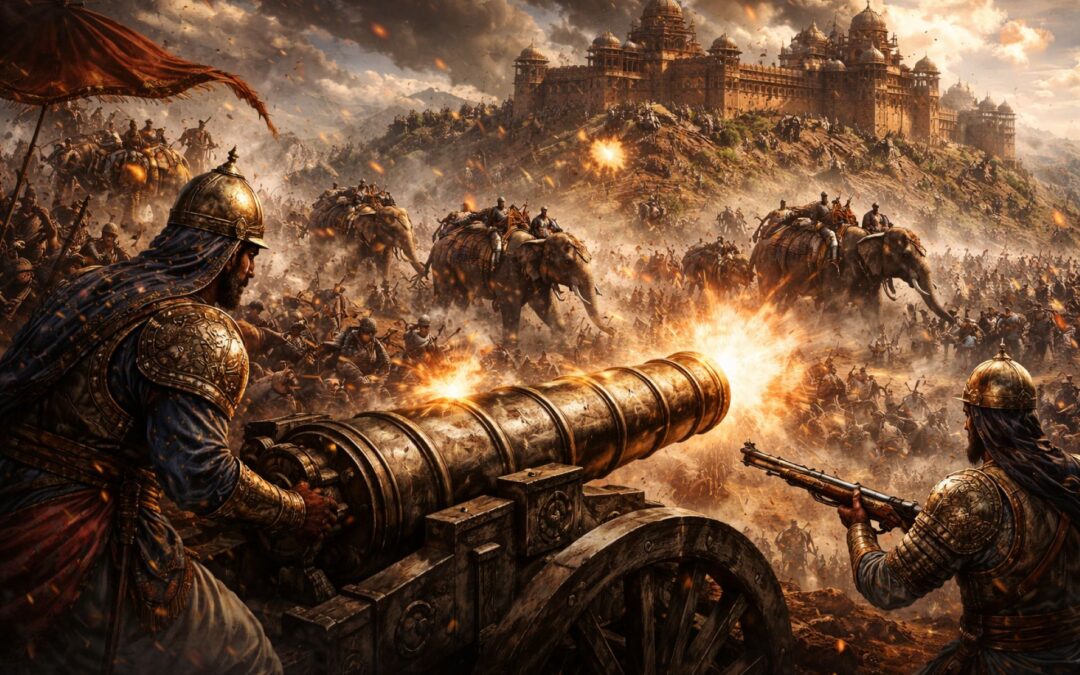
In 1565, one of the most powerful empires in India collapsed in a matter of days.
The Vijayanagar Empire—rich, vast, and militarily formidable—had survived decades of conflict against rival kingdoms. It commanded massive armies, fielded war elephants, and controlled immense resources. By all conventional measures, it should have endured.
But it didn’t.
At the Battle of Talikota, a coalition of Deccan Sultanates used something Vijayanagar had underestimated—not just guns and cannons, but a better understanding of how to use them. Their artillery formations were coordinated, mobile, and tactically integrated into the battlefield. Vijayanagar, despite possessing significant firepower of its own, relied on outdated methods and static defenses.
The result was not just defeat—it was annihilation. Soon after the battle, the capital lay abandoned, its defenses rendered useless in the face of modern siege warfare.
This moment captures a much larger transformation.
Between the 1400s and 1600s, the Indian subcontinent underwent its own version of the gunpowder revolution. Firearms and cannons didn’t simply add new weapons to existing armies—they fundamentally altered how wars were fought, how states were governed, and who could hold power. Armies grew larger, taxation systems became more sophisticated, and political authority began to centralize in ways previously impossible.
But this transformation was uneven.
Some empires embraced gunpowder technology, investing in innovation, infrastructure, and tactical evolution. Others adopted it superficially or failed to adapt at all. Over time, this difference in approach created a stark divide—one that determined the fate of kingdoms.
This article explores that divide.
It traces how gunpowder entered India, how it reshaped military and political systems, and why it propelled some empires to dominance while driving others to collapse. Because in medieval India, as in much of the world, the story of power was no longer just about strength or strategy.
It was about technology—and who understood it first.
The Blind Spot in the Military Revolution Narrative
The idea of a “military revolution” is one of the most widely accepted frameworks in global history. It describes the transformation of warfare between the 15th and 17th centuries—when gunpowder weapons, new fortifications, and professional armies reshaped how states fought and governed. In most tellings, this revolution begins in Europe, spreads across the Mediterranean, and culminates in the rise of powerful centralized states that would eventually dominate the world.
But this narrative has a glaring omission.
The Indian subcontinent—one of the largest, wealthiest, and most politically dynamic regions of the early modern world—is often treated as a peripheral player in this transformation. At best, it appears as a recipient of foreign technology. At worst, it is ignored entirely. This creates the impression that the gunpowder revolution was something that happened elsewhere and merely arrived in India as a secondary development.
The reality is far more complex.
India did not passively absorb gunpowder technology. It engaged with it actively, creatively, and at scale. By the 15th and 16th centuries, Indian polities were not only importing firearms and cannons but also producing them, adapting them, and integrating them into their own military traditions. In many cases, they were innovating in ways that reflected local conditions—developing mobile artillery systems, experimenting with different materials, and incorporating gunpowder into existing tactical frameworks.
This was not imitation. It was transformation.
What makes the Indian case especially significant is the diversity of responses to gunpowder technology. Unlike Europe, where states gradually converged toward similar military structures, the Indian subcontinent saw a wide spectrum of adaptation. Some empires embraced firearms wholeheartedly, reorganizing their armies and fortifications around them. Others adopted them partially, treating them as supplementary rather than central. And some, despite early exposure, failed to evolve at all.
These differences mattered.
Because gunpowder was not just another weapon—it was a system. It required infrastructure, skilled labor, steady revenue, and strategic understanding. States that invested in these areas gained a decisive edge. Those that didn’t found themselves increasingly vulnerable, no matter how strong they had once been.
By overlooking India’s role in this transformation, traditional narratives miss a crucial insight: the military revolution was not a single, uniform process centered in one region. It was a series of parallel transformations, unfolding in different parts of the world, shaped by local conditions but driven by the same underlying force—the disruptive power of gunpowder.
To understand how this played out in India, we need to start at the beginning.
Not with cannons dominating battlefields, but with a much earlier, more tentative introduction of gunpowder technology—one that would take centuries to fully reshape the subcontinent.
The Arrival of Gunpowder Technology in India
Gunpowder did not arrive in India with a dramatic battlefield debut. It entered quietly, almost experimentally, long before it began to reshape the subcontinent’s military and political landscape.
The earliest exposure dates back to the 1200s, when knowledge of gunpowder weapons filtered into northern India through connections with the wider Asian world. Chinese rocket technology, in particular, made its way into the region, introducing the basic principles of explosive propulsion. But these early weapons were more curiosities than game-changers. They lacked the power, reliability, and tactical integration needed to disrupt established modes of warfare.
For the next two centuries, the core structure of Indian warfare remained largely unchanged—dominated by cavalry charges, war elephants, archers, and fortified strongholds.
The real turning point came in the 1400s.
This was not a result of a single invention or invasion, but of trade. The Indian Ocean was one of the most vibrant commercial networks in the world, connecting South India and the Deccan to the Middle East, East Africa, and Southeast Asia. Through these maritime routes, Indian states—especially in the south—began to acquire more advanced firearms and artillery.
The Deccan Sultanates played a crucial role in this process. Their economic exchanges with Middle Eastern powers involved not just textiles and spices, but also military technology. Muskets and cannons began to flow into the subcontinent, arriving not as isolated artifacts but as part of a broader system of knowledge—how to build, maintain, and deploy them.
This shift marked the beginning of a new phase.
Unlike the earlier, tentative use of rockets, these weapons had immediate and visible impact. Matchlock muskets could penetrate armor with ease. Cannons could batter fort walls that had once been considered impregnable. Even in their early forms, these technologies hinted at a different kind of warfare—one less dependent on individual skill and more on coordinated firepower.
What makes this phase particularly important is where it happened.
The initial adoption of effective gunpowder weapons was strongest in South India and the Deccan, regions deeply embedded in maritime trade networks. This meant that the transformation did not originate from the traditional political centers of North India, but from areas that were more outward-looking and commercially connected.
From there, the technology spread.
Over time, firearms and cannons moved across the subcontinent, carried by trade, warfare, and migration. Different states encountered them at different moments, under different circumstances—and responded in different ways. Some quickly recognized their potential. Others underestimated them. A few attempted to control their spread altogether.
But by the late 15th century, one thing was clear: gunpowder was no longer a novelty.
It was becoming a decisive factor in warfare—and soon, in the fate of empires.
The Arsenal of Empire: Weapons That Changed Warfare
By the late 1400s and early 1500s, gunpowder weapons in India had evolved from experimental imports into a diverse and increasingly sophisticated arsenal. These were not uniform tools used in the same way everywhere. Instead, they formed a layered system of weapons—each with its own role, strengths, and limitations.
Together, they began to reshape how wars were fought.
Matchlock Muskets and Mass Infantry
The matchlock musket was one of the most transformative additions to Indian warfare. Unlike traditional weapons such as bows or swords, muskets required relatively little training. A soldier could be taught to load and fire effectively within a matter of months—a stark contrast to the years of practice needed to master archery or cavalry combat.
This had profound consequences.
For the first time, states could rapidly expand their armies without sacrificing effectiveness. Large numbers of infantry could be recruited, trained, and deployed in a short span of time, leading to a significant increase in military manpower. Warfare began to shift away from elite warrior classes toward broader, more standardized forces.
On the battlefield, muskets were especially effective against cavalry—the traditional backbone of Indian armies. A well-placed shot could kill or cripple a warhorse, neutralizing even heavily armored riders. This reduced the dominance of cavalry charges and forced commanders to rethink their tactics.
Firepower, not mobility or individual skill, was becoming the decisive factor.
Cannons: From Siege Engines to Battlefield Weapons
Cannons had an even more dramatic impact, particularly in siege warfare.
Early artillery in India came in two main forms: massive heavy mortars and smaller, more flexible light cannons. Heavy mortars could be enormous—stretching over nine meters in length and weighing dozens of tons. These weapons were devastating but difficult to move, making them most useful in planned sieges where logistics could be carefully arranged.
Light cannons, on the other hand, evolved more rapidly.
Initially modeled after heavy designs, they gradually became more refined—featuring narrower barrels, improved gunpowder efficiency, and the ability to fire lead projectiles instead of stone. These innovations made them more reliable, easier to handle, and more adaptable to different combat scenarios.
Cannons were no longer limited to breaking walls.
They began to play a direct role on the battlefield—disrupting infantry formations, scattering war elephants, and creating psychological shock. In some regions, particularly in the Deccan, artillery was even used in unconventional ways. Cannons could be loaded with coins or metal fragments, effectively turning them into massive shotguns capable of devastating large groups of soldiers in a single blast.
But cannons also had weaknesses.
They were slow to reload, vulnerable to attack, and often difficult to maneuver. Early artillery could dominate a position—but only if it was used correctly. Misuse could render even the most powerful cannons ineffective.
Specialized Innovations: Rockets, Mines, and Camel Guns
Beyond muskets and cannons, Indian armies developed a range of specialized gunpowder weapons that reflected both ingenuity and adaptability.
Rockets, building on earlier Chinese designs, were used to create large-scale barrages that could disorient and intimidate enemy forces. While not always precise, their psychological impact was significant, especially when deployed in large numbers.
Explosive mining was another important innovation. Specialized troops, sometimes referred to as fireworkers, would tunnel beneath fort walls and plant explosive charges in weak points. When detonated, these mines could breach defenses that would otherwise withstand prolonged siege.
Perhaps the most distinctive innovation, however, was the use of mobile artillery.
To address the problem of immobility, Indian armies began mounting guns on animals. Horse-drawn artillery improved transport, but camel-mounted swivel guns—often called “artillery of the stirrup”—offered something more dynamic. These weapons could be moved quickly across the battlefield, repositioned as needed, and fired with relative ease once the camel was made to kneel.
This added a new dimension to warfare.
Instead of being fixed in place, firepower could now move, adapt, and respond in real time. Enemy formations could be harassed from multiple angles, forcing constant repositioning and creating chaos in the ranks.
Taken together, these weapons did more than expand the toolkit of Indian armies.
They introduced a new logic of warfare—one where success depended not just on numbers or bravery, but on how effectively different forms of firepower were combined, coordinated, and deployed.
Gunpowder and the Rise of Centralized Power
Gunpowder did not just change how wars were fought—it changed who could afford to fight them.
In its early stages, gunpowder warfare was expensive. Cannons were often cast in bronze or brass, materials that were costly and required specialized skills to work with. Producing firearms and artillery at scale demanded access to raw materials, skilled craftsmen, and organized manufacturing processes. This was not something every ruler—or local warlord—could manage.
As a result, gunpowder created a natural advantage for larger, wealthier states.
Empires that controlled significant revenue streams were better positioned to invest in firearms. They could build arsenals, maintain supply chains, and sustain the logistical demands of gunpowder warfare. Smaller principalities, on the other hand, struggled to keep up. They lacked both the financial resources and the infrastructure needed to compete in what was quickly becoming an arms race.
This imbalance had far-reaching consequences.
To support the growing costs of firearms and standing armies, states were forced to rethink how they generated revenue. Traditional systems of tribute and feudal obligations were no longer sufficient. Instead, more structured and efficient taxation systems began to emerge, designed to extract consistent and predictable income from land and trade.
Administration became more sophisticated.
Officials were needed to assess land, collect taxes, manage resources, and oversee production. Military expansion was now tied directly to bureaucratic expansion. In this sense, gunpowder did not just strengthen armies—it strengthened states.
At the same time, the balance of power within those states began to shift.
Feudal systems, which relied on semi-autonomous local chiefs and warrior elites, started to weaken. These local powers had traditionally derived their influence from control over land and the ability to raise troops. But firearms changed that equation. Military effectiveness was no longer determined solely by personal retinues or inherited status—it depended on access to centralized resources and standardized weaponry.
Central authority gained the upper hand.
We see this clearly in the ability of larger empires to suppress regional rebellions. In the Vijayanagar Empire, for example, rebellious Tamil chiefs in the south were subdued with relative ease—not because they lacked courage or manpower, but because they lacked comparable firepower. Artillery and firearms provided the central state with a decisive edge that local leaders simply could not match.
For a time, this led to greater political consolidation.
Large empires tightened their grip over territories, reducing the autonomy of local elites and bringing more regions under direct control. The old feudal order, built on fragmented authority, began to give way to more centralized systems of governance.
But this shift was not permanent.
Because the same technology that empowered central states would eventually become more accessible—and when it did, it would begin to undermine the very structures it had helped create.
The Wrought Iron Breakthrough and the Spread of Firearms
For a time, gunpowder favored the powerful.
As long as firearms and cannons remained expensive to produce—requiring bronze, brass, and specialized foundries—only wealthy empires could deploy them at scale. This gave centralized states a clear advantage over smaller rivals and helped consolidate their authority.
But this balance did not last.
A crucial technological shift changed everything: the transition from bronze to wrought iron.
Unlike bronze, wrought iron was far cheaper and more widely available. It did not require the same level of specialized resources, and it could be worked by a broader range of craftsmen. This dramatically lowered the barrier to producing firearms and artillery.
The knowledge of wrought iron gunmaking did not emerge in isolation.
It was introduced and accelerated through foreign contact—particularly via the Portuguese. In the early 1500s, Portuguese soldiers and renegades who settled along India’s western coast brought with them new techniques of gunsmithing. In places like Kerala and Goa, this knowledge began to spread, blending with existing local traditions.
The effect was immediate and far-reaching.
Firearms, once the exclusive domain of imperial power, began to proliferate. Light cannons and muskets could now be manufactured more cheaply and in greater numbers. What had once been a controlled and centralized technology started to diffuse across the subcontinent.
This created a new problem for the very states that had benefited from gunpowder.
If everyone could access firearms, then the advantage of central authority would begin to erode. Local chiefs, zamindars, and even peasant groups could potentially arm themselves with weapons that had previously been out of reach.
Gunpowder was no longer just a tool of control—it was becoming a force of disruption.
States responded by attempting to regulate this spread. They sought to maintain their edge by controlling production, limiting access, and centralizing the manufacture of weapons. But the logic of the new technology made such control difficult to sustain.
Because once knowledge spreads, it rarely stays contained.
And as firearms became more common, the political landscape began to shift again—this time in a direction that threatened the very empires that had once dominated the gunpowder age.
Monopoly, Control, and Rebellion
As firearms became cheaper and more widespread, Indian empires faced a new and unexpected challenge.
Gunpowder had once strengthened central authority by concentrating military power in the hands of the state. But now, with the spread of wrought iron weapons and gunsmithing knowledge, that same power was beginning to slip beyond imperial control.
The response was predictable.
States attempted to impose monopolies over the production and distribution of firearms. The logic was simple: if the state could control who made weapons and who owned them, it could preserve its military superiority. In practice, this meant regulating blacksmiths, licensing production, and restricting access to gunpowder and artillery.
In the Mughal Empire, for example, local craftsmen were not allowed to produce firearms without official permission. Gunsmithing became a controlled profession, tied directly to the interests of the state. Workshops, materials, and skilled labor were all brought under varying degrees of supervision.
But enforcement was never perfect.
India’s vast geography, combined with its decentralized social structure, made it difficult to fully regulate such a widely dispersed technology. Knowledge of gunmaking could not be easily erased once it had spread. Even if official production was restricted, informal networks of craftsmen and local workshops continued to operate—sometimes quietly, sometimes openly in defiance of imperial authority.
And when these restrictions broke down, the consequences were significant.
Local elites, particularly zamindars, began to acquire firearms and arm their followers. What had once been small, localized power bases now had access to weapons capable of challenging imperial forces. Even peasant groups, when mobilized, could become far more dangerous than before.
Rebellion became more viable.
Where earlier uprisings might have been quickly crushed by superior imperial firepower, the new reality was more complex. Armed with muskets and light artillery, rebels could mount more sustained resistance. They could defend positions, challenge sieges, and inflict meaningful damage on state forces.
Gunpowder had leveled the playing field—at least partially.
This did not mean that central states lost their dominance overnight. They still possessed greater resources, larger armies, and more organized structures. But the margin of superiority had narrowed. Control was no longer absolute, and maintaining it required constant effort.
In a sense, gunpowder introduced a paradox.
It had helped build stronger, more centralized states—but by becoming more accessible, it also gave their challengers the tools to resist. The same technology that once reinforced authority was now quietly undermining it.
And this dynamic would continue to evolve, shaped not just by access to weapons, but by how effectively different powers adapted to a rapidly changing military landscape.
The Global Exchange Behind India’s Gunpowder Industry
Gunpowder technology in India did not develop in isolation. It was the product of a vast and dynamic network of global exchanges—where ideas, techniques, and skilled individuals moved across regions, often in unpredictable ways.
At the center of this exchange was the western coast of India.
Ports like Goa became crucial hubs where different worlds collided. When the Portuguese captured Goa in 1510, they did not introduce firearms to an unprepared region. Instead, they encountered an already active military-industrial base. The Bijapur Sultanate had established munitions facilities there, complete with artillery, gunpowder supplies, and the tools required for manufacturing weapons.
This discovery surprised the Portuguese.
Accounts from the time suggest that European observers were impressed—not just by the quantity of weapons, but by their quality. Indian gunsmiths were producing firearms that could rival, and in some cases surpass, those found in Europe. This was not a backward periphery catching up; it was a region fully engaged in the technological currents of its time.
A major reason for this sophistication was the influx of foreign expertise.
The Indian subcontinent attracted a wide range of skilled individuals—some invited, others arriving as renegades, defectors, or refugees. Portuguese soldiers who settled in coastal regions shared their knowledge of wrought iron gunmaking. Turkish experts, displaced by conflicts elsewhere, brought experience in artillery deployment and manufacturing. Venetian and Genoese craftsmen added their own techniques to the mix.
These were not isolated contributions.
They interacted with existing Indian traditions of metallurgy and craftsmanship, creating a hybrid system of weapons production. Techniques were adapted, improved, and localized. Over time, this led to the emergence of a distinctly Indo-Portuguese-Arab style of firearms—one that combined elements from multiple regions into a coherent and effective whole.
The impact of this synthesis extended far beyond India.
Firearms produced in the subcontinent began to circulate across Southeast Asia and even reached Japan. In this sense, India was not just a consumer of gunpowder technology—it was also a producer and exporter, actively shaping military developments in other parts of the world.
This global exchange had another important consequence.
It accelerated the pace of innovation. Exposure to different techniques and ideas meant that Indian states could adapt quickly, experimenting with new designs and production methods. At the same time, it made the spread of knowledge harder to control. Once techniques entered the system, they could diffuse rapidly through networks of craftsmen and traders.
The result was a highly dynamic environment.
Gunpowder technology in India evolved through a continuous process of borrowing, adapting, and refining. It was shaped as much by local needs as by global influences, creating a military landscape that was both deeply rooted in the subcontinent and connected to a wider world.
And within this landscape, the success of an empire increasingly depended on one thing:
Not just access to technology—but the willingness to invest in it, improve it, and integrate it into a larger strategic vision.
The Vijayanagar Empire: Early Adoption Without Innovation
The Vijayanagar Empire was not blind to the importance of gunpowder.
In fact, it was one of the earliest powers in India to adopt firearms and artillery. By the 15th century, Vijayanagar armies had already begun incorporating matchlock muskets and cannons into their military structure. They had access to the same trade networks, the same foreign expertise, and the same technological opportunities as their rivals in the Deccan.
On the surface, they seemed well-positioned to thrive in the gunpowder age.
But beneath this early adoption lay a critical weakness.
Vijayanagar treated gunpowder weapons as an addition—not a transformation.
Cannons and muskets were integrated into existing military frameworks rather than reshaping them. The empire continued to rely heavily on traditional strengths: massive infantry formations, powerful cavalry, and war elephants. Firearms were present, but they were not central to strategy. They supplemented the army rather than defining it.
This distinction would prove decisive.
Because gunpowder warfare was not just about possessing new weapons—it required a complete rethinking of how wars were fought. It demanded changes in tactics, logistics, infrastructure, and even fort design. States that failed to make these deeper adjustments risked falling behind, even if they appeared well-armed.
Vijayanagar’s lack of long-term investment reflects this gap in understanding.
There is little evidence that the empire developed the kind of military infrastructure needed to sustain and advance gunpowder technology. It did not establish large-scale arsenals or dedicated matchlock foundries. It did not systematically innovate in artillery design or deployment. Instead, it remained dependent on existing systems, using firearms without fully committing to their potential.
This created a dangerous illusion of strength.
Victories achieved with a mix of traditional and gunpowder forces reinforced the belief that the existing model was sufficient. There was no immediate pressure to change, no clear signal that deeper transformation was necessary.
Meanwhile, their rivals were learning.
In the Deccan Sultanates, setbacks led to reflection and adaptation. Artillery was studied, improved, and integrated more effectively into military doctrine. Over time, this created a growing divergence—one that was not immediately visible, but steadily widening.
Vijayanagar, confident in its power, did not see the gap forming.
And by the time it became clear, it was already too late.
The Battle of Raichur: A Missed Lesson
In 1520, the Battle of Raichur offered a clear preview of the changing nature of warfare in India.
On one side stood Krishnadevaraya of the Vijayanagar Empire, commanding a vast and traditionally structured army—large infantry formations, strong cavalry, and significant manpower. On the other side was Ismail Adil Shah of the Bijapur Sultanate, whose forces were smaller but possessed a decisive advantage in artillery.
By all appearances, this should have been a test of gunpowder supremacy.
Bijapur brought hundreds of heavy cannons and gun carriages to the battlefield, confident that its firepower would overwhelm Vijayanagar’s forces. The expectation was straightforward: superior artillery would break enemy lines before conventional forces even came into play.
But that is not what happened.
Instead of using their cannons in a coordinated and sustained manner, Bijapur’s forces made a critical tactical mistake—they fired their artillery all at once. This single, overwhelming volley created an impressive display of force, but it came at a cost. Cannons took time to reload, and without staggered firing, Bijapur’s artillery was left temporarily silent at the worst possible moment.
Krishnadevaraya seized the opportunity.
With speed and precision, Vijayanagar’s cavalry advanced before the cannons could be brought back into action. The initial shock of the artillery barrage was not enough to stop the charge, and once close combat began, Bijapur’s advantage in firepower diminished rapidly. The battle turned, and Vijayanagar emerged victorious.
The lesson should have been obvious.
Gunpowder weapons were not inherently decisive. Their effectiveness depended on how they were used—on timing, coordination, and tactical integration. A poorly managed artillery force could be neutralized, even defeated, by a well-executed traditional army.
But the implications of this lesson were misunderstood.
For Vijayanagar, the victory reinforced existing beliefs. It appeared to confirm that traditional strengths—mass, mobility, and aggressive tactics—were still sufficient to overcome gunpowder-equipped enemies. Cannons had been present on the battlefield, yet they had failed to decide the outcome. From this perspective, there was little reason to fundamentally rethink military strategy.
This was a dangerous conclusion.
Because the real takeaway from Raichur was not that gunpowder was ineffective—but that it had been used incorrectly. The technology itself had not failed; its application had. And for those willing to learn from that mistake, the potential remained enormous.
Bijapur and its Deccan neighbors would come to understand this.
Vijayanagar would not.
And in that difference lay the seeds of a future catastrophe.
The Deccan Sultanates: Learning and Adapting
Defeat at Raichur did not weaken the Deccan Sultanates—it educated them.
Where Vijayanagar saw confirmation of its existing strengths, the Deccan states saw failure as a problem to be solved. Instead of abandoning artillery after its ineffective use, they studied it, refined it, and began to systematically address its weaknesses.
This difference in response marked a turning point.
The first issue they tackled was mobility and flexibility. Early cannons, especially heavy ones, were difficult to maneuver and limited in their range of motion. Once positioned, they could only fire in fixed directions, making them predictable and easy to work around—as Vijayanagar had done at Raichur.
The solution was innovation in mounting systems.
Engineers began developing trunnions and swivel mechanisms that allowed cannons to move both vertically and horizontally. Instead of being locked into a single firing angle, artillery could now be adjusted in real time. Some cannons were even mounted in ways that enabled near 360-degree rotation, dramatically expanding their field of fire.
This changed how artillery functioned on the battlefield.
Cannons were no longer static instruments. They became dynamic tools, capable of tracking enemy movements, responding to shifting conditions, and maintaining continuous pressure. This made it far more difficult for opposing forces to exploit gaps or approach safely.
The second area of improvement was positioning.
Rather than scattering artillery or using it in isolated bursts, the Deccan Sultanates began to organize their cannons into coordinated systems. Guns were placed on elevated bastions or carefully arranged formations, allowing them to cover wide areas of terrain. A single well-positioned cannon could now dominate a significant portion of the battlefield.
Defense, in particular, was transformed.
Forts were redesigned to maximize the effectiveness of artillery. High platforms, angled bastions, and improved ramparts allowed cannons to deliver flanking fire, covering areas that would otherwise be vulnerable. Attackers could no longer rely on predictable blind spots or approach routes.
In effect, the Deccan Sultanates turned artillery into both an offensive and defensive force multiplier.
The final shift was conceptual.
Gunpowder was no longer treated as a supporting element—it became central to military strategy. Infantry, cavalry, and archers were reorganized around artillery, not the other way around. Different units were coordinated to create layered attacks: archers could disrupt enemy formations, artillery could deliver decisive blows, and mobile units could exploit openings.
This level of integration required discipline, planning, and experience.
But once achieved, it created a formidable system—one that was far more than the sum of its parts.
Over time, these adaptations produced a clear advantage.
While Vijayanagar remained largely static in its approach, the Deccan Sultanates were evolving. They were learning how to use gunpowder effectively, not just possess it. And with each improvement, the gap between them and their rivals grew wider.
By the time they faced each other again on a decisive battlefield, that gap would no longer be subtle.
It would be overwhelming.
The Battle of Talikota: When Gunpowder Decided an Empire’s Fate
In 1565, the long-building divergence between Vijayanagar and the Deccan Sultanates reached its breaking point at the Battle of Talikota.
On paper, Vijayanagar still looked formidable.
Rama Raya, the empire’s leader, commanded a massive force—tens of thousands of infantry, a powerful cavalry contingent, and a large number of war elephants. He also brought significant firepower to the field. Cannons and muskets were not absent from his army; in fact, they were present in considerable numbers. At the outset of the battle, Vijayanagar forces unleashed an enormous barrage of rockets, muskets, and artillery.
But quantity was not the issue.
The Deccan Sultanates, though fielding a smaller force, brought something far more important: a system.
Their artillery was carefully organized into layered formations. Hundreds of cannons of varying calibers were arranged in rows—heavy guns in the front, intermediate pieces behind them, and lighter, more mobile swivel guns forming the rear line. These cannons were not isolated units; they were linked, sometimes literally, with chains to prevent cavalry breakthroughs and to maintain structural cohesion under pressure.
More importantly, they were coordinated.
Artillery was integrated with other arms of the military. Archers were positioned to screen the cannons, showering advancing forces with arrows before falling back at the right moment to allow the guns to fire. This created a rhythm of attack—disruption, withdrawal, and concentrated firepower—that maximized the effectiveness of each unit.
Under the command of experienced artillery leaders, this system worked with precision.
As Vijayanagar’s forces advanced, they encountered not a scattered line of defenders, but a layered wall of coordinated firepower. Cavalry charges were disrupted, infantry formations were broken, and the battlefield itself became increasingly hostile to movement.
The difference in approach became decisive.
Vijayanagar’s firepower, though substantial, lacked the same level of integration and tactical sophistication. Its artillery was not deployed in a way that could sustain pressure or adapt dynamically to the flow of battle. Once the initial barrage passed, the army reverted to more traditional modes of engagement—precisely where the Deccan system held the advantage.
The result was a collapse.
What began as a contest between two powerful forces quickly turned into a one-sided defeat. Vijayanagar’s lines broke, its leadership faltered, and its army disintegrated under sustained pressure. The scale of the defeat was immense—not just a lost battle, but a shattered military structure.
But the true significance of Talikota lay in what followed.
The victory exposed a deeper reality: the gap between the two sides was not one of strength, but of adaptation. The Deccan Sultanates had mastered the use of gunpowder as a system. Vijayanagar had not.
And in the gunpowder age, that difference was fatal.
Fortifications in the Age of Cannons
Gunpowder did not just transform armies—it transformed walls.
For centuries, fortifications in India had been designed to withstand traditional siege tactics. High stone walls, narrow gateways, and elevated positions were effective against ladders, battering rams, and archers. Defense relied on height, thickness, and endurance. A well-built fort could hold out for months, even years.
Cannons changed that equation completely.
Artillery made vertical walls vulnerable. A sustained barrage could weaken, crack, and eventually breach even the strongest fortifications. What had once been an advantage—tall, exposed walls—now became a liability. Defenders could no longer rely on passive resistance. They needed structures designed to absorb and respond to cannon fire.
Some Indian states understood this shift.
In the Deccan Sultanates, fort design evolved rapidly. Walls were reinforced and reshaped. Instead of relying solely on height, engineers began incorporating angled surfaces and thicker, more resilient structures that could better withstand impact. Semi-circular bastions were introduced, allowing defenders to mount cannons with wider firing arcs and provide flanking fire along the walls.
This was a crucial innovation.
With properly designed bastions, defenders could cover blind spots and prevent attackers from approaching safely. Cannons mounted on these platforms could fire both directly outward and along the length of the walls, creating overlapping fields of fire. Attackers could no longer gather at the base of a fort without being exposed to sustained artillery fire.
Mobility within the fort also improved.
Wider ramparts and walkways allowed cannons to be repositioned as needed. Instead of being fixed in place, artillery could be moved to respond to threats, reinforcing weak points or concentrating fire where it was most effective. Additional features—such as projecting turrets, extended walls, and broader moats—further enhanced defensive capability.
In effect, forts became active combat systems rather than static barriers.
Vijayanagar, however, failed to keep pace.
Despite its early exposure to gunpowder weapons, the empire did not significantly modernize its fortifications. Many of its defenses remained rooted in older architectural styles—stone walls built without mortar, square bastions, and limited provisions for artillery deployment. Cannons, where present, were often fixed in place with restricted fields of fire.
This created a fatal weakness.
Without the ability to deliver flanking fire or adapt to changing conditions, Vijayanagar’s forts could not effectively resist modern siege tactics. Attackers could approach walls with relative predictability, exploit blind spots, and concentrate their efforts without facing sustained defensive fire.
By the time of Talikota, this gap in fortification design had become impossible to ignore.
The Deccan Sultanates had built defenses suited for the gunpowder age. Vijayanagar had not.
And in an era where sieges were increasingly decided by artillery, the difference between the two was not just architectural—it was existential.
The Fall of Vijayanagar: Technology as Destiny
The defeat at Talikota was catastrophic—but it was not, by itself, the end of Vijayanagar.
Empires had survived lost battles before. With its resources, territory, and fortified capital, Vijayanagar should have been able to regroup, retreat behind its defenses, and prolong resistance. Its cities and forts were expected to absorb the shock of defeat and buy time for recovery.
But that is not what happened.
In the aftermath of Talikota, the empire’s capital was abandoned with surprising speed. There was no prolonged siege, no determined last stand behind fortified walls. Instead, the city was left exposed, and the invading forces moved in with little meaningful resistance.
At first glance, this seems puzzling.
Why would a powerful empire with significant defensive structures choose not to defend itself?
The answer lies in a harsh realization.
Vijayanagar’s leaders understood that their defenses were no longer viable. Their forts—designed for an earlier age—were not equipped to withstand the kind of artillery the Deccan Sultanates now possessed. The walls could be breached, the bastions outmaneuvered, and the defenders exposed to sustained, coordinated firepower.
A siege would not have been a test of endurance.
It would have been a demonstration of vulnerability.
Without modernized fortifications—without angled bastions, mobile artillery positions, and integrated defensive systems—the capital could not hold. Any attempt to resist would likely have resulted in the same outcome, only more slowly and at greater cost.
So the defenders made a calculation.
They chose flight over futile resistance.
This decision reveals the true extent of Vijayanagar’s technological lag. The empire had not simply lost a battle—it had fallen behind in a way that made recovery nearly impossible. Its military structure, its fortifications, and its strategic assumptions were all rooted in a world that no longer existed.
Gunpowder had changed the rules.
And Vijayanagar had not changed with it.
What followed was not just the fall of a capital, but the collapse of an entire system. The empire fragmented, its authority weakened, and its position as a dominant power in South India effectively ended.
In this sense, Vijayanagar’s fall was not sudden—it was cumulative.
It was the result of years of partial adaptation, missed opportunities, and misunderstood lessons. Talikota did not create these weaknesses; it exposed them.
And once exposed, they proved fatal.
Conclusion: How Gunpowder Reshaped Power in India
The story of gunpowder in medieval India is not just a story of weapons—it is a story of power.
Firearms and cannons did more than alter the battlefield. They reshaped the very structure of states. They demanded new systems of taxation, new forms of administration, and new approaches to warfare. They weakened old hierarchies while strengthening centralized authority—at least for a time. And they forced every empire, large or small, to confront the same question: adapt or fall behind.
Some answered that question better than others.
The Deccan Sultanates treated gunpowder as a system. They invested in it, experimented with it, and reorganized their military and defensive structures around it. They learned from failure, refined their tactics, and built an integrated approach to warfare that maximized the potential of new technology.
Vijayanagar, despite its early adoption, did not.
It used firearms, but it did not fully understand them. It incorporated cannons into its armies, but it did not redesign its strategies or fortifications to match the demands of the gunpowder age. Its victories reinforced complacency, and its failures came too late to correct course.
In the end, the difference was not access—but adaptation.
This is what makes India’s gunpowder transformation so significant.
It shows that the “military revolution” was not confined to Europe or the Middle East. It was a global process, unfolding in different regions with different outcomes. In India, it played out through a complex interplay of trade, innovation, political ambition, and strategic decision-making.
And its consequences were profound.
Empires rose by mastering new technologies. Others fell by underestimating them. The balance of power shifted, not gradually, but decisively—driven by those who could see beyond tradition and recognize the future taking shape around them.
Because in the end, gunpowder did not just change how wars were fought.
It changed who won them—and why.