
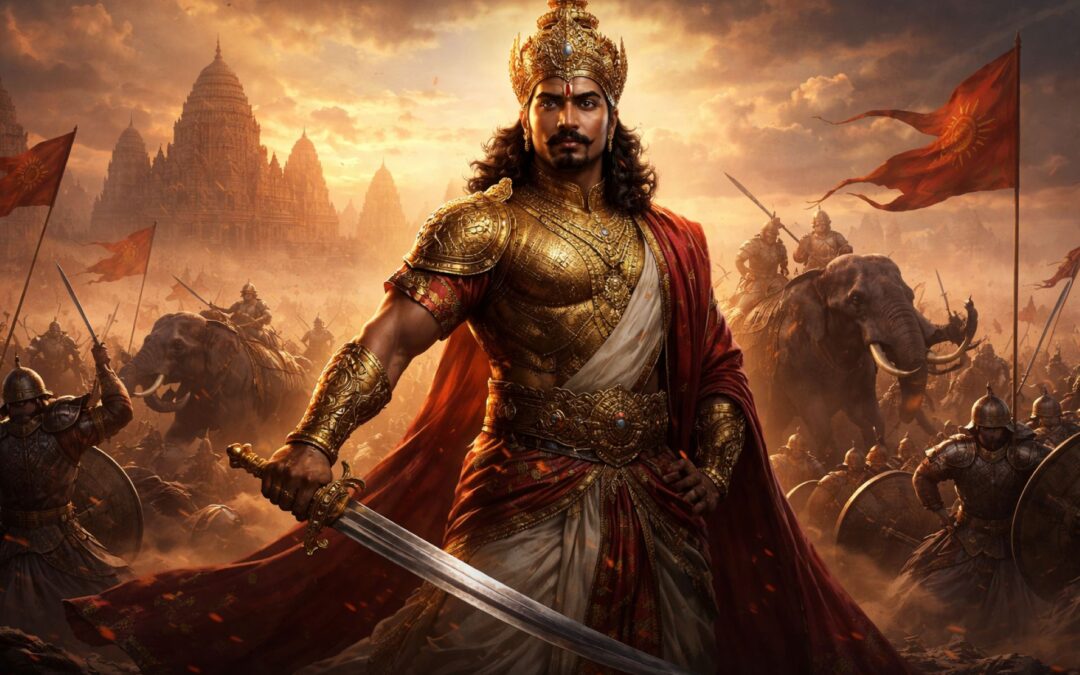
There are moments in history when the fate of an empire hangs not on armies or wealth, but on a single decision made in the shadows.
In 1509 CE, the Vijayanagara Empire stood at such a crossroads. Its emperor lay dying, its borders threatened by hostile powers, and its future uncertain. The obvious successor—Krishnadeva Raya—was everything the empire needed: intelligent, battle-tested, and politically astute. Yet he was also everything the empire distrusted. Born to a low-status mother, dismissed as illegitimate, and seen by many as unworthy of the throne, he was an outcast within his own royal lineage.
The dying emperor ordered that he be blinded.
What followed was not just a political maneuver, but an act of quiet defiance that would alter the course of Indian history. Through deception, courage, and the calculated intervention of a loyal minister, Krishnadeva Raya ascended a throne that was never meant to be his.
But this was only the beginning.
Over the next two decades, he would transform Vijayanagara into the most powerful empire in the subcontinent—crushing rivals, outmaneuvering enemies, and presiding over a golden age of prosperity and culture. He would challenge deeply entrenched social hierarchies, blur the lines between tradition and ambition, and rule with a force of personality that was as inspiring as it was unpredictable.
And yet, like many great rulers, the very qualities that fueled his rise would also sow the seeds of future instability.
This is the story of Krishnadeva Raya—not just the emperor who conquered kingdoms, but the outcast who redefined power itself, and the man whose legacy would shape both the glory and the downfall of one of India’s greatest empires.
A Throne Built on Deception and Defiance
The death of an emperor rarely brings clarity—it invites chaos.
As Veera Narasimha Raya lay on his deathbed, the Vijayanagara court was already fracturing into competing factions. The question of succession loomed large, and in such moments, logic often takes a backseat to fear, pride, and personal ambition.
On paper, the answer seemed straightforward. Krishnadeva Raya, the emperor’s half-brother, had already proven himself as a capable commander and an intelligent political actor. He had the support of powerful nobles, the loyalty of the army, and the backing of the empire’s most influential statesman—Timmarusu, the prime minister who had quietly mentored him for years.
But Veera Narasimha Raya saw things differently.
He wanted his young son, barely eight years old, to inherit the throne. To him, bloodline mattered more than ability. And Krishnadeva Raya, despite his royal connection, carried a stain that could not be ignored—the circumstances of his birth. As the son of a lower-status woman, he was seen not just as a rival, but as a threat to the very legitimacy of the dynasty.
So the emperor made a chilling decision.
He ordered that Krishnadeva Raya be blinded.
In the brutal political logic of the time, blinding was not merely punishment—it was disqualification. A blind man could not rule. With a single act, the emperor intended to eliminate his most dangerous competitor without the bloodshed of execution.
But Vijayanagara was not ruled by the emperor alone.
Timmarusu understood what was at stake. He knew that placing a child on the throne in such turbulent times would invite disaster. Enemies circled the empire’s borders, internal divisions simmered beneath the surface, and only a strong, experienced ruler could hold everything together.
So he chose deception over obedience.
Instead of carrying out the emperor’s order, Timmarusu staged an elaborate ruse. He had a goat slaughtered, removed its eyes, and presented them to the dying ruler as proof that the deed had been done. The resemblance was convincing enough. Veera Narasimha Raya, satisfied that his will had been fulfilled, breathed his last in peace.
The moment he died, the illusion ended.
Timmarusu moved swiftly. Backed by loyalists within the court and the military, he crowned Krishnadeva Raya as the new emperor of Vijayanagara. It was a calculated gamble—one that defied the dying wishes of the previous ruler, challenged entrenched social hierarchies, and risked plunging the empire into civil conflict.
But it worked.
Krishnadeva Raya ascended the throne not through inheritance, but through a combination of merit, loyalty, and one of the boldest acts of political deception in Indian history.
His reign began, fittingly, not with legitimacy—but with defiance.
The Wounded Empire He Inherited
Krishnadeva Raya did not inherit a rising empire. He inherited a wounded one.
By the time he took the throne in 1509, Vijayanagara had already existed for nearly two centuries. It was not a fragile kingdom, but a vast and complex imperial project—one born out of crisis, shaped by war, and sustained by a powerful vision of unity in a deeply divided landscape.
That story began in the early 14th century, when the political order of South India was shattered.
In 1310, the armies of the Delhi Sultanate swept into the Deccan under the command of Malik Kafur. What followed was not a single conquest, but a cascade of collapses. Established dynasties fell, cities were plundered, and long-standing power structures disintegrated. The south, once home to stable regional kingdoms, was left fragmented and vulnerable.
It was from this chaos that Vijayanagara emerged.
Founded in 1336 by the brothers Harihara and Bukka, the empire was not merely a new kingdom—it was a response to collapse. Guided, according to tradition, by a Hindu sage who envisioned a unified resistance, the founders set out to build a state that could withstand both internal fragmentation and external invasion. Vijayanagara was meant to be different: centralized, resilient, and expansive in its ambitions.
And for a time, it succeeded spectacularly.
Under successive rulers, the empire grew into one of the largest and most prosperous in the world. Its capital became a global city—second in size only to Beijing—drawing merchants, diplomats, and adventurers from across continents. Its administration was sophisticated, its military formidable, and its culture vibrantly cosmopolitan. Contrary to later simplifications, it was not an isolated Hindu stronghold but a multiethnic, multi-religious power that integrated diverse communities into its system.
But prosperity did not guarantee stability.
By the late 15th century, Vijayanagara was beginning to crack from within. Succession disputes turned violent, court politics grew treacherous, and imperial authority weakened. At the same time, external pressures intensified. The Bahmani Sultanate to the north launched repeated incursions, while regional powers like the Gajapati kingdom chipped away at its territories.
What had once been a confident, expanding empire was now struggling to hold its ground.
A desperate attempt to stabilize the situation came with the rise of Narasa Nayaka, a powerful military commander who seized control and laid the foundation for a new ruling dynasty. His actions temporarily halted the empire’s decline, but they also exposed a deeper truth—Vijayanagara’s survival now depended less on lineage and more on raw capability.
By the time Krishnadeva Raya ascended the throne, this reality was impossible to ignore.
The empire still possessed immense wealth, strategic depth, and cultural prestige. But it was surrounded by enemies, weakened by internal fractures, and in urgent need of decisive leadership.
It was not a throne of comfort.
It was a throne of responsibility—one that demanded not just a ruler, but a restorer.
Born an Outsider in a World Obsessed With Birth
In many ways, Krishnadeva Raya’s greatest battle began long before he stepped onto any battlefield.
It was the battle for legitimacy.
In a society where hierarchy was deeply ingrained and birth dictated status, his origins were a problem that could not be ignored. Though he was of royal blood through his father, Narasa Nayaka, his mother was a woman of low social standing—a servant. This single fact was enough to cast a long shadow over his claim to power.
To many within and beyond Vijayanagara, he was not a rightful heir. He was an anomaly.
The idea of kingship, especially in much of the Indian subcontinent, was tied not just to power but to purity—of lineage, of caste, of divine sanction. A ruler was expected to embody a certain ideal, and Krishnadeva Raya did not neatly fit into that mold. His ascent challenged an assumption that had remained largely unquestioned: that authority flowed naturally from birth.
And this discomfort was not limited to his own court.
Rival rulers weaponized his origins against him. None did so more openly than the Gajapati king of Odisha, who viewed Krishnadeva Raya not merely as a political adversary but as a social inferior. He dismissed him with contempt, referring to him as the “son of a servant girl”—a label meant not just to insult, but to delegitimize.
It was a calculated attack, and a dangerous one.
Because in a world where perception shaped power, legitimacy could be as important as military strength. A king who was not accepted as rightful could face rebellion from within and disrespect from without. Authority, in such a system, had to be constantly proven.
But Vijayanagara was not like other states.
By the time Krishnadeva Raya came to power, the rigid link between birth and authority had already begun to loosen, at least within the empire. His father himself had risen through military ranks to seize the throne, openly embracing his identity as a shudra warlord. The empire’s administrative system had grown increasingly pragmatic, incorporating individuals from diverse backgrounds—Hindu and Muslim, native and foreign—based on skill rather than pedigree.
This created an unusual environment.
Krishnadeva Raya may have been an outsider by traditional standards, but he was not alone in defying them. Vijayanagara, out of necessity, had evolved into a state where merit could, at times, override orthodoxy.
He understood this better than anyone.
Instead of attempting to mask or compensate for his origins, he leaned into what he could control—his ability. He cultivated alliances, earned the loyalty of powerful figures like Timmarusu, and built a reputation as a capable military leader even before his coronation. Where birth denied him automatic respect, competence forced recognition.
In doing so, he began to reshape the very idea of kingship.
His rule would not rest on unquestioned legitimacy. It would rest on performance—on victories won, order restored, and prosperity delivered. Every campaign, every policy, every decision became part of a larger argument: that he deserved to rule not because of where he came from, but because of what he could achieve.
And over time, that argument became impossible to ignore.
A Ruler of Contradictions
If Krishnadeva Raya’s rise defied expectations, his personality made him even harder to define.
He was not a ruler who fit neatly into a single archetype. He was, instead, a collection of contradictions—each one shaping the way he governed, fought, and lived.
On one hand, he was a fearsome warrior. Even before ascending the throne, he had built a reputation as an undefeated commander. He led from the front, took personal risks in battle, and inspired fierce loyalty among his troops. His presence on the battlefield was not symbolic—it was decisive.
On the other hand, he was deeply intellectual.
Krishnadeva Raya was not just a patron of literature; he was a writer himself. His work, Amuktamalyada, was not merely poetic—it was political. In it, he reflected on the responsibilities of kingship, criticized corrupt officials, and articulated a vision of governance rooted in justice and accountability. This was not the voice of a distant monarch, but of a ruler actively thinking about the state he controlled.
He could be generous to a fault.
Contemporary accounts, especially from Portuguese visitors like Domingo Paes, describe him as cheerful, approachable, and remarkably giving. Gifts, rewards, and honors were not distributed out of obligation, but as genuine expressions of favor. He built relationships through warmth as much as through authority.
And yet, he was also capable of sudden, explosive anger.
His temper was infamous. Decisions could be swift and unforgiving, especially when he felt disrespected or challenged. This volatility added an unpredictable edge to his rule—one that could both intimidate enemies and unsettle allies.
But perhaps his most defining contradiction was this: he was both deeply traditional and quietly rebellious.
He upheld the ideal of the righteous king, embraced religious duties, and invested in temples, culture, and established institutions. At the same time, he consistently acted in ways that challenged the very structures he appeared to support—whether it was his stance on caste, his personal relationships, or his willingness to elevate merit over lineage.
This duality made him uniquely effective.
He could speak the language of tradition when it suited him, reassuring elites and maintaining continuity. But when necessary, he could step outside those boundaries, adapting to the realities of power and reshaping norms to his advantage.
It also made him deeply human.
Krishnadeva Raya was not a distant, idealized figure. He was a ruler who felt intensely, thought deeply, and acted decisively—sometimes brilliantly, sometimes impulsively. His greatness did not come from being flawless, but from the sheer force of his personality and the clarity of his intent.
In a time of uncertainty, that combination proved invaluable.
Because Vijayanagara did not just need a king who could rule.
It needed a king who could bend the rules—and still hold everything together.
Love, Power, and Defiance of Social Norms
For Krishnadeva Raya, power was never just political. It was deeply personal.
And nowhere was this more evident than in his relationship with Chinna Devi.
Long before he became emperor, Krishnadeva Raya had formed a bond with her—a woman far removed from the expectations of royal marriage. She was a dancer from a modest background, with no claim to status, no political advantage, and no place in the rigid hierarchy that governed elite alliances.
By every conventional standard, she was unsuitable.
But to Krishnadeva Raya, she was irreplaceable.
As he rose closer to power, he made a promise—if he ever became king, he would marry her. It was a vow rooted not in strategy, but in emotion. And once he took the throne, he intended to keep it.
That intention, however, collided with reality.
Royal marriages were not personal choices; they were instruments of statecraft. Every union had implications—alliances to secure, territories to stabilize, factions to appease. For an emperor, love was expected to follow politics, not the other way around.
When Timmarusu learned of the situation, he understood the danger immediately.
Allowing the emperor to marry a low-status woman as his primary queen would not just raise eyebrows—it could destabilize the court, alienate powerful elites, and weaken the perception of royal authority. In a system already sensitive to questions of legitimacy, this was a risk Vijayanagara could not afford.
But Krishnadeva Raya refused to back down.
He made his position clear: he would rather give up the throne than abandon Chinna Devi.
It was a remarkable declaration—not just of love, but of defiance. In that moment, he challenged the very logic of kingship that had shaped his world. Birth, status, political necessity—none of it, to him, outweighed personal commitment.
Timmarusu, ever the pragmatist, sought a compromise.
Krishnadeva Raya would first enter into a politically advantageous marriage with a princess from a noble lineage—ensuring stability and legitimacy in the eyes of the court. Only then, quietly and without fanfare, would he be allowed to marry Chinna Devi.
It was an elegant solution, balancing emotion with necessity.
And Krishnadeva Raya accepted it.
He fulfilled his political duty, securing alliances through his first marriage. But he also kept his promise. In a private ceremony, away from the gaze of the court, he married Chinna Devi—the woman who remained, by all accounts, his true companion throughout his life.
This episode revealed something essential about his character.
He was not reckless enough to ignore the demands of power. But neither was he willing to let power completely dictate his choices. Where others might have surrendered to convention, he negotiated with it—finding ways to assert his will without breaking the system entirely.
It was a pattern that would repeat throughout his reign.
Krishnadeva Raya did not seek to overthrow tradition. He reshaped it—quietly, strategically, and always on his own terms.
Consolidating the South: Order Before Expansion
Before Krishnadeva Raya could dream of conquest, he had to secure what he already possessed.
When he ascended the throne, Vijayanagara was not in a position to expand. Its authority in the southern regions was uneven, local chieftains had grown assertive during years of instability, and feudal loyalties were fragile at best. Without internal order, any external campaign would be built on shaky ground.
Krishnadeva Raya understood this instinctively.
His first priority was consolidation.
Rebellions were dealt with swiftly and decisively. One notable uprising in Ummatur was crushed through a methodical campaign—rather than rushing into a costly assault, his forces surrounded the rebel stronghold and cut off its supplies, slowly suffocating resistance. It was a display not just of strength, but of patience and strategic discipline.
The message was clear: defiance would not be tolerated.
At the same time, he moved to restore the credibility of imperial authority. Feudal lords who had grown too independent were brought back into line, either through force or through calculated accommodation. Loyalty was rewarded, but only when it aligned with the stability of the state.
This was not simply about control—it was about rebuilding trust in the center.
Administratively, Krishnadeva Raya strengthened the empire’s foundations. Tax systems were reassessed, revenues were streamlined, and resources were redirected toward rebuilding the military and reinforcing the treasury. These reforms ensured that Vijayanagara was not just politically stable, but financially and militarily prepared for the challenges ahead.
And those challenges were considerable.
To the north and east, rival powers were watching closely, waiting for signs of weakness. Internally, the memory of recent instability had not yet faded. The empire needed not just a ruler, but a stabilizer—someone who could transform uncertainty into confidence.
Krishnadeva Raya became that figure.
By the time he turned his attention outward, the south was no longer a liability. It was a secure base—a platform from which the empire could project power rather than merely defend itself.
Only then did expansion become possible.
Because Krishnadeva Raya did not rush into greatness.
He built the conditions that made it inevitable.
Playing the Deccan: Strategy Beyond the Battlefield
If consolidating the south required discipline, navigating the Deccan required intelligence.
To the north of Vijayanagara lay a region in flux. The once-powerful Bahmani Sultanate had fractured into five successor states—Bijapur, Golconda, Ahmadnagar, Bidar, and Berar. On the surface, this fragmentation appeared to be an opportunity. A divided enemy is easier to defeat.
But in reality, it created a far more complex political landscape.
These successor states were not weak—they were ambitious, competitive, and constantly shifting in their alliances. Any one of them could become a threat, and any coalition among them could pose a serious challenge to Vijayanagara’s dominance.
Krishnadeva Raya understood that brute force alone would not be enough.
He needed to play the game.
Instead of confronting the Deccan sultanates as a unified bloc, he exploited their divisions. Alliances were formed, broken, and reconfigured depending on circumstance. One sultanate could be supported against another, only to be opposed later when the balance of power shifted. It was a fluid, calculated approach—less about permanent friendships and more about maintaining strategic advantage.
War, in this context, became just one tool among many.
Diplomacy, intelligence gathering, and psychological pressure all played crucial roles. Krishnadeva Raya was known to personally involve himself in understanding the pulse of his empire, even venturing out in disguise to observe conditions firsthand. This same attentiveness extended to his dealings with neighboring powers. Information was power, and he made sure he had it.
At the same time, he was not hesitant to use force when necessary.
When provoked or when opportunity presented itself, he acted decisively—launching campaigns that were as much about sending a message as they were about gaining territory. His responses were often swift and overwhelming, designed to discourage future challenges.
What made his approach effective was balance.
He did not overcommit to endless warfare, nor did he rely solely on negotiation. He moved between the two, adapting to circumstances, keeping his rivals uncertain, and preventing any single power from gaining enough strength to threaten Vijayanagara outright.
In doing so, he turned a volatile region into a manageable one.
The Deccan remained dangerous, but it was no longer unpredictable. Under Krishnadeva Raya, it became a chessboard—one where he dictated the tempo, even if he did not control every piece.
And when the time came for open confrontation, he would be ready—not just with armies, but with an understanding of exactly where and how to strike.
The War Against Bijapur and the Power of Shock Tactics
For all his skill in diplomacy, Krishnadeva Raya was never far from war.
And when conflict came with Bijapur, it did not emerge from grand strategy alone—it was fueled by memory, pride, and a willingness to respond with overwhelming force.
Tensions between Vijayanagara and Bijapur had been simmering for years. Old betrayals lingered. Insults were not forgotten. So when reports reached Krishnadeva Raya that the Bijapuri ruler had spoken of him with contempt, it was enough. Whether it was the insult itself or the history behind it, the decision was made.
War would follow.
The two forces eventually met near the Krishna River, a natural boundary that had long defined the frontier between competing powers. On the surface, the situation seemed balanced—two formidable armies, both experienced, both determined.
But Krishnadeva Raya was not interested in a conventional contest.
Instead, he relied on disruption.
On the advice of his commanders, a specialized detachment was sent ahead—not to engage in direct combat, but to break the cohesion of the enemy. These troops targeted the symbolic and structural center of the opposing army: the command tent and the elephants that anchored their formation.
What followed was chaos by design.
The detachment moved with speed and precision, cutting through defenses and attacking in unexpected ways. War elephants, already difficult to control, were thrown into panic. As they turned against their own ranks, trampling soldiers and breaking formations, the carefully arranged lines of the Bijapuri forces began to unravel.
In pre-modern warfare, discipline was everything. Once it broke, recovery was nearly impossible.
Krishnadeva Raya recognized the moment instantly.
He ordered a full assault.
With the enemy disoriented and their command structure compromised, Vijayanagara’s forces surged forward. What had begun as a structured engagement quickly turned into a rout. Soldiers fled toward the river, hoping to escape across it—but the terrain turned against them. Rising waters, confusion, and desperation led many to drown, while others were cut down in the retreat.
It was not just a victory.
It was a statement.
Krishnadeva Raya had demonstrated that warfare was not merely about strength or numbers, but about timing, psychology, and the ability to break an opponent’s will. By targeting morale and structure rather than just bodies, he turned a difficult battle into a decisive triumph.
And as news of the defeat spread, so did his reputation.
He was no longer just a capable ruler holding together a fragile empire.
He was a force to be reckoned with—one who could outthink as easily as he could overpower.
The Gajapati Campaign: Conquest Through Force and Deception
If the war against Bijapur showcased Krishnadeva Raya’s tactical brilliance, his campaign against the Gajapati kingdom revealed something deeper—his ability to blend force with psychological warfare.
This was not just another conflict.
It was personal.
The Gajapati ruler of Odisha had long viewed Krishnadeva Raya with open contempt. To him, the Vijayanagara emperor was not a legitimate king, but a social inferior—an upstart who had no right to rule. The insult was not subtle. He referred to him dismissively as the “son of a servant girl,” reducing a powerful emperor to the circumstances of his birth.
For Krishnadeva Raya, this was more than a political challenge. It was a direct attack on his authority.
And he intended to answer it.
The campaign began in the Andhra region—territory that had once belonged to Vijayanagara but had been absorbed into the Gajapati sphere during earlier periods of instability. Rather than launching a reckless invasion, Krishnadeva Raya advanced methodically.
Local chieftains were approached, negotiated with, and gradually brought back into the Vijayanagara fold. Some submitted willingly, recognizing the shifting balance of power. Others resisted and were dealt with through siege and force. Fortress after fortress fell, not always through brute strength, but through a combination of pressure, persuasion, and patience.
But the conflict reached a turning point when the Gajapati king attempted to intervene directly.
In one engagement, his forces failed to break the Vijayanagara advance, and the situation deteriorated further when his own son was captured. What followed was a moment that revealed the depth of the social divide driving the conflict.
When asked to demonstrate his skill in combat, the captured prince refused—not out of fear, but out of pride. He would not cross swords with a man of lower birth. The insult was so deeply felt that he chose death over perceived humiliation.
For Krishnadeva Raya, it was a stark reminder.
This was not just a war for land. It was a clash of worldviews—between inherited status and earned authority.
And he decided to end it decisively.
Instead of pushing deeper into enemy territory through prolonged warfare, he turned to deception. With the guidance of Timmarusu, a plan was devised that attacked not the army, but the trust holding it together.
Chests of treasure were sent to key Gajapati nobles, each accompanied by messages thanking them for their supposed loyalty to Vijayanagara. The goal was simple: create suspicion.
It worked perfectly.
When these chests were intercepted, the Gajapati king believed he had uncovered a conspiracy. Convinced that his own nobles had betrayed him, he fled his capital in fear, abandoning his position without a fight.
Krishnadeva Raya marched in unopposed.
Yet, in victory, he showed restraint.
Rather than fully annexing the Gajapati kingdom, he chose to leave it intact as a buffer state, securing peace through a marriage alliance and political agreement. It was a pragmatic decision—one that avoided overextension while ensuring long-term stability.
In this campaign, Krishnadeva Raya achieved more than territorial gain.
He dismantled a rival’s power, humiliated an adversary who had questioned his legitimacy, and demonstrated that the most decisive victories are not always won on the battlefield.
Sometimes, they are won in the mind.
Raichur: The Battle That Defined His Greatness
If there was a single moment that cemented Krishnadeva Raya’s legacy, it was the campaign for Raichur.
This was not just another fortress.
Raichur sat between the Krishna and Tungabhadra rivers—a fertile, strategically vital region that had long been contested between Vijayanagara and the Deccan sultanates. Whoever controlled it commanded not only land, but prestige. For decades, it had symbolized unfinished business.
For Krishnadeva Raya, capturing Raichur was more than a military objective.
It was the final proof of supremacy.
But in medieval politics, wars needed justification. And Krishnadeva Raya, ever calculating, engineered one. Through a carefully staged defection involving one of his own officers, he created a diplomatic dispute that allowed him to present his campaign as righteous rather than aggressive.
With legitimacy secured, he marched.
The Raichur fort was no ordinary target. It was a heavily fortified stronghold, built with multiple layers of thick granite walls, stocked with provisions, and equipped with advanced weaponry—including artillery and matchlock infantry. It was designed to withstand long sieges, and its defenders were well prepared.
Krishnadeva Raya began with persistence.
Instead of relying solely on cannon fire, his forces attempted to dismantle the outer defenses manually—stone by stone, under constant enemy fire. It was grueling, costly, and slow. For months, progress was limited, and casualties mounted.
Then the situation worsened.
The Bijapur ruler, Ismail Adil Shah, arrived with a powerful army to relieve the fort. What had been a siege was now turning into a full-scale confrontation. As the two forces clashed near the river, Krishnadeva Raya’s troops initially faltered under the pressure of concentrated gunfire and cavalry charges.
For a moment, defeat seemed possible.
And then the king intervened.
Riding out before his retreating army, Krishnadeva Raya did something that few rulers dared—he placed himself at the center of danger. He called his men back, not with orders, but with conviction. If death was inevitable, he declared, it should be met with courage, not flight.
It was a turning point.
Inspired by his resolve, the army rallied. What had been a retreat transformed into a counterattack. The Bijapuri forces, unprepared for such a reversal, began to break. Chaos spread through their ranks, and the battle shifted decisively in Vijayanagara’s favor.
The enemy retreated.
But the victory was not yet complete.
Returning to the siege, Krishnadeva Raya found himself facing the same stubborn defenses. This time, however, an unexpected advantage arrived in the form of Portuguese allies. Armed with advanced matchlock firearms, they introduced a new dimension to the battle.
From a distance, they targeted defenders on the walls—something traditional weapons could not achieve with precision. For the first time, the fort’s defenders were exposed. Their movements became dangerous, their positions vulnerable.
Under this new pressure, the balance tipped.
With the defenders suppressed and the walls steadily weakened, Raichur finally fell. The fortress that had resisted for so long surrendered, marking the end of one of the most hard-fought campaigns of Krishnadeva Raya’s reign.
It was a victory of endurance, leadership, and adaptation.
He had faced a fortified enemy, a relieving army, and the threat of collapse—and emerged victorious each time. More importantly, he had shown an ability to learn and evolve, incorporating new technologies and strategies when needed.
After Raichur, there was little doubt left.
Krishnadeva Raya was no longer just a powerful ruler within the subcontinent.
He was its dominant force.
The Golden Age of Vijayanagara
By the time Raichur fell, Vijayanagara was no longer a contested power.
It was the center of gravity in the subcontinent.
Under Krishnadeva Raya, the empire entered a phase that would later be remembered as its golden age—a period not just of military dominance, but of extraordinary prosperity, stability, and cultural vitality.
At the heart of this transformation was governance.
Krishnadeva Raya was not a ruler who delegated blindly. He was deeply involved in the functioning of the state, paying close attention to administration, taxation, and justice. Revenue systems were refined to ensure a steady flow of wealth into the treasury without completely alienating local populations. Officials were expected to perform, and those who failed—or abused their positions—were dealt with firmly.
The result was a state that worked.
Trade flourished across land and sea. Vijayanagara’s markets were filled with goods from across the world—horses from Arabia, textiles from across India, precious stones, spices, metals, and luxury items that moved through an increasingly interconnected commercial network. Foreign merchants, especially the Portuguese, became regular participants in this exchange, further integrating the empire into global trade routes.
And at the center of it all stood the capital.
Vijayanagara was not just a political seat—it was a spectacle. Contemporary accounts describe it as one of the largest cities in the world, rivaling or even surpassing many European capitals. Its streets were wide and bustling, its bazaars vibrant, and its architecture monumental. Temples, markets, palaces, and public spaces reflected both wealth and ambition.
But prosperity alone does not define a golden age.
Culture flourished alongside power.
Krishnadeva Raya was a patron of literature, art, and intellectual life. His court attracted poets, scholars, and thinkers, creating an environment where creativity was not just tolerated, but encouraged. Languages like Telugu, Kannada, and Sanskrit saw significant literary contributions during his reign, and the blending of cultural influences added richness to the empire’s identity.
At the same time, Vijayanagara remained remarkably cosmopolitan.
Despite its origins as a response to northern invasions, the empire was not insular. Muslims held positions within the administration and military, foreign envoys were welcomed, and diverse communities coexisted within its cities. Cultural exchange was not seen as a threat, but as a source of strength.
This openness, combined with strong leadership, created a rare balance.
The empire was secure enough to grow, and flexible enough to adapt.
For its people, this translated into relative stability and opportunity. Agriculture thrived in fertile regions, trade enriched urban centers, and public works—temples, irrigation systems, and infrastructure—reinforced both economic and social life.
It was, in many ways, the realization of Vijayanagara’s original promise.
An empire born from chaos had reached its peak—not just surviving, but shaping the world around it.
And at the center of it all stood Krishnadeva Raya, the outcast who had turned uncertainty into dominance, and power into prosperity.
The Mistakes That Undermined an Empire
Great empires are rarely destroyed in a single moment.
More often, they begin to unravel at their peak—when confidence turns into overreach, and strength begins to blind itself.
For Krishnadeva Raya, the turning point came not in defeat, but in victory.
After the triumph at Raichur, his position seemed unassailable. His rivals had been humbled, his authority was unquestioned, and Vijayanagara stood as the dominant power in the region. But it was precisely this dominance that began to reshape his decisions.
One of his first major missteps was diplomatic.
In the aftermath of defeat, the Bijapur ruler sought a negotiated settlement. It was an opportunity to stabilize relations, to consolidate gains, and to avoid further escalation. But Krishnadeva Raya’s response was not measured—it was provocative.
He demanded submission in the most humiliating terms.
Whether driven by pride, anger, or a desire to assert unquestioned superiority, this decision had consequences. It transformed a defeated rival into a resentful enemy and signaled to the other Deccan sultanates that Vijayanagara was not just powerful, but potentially domineering and unpredictable.
The balance he had so carefully maintained began to shift.
Instead of keeping the Deccan states divided, his actions pushed them toward a shared realization—that they had more to fear from Vijayanagara than from each other. A ruler who had once excelled at playing rivals against one another was now, unintentionally, giving them a reason to unite.
And then came a more dangerous move.
Krishnadeva Raya intervened directly in the internal politics of his enemies, installing a puppet ruler in the remnants of the Bahmani Sultanate. It was a bold assertion of power, but also a risky one. By interfering so openly, he crossed an invisible line—from competitor to threat.
The message was unmistakable: no throne was beyond his reach.
For neighboring powers, this was not just concerning—it was unacceptable.
At the same time, trouble was brewing within his own empire.
As Krishnadeva Raya grew older, the question of succession became urgent. Determined to secure stability, he made the decision to elevate his young son as heir while still alive, intending to guide him and ensure a smooth transition of power.
On the surface, it seemed prudent.
But it exposed a vulnerability.
Court politics intensified. Rival factions maneuvered for influence, and the absence of a fully mature, independent heir created uncertainty. The empire, for all its strength, now depended heavily on a delicate balance of personalities and loyalties.
And that balance was fragile.
Krishnadeva Raya, who had spent years mastering the external game of power, now found himself facing a more unpredictable battlefield—his own court.
The same decisiveness that had brought him success in war began to show its limits in this environment.
Because internal threats are not defeated with armies.
They require patience, restraint, and above all, trust—qualities that would soon be tested in the most devastating way possible.
The Fall of a King and the Shadow of Collapse
In the end, Krishnadeva Raya was not undone by his enemies.
He was undone by a failure of judgment—one that struck at the very foundation of his power.
The crisis began with tragedy. As part of his succession plan, his young son—the chosen heir—fell suddenly ill and died. The loss was devastating, not just emotionally, but politically. With the future of the empire once again uncertain, suspicion spread quickly through the court.
And suspicion, in such environments, is rarely quiet.
Accusations began to surface, pointing toward one man—Timmarusu.
The same minister who had secured Krishnadeva Raya’s rise, who had protected him when he was vulnerable, who had guided him through the early years of his reign, was now accused of orchestrating the poisoning of the prince.
It was an extraordinary claim.
And it demanded careful scrutiny.
But grief does not lend itself to patience.
Krishnadeva Raya, overwhelmed by loss and surrounded by intrigue, made a decision that would have lasting consequences. He chose to believe the accusation.
Timmarusu was arrested.
Not only him, but members of his family—men who held influence, who had been pillars of the administration—were imprisoned. And in a brutal act meant to ensure that they could never again threaten the throne, Timmarusu was blinded.
It was a grim echo of the fate that had once nearly been his own.
The irony was cruel.
The man who had saved Krishnadeva Raya from political elimination now suffered that very punishment at his hands.
And worse still, it appears he was innocent.
Later accounts suggest that the real architect behind the poisoning—and the accusations—was a rival within the court, a man with ambitions of his own. By removing Timmarusu, Krishnadeva Raya had unknowingly eliminated one of his most loyal and capable allies, weakening the very system that had sustained his rule.
The damage was immediate.
With Timmarusu gone, the court lost a stabilizing force. Loyal networks fractured, trust eroded, and the emperor found himself increasingly isolated. The careful balance of power that had held Vijayanagara together began to shift, not with a dramatic collapse, but with a quiet erosion.
And there was no time left to repair it.
When Krishnadeva Raya died in 1529, he left behind an empire at the height of its power—wealthy, expansive, and dominant. But beneath that surface, the foundations had been shaken.
There was no strong, prepared successor.
There was no trusted inner circle to ensure continuity.
There was, instead, a vacuum—one that would soon be filled by competing ambitions and external pressures.
Krishnadeva Raya’s life had been defined by defiance—against expectations, against rivals, against the limitations of his birth.
But in the end, it was not defiance that defined his legacy.
It was the fragile truth that even the greatest rulers cannot escape:
Power, once destabilized from within, rarely survives for long.
Conclusion: Greatness, Defiance, and the Cost of Power
Krishnadeva Raya’s story is not just the story of a king.
It is the story of how power is built—and how it begins to slip.
He rose in defiance of everything that should have held him back. In a world obsessed with lineage, he proved that ability could outweigh birth. In an empire on the brink, he restored order, crushed rivals, and transformed Vijayanagara into the most powerful state in the subcontinent. His reign brought prosperity, stability, and a cultural flourishing that would echo long after his death.
He did not merely inherit an empire.
He remade it.
And yet, his story refuses to be simple.
Because the same qualities that fueled his rise—his confidence, his decisiveness, his refusal to accept limits—also shaped his fall. In victory, he pushed too far. In grief, he trusted too quickly. In securing the future, he destabilized the present.
The empire he left behind was magnificent.
But it was also vulnerable.
That is what makes his legacy enduring.
Krishnadeva Raya was not great because he was flawless. He was great because he operated at the edge of possibility—reshaping power, bending tradition, and forcing the world to adapt to him. But like all rulers who change the rules of the game, he also left behind a system that depended too heavily on his presence.
When he was gone, the balance he had created could not hold.
In the end, his life stands as both an achievement and a warning.
That greatness can be forged from defiance.
But it must also be sustained with restraint.