
Introduction: The Empire That Defied India’s Geographic Divide
For much of Indian history, power seemed to flow in a familiar direction—from the fertile plains of the north toward the rest of the subcontinent. The great imperial centers of ancient India—the Mauryas, the Guptas—had all risen from the Gangetic heartland, projecting authority outward. North India was not just a region; it was the symbolic core of political legitimacy, wealth, and civilizational prestige.
And yet, in the early medieval period, this long-standing pattern was dramatically disrupted.
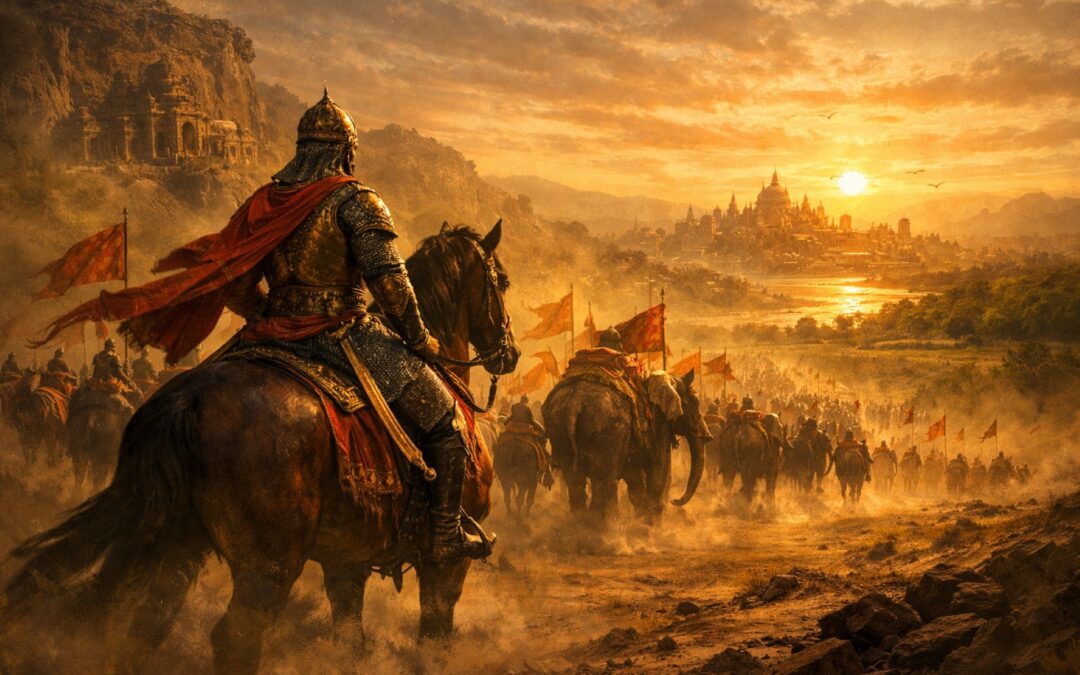
From the rugged, semi-arid plateau of the Deccan emerged a dynasty that would challenge the very idea of where power in India ought to originate. The Rashtrakuta Empire, a South Indian power with its base far from the Ganges, did not merely defend its territory or expand locally. It marched north—again and again—into the political heart of the subcontinent. It defeated northern kings, occupied the legendary city of Kannauj, and forced the great powers of North India to acknowledge its supremacy.
This was not a fleeting raid or a symbolic incursion. It was a sustained assertion of imperial ambition that unfolded over generations, drawing the Rashtrakutas into a fierce three-way struggle with the Pratiharas and the Palas for control of North India. In doing so, they reshaped the political map of the subcontinent and demonstrated that imperial authority in India was not confined to geography—it could be seized, contested, and redefined.
But the story of the Rashtrakutas is more than just a tale of conquest. It is a story of strategic brilliance, of rulers who understood the deeper mechanics of power—trade, legitimacy, diplomacy, and culture. It is also the story of an empire that, at its height, stretched from the southern seas to the edges of the Himalayas, only to collapse under the weight of its own success and internal fractures.
Today, the Rashtrakutas remain one of the most powerful yet underappreciated dynasties in Indian history. Their achievements are often overshadowed by the empires that came before and after them. But for a brief and remarkable period, they accomplished something extraordinary: they reversed the direction of Indian imperial ambition and proved that the road to power did not always begin in the north.
This is the story of the empire that dared to cross that divide—and conquered it.
The World Before the Rashtrakutas: A Fragmented Subcontinent
By the time the Rashtrakutas began their rise in the 8th century, the Indian subcontinent was no longer dominated by a single, overarching imperial power. The age of the Mauryas and the Guptas—when vast territories were unified under centralized rule—had long since passed. In their place had emerged a patchwork of regional kingdoms, each ambitious, each competitive, and each vying for influence in an increasingly fragmented political landscape.
This fragmentation did not imply weakness alone—it also meant opportunity.
Across the subcontinent, new dynasties were asserting themselves. In the Deccan, the Chalukyas had established a powerful kingdom, though by the mid-8th century their authority was beginning to weaken. In the south, the Pallavas and the Pandyas competed for dominance over Tamil country. Meanwhile, in the north, the political vacuum left by earlier empires had given rise to new contenders—most notably the Pratiharas in the northwest and the Palas in the northeast.
Yet despite this decentralization, one idea remained remarkably consistent: North India still held the key to imperial legitimacy.
At the center of this idea stood the city of Kannauj.
Located in the fertile Ganges basin, Kannauj was more than just a prosperous urban center—it was a symbol. Whoever controlled Kannauj could claim not only access to wealth and trade routes, but also a kind of political and cultural supremacy that resonated across the subcontinent. It had been a seat of power under earlier rulers, and its prestige endured even as empires rose and fell around it.
This made Kannauj the ultimate prize in early medieval India.
For the Pratiharas and the Palas, both based in North India, the contest for Kannauj was a natural extension of their regional ambitions. But for a southern power to enter this arena was something altogether different. It required not only military strength but also the confidence—and vision—to challenge a deeply ingrained geographic hierarchy.
It is within this volatile and competitive environment that the Rashtrakutas emerged.
What made their rise so remarkable was not merely that they became powerful, but that they chose to compete on the grandest stage available. They did not limit themselves to consolidating the Deccan or defending their southern frontiers. Instead, they looked north—to the symbolic heart of India—and decided that it, too, was within their reach.
In doing so, they would transform a fragmented political landscape into a battleground for one of the most intense and consequential power struggles in Indian history.
The Rise of the Rashtrakutas: From Feudatories to Conquerors
The Rashtrakutas did not begin as empire-builders. Like many great dynasties in Indian history, their origins lay in service—specifically, as feudatories under a more powerful ruling house.
In the early 8th century, the Deccan was dominated by the Chalukya Empire, a formidable power that controlled large swathes of peninsular India. It was within this political framework that the Rashtrakutas first appear, operating as subordinate rulers with regional authority but limited autonomy. Yet beneath this outward loyalty, the conditions for rebellion were quietly taking shape.
The turning point came with a leader named Dantidurga.
Dantidurga was not content with the constraints of feudatory status. His early career was marked by military success, most notably in helping repel Arab incursions into the Deccan—campaigns that enhanced both his reputation and his strategic standing. These victories were more than defensive triumphs; they were a demonstration of capability, a signal that the Rashtrakutas were no longer just vassals, but contenders.
Over the next decade and a half, Dantidurga moved methodically. He expanded his influence across central India, subdued neighboring rulers, and—crucially—built alliances that would isolate his Chalukya overlords. One of his most strategic moves was forging ties with the Pallavas in the south, effectively surrounding the Chalukyas from multiple directions.
By the early 750s, the balance of power had shifted.
In 753 CE, Dantidurga launched his decisive challenge. With the Chalukyas weakened and encircled, he struck at their core territories, dismantling their authority and declaring independence. What had once been a subordinate house had now become a sovereign power.
But Dantidurga’s reign was only the beginning.
After his death in 756 CE, his uncle Krishna I ascended the throne and completed what Dantidurga had started. Where Dantidurga had broken the Chalukya hold, Krishna I eliminated it entirely. By 757 CE, the Chalukyas had been decisively displaced, and the Rashtrakutas stood as the dominant power in the Deccan.
Krishna I did not stop at consolidation. He expanded aggressively, bringing the Ganga dynasty and the Konkan coastal regions under Rashtrakuta control, and forcing the Eastern Chalukyas into submission as feudatories. His reign established a pattern that would define the dynasty—relentless expansion paired with strategic subjugation of rivals.
Yet Krishna I’s legacy was not only written in warfare.
He is also credited with commissioning one of the most extraordinary architectural achievements in Indian history: the Kailasa temple at Ellora. Carved out of a single rock, the temple was not just a religious monument but a statement of imperial ambition—an assertion that the Rashtrakutas possessed not only military power, but also the resources, organization, and vision to create enduring cultural landmarks.
By the end of Krishna I’s reign in 774 CE, the transformation was complete.
The Rashtrakutas had evolved from regional subordinates into the preeminent power of South India. Their core territories were secure, their rivals subdued or subordinated, and their ambitions beginning to stretch beyond the Deccan.
The stage was now set for something far more audacious.
Having conquered the south, the Rashtrakutas would turn their gaze north—toward the richest, most symbolic prize in the subcontinent.
Why Kannauj Mattered: Wealth, Trade, and Imperial Legitimacy
If the Rashtrakutas were to challenge the established order of the subcontinent, they needed more than military strength—they needed a prize worthy of imperial ambition. That prize was Kannauj.
To understand why Kannauj mattered so deeply, one must look beyond its geography and into what it represented.
Situated in the fertile Ganges basin, Kannauj occupied one of the most economically productive regions in India. The surrounding plains were rich in agriculture, capable of sustaining large populations and generating significant revenue. Control over this region meant access to wealth on a scale that few other areas could rival.
But Kannauj’s importance extended far beyond agriculture.
It was a major node in North India’s trade networks, linking routes that stretched across the subcontinent and beyond. Merchants, goods, and ideas flowed through this region, making it not just a center of economic activity but also a hub of cultural exchange. For any empire seeking long-term dominance, controlling Kannauj meant tapping into these networks—gaining both material resources and strategic advantage.
Yet perhaps the most powerful aspect of Kannauj was symbolic.
For centuries, North India had been the seat of India’s most prestigious empires. Even after the decline of the Guptas, the idea persisted that true imperial authority was rooted in the Gangetic heartland. Kannauj, as one of its most prominent cities, became a kind of political trophy—a place whose possession conferred legitimacy far beyond its walls.
To rule Kannauj was to make a statement: not merely that one was powerful, but that one belonged among the great imperial powers of India.
This is what drew not one, but three major dynasties into its orbit.
The Pratiharas, based in northwestern India, saw Kannauj as a natural extension of their domain. The Palas, ruling in the east, viewed it as essential to securing their influence across the Gangetic plain. And then there were the Rashtrakutas—an empire from the Deccan, far removed from this northern center of power, yet determined to claim it nonetheless.
For them, Kannauj represented something even more profound.
It was a chance to break the geographic monopoly of power. To prove that a South Indian empire could not only compete with northern dynasties but surpass them—on their own ground, by their own standards.
This convergence of wealth, strategy, and symbolism turned Kannauj into the focal point of one of the most intense and enduring conflicts of early medieval India.
It was no longer just a city.
It was the battlefield upon which the very idea of empire in India would be contested.
The Tripartite Struggle: Rashtrakutas, Pratiharas, and Palas
The contest for Kannauj did not unfold as a simple war between two rivals. Instead, it evolved into a prolonged and complex three-way conflict—one that would dominate the political landscape of early medieval India for nearly two centuries.
At its core were three great powers:
- The Rashtrakutas, rising from the Deccan in the south
- The Pratiharas, entrenched in the arid regions of northwestern India
- The Palas, ruling the fertile lands of Bengal in the northeast
Each of these dynasties had its own geographic base, its own strengths, and its own vision of imperial dominance. But they were united by a single objective: control over Kannauj and, by extension, the heart of North India.
This three-sided contest came to be known as the Tripartite Struggle.
Unlike many wars that culminate in decisive victories, the Tripartite Struggle was defined by its fluidity. Power shifted constantly. Alliances formed and dissolved. Victories were often temporary, and control over Kannauj changed hands multiple times across generations.
The Pratiharas, positioned closest to Kannauj, had the advantage of proximity. Their stronghold in Rajasthan and western India allowed them to respond quickly to threats and assert influence over the Gangetic plains. The Palas, on the other hand, commanded the wealth and manpower of Bengal, enabling them to project power westward into the same contested region.
The Rashtrakutas were the outliers.
Geographically distant from Kannauj, they faced logistical challenges that their northern rivals did not. Every campaign into North India required long marches across the subcontinent, stretching supply lines and exposing their core territories to potential threats. And yet, despite these disadvantages, they repeatedly entered the fray—and often emerged victorious.
What made the Tripartite Struggle so significant was not just the scale of the conflict, but what it revealed about the nature of power in India at the time.
No single dynasty was strong enough to dominate the others permanently. The balance of power was delicate, constantly recalibrated by military campaigns, political marriages, and shifting loyalties among feudatories. Regional rulers played crucial roles, sometimes acting as allies, sometimes as opportunists waiting to exploit moments of weakness.
In this environment, empire was not a static achievement—it was a continuous process.
For the Rashtrakutas, participation in this struggle was both a risk and a necessity. To ignore Kannauj would have been to accept a secondary status in the hierarchy of Indian powers. To contest it, however, meant committing to a cycle of campaigns that would test the limits of their military and administrative capabilities.
They chose to contest it.
And in doing so, they ensured that the Tripartite Struggle would not remain a northern affair. It would become a truly subcontinental conflict—one in which a South Indian empire would repeatedly challenge, disrupt, and redefine the balance of power in North India.
Dhruva’s Northern Campaigns: The First Southern Strike into the North
The Rashtrakutas had established themselves as the dominant power in the Deccan under Dantidurga and Krishna I. But it was under Dhruva I that the dynasty took its first decisive step into the larger contest for supremacy in India.
Dhruva inherited not just a strong kingdom, but an opportunity.
By the late 8th century, the political situation in North India was fluid. The Pratiharas and the Palas were already competing for influence, and the city of Kannauj—so central to their ambitions—remained vulnerable. For a ruler with both military strength and strategic vision, this was the perfect moment to intervene.
Before looking north, however, Dhruva did what any successful ruler of the time had to do: he secured his base.
He consolidated Rashtrakuta authority in the south, suppressed internal rebellions, and ensured that rival powers in the Deccan were either subdued or contained. Only after stabilizing his core territories did he turn his attention toward the far more ambitious goal of northern expansion.
When Dhruva finally moved north, he did so with remarkable speed and effectiveness.
His first major confrontation was with the Pratiharas, who controlled key regions such as Gujarat and Malwa—areas that formed the natural gateway between the Deccan and North India. Dhruva’s campaign against them was swift and decisive. The Pratihara forces were defeated and pushed back into their western strongholds, leaving these strategic regions open to Rashtrakuta influence.
With this obstacle removed, Dhruva advanced further north.
His next target was the Pala-controlled territories around Kannauj. Here, the campaign appears to have taken the form of a powerful raid rather than a sustained occupation. Dhruva’s forces penetrated deep into the Gangetic heartland, driving out the Palas and plundering the rich city of Kannauj. Contemporary descriptions suggest that his army—particularly its war elephants—left a profound impression, both materially and symbolically.
Yet, despite this success, Dhruva did not attempt to hold Kannauj.
Instead, he withdrew south with substantial plunder and prestige, choosing not to overextend his empire by trying to govern a region so distant from his power base. At first glance, this might seem like a missed opportunity. But in reality, it reflects a calculated approach.
Dhruva’s campaign was not about immediate territorial control—it was about announcing Rashtrakuta power on a subcontinental scale.
For the first time, a South Indian empire had marched into the heart of North India, defeated its major powers, and demonstrated that it could operate far beyond its traditional sphere. The psychological impact of this was immense. The Rashtrakutas were no longer just a regional force; they had become a central player in the struggle for Kannauj.
At the same time, Dhruva remained attentive to developments closer to home.
Upon returning south, he reasserted control over the Eastern Chalukyas—frequent challengers to Rashtrakuta authority—using a combination of military force and diplomatic marriage alliances. This ability to shift focus between distant campaigns and local stability would become a hallmark of Rashtrakuta strategy.
Dhruva’s reign thus marked a turning point.
He transformed the Rashtrakutas from a powerful Deccan empire into an all-India contender. His northern expedition may not have resulted in permanent conquest, but it fundamentally altered the balance of power, drawing the Rashtrakutas fully into the Tripartite Struggle.
And more importantly, it set a precedent.
The road to Kannauj had been opened—and future Rashtrakuta rulers would not hesitate to walk it again.
Govinda III: The Emperor Who Touched the Himalayas
If Dhruva I opened the road to North India, it was his son Govinda III who marched down that road with far greater ambition—and far greater success.
But Govinda III’s rise was anything but smooth.
When he ascended the throne in 793 CE, he did so in the midst of a bitter succession struggle. His elder brother, unwilling to accept his claim, rallied a powerful coalition of feudatories and challenged him for control of the empire. The conflict was not a minor rebellion—it was a full-scale civil war that threatened to fracture the Rashtrakuta state at a critical moment.
Govinda III emerged victorious, but the cost of that victory was instability.
Key regions such as Gujarat and Malwa slipped out of Rashtrakuta control, returning to Pratihara hands. Kannauj, too, fell back under Pala influence. Even in the south, the ever-restless Eastern Chalukyas seized the opportunity to assert their independence once again.
In many ways, Govinda III inherited an empire that was unraveling.
What followed was one of the most remarkable recoveries in Indian imperial history.
Rather than merely restoring the status quo, Govinda III chose to rebuild the empire on stronger, more durable foundations. Around 800 CE, he launched a series of campaigns that would not only reclaim lost territories but expand Rashtrakuta influence to unprecedented levels.
His first objective was to secure the western and central regions—Gujarat and Malwa.
These territories were not just borderlands; they were strategic corridors that connected the Deccan to North India. Without firm control over them, any northern campaign would remain vulnerable. Govinda III moved decisively, defeating the Pratihara forces and reasserting Rashtrakuta dominance in the region.
But this time, he made a crucial strategic innovation.
Instead of allowing local rulers to remain in place as semi-autonomous feudatories—a system that had previously proven unreliable—Govinda III installed loyal dynasties to govern these regions. In Gujarat, he placed his own brother on the throne, creating a Rashtrakuta branch line. In Malwa, he established the Paramaras as loyal subordinates.
This was not just conquest—it was reorganization.
With his northern frontier now more secure, Govinda III advanced toward Kannauj.
Unlike his father, he did not merely raid the region. He captured the city and compelled the submission of the Pala ruler, Dharmapala. The Pratiharas, already weakened, were unable to effectively challenge his advance. For a brief but significant moment, Govinda III stood as the dominant power across much of the subcontinent.
Contemporary accounts describe the scale of his campaign in almost poetic terms.
It is said that his horses drank from the icy streams of the Himalayas, while his war elephants tasted the waters of the Ganges—a symbolic way of expressing just how far his influence had reached.
And yet, even at the height of this success, Govinda III did not attempt to permanently hold Kannauj.
Like Dhruva before him, he recognized the practical limits of direct control over such distant territories. Instead, his campaign was about something more enduring: establishing unquestioned supremacy. By defeating both the Pratiharas and the Palas and forcing their submission, he ensured that the Rashtrakutas were not merely participants in the Tripartite Struggle—they were its dominant force.
Eventually, new challenges drew him back to the south.
The Eastern Chalukyas, true to form, had once again asserted their independence. Govinda III responded swiftly, defeating them and installing a loyal ruler in their place. This pattern—northern conquest followed by southern consolidation—became a defining rhythm of Rashtrakuta rule.
By the end of his reign, Govinda III had achieved something extraordinary.
He had taken an empire weakened by civil war and transformed it into a subcontinental power. He had not only matched his father’s achievements but surpassed them, combining military brilliance with administrative foresight.
Most importantly, he had proven that a South Indian empire could project power from the Deccan to the Himalayas—and compel the greatest powers of North India to bow before it.
In doing so, Govinda III did not just expand the Rashtrakuta Empire.
He redefined what it meant to be an empire in India.
Imperial Strategy: How the Rashtrakutas Ruled a Vast Empire
Conquering territory was one challenge. Holding it—especially across the vast and diverse landscape of the Indian subcontinent—was another entirely.
The Rashtrakutas succeeded not merely because of their military strength, but because of the strategic systems they developed to govern an empire that stretched across regions, cultures, and political traditions. Their approach was neither rigidly centralized nor loosely fragmented. Instead, it was a carefully balanced structure that combined direct control with delegated authority.
At the heart of this system was the use of feudatories.
Rather than attempting to administer every region directly from their capital, the Rashtrakutas relied on a network of subordinate rulers who governed territories in their name. These feudatories were often local kings or nobles who retained a degree of autonomy in exchange for loyalty, tribute, and military support.
This system offered clear advantages. It allowed the Rashtrakutas to extend their influence over vast areas without overburdening their administrative capacity. It also helped maintain local stability, as existing power structures were often preserved rather than dismantled.
But it came with risks.
Feudatories were not always reliable. Given the opportunity, they could—and often did—switch allegiances, rebel, or assert independence. The Rashtrakutas were acutely aware of this vulnerability, and their strategy evolved accordingly.
Under rulers like Govinda III, a more assertive approach began to emerge.
In strategically important regions such as Gujarat and Malwa, the Rashtrakutas moved beyond simply accepting local rulers as subordinates. Instead, they installed loyal dynasties—sometimes even members of their own family—to govern these territories. This reduced the likelihood of rebellion and ensured tighter integration with the imperial core.
This blend of delegation and control became a hallmark of Rashtrakuta governance.
Military organization played an equally crucial role.
The Rashtrakuta army was structured along the lines typical of early medieval Indian warfare, consisting of infantry, cavalry, and war elephants. Among these, cavalry emerged as the most decisive arm. Mobility was essential for an empire that had to respond quickly to threats across great distances, and Rashtrakuta forces were well-equipped to conduct rapid campaigns—whether in the Deccan, the western coast, or deep into North India.
The prominence of cavalry was so significant that it even found expression in Rashtrakuta coinage, symbolizing speed, aggression, and imperial reach.
At the same time, war elephants continued to serve as powerful instruments of shock and intimidation, particularly in large-scale battles and sieges. Infantry, though often less heavily armored, provided the bulk of manpower and logistical support.
What truly distinguished the Rashtrakutas, however, was their ability to balance expansion with consolidation.
Their rulers understood that campaigns into distant regions like Kannauj could not be sustained indefinitely without risking instability at home. As a result, their strategy often followed a deliberate pattern: a period of aggressive expansion, followed by a phase of consolidation, diplomacy, and internal stabilization.
Marriage alliances were a key tool in this process.
By marrying into rival dynasties or influential families, the Rashtrakutas were able to secure peace, reduce the likelihood of rebellion, and integrate different regions into their sphere of influence. These alliances were not merely symbolic—they were practical instruments of governance, reinforcing political relationships that extended beyond the battlefield.
Trade and diplomacy also played vital roles.
With access to the western coastline, the Rashtrakutas engaged in active trade with the Arab world, strengthening their economic base and fostering connections that extended beyond the subcontinent. These relationships were not only commercial but also strategic, influencing their policies of religious tolerance and diplomatic engagement.
In essence, the Rashtrakuta Empire was held together by a combination of force, flexibility, and foresight.
It was an empire that could strike deep into enemy territory when necessary, yet also knew when to step back, consolidate, and govern through a network of alliances and subordinate rulers. This adaptability allowed it to endure for over two centuries—a remarkable achievement in an era defined by constant conflict and shifting power.
And it was this very system—both its strengths and its inherent vulnerabilities—that would shape the empire’s future, for better and eventually, for worse.
Amoghavarsha and the Golden Age of Stability
After the relentless campaigns of Dhruva and Govinda III, the Rashtrakuta Empire stood at the height of its military power. It had proven its ability to challenge and dominate the greatest kingdoms of North India. But empires cannot exist in a constant state of war.
With the accession of Amoghavarsha I, the Rashtrakutas entered a very different phase—one defined not by conquest, but by consolidation, culture, and stability.
Amoghavarsha’s rise to power was far from secure. Ascending the throne at a young age, he initially ruled under the guardianship of his cousin Karka. The empire he inherited was vast but fragile, and almost immediately, it was shaken by rebellion. A powerful feudatory, Shivamara II, led an uprising that briefly displaced Amoghavarsha from power, threatening to undo the gains of previous reigns.
Yet, unlike the earlier emperors who relied primarily on force, Amoghavarsha responded with a combination of military resistance and diplomatic finesse.
With Karka’s support, he defeated the rebellion and reclaimed the throne. But instead of continuing a cycle of suppression, he shifted strategy. Marriage alliances were used to stabilize relationships with rival powers and rebellious factions. Diplomatic accommodation replaced constant confrontation.
By around 821 CE, this approach had begun to pay off.
The empire stabilized, and for the next several decades, Amoghavarsha presided over one of the longest and most peaceful reigns in Indian history. His rule, lasting over six decades, marked a profound shift in the nature of Rashtrakuta power.
This was the empire at peace with itself.
One of Amoghavarsha’s most significant decisions was to move the capital to Manyakheta. From here, he cultivated not just political authority but also a vibrant cultural and intellectual life. The court became a center of scholarship, attracting poets, philosophers, and religious thinkers from across the subcontinent.
Amoghavarsha himself was not merely a patron—he was a participant.
He is credited with authoring the Kavirajamarga, one of the earliest known literary works in the Kannada language. This was not just a literary achievement; it was a cultural milestone, helping to elevate regional language and identity within the broader framework of imperial rule.
Religion, too, played a central role in his reign—but in a manner that reflected inclusivity rather than dominance.
Though Amoghavarsha personally leaned toward Jainism, his rule was marked by a remarkable degree of religious tolerance. Hinduism, Buddhism, and Jainism all received patronage. Temples were constructed, scholars were supported, and different traditions coexisted within the empire.
Even more striking was the Rashtrakutas’ engagement with the wider world.
Arab merchants and travelers were active within the empire, particularly along its western coast. Amoghavarsha’s administration made provisions for Muslim communities, including the construction of mosques—an indication not only of tolerance but also of pragmatic statecraft. Trade with the Arab world was vital, and maintaining these relationships required openness and adaptability.
This blend of cultural patronage, religious inclusivity, and diplomatic engagement gave the Rashtrakuta Empire a distinct character.
It was not just a military power—it was a cosmopolitan state.
At the same time, this shift away from aggressive expansion had consequences.
Amoghavarsha showed little interest in pursuing sustained campaigns in North India. The Tripartite Struggle did not disappear, but the Rashtrakutas’ role in it became less dominant during his reign. This allowed their rivals—the Pratiharas and the Palas—to regain some ground.
Yet this was not necessarily a sign of weakness.
Amoghavarsha understood that empire was not only built through conquest, but also through endurance. By prioritizing internal stability, economic prosperity, and cultural development, he ensured that the Rashtrakuta state remained resilient—capable of surviving beyond the lifetime of any single ruler.
His reign represents a rare moment in imperial history: a pause in expansion that strengthened rather than weakened the state.
When Amoghavarsha’s long rule came to an end, the Rashtrakuta Empire was not exhausted by war. It was stable, prosperous, and culturally vibrant.
But the peace he cultivated would not last.
The forces that had driven the empire to greatness—ambition, rivalry, and the lure of northern dominance—would soon re-emerge, pulling the Rashtrakutas back into the cycle of conflict that had defined their earlier history.
The Return of War: Renewed Northern Campaigns
The long and stable reign of Amoghavarsha had given the Rashtrakuta Empire time to consolidate, recover, and flourish. But it had not erased the deeper currents of ambition and rivalry that defined early medieval India.
The struggle for Kannauj—the symbolic heart of North India—had never truly ended.
In the decades following Amoghavarsha’s death, the empire gradually returned to a more aggressive posture. The balance of power in North India remained unstable, and moments of weakness among rival dynasties created opportunities that the Rashtrakutas were once again ready to exploit.
The resurgence began under Indra III in the early 10th century.
Sensing internal conflict within the Pratihara kingdom, Indra III launched a campaign toward Kannauj with characteristic decisiveness. This was not a tentative incursion but a calculated strike at a vulnerable opponent. The Pratiharas, weakened by dynastic disputes, were unable to mount an effective resistance.
Indra III captured Kannauj, reasserting Rashtrakuta dominance over the city and, by extension, the Gangetic heartland.
For a time, the Rashtrakutas once again stood as the preeminent power in North India. The achievement echoed the earlier successes of Dhruva and Govinda III, reaffirming the dynasty’s ability to project power across vast distances and challenge entrenched northern states on their own ground.
Yet, as before, this control was difficult to sustain.
Kannauj lay far from the Rashtrakuta core in the Deccan, and maintaining a permanent presence there required continuous military and administrative effort. Within a few decades, control of the city would once again shift, reflecting the enduring instability of the Tripartite Struggle.
Even so, Indra III’s campaign demonstrated that the Rashtrakutas had not lost their edge.
The final great phase of Rashtrakuta expansion came under Krishna III, the last of their truly powerful rulers.
Krishna III combined military aggression with political acumen, seeking to reassert Rashtrakuta authority both in the north and the south. His reign saw a series of campaigns that pushed the empire to its greatest territorial extent.
In the south, he achieved a decisive victory against the rising Chola Empire at the Battle of Takkolam in 949 CE. This victory was not merely tactical—it disrupted Chola power for decades, allowing the Rashtrakutas to extend their influence deep into Tamil country.
At the same time, Krishna III continued to assert influence in the north, maintaining the tradition of Rashtrakuta intervention in the Gangetic region.
At its height under Krishna III, the Rashtrakuta Empire stretched from the southern tip of the subcontinent—reaching into Sri Lanka—to the edges of the Himalayas in the north. It commanded access to both the western and eastern seas, controlling vital trade routes and strategic territories across India.
This was the empire at its maximum reach.
But within this success lay the seeds of decline.
The very scale of Krishna III’s achievements placed immense strain on the empire’s administrative structure. Managing such a vast and diverse territory required constant vigilance, strong leadership, and loyal subordinates—conditions that are difficult to sustain over time.
Moreover, the reliance on feudatories, which had long been a strength of Rashtrakuta governance, began to reveal its limitations once again. Powerful subordinates, entrusted with significant authority, were always potential rivals.
Krishna III’s reign thus represents both a culmination and a turning point.
It marked the last great assertion of Rashtrakuta power—the final moment when the dynasty could dominate both North and South India. But it also set the stage for the challenges that would soon follow, as internal weaknesses and external pressures began to converge.
The empire had reached its peak.
From here, there was only one direction left to go.
The Beginning of the End: Internal Weakness and Rising Rivals
Empires rarely fall at the moment of their greatest triumph. More often, decline begins quietly—hidden beneath the surface of apparent strength. For the Rashtrakutas, this process had already begun during the later years of their expansion.
The very factors that had enabled their rise were now becoming sources of vulnerability.
At the heart of the problem was overextension.
By the time of Krishna III, the Rashtrakuta Empire spanned an enormous geographic area—from the deep south to the fringes of the north. Governing such a vast domain required constant coordination, rapid military response, and unwavering loyalty from regional authorities. Even a strong ruler would struggle to maintain such a system indefinitely.
And strong rulers do not last forever.
After Krishna III, the empire entered a period of weaker leadership. Successors lacked the authority, military skill, and strategic clarity of their predecessors. Without a commanding figure at the center, the delicate balance that held the empire together began to unravel.
This exposed a deeper structural issue: the dependence on feudatories.
For generations, the Rashtrakutas had relied on subordinate rulers to administer distant regions. This system had worked as long as the central authority remained strong enough to enforce loyalty. But as imperial power weakened, these feudatories began to act more independently.
Some withheld tribute. Others shifted allegiances. A few began to nurture ambitions of their own.
Among them were dynasties that the Rashtrakutas themselves had once elevated.
The Paramaras, originally installed as loyal subordinates in Malwa, began to assert greater independence. Other regional powers sensed the weakening grip of Rashtrakuta authority and moved to expand their own influence. What had once been a stable network of controlled territories was gradually transforming into a patchwork of semi-independent states.
At the same time, external pressures were intensifying.
In the south, the Cholas—temporarily subdued under Krishna III—were regaining strength. Their resurgence posed a renewed challenge to Rashtrakuta dominance in Tamil country and beyond. In the north, the Pratiharas and other regional powers continued to contest control over key territories, ensuring that the Rashtrakutas could not focus on any single front without risking losses elsewhere.
The empire was being pulled in multiple directions at once.
Amid this growing instability, one decision proved particularly consequential.
Krishna III had granted significant territories to one of his most capable commanders, Tailapa II. At the time, this may have seemed like a reward for loyalty and service. But Tailapa was no ordinary subordinate—he possessed both military strength and a legitimate claim to power through ancient lineage.
In a stable empire, such a figure might have remained a loyal servant.
In a weakening one, he became a threat.
By the late 10th century, the Rashtrakuta Empire was no longer the cohesive force it had once been. Its authority was fragmented, its rivals emboldened, and its internal structure increasingly fragile.
The stage was set for a decisive break.
All that remained was the spark that would bring the entire structure crashing down.
The Collapse of the Rashtrakuta Empire
The end of the Rashtrakuta Empire did not come as a slow fading into irrelevance. It arrived with sudden clarity—a rapid unravelling that exposed just how fragile the imperial structure had become.
The first major blow came from within the very system the Rashtrakutas had relied on for centuries.
In 972 CE, the Paramaras, once loyal feudatories installed by the Rashtrakutas themselves, sensed weakness at the center. Seizing the moment, they launched an invasion into the heart of the empire. Their forces struck at Manyakheta, the imperial capital, plundering the city and forcing the Rashtrakuta leadership to flee.
This was more than just a military setback.
It was a symbolic collapse of authority. When an empire can no longer defend its own capital, its claim to power begins to dissolve rapidly. Feudatories who had once remained loyal out of necessity or respect now saw an opportunity to assert independence.
Among them, one figure stood above the rest: Tailapa II.
Tailapa was no ordinary subordinate. A powerful commander with deep regional influence—and a lineage that connected him to earlier ruling traditions—he was uniquely positioned to challenge Rashtrakuta authority. As the empire faltered, he moved decisively.
Declaring independence, Tailapa began to gather support from other feudatories, many of whom had already begun drifting away from the weakening center. The loyalty that had once held the empire together now shifted toward a new power.
What followed was swift.
Tailapa marched on Manyakheta, capturing the city and consolidating his control. By 973 CE, the Rashtrakuta Empire had effectively ceased to exist, replaced by the emerging power of the Western Chalukyas under Tailapa’s leadership.
The fall was complete.
What makes this collapse particularly striking is how quickly it unfolded. An empire that had once stretched from the southern seas to the edges of the Himalayas—an empire that had dominated both North and South India—was brought down in the span of just a few years.
Yet this was not merely the result of a single invasion or rebellion.
It was the culmination of deeper structural weaknesses. The reliance on feudatories, once a strength, had turned into a liability. Overextension had strained the empire’s ability to respond effectively to crises. And the absence of strong leadership at a critical moment had allowed these pressures to converge into collapse.
In many ways, the Rashtrakutas were undone by the very system that had made them great.
Their empire had been built on flexibility, delegation, and strategic alliances. But when central authority weakened, those same features made it easier for ambitious subordinates to break away and establish their own power.
And yet, even in collapse, the Rashtrakutas left behind something significant.
Their fall did not erase their influence. The political structures they had shaped, the dynasties they had elevated, and the networks they had established continued to define the subcontinent in the years that followed.
The empire was gone.
But its imprint on Indian history remained—waiting to be recognized.
The Legacy of the Rashtrakutas: India’s Forgotten Superpower
The Rashtrakuta Empire may have collapsed in the late 10th century, but its impact did not vanish with it. In many ways, the structures it built and the precedents it set continued to shape the political and cultural landscape of India long after its fall.
And yet, despite its extraordinary achievements, the Rashtrakutas remain one of the most overlooked powers in Indian history.
At a purely military and political level, their accomplishments were remarkable.
They were one of the few South Indian dynasties to consistently project power deep into North India, challenging—and at times dominating—the great northern kingdoms. Through repeated campaigns into Kannauj and the Gangetic plains, they broke the long-standing assumption that imperial authority in India was inherently tied to geography.
They proved that power could move.
This alone sets them apart.
But their legacy extends far beyond warfare.
The Rashtrakutas were also builders—both in the physical and cultural sense. The Kailasa temple at Ellora, commissioned under Krishna I, stands as one of the most extraordinary achievements of Indian architecture. Carved from a single rock, it reflects not only technical mastery but also the scale of resources and organization that the empire could command.
It is a monument not just to religion, but to imperial ambition.
Culturally, the Rashtrakutas played a pivotal role in the development of regional languages and literary traditions. Under Amoghavarsha, Kannada literature reached new heights, with works like the Kavirajamarga laying the foundation for a rich literary heritage. At the same time, Sanskrit scholarship continued to flourish, supported by royal patronage.
This dual emphasis reflects the inclusive nature of their cultural policy—one that embraced both classical and regional traditions.
Religiously, the Rashtrakutas stand out for their pragmatism and tolerance.
In an era often marked by sectarian competition, they supported multiple traditions, including Hinduism, Jainism, and Buddhism. Their openness extended even further, as seen in their interactions with Muslim merchants and communities along the western coast. This willingness to accommodate diversity was not just a matter of principle—it was also a reflection of their engagement with global trade networks and their understanding of the broader world.
Economically, their control over key trade routes—particularly those linking India to the Arab world—helped integrate the subcontinent into wider commercial systems. Ports along the western coast became gateways for exchange, bringing wealth, ideas, and connections that strengthened the empire’s position.
Perhaps most importantly, the Rashtrakutas reshaped the political imagination of their time.
They demonstrated that empire in India was not a static inheritance, but a dynamic achievement. They showed that regional powers could rise to challenge established hierarchies, that legitimacy could be contested, and that ambition—backed by strategy—could redefine the map.
So why, then, are they so often forgotten?
Part of the answer lies in what came after. The rise of the Cholas in the south and later the Delhi Sultanate in the north shifted historical attention toward new centers of power. Over time, the Rashtrakutas were overshadowed, their story compressed into brief mentions rather than explored in full.
But to overlook them is to miss a crucial chapter in Indian history.
For over two centuries, the Rashtrakutas stood at the center of a subcontinental struggle. They built an empire that spanned regions, cultures, and economies. They challenged assumptions, created enduring works of art and literature, and left behind a legacy that quietly shaped the course of history.
They were, in every sense, a superpower of their time.
And their story deserves to be remembered as such.
Conclusion: Rewriting the Map of Medieval India
The story of the Rashtrakuta Empire is, at its core, a story about challenging assumptions.
In a world where power was expected to flow from the Gangetic plains, they rose from the Deccan and pushed relentlessly northward. They did not simply participate in the politics of their time—they redefined them. By contesting Kannauj, defeating northern dynasties, and asserting their presence across the subcontinent, they broke the long-standing idea that imperial legitimacy belonged to a single region.
They proved that geography did not dictate destiny.
But their achievement was not just in conquest.
The Rashtrakutas built an empire that could adapt. They balanced warfare with diplomacy, centralized authority with regional autonomy, and ambition with pragmatism. Under rulers like Govinda III, they demonstrated unmatched military reach. Under Amoghavarsha, they revealed the strength that comes from stability, culture, and intellectual life.
Few empires manage both phases successfully. The Rashtrakutas did.
And yet, like many great powers, they were ultimately undone by the very systems that had sustained them. Their reliance on feudatories, their vast territorial reach, and the inevitability of weaker successors created conditions that no empire could indefinitely withstand. When the center weakened, the structure fractured—swiftly and decisively.
Their fall was dramatic, but it does not diminish what they accomplished.
For over two centuries, the Rashtrakutas stood at the center of one of the most intense power struggles in Indian history. They connected regions, shaped trade, fostered culture, and left behind monuments and ideas that outlived their rule. They were not a peripheral dynasty—they were one of the defining forces of early medieval India.
To revisit their story is to see the subcontinent differently.
It is to recognize that India’s history has never been a simple narrative of north or south, center or periphery. It has always been dynamic, contested, and interconnected—shaped by powers that rose from unexpected places and left lasting marks.
The Rashtrakutas were one such power.
And for a time, they did something extraordinary: they rewrote the map of medieval India.