
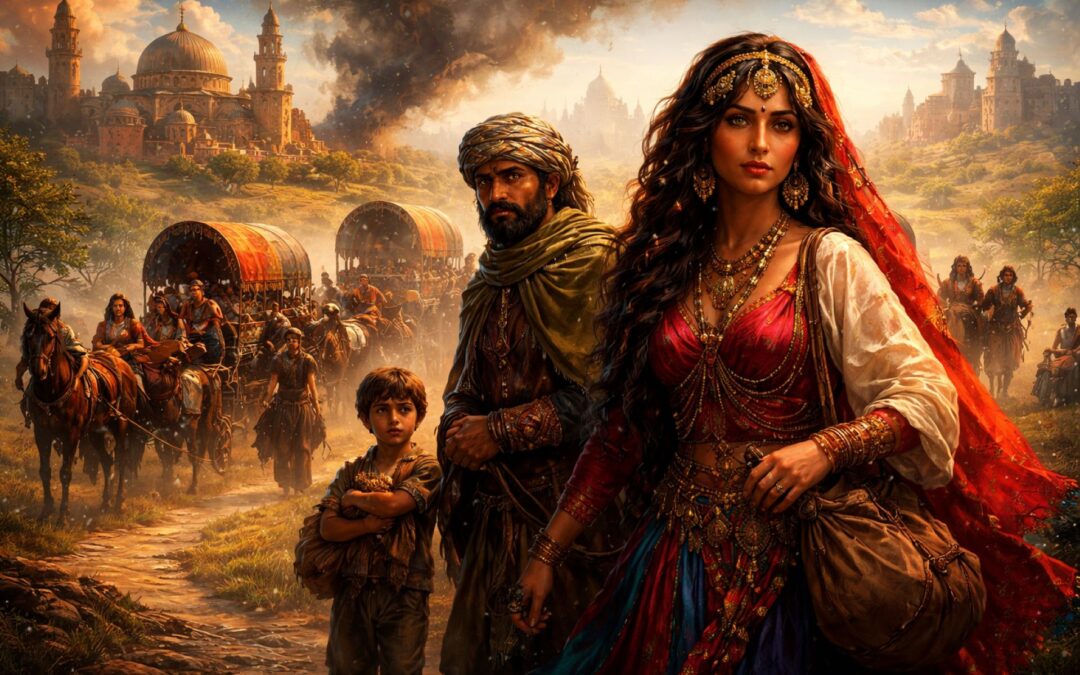
Introduction: The Indians Europe Never Recognized
When we picture medieval Europe, we imagine castles, knights, and tightly knit feudal societies bound by tradition and religion. It feels like a closed world—homogeneous, familiar, and distinctly European.
But hidden within this picture is a surprising truth: medieval Europe was home to thousands of people who were not European at all.
They were Indian.
Known today as the Romani—often mislabeled as “Gypsies”—these communities were scattered across the continent, moving from region to region, speaking unfamiliar languages, practicing unfamiliar customs, and living in ways that defied the norms of settled European life. To Europeans, they were mysterious, exotic, and often deeply unsettling.
And yet, the greatest irony is this: the Romani themselves knew they were not from Europe. Their stories, traditions, and even their language carried echoes of a distant homeland—one that lay thousands of kilometers away in the Indian subcontinent.
For centuries, Europeans speculated wildly about their origins. Some believed they came from Egypt, giving rise to the term “Gypsy.” Others thought they were spies, heretics, or wanderers cursed to roam forever. The truth, however, remained hidden until linguistic and genetic evidence finally revealed it: the Romani were descendants of Indian communities who had migrated west nearly a thousand years earlier.
This raises a powerful and often overlooked question:
How did groups of Indians leave the subcontinent, travel across Persia and Byzantium, and eventually spread throughout Europe—and why were they treated as perpetual outsiders wherever they went?
The answer is not a simple tale of migration. It is a story shaped by war, survival, opportunity, and resilience. It begins in the turmoil of medieval India, passes through the great empires of the Middle East, and unfolds into one of the most misunderstood chapters of European history.
The journey of the Romani is not just about movement across geography—it is about identity carried across centuries.
And once you see it, you can’t unsee it: Europe’s most “foreign” people were, in fact, Indians all along.
Origins in India: The Forgotten Homeland
Long before they became Europe’s most misunderstood outsiders, the ancestors of the Romani were part of the complex social and cultural fabric of the Indian subcontinent.
For centuries, their true origins remained a mystery. European scholars speculated endlessly—Egypt, the Middle East, even mythical lands—but none of these theories held up under scrutiny. The breakthrough came much later, when linguists began to notice something striking: the Romani language bore a deep and unmistakable resemblance to languages spoken in India.
Core vocabulary, grammar, and sentence structure all pointed in one direction—northwestern India. Words for basic concepts like body parts, numbers, and everyday objects closely matched those found in Indo-Aryan languages such as Hindi, Punjabi, and Rajasthani. This was not coincidence. It was evidence of origin.
Genetic studies would later confirm what language had already revealed: the Romani were descendants of Indian populations who had left the subcontinent roughly a thousand years ago.
But who exactly were these people?
Most historians trace their roots to itinerant communities—groups that lived on the move rather than in permanent settlements. In India, such communities played a vital role in society. They were not outsiders, but specialists. They traveled from village to village offering essential services that settled populations depended on.
These services were diverse and highly practical:
- Blacksmithing and metalwork, crucial for tools, weapons, and agriculture
- Animal care and horse trading, vital in pre-industrial economies
- Craftsmanship, including repair work and handmade goods
- Performance and entertainment, from music to storytelling
This mobile way of life gave them a unique advantage: adaptability.
Unlike settled agricultural communities, itinerant groups were not tied to land. They were used to movement, negotiation, and survival in changing environments. They understood how to navigate unfamiliar territories and integrate—at least partially—into new societies while maintaining their own internal cohesion.
This flexibility would prove to be critical.
Because when waves of violence, invasion, and instability began to sweep through northwestern India, these communities were among the few who had both the means and the mindset to leave.
Their migration was not random. It was not aimless wandering.
It was a calculated response to a world that was rapidly becoming unlivable.
And so, what began as a localized way of life—moving between villages within India—would soon evolve into something far more dramatic: a journey across continents.
The First Wave: Sinti Migration After Early Islamic Invasions
The first major movement of Romani ancestors out of India did not begin as an exploration—it began as an escape.
In the 7th and 8th centuries, a powerful new force was expanding rapidly across the known world: the early Islamic caliphates. Under the Rashidun Caliphate and later the Umayyad Caliphate, armies swept through the Middle East, North Africa, and Persia with astonishing speed.
Eventually, this expansion reached the northwestern edge of the Indian subcontinent.
One of the earliest regions to fall was Sindh—a prosperous and culturally rich area that connected India to Central and West Asia. Its conquest was not a quiet transition of power. Contemporary accounts and later reconstructions describe widespread destruction: cities damaged, agricultural systems disrupted, and large populations displaced.
For the people living there, the consequences were severe.
- Mass enslavement, with captives sent to markets across the Middle East
- Economic collapse, as infrastructure and farmland were destroyed
- Famine and drought, exacerbated by war and instability
- Heavy taxation, especially on non-Muslim populations
Under such conditions, staying put was no longer a viable option.
This is where the story of the Sinti—one of the earliest Romani groups—begins.
Unlike settled farmers or urban populations, the Sinti likely emerged from itinerant communities already accustomed to movement. They had the skills, networks, and mindset needed to survive outside a fixed homeland. When the pressure became unbearable, they did what they had always done on a smaller scale—they moved.
But this time, the movement was different.
Instead of traveling between neighboring regions, they began a long westward journey, leaving the Indian subcontinent entirely. What started as a response to local devastation became the first step in a migration that would eventually reshape the demographics of an entire continent.
Their path was not random. It followed the arteries of empire—through Persia and into the broader Middle Eastern world—where their skills remained valuable. As blacksmiths, animal handlers, and service providers, they could integrate into new environments, even if only on the margins.
And yet, even in these new lands, they remained outsiders.
The Sinti were not simply migrants—they were survivors of upheaval, carrying with them fragments of Indian culture, language, and identity into unfamiliar territories.
What they could not have known was that this was only the beginning.
Centuries later, another wave would follow—larger, more dispersed, and shaped by a different but equally devastating force.
The Second Wave: Roma Migration Under Ghaznavid Pressure
If the Sinti migration marked the first great movement out of India, the Roma migration that followed was larger, more sustained, and ultimately more influential in shaping the Romani presence across Europe.
This second wave began in the 10th and 11th centuries, during a period of intense upheaval in northwestern India.
At the center of this turmoil was Mahmud of Ghazni, the powerful ruler of the Ghaznavid Empire. From his base in present-day Afghanistan, Mahmud launched repeated campaigns into the Indian subcontinent—particularly targeting regions like Punjab, Rajasthan, and Gujarat.
These were not isolated invasions. They were part of a sustained strategy.
Year after year, Mahmud’s forces raided wealthy cities and temple complexes, extracting immense amounts of wealth. The plunder from India funded his military ambitions elsewhere, turning the subcontinent into a resource base for continuous warfare.
But for the people living in these regions, the consequences were devastating.
- Widespread violence and destruction, especially in urban and agricultural centers
- Disruption of local economies, as trade routes and production systems collapsed
- Enslavement and displacement, as populations were uprooted
- Recurring instability, making long-term survival increasingly uncertain
It was in this environment that the ancestors of the Roma began to move.
Like the Sinti before them, the Roma were likely drawn from itinerant or semi-itinerant communities—groups already accustomed to mobility and flexible livelihoods. This gave them a critical advantage: when conditions deteriorated, they could leave.
But the Roma migration was not just about fleeing.
It was also about adapting to opportunity.
As they moved westward, many Roma groups appear to have integrated—at least temporarily—into the very systems that had destabilized their homeland. The Ghaznavid Empire was constantly at war, not just in India but across Central and West Asia. Such campaigns required logistical support: metalworkers to forge weapons, specialists to care for animals, and mobile groups that could follow armies.
The Roma fit this role perfectly.
They may have worked as:
- Blacksmiths, producing tools and weapons
- Animal handlers, maintaining cavalry and transport animals
- Logistical support, enabling long-distance campaigns
- Possibly even mercenaries or auxiliary forces
At the same time, there is strong evidence that many Roma also carried forward a different kind of influence—one rooted in culture rather than war.
They were musicians, performers, and storytellers.
Persian sources from the period speak of traveling entertainers of Indian origin, whose music and artistry left a lasting impression. Whether as craftsmen or performers—or both—the Roma were not passive refugees. They were active participants in the societies they moved through.
Yet, despite these contributions, stability remained elusive.
The same forces that created opportunity also created pressure. Empires shifted, alliances broke, and new powers emerged. And so, just like the Sinti before them, many Roma groups continued moving—pushing further west, toward the Byzantine world and eventually into Europe.
What began as a regional displacement was now becoming a continental migration.
And with it, a pattern was emerging:
Wherever they went, the Roma adapted.
Wherever they settled, they remained different.
And that difference would shape everything that came next.
Why They Moved West Instead of Staying in India
At first glance, the direction of the Romani migration raises an obvious question: if their homeland was in India, why didn’t they simply move deeper into the subcontinent instead of embarking on a long and uncertain journey westward?
The answer lies in a combination of economic reality, social dynamics, and strategic opportunity.
India was not an empty or underpopulated space waiting to absorb displaced communities. It was already home to a vast number of itinerant and semi-itinerant groups, many of whom practiced the same trades as the ancestors of the Roma and Sinti. Blacksmithing, animal care, craftsmanship, performance—these were not unique professions. They were part of a well-established ecosystem of mobile service providers who had long-standing relationships with settled populations.
If migrating groups had moved east or south, they would have encountered direct competition for the same economic roles. Established communities would have had little incentive to accommodate newcomers who threatened their livelihoods. In such an environment, migration within India did not guarantee safety or stability—it may have simply replaced one form of hardship with another.
By contrast, the regions to the west presented a very different landscape.
Central Asia, Persia, and the broader Middle Eastern world were in a constant state of political and military flux. Empires like the Ghaznavids were not only invading India but were also engaged in continuous warfare across multiple fronts. These conflicts created a sustained demand for specialized services—precisely the kind that itinerant communities could provide.
As mobile groups, the Roma and Sinti were uniquely positioned to take advantage of this demand. Their skills were practical, adaptable, and valuable in unstable environments. Blacksmiths were needed to produce and repair weapons. Animal handlers were essential for maintaining cavalry and transport systems. Craftsmen supported the logistical backbone of moving armies. Even entertainers had a place, contributing to courtly life and boosting morale within military camps.
Equally important was the nature of their lifestyle. These communities were already accustomed to movement. They knew how to navigate unfamiliar territories, negotiate access to new regions, and operate outside rigid social hierarchies. What might have been a catastrophic displacement for a settled agricultural community could become, for them, a strategic relocation.
There was also a geographical logic to their journey. The routes leading westward were not unknown frontiers but well-established corridors of trade, warfare, and cultural exchange. By following these pathways, they were not stepping into isolation—they were entering interconnected worlds where their skills could be recognized and utilized.
In the end, the choice was shaped by necessity as much as opportunity. Staying within India meant facing competition, uncertainty, and limited prospects. Moving west carried risks, but it also offered the possibility of survival and advancement.
For communities built around mobility, the decision was not just understandable—it was inevitable.
And so, the journey continued, carrying them further away from their homeland and deeper into regions that would shape their destiny in ways they could not yet foresee.
Through Persia and Armenia: The First Stops Outside India
As the Sinti and later the Roma moved westward, their journey did not unfold in a single leap from India to Europe. Instead, it passed through a series of crucial transitional zones—regions that shaped their identity, language, and patterns of settlement for generations to come.
The first major stop was Persia.
For both groups, Persia was not just a passageway but a contact zone. It was here that they encountered new political systems, new religions, and new economic structures. Yet interestingly, the linguistic evidence suggests that for some groups—particularly the Sinti—their stay in Persia was relatively brief.
This conclusion comes from the structure of the Sinti language itself. While it contains a small number of Persian loanwords, it includes a far greater number of Armenian influences. Language, in this context, acts like a historical footprint. The fewer the linguistic borrowings, the shorter the period of sustained contact. This suggests that the Sinti moved relatively quickly through Persian territories before settling more substantially elsewhere.
That “elsewhere” was Armenia.
At the time, parts of Armenia fell under the influence of the Byzantine Empire, making it a relatively stable frontier compared to the volatile regions further east. For migrating communities seeking temporary refuge, it offered something rare: a degree of continuity.
Here, the Sinti appear to have paused.
They established a more lasting presence, interacting closely with local populations and absorbing linguistic and cultural elements that would leave a lasting imprint. This period of settlement was significant—it marked the first time since leaving India that these groups began to root themselves, even if only temporarily, in a new environment.
But stability did not mean acceptance.
Even in these early stages outside India, the Sinti remained outsiders. Their customs, appearance, and social organization set them apart from surrounding populations. They maintained internal cohesion, preserved distinct cultural practices, and continued to operate within their own community structures.
At the same time, the broader political environment remained uncertain. The transition from Umayyad to Abbasid control in parts of the region, combined with shifting power dynamics across West Asia, created ongoing instability. Taxation pressures, religious differences, and periodic conflict made long-term settlement difficult.
And so, once again, movement became necessary.
From Armenia, these communities began to edge closer to the Byzantine world—crossing into territories that would serve as the gateway to Europe. This next phase would bring them into more direct contact with established European societies, where their presence would become more visible—and far more contentious.
Persia and Armenia were not the final destination.
They were the proving ground.
It was here that the Romani identity began to transform from a regional Indian phenomenon into a transcontinental one—shaped by adaptation, yet anchored in a distant origin that remained embedded in their language, culture, and way of life.
Life in the Byzantine Empire: Outsiders with Value
By the time the Sinti—and later the Roma—entered the Byzantine world, their journey had already spanned centuries. They were no longer simply migrants from India. They had become a distinct people, shaped by movement, adaptation, and survival across multiple civilizations.
But in the Byzantine Empire, they encountered something familiar: a society that both needed them—and distrusted them.
Byzantine sources refer to these communities using the term Athinganoi, often translated as “untouchables” or “those who should not be touched.” The label is revealing. It reflects not only social distance but also a deeper unease with practices that seemed foreign and difficult to understand.
Much of this perception stemmed from cultural differences.
The Romani carried with them elements of Indian social and religious life that had persisted through generations of migration. Concepts of ritual purity, internal social divisions, and distinct community boundaries made them appear insular. Their customs did not align neatly with the norms of Orthodox Christian society, and this gap created suspicion.
At the same time, they were often associated with practices that the Byzantines found both fascinating and troubling. Some records describe them as possessing unusual knowledge—fortune-telling, animal training, or forms of ritual that were interpreted as magical. Whether exaggerated or misunderstood, these associations contributed to their reputation as people who existed on the margins of acceptable society.
And yet, despite this suspicion, they were far from useless in the eyes of the state.
The Byzantine Empire was a complex and often unstable political entity, frequently dealing with internal rebellions and external threats. In such an environment, the practical skills of Romani communities could not be ignored. They provided services that were difficult to replace—metalwork, animal care, performance, and possibly even logistical or military support.
There are accounts suggesting that, at times, they were even called upon by imperial authorities to assist in specific situations. Their perceived “otherness,” while socially limiting, could also be reframed as a kind of specialized utility.
This created a paradox.
They were simultaneously:
- Feared for their differences
- Valued for their skills
Accepted when useful, excluded when not.
Over time, this uneasy balance became harder to maintain. Religious authorities often viewed their practices as incompatible with orthodox beliefs. Social pressures increased, and their outsider status became more rigidly defined. Even when individuals or groups managed to integrate partially, the broader perception of the Romani as fundamentally “different” persisted.
Eventually, as conditions shifted—whether due to economic pressures, local tensions, or broader geopolitical changes—many Romani groups began to move again.
From the Byzantine frontier, they would push further west.
And with each step deeper into Europe, the pattern repeated: adaptation, contribution, and exclusion.
But what awaited them in Western Europe would be far harsher than anything they had experienced before.
The Roma in Persia and Beyond
While the Sinti moved relatively quickly through Persia and established themselves for a time in Armenia and the Byzantine frontier, the story of the Roma in Persia was more complex—and, in many ways, more enduring.
For many Roma groups, Persia was not just a transit zone. It became a place of settlement.
As they moved westward out of India under the pressures of Ghaznavid expansion, the Roma entered a Persian world that was already deeply interconnected—politically, culturally, and economically. Here, their skills once again found relevance. As itinerant specialists, they could integrate into local systems while maintaining their internal cohesion.
Over time, many Roma communities established deep roots in the region.
In Persia, they came to be known by names such as Luri, and their presence became woven into the broader cultural landscape. Unlike in Europe, where they would later be treated with suspicion and hostility, in Persia they were often viewed with a degree of familiarity. Their roles as musicians, performers, and craftsmen earned them recognition, and in some cases, even admiration.
Persian literary traditions, for instance, contain references to traveling entertainers of Indian origin—figures described as skilled, expressive, and culturally distinctive. These portrayals suggest that the Roma were not merely tolerated, but were seen as contributors to the aesthetic and social life of the region.
Religion also played a role in this relative integration.
In Persia and surrounding regions, many Roma groups converted to Islam, either gradually or under social and political pressure. Conversion offered practical benefits: it eased taxation burdens, reduced social barriers, and allowed for smoother interaction with dominant institutions. Yet, even after conversion, many communities retained elements of their earlier traditions—blending new religious identities with older cultural practices.
But not all Roma stayed.
For some, Persia represented stability. For others, it was simply another stage in a longer journey. As political dynamics shifted and new pressures emerged, certain groups chose to move on—continuing westward toward the Byzantine Empire, following paths already taken centuries earlier by the Sinti.
At the same time, the migration was not uniform.
Some Roma groups branched off in different directions:
- Into the Levant, integrating into societies across the eastern Mediterranean
- Into North Africa, where they adapted to entirely new cultural environments
- Deeper into Central Asia, blending into local populations
This divergence highlights an important truth: the Roma were never a single, unified migration. They were a collection of communities, each making decisions based on local conditions, opportunities, and pressures.
And yet, despite these differences, a shared thread remained.
Whether in Persia, the Levant, or beyond, they carried with them traces of their Indian origin—visible in language, social structure, and cultural practices. These traces persisted even as they adapted, converted, and integrated into new societies.
But for those who continued westward, a new chapter was about to begin.
They were about to enter Europe.
And unlike Persia, where familiarity had softened the edges of difference, Europe would respond to them in a very different way.
The Push Into Europe: War, Empires, and Opportunity
By the time the Roma began moving beyond the Byzantine world and into Europe, their migration had already stretched across centuries. They had crossed India, Persia, and parts of the Middle East. They had adapted, settled, moved again. But their entry into Europe was not a sudden invasion—it was a gradual expansion shaped by shifting empires and rising pressures.
The turning point came with the rise of the Ottoman Empire.
In the 14th century, the Ottomans began expanding rapidly into territories that had once been controlled by the Byzantine Empire. As their influence spread across Anatolia and into the Balkans, the regions where many Roma had settled were once again transformed by war, taxation, and political instability.
For the Roma, this created a familiar dilemma.
Under Ottoman rule, non-Muslim populations were subject to taxes such as the jizya, which could place significant financial strain on already mobile and economically vulnerable communities. Conversion to Islam offered a way out, and many Roma groups did convert and remained within Ottoman territories, gradually integrating into local cultures.
But others chose a different path.
Rather than adapt to yet another shifting imperial structure, they moved.
Following routes that had already been established through earlier migrations, Roma groups began to cross into southeastern Europe—particularly the Balkans and the Peloponnese. These regions, caught between Byzantine decline and Ottoman expansion, offered both opportunity and risk.
In some cases, their arrival was welcomed.
Settled European communities recognized the practical value of itinerant groups. The Roma brought with them skills that were immediately useful—metalworking, animal care, and logistical support. In frontier regions under constant threat of conflict, these abilities could be the difference between survival and collapse.
There are records of Roma groups being granted permission to settle in exchange for services. In certain cities, they even played roles in local defense, assisting against Ottoman incursions. Their mobility, once again, became an asset in unstable environments.
But this acceptance was fragile.
As Ottoman pressure intensified, violence escalated across the region. Raids, destruction, and displacement became common. Entire populations were uprooted, and the Roma—already mobile—responded in the only way they knew how: they moved again.
This time, however, the movement was wider and more permanent.
From the Balkans, Roma groups spread rapidly across Europe:
- Into Central Europe—Hungary, Austria, and Germany
- Into Western Europe—France, Italy, and Spain
- Into Northern Europe—England and even Scandinavia
This was no longer a migration confined to frontier zones. It was a continental dispersal.
And with it, the Roma became visible in a way they had never been before.
They were no longer passing through empires on the edges of civilization—they were now living within the heart of European societies. Their presence was noticeable, their differences more pronounced, and their way of life increasingly difficult for settled populations to understand.
For a brief moment, their skills still opened doors.
But those doors would not stay open for long.
Because as the Roma spread across Europe, they were about to encounter something far more dangerous than war or taxation.
They were about to face fear, misunderstanding, and systemic persecution on a scale they had never experienced before.
A Harsh Reception: Persecution Across Europe
As the Roma and Sinti spread across Europe, their journey entered its darkest phase.
Unlike Persia or parts of the Byzantine world—where they had at least found moments of acceptance—Europe proved far less accommodating. What began as cautious curiosity quickly hardened into suspicion, and suspicion, in time, turned into systematic persecution.
From the very beginning, the Romani were seen as outsiders.
They looked different. They spoke unfamiliar languages. They lived in mobile communities that did not conform to the settled rhythms of European life. In societies that valued stability, hierarchy, and religious conformity, this difference was not merely unusual—it was threatening.
And so, across Europe, a pattern emerged.
In Eastern Europe, particularly in regions like Wallachia and Romania, Roma communities were subjected to slavery. Historical records document entire families being bought, sold, and gifted—treated not as people, but as property. One of the earliest surviving records dates back to the late 14th century, when dozens of Roma families were transferred to a monastery as slaves. This system would persist for centuries.
Elsewhere, governments attempted forced assimilation.
In parts of Central Europe, policies were introduced to break Romani identity altogether. Children were taken from their families and placed into non-Romani households in an effort to “civilize” them. Communities were pressured—or outright forced—to abandon their language, customs, and way of life.
But perhaps the most disturbing aspect of their treatment was the normalization of violence.
In some regions, particularly in Western Europe, practices such as “Gypsy hunting” emerged. Authorities offered rewards for capturing or killing Romani individuals. In certain areas, this became a form of sanctioned brutality—where human lives were reduced to bounties, and violence was not only tolerated but encouraged.
At the same time, myths and accusations spread rapidly.
The Roma were often labeled as:
- Spies, accused of working for foreign powers like the Ottomans
- Criminals, blamed for theft and disorder
- Heretics or practitioners of dark arts, feared for their supposed connection to magic
These accusations were rarely based on evidence. Instead, they reflected a deeper anxiety—an inability to understand a community that did not fit within established social norms.
This persecution reached its most extreme form during the 20th century.
Under Nazi rule, Roma and Sinti communities were targeted alongside other marginalized groups in what is now recognized as the Porajmos—the Romani Holocaust. Between 500,000 and 800,000 Romani people were murdered in concentration camps. Entire communities were erased, and the demographic impact was devastating—particularly for the Sinti, whose population was nearly wiped out in some regions.
What makes this history especially tragic is its continuity.
From medieval slavery to early modern violence to modern genocide, the Romani experience in Europe was marked not by isolated incidents, but by a long, unbroken pattern of exclusion and abuse.
They had fled war and instability in their homeland.
They had adapted, contributed, and survived across multiple empires.
And yet, in Europe, they were reduced to something far less than human in the eyes of many.
This raises a deeper question—one that goes beyond historical events:
Why were the Roma and Sinti treated this way?
To answer that, we have to look not just at what they did—but at how they were perceived.
Why Europe Rejected Them
The persecution of the Roma and Sinti in Europe was not random, nor was it the result of a single event. It was driven by a deeper and more persistent force: the way European societies perceived difference—and the threat they believed it posed.
At the heart of this rejection was cultural unfamiliarity.
The Romani were not just migrants; they were visibly and structurally different. They maintained tight-knit communities, preserved distinct customs, and followed social practices that did not align with European norms. Concepts such as ritual purity, internal group boundaries, and community autonomy made them appear closed off and resistant to integration.
In a world where identity was closely tied to land, religion, and hierarchy, this kind of separateness was unsettling.
Unlike other groups that gradually assimilated, the Romani retained a strong sense of internal identity. They did not fully adopt local languages, did not integrate into guild systems, and did not settle permanently in the way European societies expected. This made them difficult to categorize—and what cannot be categorized is often feared.
But cultural difference alone does not fully explain the hostility.
There was also an economic dimension.
Many Roma and Sinti worked as blacksmiths, metalworkers, and craftsmen—professions that were not only essential but also highly competitive. Their mobility allowed them to operate outside the restrictions of local guilds, which controlled trade and production in many European cities. This gave them an advantage, but it also made them targets.
Guilds and local workers saw them as a threat.
In response, narratives began to shift. Skilled craftsmanship was no longer admired—it was questioned. In some cases, accusations emerged that Romani blacksmiths were connected to sinister or heretical practices. One particularly striking example is the claim that they forged the nails used in the crucifixion of Jesus—a myth that transformed economic competition into moral condemnation.
Such stories were not just symbolic. They had real consequences.
They justified exclusion, reinforced suspicion, and turned professional rivalry into social hostility.
Another factor was the itinerant lifestyle itself.
Across cultures, settled societies have historically viewed nomadic or mobile groups with suspicion. Movement challenges control. It makes taxation difficult, complicates governance, and disrupts the idea of fixed identity tied to land. In Europe, where feudal and later centralized systems depended on stability and order, itinerancy was seen as inherently problematic.
The Roma and Sinti became easy scapegoats.
When crimes occurred, blame could be assigned to groups that were passing through. When social tensions rose, their presence could be framed as the cause. Their visibility—and their difference—made them convenient targets in times of uncertainty.
Finally, there was the role of myth and imagination.
The Romani were often portrayed as mysterious figures—fortune tellers, magicians, wanderers with hidden knowledge. While these images could sometimes carry a sense of fascination, they more often reinforced the idea that the Romani existed outside the boundaries of normal society.
They were not seen as neighbors.
They were seen as something other.
And once a group is defined as fundamentally “other,” exclusion becomes easier to justify.
Taken together, these forces—cultural distance, economic competition, suspicion of mobility, and the power of myth—created an environment where acceptance was always fragile and rejection was always close at hand.
The tragedy is not just that the Roma and Sinti were different.
It is that their difference was never given the space to be understood.
And yet, this was not the only way their story could unfold. In other regions, under different conditions, the same communities experienced a very different kind of reception.
A Different Story in Persia: Acceptance and Integration
To understand how unusual the European response to the Roma and Sinti was, it helps to look at a different setting—one where the same communities were treated in a markedly different way.
That setting was Persia.
Unlike Europe, where the Romani were often viewed with suspicion and hostility, Persian society showed a greater degree of familiarity and acceptance. This difference did not come from a single policy or attitude, but from a combination of cultural proximity, economic integration, and historical context.
First, there was cultural familiarity.
Persia had long-standing connections with the Indian subcontinent—through trade, migration, and shared intellectual traditions. Indian goods, ideas, and people were not unknown in Persian society. This made the arrival of Indian-origin communities less shocking and less alien.
The Roma, with their roots in India, were not perceived as entirely foreign. Their customs, while distinct, existed within a broader cultural spectrum that Persia was already accustomed to navigating.
Second, there was economic integration.
In Persia, the Roma were able to establish themselves as contributors rather than competitors. Their roles as musicians, performers, and craftsmen aligned well with existing cultural and economic systems. Rather than being excluded from guild structures or seen as threats, they found niches where their skills were valued.
Persian literary traditions reflect this acceptance.
Traveling entertainers of Indian origin appear in poetry and storytelling, often described in positive terms—skilled, expressive, and aesthetically refined. These portrayals suggest not just tolerance, but a level of appreciation for what they brought to society.
Third, there was religious adaptability.
Many Roma groups in Persia converted to Islam over time. This reduced barriers to integration, allowing them to participate more fully in social and political life. Conversion was not always purely voluntary—it was shaped by practical considerations—but it helped ease tensions that might otherwise have arisen.
At the same time, the Roma retained elements of their earlier traditions, blending new religious identities with older cultural practices. This ability to adapt without fully dissolving their identity was a key part of their resilience.
Finally, there was the question of perception.
In Persia, the Roma were not defined primarily by what made them different. They were defined by what they contributed. Their skills, their artistry, and their roles in society were foregrounded, while their differences were less heavily emphasized.
This stands in sharp contrast to Europe, where difference itself became the defining feature—and the basis for exclusion.
The comparison is striking.
The same communities, carrying the same heritage, were:
- Integrated and appreciated in one region
- Marginalized and persecuted in another
This tells us something important.
The fate of the Roma and Sinti was not inevitable. It was shaped by the societies they encountered—their openness, their fears, and their willingness to accommodate difference.
And yet, despite these different experiences, one thing remained constant.
Across Persia, Byzantium, and Europe, the Romani carried with them a cultural thread that stretched all the way back to India.
It was this thread—resilient, adaptable, and enduring—that allowed them to survive even the harshest conditions.
Which brings us to the final part of their story: not just how they moved, but how they endured.
Cultural Resilience: Carrying India Across Continents
Despite centuries of migration, displacement, and persecution, the most remarkable aspect of the Romani story is not just that they survived—it is that they remained themselves.
Across thousands of kilometers and countless generations, the Roma and Sinti carried with them a cultural core that refused to disappear.
The most striking evidence of this resilience lies in their language.
Romani languages, spoken across Europe today, still retain deep structural and vocabulary roots in Indo-Aryan languages of India. Words for everyday life—family, numbers, body parts—echo their origins in the subcontinent. Even after absorbing influences from Persian, Armenian, Greek, and various European languages, the foundation remains unmistakably Indian.
Language, in this case, is more than a tool of communication. It is a living record of memory.
But language is only one part of the story.
Social organization within Romani communities also reflects patterns that trace back to India. Internal divisions, community boundaries, and concepts resembling caste-like structures have persisted in various forms. These systems governed marriage, occupation, and social interaction, helping maintain cohesion even in foreign environments.
Equally significant are the cultural practices that survived the journey.
Ideas of ritual purity, for instance, continued to shape daily life—dictating rules around cleanliness, food, and social behavior. These practices, though often misunderstood or misinterpreted by outsiders, provided a framework for preserving identity in constantly changing surroundings.
Even as they adapted to new religions—converting to Islam in Persia or Christianity in Europe—many Romani groups retained elements of older traditions. This blending did not erase their past; it layered new identities over an enduring cultural base.
Their occupations, too, became part of this continuity.
Blacksmithing, performance, craftsmanship—these were not just economic activities but cultural signatures carried across regions. Over time, these roles evolved, but the underlying adaptability remained constant. Wherever they went, the Romani found ways to make themselves relevant without fully surrendering who they were.
What makes this resilience even more remarkable is the context in which it occurred.
The Romani were not preserving their culture in isolation or stability. They were doing so under pressure—facing discrimination, forced assimilation, and, at times, outright violence. In many cases, their very identity was targeted for erasure.
And yet, it endured.
This endurance was not passive. It was active, deliberate, and often difficult. It required balancing adaptation with preservation, navigating hostile environments while maintaining internal cohesion.
In a sense, the Romani did something extraordinary.
They turned migration into continuity.
They transformed displacement into a vehicle for cultural survival.
And in doing so, they carried India—not as a place, but as a living identity—across continents and centuries.
It is this resilience, more than anything else, that defines their story.
And it is this resilience that brings us to the final reflection on what their journey truly means.
Conclusion: A Thousand-Year Journey of Survival and Identity
The story of the Romani is one of the most extraordinary—and most misunderstood—migrations in human history.
What began as a response to upheaval in northwestern India unfolded into a journey that spanned continents, empires, and centuries. From the violence of early invasions to the shifting political landscapes of Persia and Byzantium, and finally into the heart of Europe, the Romani moved not out of choice, but out of necessity.
And yet, wherever they went, they adapted.
They became craftsmen, performers, traders, and specialists. They supported armies, enriched cultures, and contributed to the societies they entered. In some regions, they were accepted—even admired. In others, they were feared, excluded, and violently persecuted.
This contrast is perhaps the most revealing part of their story.
The same people, carrying the same heritage, were treated in radically different ways depending on the society they encountered. Their fate was not determined by who they were—but by how others chose to see them.
And still, through all of it, they endured.
They preserved their language, their customs, and their sense of identity across a thousand years of displacement. They carried echoes of India into lands that neither understood nor always welcomed them. They survived systems that sought to erase them—and emerged as one of the most resilient cultural communities in the world.
Today, the Romani are often still viewed through the lens of stereotype and myth.
But behind those misconceptions lies a deeper truth.
They are not simply wanderers or outsiders. They are the descendants of a long and complex history—one that connects medieval India to modern Europe, one that speaks of survival against overwhelming odds, and one that challenges us to rethink what we believe about identity, migration, and belonging.
Because in the end, the Romani story is not just about where people come from.
It is about what they carry with them—and what they refuse to lose.