
History often remembers kings, generals, and emperors as the architects of civilizations. Yet sometimes the course of a nation can be shaped by an unlikely traveler—someone with no army, no kingdom, and no political office. In the eighth century, such a traveler arrived in Japan from thousands of kilometers away: a Buddhist monk from South India named Bodhisena.
His journey began in the Tamil Pandya kingdom, in the city of Madurai, and eventually carried him across the vast maritime networks of the Buddhist world—from India to China and then onward to Japan. By the time he reached the Japanese archipelago in 736 CE, he had already undertaken a remarkable spiritual quest. But what awaited him there was far more consequential than he could have imagined.
Japan at the time was experiencing one of the most unstable periods in its early history. The country was grappling with devastating epidemics, political rivalries among powerful clans, economic strain, and deep religious tensions. Buddhism, introduced only a few centuries earlier, was still seen by many as a foreign belief system competing with the native Shinto tradition. Emperor Shōmu, however, believed that Buddhism could bring unity and spiritual protection to his troubled realm.
Into this volatile environment stepped Bodhisena—a monk whose origins in India gave him extraordinary religious prestige in East Asia. Because India was the birthplace of Buddhism and the source of its sacred languages and scriptures, monks who came directly from the subcontinent were treated with immense reverence. Bodhisena’s presence alone carried symbolic authority.
That authority would soon place him at the center of major political and religious developments in Japan. He would become involved in imperial court affairs, help legitimize influential Buddhist leaders, participate in one of the most important religious ceremonies in Japanese history, and contribute to the integration of Buddhism into the country’s cultural and political life.
Yet despite his influence, Bodhisena remains a relatively obscure figure outside specialist circles. His story sits at the crossroads of multiple worlds: Indian spirituality, Chinese Buddhism, and Japanese state formation. It is also a reminder that the ancient world was far more interconnected than many people imagine.
The journey of this South Indian monk reveals not only the power of religious ideas to travel across continents but also how a single individual—arriving at exactly the right moment in history—can leave a lasting mark on an entire civilization.
Bodhisena: A Monk From the Tamil Pandya Kingdom
Bodhisena was born in 704 CE in the ancient South Indian city of Madurai, which at the time was part of the powerful Pandya Kingdom. Madurai had long been one of the most important cultural and religious centers of southern India. It was a thriving hub of trade, literature, and temple culture, connected to the wider Indian Ocean world through maritime routes that stretched from the Middle East to Southeast Asia.
Very little is known about Bodhisena’s childhood, but historical records preserved in Japan provide a few clues about his background. Court chronicles refer to him as “Baramon Sōjō,” meaning Brahmin Abbot. This title strongly suggests that he was originally born into a Brahmin family, the highest priestly caste in Hindu society.
If this was indeed the case, Bodhisena’s later decision to become a Buddhist monk would have been dramatic and controversial. In early medieval India, religious identity was closely tied to family and community life. A Brahmin abandoning the traditional Hindu path to enter a Buddhist monastic order was not merely a personal spiritual choice—it could also be seen as a rejection of social expectations and inherited duties.
Such conversions were not unheard of, however. Buddhism had long maintained a strong missionary tradition, encouraging monks to spread teachings across regions and cultures. Monastic life offered a path that emphasized learning, discipline, and spiritual enlightenment over social hierarchy. This ideal attracted many seekers who were willing to leave behind the structures of caste and family.
For someone from a prominent background, the decision could be deeply disruptive. Historical accounts from the broader Buddhist world describe families protesting ordination ceremonies or attempting to prevent relatives from entering monastic life. Given Bodhisena’s apparent Brahmin status, it is likely that his own path toward Buddhism involved similar tensions.
By the early eighth century, Buddhism in India was also facing increasing decline. Although it had once flourished across the subcontinent, many regions were witnessing a resurgence of Hindu traditions and the gradual weakening of Buddhist institutions. Monasteries that had once been centers of learning were losing patronage, and the religion’s influence was slowly shifting toward East Asia and Southeast Asia, where it continued to grow.
In this sense, Bodhisena belonged to a generation of monks whose spiritual horizons extended far beyond India itself. Buddhist networks already stretched across the continent, linking monasteries, scholars, and pilgrims through a combination of land routes like the Silk Road and maritime trade routes across the Indian Ocean.
These networks allowed monks to travel astonishing distances in search of sacred texts, teachers, and enlightenment. Pilgrims from China journeyed to India to study the Buddha’s teachings at their source, while Indian monks traveled east to spread those same teachings to new lands.
It was within this interconnected Buddhist world that Bodhisena began to shape his own spiritual destiny. His life would soon take a dramatic turn when he became convinced that he had received a divine calling—one that would set him on a journey across Asia and eventually bring him to Japan.
A Vision From Manjushri and the Journey to China
At some point in his early adulthood, Bodhisena experienced a profound spiritual turning point that would shape the rest of his life. According to later accounts, he became convinced that he was receiving inspiration from Manjushri, the Bodhisattva of wisdom in Mahayana Buddhism.
In Buddhist tradition, Manjushri occupies a special place among the bodhisattvas—enlightened beings who postpone their own final liberation in order to help guide others toward enlightenment. He is often depicted wielding a flaming sword that cuts through ignorance and holding a scripture representing transcendent wisdom. For centuries, Manjushri had been revered across the Buddhist world as one of the Buddha’s closest spiritual companions.
Bodhisena reportedly developed a powerful desire to encounter this embodiment of wisdom. Of course, the historical Manjushri was not a living teacher whom one could simply seek out. Yet within the religious imagination of Mahayana Buddhism, bodhisattvas were not confined to the distant past. Many believers held that they continued to manifest themselves in the world, appearing in various forms to guide devoted practitioners.
Bodhisena soon heard of a widely held belief circulating among Buddhist communities: that an incarnation of Manjushri resided at Mount Wutai in northern China. Mount Wutai had already become one of the most sacred pilgrimage destinations in East Asian Buddhism. Monks and pilgrims from across Asia traveled there in the hope of receiving spiritual insight or encountering manifestations of the bodhisattva.
For Bodhisena, the idea was irresistible. If Manjushri truly manifested at Mount Wutai, then traveling there could bring him closer to the ultimate source of wisdom he sought. Sometime between 720 and 730 CE, he embarked on an extraordinary journey across the seas toward China.
Such a voyage was no small undertaking. The maritime routes connecting India and China formed part of a vast commercial and cultural network often described as the Maritime Silk Road. Merchant ships carried spices, textiles, ceramics, and precious metals between distant ports. Alongside these goods traveled monks, scholars, translators, and pilgrims who transmitted religious ideas and intellectual traditions across the region.
Travel by sea was dangerous and unpredictable. Storms, pirates, and disease made long-distance voyages risky even for experienced sailors. Yet these routes also enabled unprecedented cultural exchange, allowing Buddhist teachings to move from India to China, Korea, and Japan over the course of several centuries.
After a long journey, Bodhisena eventually reached Mount Wutai. But instead of finding the revelation he had hoped for, he encountered an unexpected twist in his quest.
According to the story, monks at the mountain informed him that the incarnation of Manjushri he was seeking was not in China at all. Instead, they claimed that the bodhisattva was living in Japan.
This revelation must have been both surprising and bewildering. Japan lay far beyond the eastern edge of the known Buddhist world from Bodhisena’s perspective. Yet the idea of continuing the search did not deter him. For several years he remained in China, studying, teaching, and interacting with Buddhist communities while contemplating his next step.
His story might easily have ended there, lost among the countless pilgrims and monks who traveled across the Buddhist world. Instead, a chance encounter in the Tang capital would soon change everything and set Bodhisena on the final leg of his remarkable journey.
The Maritime Silk Road Journey to Japan
Bodhisena’s fortunes changed dramatically when he traveled to Chang’an, the magnificent capital of the Tang Dynasty. In the eighth century, Chang’an was one of the largest and most cosmopolitan cities in the world. Merchants, scholars, monks, diplomats, and travelers from across Asia gathered there, making it a center of cultural exchange and intellectual life.
It was in this bustling environment that Bodhisena encountered a delegation from Japan.
The delegation was led by Tajihi no Hironari, a Japanese ambassador who had been sent to China as part of Japan’s regular diplomatic missions to the Tang court. These missions were extremely important to Japan at the time. Japanese rulers looked to Tang China as a model for governance, culture, religion, and scholarship. Envoys traveled to China to study its administrative systems, collect Buddhist scriptures, and bring back knowledge that could strengthen the Japanese state.
Hironari was reportedly impressed by Bodhisena’s learning and religious authority. As a monk from India—the birthplace of Buddhism—Bodhisena possessed a level of prestige that few others could match. His knowledge of Sanskrit, the sacred language in which many Buddhist scriptures were originally composed, further enhanced his reputation.
Recognizing the value of such a figure, Hironari and his companions extended an invitation: Bodhisena should travel to Japan with them.
The offer was significant. For the Japanese court, bringing an Indian monk to their country was an opportunity to deepen the legitimacy and authority of Buddhism within the archipelago. For Bodhisena, the invitation seemed to align perfectly with the spiritual message he had received at Mount Wutai—that the incarnation of Manjushri he sought might be found in Japan.
With the path now open, Bodhisena agreed to join the Japanese delegation.
The journey to Japan began with a voyage along the maritime trade routes that connected China with Southeast Asia and the Japanese islands. The ship carrying Bodhisena was no ordinary vessel; it transported an extraordinary group of scholars, monks, and cultural figures who would each leave their own mark on Japanese history.
Among the travelers was Butsutsu, a disciple of Bodhisena who would later help introduce new artistic traditions to Japan. Another passenger was Genbō, a Japanese monk and scholar who had spent years in China collecting Buddhist texts. By the time he returned to Japan, he had gathered thousands of sutras that would greatly enrich Japanese Buddhist scholarship.
Also on board was Kibi no Makibi, a nobleman and scholar who had studied Chinese learning extensively. He would later introduce several cultural elements to Japan, including aspects of Chinese music and possibly even the strategic board game Go.
Together, this group represented a remarkable transfer of knowledge across Asia. Their ship was effectively a floating bridge between civilizations, carrying religion, art, literature, and scholarship from the great cultural centers of the continent to the Japanese archipelago.
The voyage itself was far from easy. Travel across the seas was notoriously dangerous, and storms could easily destroy ships or push them far off course. After a difficult journey plagued by rough weather, the expedition finally reached Japan.
In August 736 CE, the ship arrived safely at the port of Naniwa, near what is now modern-day Osaka.
Bodhisena had finally reached Japan. Yet his arrival was only the beginning. Within a short time, he would meet one of the most influential figures in Japanese Buddhism—and that encounter would place him directly at the center of Japan’s religious and political transformation.
Arrival in Japan and the Meeting With Gyoki
When Bodhisena arrived in Japan in 736 CE, he was greeted by one of the most influential religious figures in the country: the monk Gyōki.
Gyōki was no ordinary cleric. By the time Bodhisena reached Japan, he had already become a widely respected Buddhist leader known for his charitable work among the common people. Unlike many monks who remained confined to monasteries or close to the imperial court, Gyōki traveled extensively across the countryside, organizing public works projects and helping communities in practical ways.
He supervised the construction of roads, bridges, irrigation systems, and temples, while also teaching agricultural techniques and providing aid to the poor. These activities made him immensely popular among ordinary people, and over time he gained enormous moral authority throughout the country.
At the same time, Gyōki had developed a close relationship with Emperor Shōmu, who saw Buddhism as a powerful tool for strengthening and protecting the Japanese state. The emperor believed that Buddhist teachings could bring spiritual stability to a country that was facing serious crises.
According to later accounts preserved in Japanese records, the meeting between Bodhisena and Gyōki carried a deeply symbolic meaning.
When the two monks first encountered each other, Gyōki reportedly declared that he recognized Bodhisena from a previous life. He claimed that they had once been disciples of the historical Buddha together at a sacred place known as Vulture Peak, a mountain in India where the Buddha was believed to have delivered important sermons.
Bodhisena responded with equal conviction. He declared that he had finally found the incarnation of Manjushri, the Bodhisattva of wisdom whom he had been seeking during his long spiritual quest.
And according to Bodhisena, that incarnation was Gyōki himself.
Whether anyone truly believed this remarkable exchange is difficult to know. But from a political and religious perspective, the implications were enormous.
If Gyōki could be recognized as an incarnation of Manjushri by a respected monk from India, his authority would be elevated to an entirely new level. Since India was considered the sacred homeland of Buddhism, endorsement from an Indian monk carried extraordinary legitimacy in East Asia.
In effect, Bodhisena’s declaration strengthened Gyōki’s standing as one of the foremost Buddhist figures in Japan.
Soon after their meeting, Gyōki introduced Bodhisena to the imperial court in the capital city of Nara. There, Bodhisena was presented before Emperor Shōmu, who welcomed him warmly.
The emperor granted Bodhisena prestigious titles and offered him residence at Daian-ji Temple, one of the major Buddhist institutions in the capital. For Shōmu, the arrival of a learned monk from India was an opportunity to reinforce his vision of Japan as a nation protected and guided by Buddhist teachings.
But Bodhisena’s presence also had political consequences. His authority as an Indian monk gave additional credibility to Buddhist leaders and advisors who were already gaining influence at court.
In a period when religious authority and political power were closely intertwined, that credibility could shift the balance between rival factions.
And in eighth-century Japan, the struggle between those factions was becoming increasingly intense.
Emperor Shōmu and the Rise of Buddhism in Japan
By the time Bodhisena arrived in Japan, the country was undergoing a profound transformation under the rule of Emperor Shōmu, who reigned from 724 to 749 CE. Shōmu was one of the most devout Buddhist rulers in early Japanese history, and he believed that the teachings of the Buddha could help stabilize and unify the realm.
Buddhism had first been introduced to Japan in the sixth century, arriving through diplomatic and cultural contacts with the Korean peninsula and China. Over the following centuries it gradually gained followers among the aristocracy and the imperial court. Yet it was still considered, by many, a foreign religion, distinct from Japan’s traditional spiritual system.
That native system was Shinto, a set of beliefs centered around the worship of kami—spiritual beings associated with natural forces, ancestors, and sacred places. Shinto traditions had long been closely tied to the legitimacy of the imperial family, which traced its lineage to the sun goddess Amaterasu.
For many members of the political elite, the growing influence of Buddhism raised uncomfortable questions. Buddhist monks were increasingly active in court politics, advising rulers and participating in state ceremonies. Some nobles worried that foreign religious ideas might undermine established traditions and weaken the authority of powerful clans.
Emperor Shōmu, however, saw things very differently.
To him, Buddhism offered a universal moral and spiritual framework that could protect the state and bring harmony to society. He believed that a properly guided Buddhist kingdom would enjoy divine protection and prosperity. As a result, he actively promoted the religion and sought to weave it into the machinery of government.
Under Shōmu’s rule, Buddhist institutions gained unprecedented influence. Monasteries received imperial patronage, monks were given important advisory roles, and Buddhist rituals were increasingly incorporated into state affairs. In many ways, the emperor envisioned Japan as a Buddhist state, guided by religious principles as well as political authority.
These changes were not merely symbolic. Buddhist monks began to serve in roles that extended beyond purely spiritual matters. Some advised on governance, while others held administrative responsibilities within the imperial system. Their influence in the court steadily expanded, sometimes provoking resentment from aristocratic families who felt their own power threatened.
The arrival of Bodhisena further strengthened the emperor’s vision.
Because he came directly from India, Bodhisena represented a living connection to the birthplace of Buddhism. His knowledge of Sanskrit, Buddhist scripture, and ritual practice gave him exceptional prestige. For Emperor Shōmu, hosting such a figure at court helped reinforce the legitimacy of Japan’s Buddhist institutions and demonstrated the country’s place within the broader Buddhist world.
But while the emperor’s policies strengthened Buddhism, they also intensified political tensions.
Powerful aristocratic families—especially those whose authority had traditionally balanced imperial power—were growing uneasy. At the same time, the country was entering a period of severe crisis that would test the stability of the entire political system.
Famine, disease, and social unrest were about to strike Japan with devastating force.
Crisis in the Tempyo Era: Epidemics, Drought, and Political Turmoil
The period during which Bodhisena arrived in Japan is known as the Tempyo era (729–749 CE), a time remembered for both remarkable cultural achievements and severe national crises. While Emperor Shōmu was attempting to strengthen the country through Buddhism, Japan was simultaneously facing disasters that threatened the stability of the entire state.
One of the most devastating events of the era was the smallpox epidemic of 735–737 CE.
Smallpox was one of the deadliest diseases in the pre-modern world, and when it spread through Japan it did so with terrifying speed. Entire communities were wiped out, agricultural production collapsed in many regions, and the country’s fragile administrative system struggled to function.
The scale of the disaster was enormous. Historical estimates suggest that as much as one-third of Japan’s population died during the epidemic. For a society already dependent on delicate agricultural systems and local governance networks, such losses were catastrophic.
The epidemic struck the political elite particularly hard.
At the heart of the imperial government was a council of powerful aristocrats responsible for assisting the emperor in ruling the country. Among the most influential members of this governing circle were leaders of the Fujiwara clan, one of the most powerful families in Japan.
But during the epidemic, four of the ten most important council members died, and all four belonged to the Fujiwara family.
Their deaths created an enormous political vacuum.
Rather than replacing the deceased officials with other Fujiwara relatives, Emperor Shōmu made a strategic decision. He appointed members of rival aristocratic clans to the vacant positions. By doing so, he prevented any single family from dominating the government and reduced the traditional influence of the Fujiwara.
This maneuver strengthened imperial authority, but it also deepened resentment among members of the Fujiwara clan who believed their long-standing power had been unfairly diminished.
At the same time, Japan was suffering from years of drought and poor harvests, which compounded the misery caused by disease. Food shortages spread across the countryside, and economic strain placed heavy pressure on the state.
Many people interpreted these disasters as signs of divine displeasure.
In the worldview of the time, natural calamities were often understood as spiritual warnings—evidence that the balance between heaven, the gods, and human rulers had been disturbed. For critics of Emperor Shōmu, the disasters seemed to confirm their fears that the emperor’s heavy promotion of Buddhism had angered traditional Shinto deities.
These tensions created a volatile political atmosphere in the capital at Nara.
While the emperor and his supporters believed Buddhism could protect the nation and restore stability, many nobles felt that foreign monks and religious advisers had gained too much influence over state affairs.
The stage was set for open conflict.
Within just a few years of Bodhisena’s arrival, political resentment among Japan’s aristocracy would erupt into rebellion—and Buddhist monks themselves would become central figures in the struggle.
Monks, Power, and the Fujiwara Rebellion
As Buddhism gained influence at the imperial court, some monks began occupying positions that extended far beyond purely religious responsibilities. This blending of spiritual authority and political power created growing tensions within the aristocracy, particularly among members of the powerful Fujiwara clan.
One of the most controversial figures of the time was a scholar-monk named Genbō.
Genbō had traveled to China as part of the same mission that eventually brought Bodhisena to Japan. During his years abroad, he studied Buddhist philosophy and collected an enormous number of sacred texts—reportedly returning to Japan with thousands of sutras. His knowledge and learning quickly earned him a position of prominence at the imperial court.
But Genbō was not known for living a particularly ascetic or humble life.
Despite being a monk, he enjoyed significant privileges and wealth. According to contemporary accounts, he received land grants and personal servants after performing rituals that were believed to have saved the emperor’s mother from illness. His influence within the court grew rapidly, and his close relationship with Emperor Shōmu made him one of the most powerful religious figures in the capital.
This situation angered many aristocrats who believed monks should not wield such authority.
Among Genbō’s most outspoken critics was Fujiwara no Hirotsugu, a member of a branch of the Fujiwara clan whose political power had recently been weakened. Hirotsugu viewed the growing influence of monks like Genbō and other foreign-trained scholars as a dangerous corruption of government.
The conflict reached a breaking point in 738 CE.
According to historical accounts, Genbō made inappropriate advances toward the wife of Hirotsugu. Whether the story was exaggerated or entirely accurate is difficult to know, but it provided Hirotsugu with the perfect opportunity to challenge Genbō’s influence.
Hirotsugu submitted a formal petition to the emperor demanding that Genbō and another influential court figure, Kibi no Makibi, be removed from their positions.
The emperor refused.
Instead, Genbō and his allies countered by accusing Hirotsugu of misconduct. The imperial court sided with Genbō, and Hirotsugu was punished by being demoted and assigned to a distant provincial post.
Humiliated and enraged, Hirotsugu responded by raising an army.
In 740 CE, he launched a rebellion against the imperial government. In his declaration, Hirotsugu accused the court of being corrupted by Buddhist monks and foreign influences. He argued that the disasters afflicting Japan—epidemics, famine, and economic hardship—were the result of the emperor’s misguided reliance on these religious advisers.
Despite the dramatic accusations, the rebellion did not last long.
Imperial forces moved quickly to suppress the uprising, and Hirotsugu’s army was defeated within a year. The rebel leader was captured and executed, bringing the revolt to an end.
However, the episode revealed just how deeply divided Japanese society had become.
Even Emperor Shōmu recognized that the influence of certain monks had contributed to the tensions that sparked the rebellion. In an effort to restore stability, he took steps to distance the court from the most controversial figures involved.
Genbō himself was eventually exiled to the province of Kyushu, where he later died under mysterious circumstances. Some accounts even claimed that the ghost of Hirotsugu had taken revenge upon him.
The rebellion may have failed, but the political crisis it exposed did not disappear. Japan remained deeply fractured by competing religious and political interests.
It was within this unstable environment that Bodhisena continued his work in the capital—an environment where religion, politics, and imperial authority were becoming increasingly intertwined.
Bodhisena and the Buddhist Transformation of Imperial Japan
When Bodhisena settled in Nara, he entered a society that was struggling to find stability after years of disaster and political turmoil. The smallpox epidemic had devastated the population, aristocratic factions were divided, and the authority of the imperial court had been shaken by rebellion and economic hardship.
For Emperor Shōmu, the solution to these crises lay in a deeper embrace of Buddhism.
The emperor believed that Buddhist teachings could provide both moral guidance and spiritual protection for the nation. In the worldview of the time, the stability of a state was closely tied to the spiritual harmony between rulers, religious institutions, and the divine forces governing the universe. If Japan could establish itself as a truly Buddhist kingdom, it might gain the protection of powerful cosmic forces.
Bodhisena’s arrival was therefore incredibly significant.
As a monk from **India—the birthplace of Buddhism—**he carried enormous symbolic authority. In East Asia, India was seen as the sacred homeland of the Buddha and the ultimate source of authentic Buddhist knowledge. A learned monk from the subcontinent possessed a legitimacy that even the most respected Chinese or Japanese monks could not easily match.
This gave Bodhisena a unique role in the religious politics of the Japanese court.
His presence helped strengthen the credibility of Buddhist leaders and institutions at a time when they were facing criticism from traditional elites. By supporting figures such as Gyōki, Bodhisena helped reinforce the growing influence of Buddhist monks within the imperial system.
At the same time, his status allowed him to participate in major religious projects sponsored by the emperor.
Shōmu was determined to transform Buddhism into a pillar of the Japanese state. One of his most ambitious initiatives was the establishment of a nationwide network of temples intended to pray for the protection of the realm. These temples were meant to serve not only as religious centers but also as symbols of imperial authority and national unity.
But the emperor’s most extraordinary project was the construction of a monumental temple complex in the capital of Nara—a temple that would house one of the largest statues of the Buddha ever created.
This project would become known as Tōdai-ji, and it would soon stand at the center of Japan’s religious and political life.
Bodhisena would play a crucial role in the completion of this monumental undertaking, participating in a ceremony that was intended to spiritually safeguard the entire nation.
The Construction of Tōdai-ji and the Great Buddha
Among Emperor Shōmu’s many religious initiatives, none was more ambitious—or more controversial—than the construction of Tōdai-ji, the Great Eastern Temple of Nara. Conceived as the spiritual center of imperial Japan, the temple was designed to house a colossal bronze statue of the Buddha that would symbolize both divine protection and the authority of the state.
The project began in the late 730s, during a period when Japan was already struggling with economic hardship, population loss, and political instability. Despite these difficulties, Shōmu committed enormous resources to the construction effort. Workers from across the country were mobilized to quarry stone, cut timber, produce clay molds, and transport materials to the capital.
At the heart of the temple complex would stand the Great Buddha of Nara, a massive bronze statue representing the cosmic Buddha Vairocana. In Mahayana Buddhist thought, Vairocana embodies the universal principle of enlightenment that permeates the entire cosmos. By dedicating the temple to this figure, the emperor was making a powerful statement: Japan itself would be placed under the spiritual protection of the Buddha’s universal wisdom.
The scale of the statue was extraordinary.
The Great Buddha stood over 15 meters (nearly 50 feet) tall, making it one of the largest bronze statues in the world at the time. Casting such a monument required vast quantities of copper, tin, gold, and labor. The construction effort stretched the resources of the state to their limits and pushed Japan’s early economy into severe debt.
Many members of the aristocracy questioned the wisdom of such a massive undertaking, especially when the country was still recovering from epidemic disease and famine. Critics argued that the emperor’s devotion to Buddhism had already placed too much strain on the nation.
Yet Shōmu believed the project was essential.
To him, the construction of Tōdai-ji and the Great Buddha was not merely an act of religious devotion but a national spiritual investment. By creating a monument that embodied the universal Buddha, he hoped to bring divine protection to Japan and restore harmony to a troubled realm.
The temple complex itself was designed to match the grandeur of its central statue. Vast wooden halls were constructed to house the Buddha image, surrounded by monasteries, lecture halls, and administrative buildings that formed one of the largest religious institutions in East Asia.
For nearly two decades, the project consumed the attention and resources of the imperial government.
As the statue gradually took shape, anticipation grew across the country. The completion of the Great Buddha would culminate in a spectacular religious ceremony—one that was intended to purify the nation and bring an end to the years of disaster that had plagued Japan.
When that moment finally arrived, Bodhisena would be chosen to perform one of the most important roles in the ceremony.
The Eye-Opening Ceremony of 752
After years of immense labor and extraordinary expense, the construction of the Great Buddha at Tōdai-ji was finally completed. The statue stood as a monumental symbol of Emperor Shōmu’s vision—a Japan spiritually protected by Buddhism and guided by universal principles of enlightenment.
But before the statue could fulfill its sacred purpose, it needed to undergo a special ritual known as the “Eye-Opening Ceremony.”
In Buddhist tradition, this ceremony is meant to transform a statue from a mere object into a sacred embodiment of the Buddha’s presence. Through ritual prayers and symbolic gestures, monks “open” the eyes of the statue, allowing it to spiritually see the world and become an active focus of devotion.
For the Great Buddha of Nara, this ceremony carried enormous national significance.
Japan had endured nearly two decades of crisis: epidemics, famine, political rebellion, and economic strain. Many people believed that the country was suffering from spiritual imbalance. The Eye-Opening Ceremony was intended to purify the nation and bring an end to the misfortune that had haunted the realm.
The ceremony took place in 752 CE and was one of the largest religious gatherings in early Japanese history.
Thousands of monks, officials, nobles, and ordinary people attended the event. Delegations from across East Asia were also present, reflecting the international character of Buddhism at the time. The ritual itself symbolized Japan’s connection to the wider Buddhist world and its aspiration to become a major center of Buddhist culture.
At the center of the ceremony stood Bodhisena.
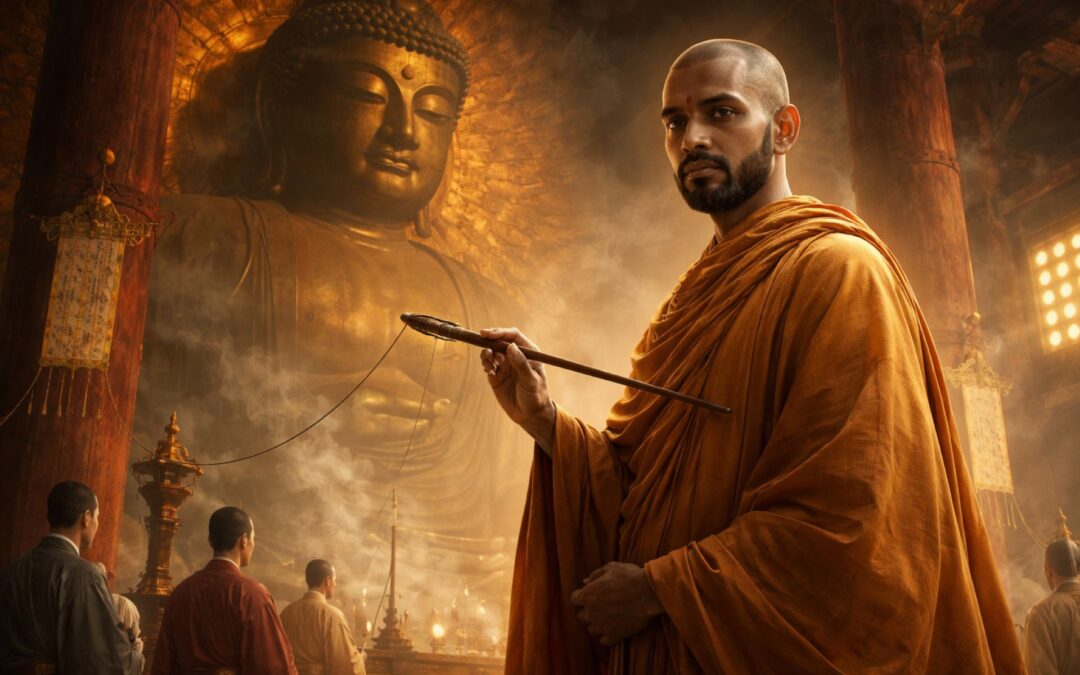
Because he was a monk from India—the birthplace of Buddhism—he was given the honor of performing the crucial ritual act. Using a ceremonial brush attached to a long cord, Bodhisena symbolically painted the pupils onto the enormous statue’s eyes, completing the sacred transformation.
The moment was deeply symbolic.
An Indian monk, representing the spiritual origins of Buddhism, was bringing the Buddha to life within Japan’s greatest temple. In a sense, the ceremony linked Japan directly to the sacred history of Buddhism stretching back to India itself.
For Emperor Shōmu, the event represented the culmination of his religious vision. The Great Buddha was now consecrated, and the empire had formally placed itself under the protection of Buddhist wisdom.
The ceremony also reinforced the growing influence of Buddhism within Japanese society. With Tōdai-ji established as a major religious center and the Great Buddha standing as its symbol, Buddhism had secured a powerful and permanent presence in the country.
Yet even as Buddhism strengthened its position, it still needed to coexist with Japan’s ancient spiritual traditions.
Resolving that challenge would require one of the most important religious innovations in Japanese history.
Reconciling Shinto and Buddhism
Despite the growing influence of Buddhism in eighth-century Japan, the religion still faced a fundamental challenge: it had to coexist with Shinto, the indigenous belief system that had long shaped Japanese spiritual life.
Shinto traditions revolved around the worship of kami, spiritual entities associated with natural forces, sacred places, and ancestral spirits. The imperial family itself claimed divine descent from the sun goddess Amaterasu, making Shinto deeply intertwined with the legitimacy of the Japanese state.
For many people, Buddhism remained a foreign import. It had arrived from the Asian continent only a few centuries earlier, and its doctrines, rituals, and monastic institutions were often viewed as unfamiliar compared to long-standing native traditions.
If Buddhism was to become a lasting part of Japanese society, these two belief systems would need to find a way to coexist rather than compete.
The monk Gyōki, Bodhisena’s influential ally, played a crucial role in addressing this problem.
Gyōki understood the political stakes involved. Emperor Shōmu had invested enormous resources in Buddhist institutions, but public resentment toward foreign religious influence had already contributed to political unrest. If Buddhism was seen as opposing Japan’s native traditions, it could provoke even stronger resistance.
To solve this problem, Gyōki sought a way to harmonize the two systems.
According to historical accounts, shortly before his death in 749 CE, Gyōki undertook a period of meditation in which he contemplated the relationship between Buddhist teachings and Shinto beliefs. When he emerged, he presented a new interpretation that would prove enormously influential.
Gyōki argued that Buddhas and bodhisattvas could manifest themselves as kami.
In other words, the native deities of Japan were not separate from Buddhist cosmology but could be understood as local expressions of universal Buddhist truths. The worship of kami could therefore coexist with Buddhist devotion, rather than contradict it.
This idea became one of the foundational principles of Japanese religious life.
By linking Shinto kami to Buddhist figures, the two traditions were gradually woven together into a complex spiritual system in which temples and shrines often existed side by side. Buddhist monks might oversee rituals connected to kami, while Shinto shrines could incorporate Buddhist imagery and teachings.
The synthesis helped reduce tensions between competing belief systems and allowed Buddhism to become deeply embedded within Japanese culture.
It also served the political interests of the imperial court. If the emperor could be seen as both a descendant of the Shinto sun goddess and a ruler guided by Buddhist principles, then the authority of the throne gained a powerful dual foundation.
Bodhisena’s role in this transformation was largely symbolic but still significant. His presence as an Indian monk reinforced the legitimacy of the Buddhist tradition that was now being integrated into Japan’s religious life.
Through this process, Buddhism ceased to be merely a foreign import. It became an integral part of Japan’s spiritual identity—an identity that would continue to evolve for centuries to come.
Cultural Contributions: Language, Dance, and Scholarship
Although Bodhisena’s most famous role was connected to the religious and political developments of the Nara period, his influence also extended into the cultural and intellectual life of Japan. Like many Buddhist monks of his time, he was not simply a spiritual teacher but also a transmitter of knowledge, art, and learning across cultures.
One of his most important contributions involved the teaching of Sanskrit, the classical language of many Buddhist scriptures.
Sanskrit held a special place in Buddhist scholarship. Many of the earliest sutras and philosophical texts had originally been composed in this language, and a deep understanding of it allowed monks to study Buddhist doctrine at its source. Bodhisena’s native familiarity with Sanskrit gave him a rare level of authority within the Japanese Buddhist community.
At Daian-ji Temple in Nara, Bodhisena and his disciple Butsutsu helped introduce the study of Sanskrit to Japanese monks. Their teaching contributed to the development of scholarly traditions that connected Japanese Buddhism more directly with the wider intellectual world of Asian Buddhism.
Over time, the influence of Sanskrit studies also affected aspects of Japanese linguistic development, particularly in the interpretation of Buddhist texts and ritual language.
Bodhisena’s circle also helped introduce new artistic traditions.
One example was a style of performance known as Champa dance (later called Rinyūgaku in Japan). This form of dance drew inspiration from Indian mythology and Southeast Asian musical traditions. It combined storytelling, movement, and music to depict episodes from Buddhist and Hindu legends.
These performances added a new dimension to courtly entertainment and religious festivals, demonstrating how cultural practices could travel alongside religious ideas across Asia’s maritime networks.
The journey that brought Bodhisena to Japan had been part of a much larger movement of scholars, monks, and artists exchanging knowledge across regions. His companions on the voyage—figures like Genbō and Kibi no Makibi—also played important roles in bringing Chinese texts, music, and scholarly traditions back to Japan.
Together, they helped create a moment of intense cultural exchange during the Nara period. Ideas and artistic forms from India, China, Korea, and Southeast Asia flowed into Japan, influencing everything from religious rituals to courtly arts.
Bodhisena himself also left a physical mark on the Japanese landscape.
According to tradition, he once noticed that Mount Tomi, located near Nara, resembled Vulture Peak—a sacred mountain in India where the historical Buddha was believed to have delivered important teachings. Seeing this resemblance, Bodhisena petitioned the emperor to rename the mountain and establish a temple there.
The resulting site became known as Ryōsen-ji, a temple complex that survives to this day and is recognized as an important historical and cultural monument.
Through these activities—teaching, artistic exchange, and religious scholarship—Bodhisena contributed to the broader cultural transformation of Japan during the Nara period. His legacy was not limited to a single ceremony or political moment; it extended into the intellectual and artistic foundations of Japanese Buddhist culture.
Bodhisena’s Later Life and Legacy in Japan
After the great religious ceremonies and political turmoil of the Tempyo era had passed, Bodhisena spent the remainder of his life quietly in Nara, continuing his work as a teacher and scholar. Compared with the dramatic events that had marked his arrival in Japan, his later years were relatively modest, devoted largely to religious instruction and cultural exchange.
He remained closely associated with Daian-ji Temple, one of the major Buddhist institutions of the Nara period. There he continued teaching Sanskrit and Buddhist doctrine to Japanese monks, helping to strengthen the intellectual foundations of Japanese Buddhism. His role as a teacher ensured that the knowledge he carried from India would continue to influence religious scholarship long after his own lifetime.
By this stage, Buddhism had firmly established itself as a central force in Japanese society. The massive temple complex at Tōdai-ji, the Great Buddha of Nara, and the network of Buddhist institutions supported by the imperial court all stood as evidence of the religion’s growing importance.
Yet the power of the Nara monasteries would eventually create new challenges for the imperial government.
As Buddhist institutions accumulated wealth, land, and influence, some emperors began to worry that the monks of Nara had become too powerful. Religious leaders could shape political decisions, mobilize followers, and exert pressure on the court in ways that threatened the balance of authority within the state.
In 794 CE, several decades after Bodhisena’s death, the imperial capital was moved from Nara to Kyoto. One of the motivations behind this move was the desire to distance the government from the powerful Buddhist monasteries that had grown influential in Nara. The relocation marked the beginning of the Heian period, a new chapter in Japanese political and cultural history.
Bodhisena himself did not live to see these later developments. He died in 760 CE, having spent more than two decades in Japan.
Although he never became a major political figure, his influence had been significant in several important ways. He had helped legitimize key Buddhist leaders, played a central role in the consecration of one of the most important religious monuments in Japanese history, and contributed to the transmission of knowledge and cultural traditions across Asia.
Despite these achievements, Bodhisena remains relatively unknown outside specialist circles today.
Yet traces of his legacy continue to survive in Japan. Temples associated with his life still stand, historical records preserve the memory of his journey, and cultural traditions linked to his teaching have endured for centuries.
In fact, in some parts of Japan, small ceremonies are still held in honor of the Indian monk who once traveled across half the world in search of wisdom. Participants celebrate his memory in a way that reflects his origins—sometimes by sharing Indian-style curry, a symbolic reminder of the distant homeland from which he came.
Through such traditions, Bodhisena’s extraordinary journey—from South India to the heart of imperial Japan—continues to echo across more than a thousand years of history.