
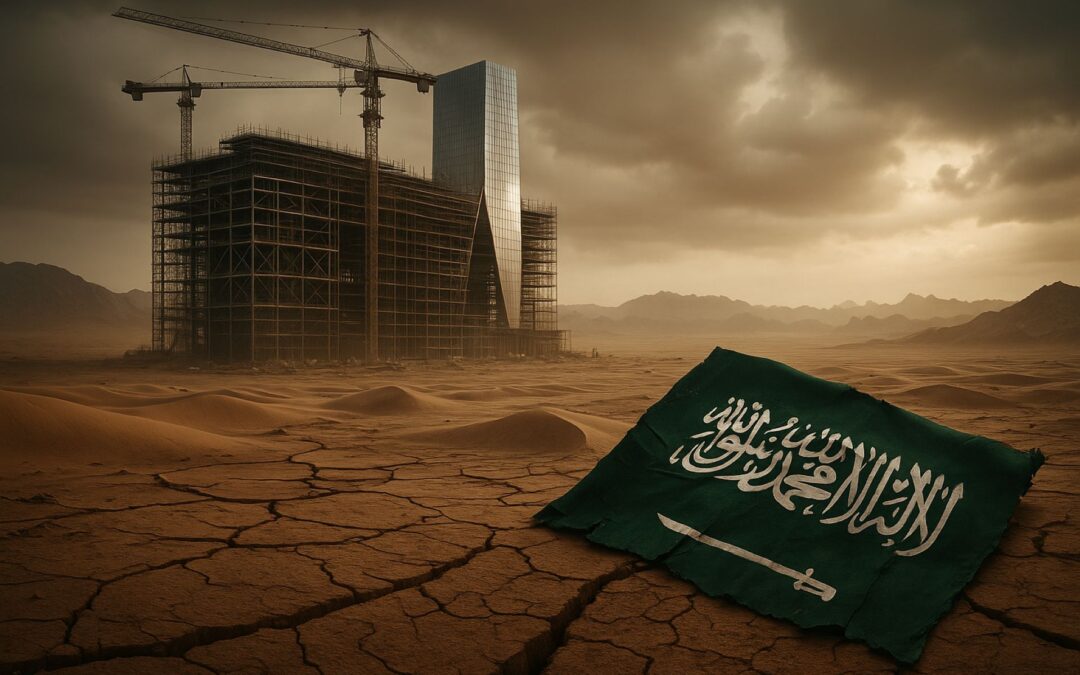
In April 2016, Mohammed bin Salman, then Deputy Crown Prince of Saudi Arabia, unveiled Vision 2030. The ambitious plan aimed to diversify the kingdom’s economy beyond oil and transform Saudi Arabia into a global commercial and cultural hub. The launch dazzled the world with breathtaking images: futuristic cities and colossal structures that looked like they’d been ripped straight from the movie Dune. At its heart was The Line—a 170-kilometer mirrored city taller than the Empire State Building.
Alongside The Line, projects like Trojena, a ski resort in the desert; The Red Sea Global, a luxury tourism venture; King Salman Park; Diriyah Gate; and Qiddiya promised to reshape the kingdom with a jaw-dropping $3 trillion investment. Yet, nearly a decade later, this visionary dream has devolved into a near-hallucinatory nightmare.
All projects are drastically behind schedule and wildly over budget. The chances of completing these endeavors anytime soon are slim to none. This is the Vision 2030 nightmare unfolding for Mohammed bin Salman.
A Century-Long Backdrop: The Birth of Saudi Oil Wealth
Saudi Arabia’s transformation from a fragmented collection of desert tribes into a unified modern state is a saga shaped by necessity, faith, and fortune. When Ibn Saud declared the formation of the Kingdom of Saudi Arabia in 1932, he was uniting disparate Bedouin clans and city-states under one banner. Yet this unification masked the harsh realities beneath: a harsh desert landscape, minimal infrastructure, and an economy built on subsistence farming, date palms, and the ebb and flow of pilgrimage.
The kingdom’s economic fabric was fragile. The Great Depression of the 1930s sent shockwaves across the globe, and Saudi Arabia was no exception. The international collapse in luxury goods demand gutted one of the kingdom’s critical exports: pearls. Simultaneously, the pilgrimage traffic, a vital source of income for Mecca and Medina, dwindled due to economic hardship and travel restrictions. These twin blows left the kingdom scrambling for new sources of wealth.
In a bold and transformative move, the Saudi leadership granted the Standard Oil Company of California (SoCal) the rights to explore for oil in the kingdom—a 60-year concession that few at the time could have imagined would alter history. The 1938 discovery of vast oil reserves in the Eastern Province was nothing short of revolutionary. It laid the foundation for Saudi Aramco, a company that would become the kingdom’s economic lifeblood and a geopolitical heavyweight on the global stage.
Oil’s discovery was more than just a resource boon—it was a catalyst for social and infrastructural change. Roads, schools, hospitals, and cities sprung up, financed by hydrocarbon wealth. However, this dependence on a single commodity planted the seeds of future vulnerability. The kingdom’s fortunes became intricately tied to the volatile oil market, a precarious position that Vision 2030 seeks to transcend.
Vision 2030: The Gigaproject Gamble
In the face of growing awareness about the limits of oil dependency, Mohammed bin Salman launched Vision 2030—a sweeping, multi-trillion-dollar blueprint to transform Saudi Arabia’s economic and social landscape. The ambition was gargantuan: to diversify the economy, foster a private sector, develop new industries, and catapult the kingdom into a post-oil future.
Inspired by the meteoric rise of Dubai as a business and tourism magnet, Saudi Arabia sought to create not just one city, but entire ecosystems of futuristic urban centers and leisure destinations. The jewel in this crown was NEOM, a $500 billion megacity envisioned as a beacon of innovation, sustainability, and high technology.
At the heart of NEOM was The Line: a city concept that defied conventional urban planning. Designed as a linear city stretching 170 kilometers, the project promised zero cars, zero streets, and zero carbon emissions. The city was to be built vertically—taller than the Empire State Building—covered in reflective surfaces to blend seamlessly with the desert environment. It was to be home to 9 million residents connected by ultra-high-speed transport, effectively redefining how humans live and interact with urban space.
Complementing The Line were other ambitious projects: Trojena, a ski resort perched in the mountains; The Red Sea Global, envisioned as an ultra-luxury island destination; Qiddiya, an entertainment and sports complex; and the Diriyah Gate, a cultural heritage site redesigned for modern tourism. Collectively, these ventures represented a $3 trillion investment designed to reinvent Saudi Arabia’s global identity.
However, the scale and audacity of these projects came with monumental challenges—engineering the impossible in unforgiving desert climates, constructing entire economies from scratch, and attracting residents and talent to a land known more for tradition than innovation. Vision 2030 was a gamble on the kingdom’s ability to rewrite itself wholesale.
The Line Shrinks: From Megacity to Miniature
As the years ticked by, the grand plans for The Line ran headlong into the hard realities of construction, finance, and logistics. What was initially touted as a 170-kilometer urban marvel suddenly faced severe setbacks, forcing a dramatic reimagining.
Instead of spanning the length of a small country, the first phase was pared down to just 2.4 kilometers—less than 2% of the original length. The projected population scaled back from a staggering 9 million to a modest 300,000. This scaling back led to a rebranding of the project as the “Desert Pittsburgh,” a far cry from the futuristic megacity that had captured imaginations.
Such an enormous contraction exposes deeper systemic issues. The technical hurdles of building a carbon-neutral, car-free linear city in a desert are daunting: sourcing materials, providing infrastructure, ensuring livability, and maintaining sustainability under extreme conditions. Beyond engineering, the complexities of financing, governance, and attracting residents compounded difficulties.
Moreover, the drastic downsizing signals an erosion of vision. The project has shifted from a revolutionary urban experiment to a more conventional, scaled-back development. This retraction may be seen as pragmatic by some, but it also underscores the gulf between ambitious plans and on-the-ground feasibility—a gulf that threatens the credibility of Vision 2030’s larger megaproject strategy.
The Fatal Flaw: Centralized Fantasy over Feasibility
The core challenge undermining NEOM and the broader Vision 2030 initiative stems from an excessive concentration of power in the hands of Mohammed bin Salman, whose personal enthusiasm for futurism and science fiction has driven the project’s conceptual ambition. However, this enthusiasm has not been tempered by the practical expertise essential for executing such complex urban and economic transformations. Unlike traditional urban planners, engineers, or financiers who rely on empirical data and risk assessments, the decision-making process here is largely fueled by visionary zeal rather than grounded analysis.
This centralized control has had several profound consequences. Dissenting opinions and critical assessments of cost, timeline, and technical viability have been systematically suppressed. For instance, Thomas Paine, the lead architect behind The Line, was reportedly barred from expressing concerns about the ballooning costs and logistical difficulties. Similarly, the project director of Sandala faced removal after questioning budgetary estimates. This environment creates a culture where cautionary voices are silenced, and only optimistic projections are allowed, skewing perceptions of the projects’ true progress and feasibility.
Moreover, external consultants like McKinsey, known for their independent advisory services, appear to have been co-opted into presenting overly optimistic financial models. By employing selective metrics such as adjusted internal rate of return calculations, they have painted a rosier picture of NEOM’s economic prospects than may be warranted. Despite charging hefty fees—estimated at $130 million—their analyses have been criticized for lacking the rigor and skepticism necessary to flag potential pitfalls.
This dangerous cocktail of unchecked ambition, centralized authority, and compromised advisory input has fostered an echo chamber where extravagant plans advance unchallenged, and the realities of engineering, finance, and social acceptance are downplayed or ignored.
The Unstoppable Cost Surge: $500 Billion to $8.8 Trillion
One of the most alarming outcomes of this centralized fantasy is the exponential escalation in projected costs. Initially, NEOM’s price tag was estimated around $500 billion—a monumental sum but arguably within the realm of mega-infrastructure projects globally. Over time, however, as realities surfaced and earlier underestimations became apparent, this figure has ballooned to a staggering $8.8 trillion.
To contextualize this, $8.8 trillion is over 25 times the annual budget of the Saudi government and eclipses the GDP of many advanced economies. Such an astronomical figure exposes fundamental miscalculations in planning and resource allocation. It also raises urgent questions about the kingdom’s fiscal sustainability and its ability to finance, let alone complete, the project without incurring debilitating debt.
The human cost and political fallout have also become visible. Mohammed bin Salman’s frustration was on display at the glitzy launch party for Sandala, an unfinished luxury island resort. Celebrities like Tom Brady and Will Smith were reportedly left waiting amid incomplete facilities, highlighting the kingdom’s overstretched ambitions. The event itself reportedly cost $40 million—a small fraction of the $4 billion already poured into the project but symbolic of misallocated resources and misplaced priorities.
This surge in cost reflects not only technical difficulties but also inefficiencies born of poor project management, political interference, and a lack of coherent strategy. The unchecked escalation undermines investor confidence and calls into question the viability of realizing Vision 2030’s most ambitious components.
Non-Oil GDP Growth: A Mirage?
Despite the grim realities facing NEOM and its sister projects, official narratives often point to increases in Saudi Arabia’s non-oil gross domestic product (GDP) as evidence that Vision 2030 is producing tangible results. Indeed, the kingdom has made concerted efforts to grow sectors such as tourism, entertainment, and industrial manufacturing to reduce reliance on hydrocarbons.
Central to this strategy is the Public Investment Fund (PIF), Saudi Arabia’s sovereign wealth fund, which has transformed from a passive financial vehicle into an active economic development engine. Unlike conventional funds focused solely on financial returns, the PIF explicitly aims to catalyze domestic diversification. It accomplishes this by investing globally in technology, energy, and infrastructure firms, while funneling proceeds back into Saudi projects.
Between 2017 and 2023, the PIF reportedly achieved an annualized return of approximately 8.7%, a respectable figure given global economic uncertainties. These returns are reinvested in local ventures, including NEOM, aiming to stimulate job creation and sectoral growth.
However, while these figures suggest progress, they obscure the fundamental imbalance in Saudi Arabia’s economy. Only about 20% of the PIF’s estimated $800 billion portfolio is invested abroad—roughly $160 billion. This amount, while sizable, pales in comparison to Saudi Arabia’s non-oil GDP, estimated around $450 billion. The returns generated from foreign investments contribute only a modest fraction—around $13.5 billion annually or 3% of non-oil GDP.
This suggests that the vast majority of non-oil economic expansion is fueled by domestic government spending and construction, not by market-driven private sector growth or foreign investment returns. The heavy reliance on public spending—much of it on ambitious but incomplete megaprojects like NEOM—raises doubts about the sustainability and resilience of this economic diversification.
In essence, the non-oil GDP growth touted by official sources risks being more mirage than reality—driven by government expenditure rather than genuine private-sector dynamism and diversified economic foundations.
The Numbers Tell a Different Story
When peeling back the layers of Saudi Arabia’s reported non-oil GDP growth, a more sobering picture emerges. The Public Investment Fund’s (PIF) foreign investments—often touted as a pillar of diversification—constitute only a small slice of the kingdom’s economic engine. With approximately $160 billion invested abroad, the PIF’s global portfolio might appear vast. However, compared to the non-oil GDP of about $450 billion, it’s relatively modest. The 8.7% annual return on this international portfolio yields roughly $13.5 billion per year, which is just around 3% of the non-oil economy’s output.
This discrepancy highlights a fundamental weakness: Saudi Arabia’s diversification is largely superficial. Instead of a vibrant private sector fueled by innovation and external investments, most economic activity is propelled by domestic projects directly tied to government spending—especially those linked to NEOM and other Vision 2030 mega-developments.
When you factor out the massive government-led construction and infrastructure spending, non-oil GDP growth starts to look shaky. It suggests that outside of these government stimulus projects, Saudi Arabia’s economy struggles to generate organic growth or attract robust private-sector engagement. This exposes a critical vulnerability: the kingdom’s diversification strategy is heavily dependent on state capital infusion rather than sustainable market forces.
The Elephant in the Room: Who Will Live in NEOM?
Beyond financial viability, one of Vision 2030’s most glaring questions remains unanswered: who will actually inhabit these futuristic cities? The original plan envisioned The Line housing 9 million residents, making it denser than Manhattan by an order of magnitude and equivalent to 26% of Saudi Arabia’s entire population. Yet, the kingdom’s current demographic trends make this scenario highly implausible.
Saudi Arabia’s net migration rate is approximately 6.7 per 1,000 people, translating to about 250,000 new immigrants annually—far short of the influx needed to populate The Line at scale within the planned timeframe. Moreover, attracting residents isn’t simply a matter of numbers; it requires appealing to individuals with the education, skills, and entrepreneurial drive necessary to sustain an innovative, high-tech urban economy.
Thus, the success of NEOM hinges not just on bricks and mortar but on its ability to become a magnet for talent. However, this demands social, cultural, and legal environments that are welcoming and conducive to innovation, something Saudi Arabia struggles with due to its conservative social structure and restrictive laws.
Talent Wars and Cultural Barriers
To fill NEOM and other Vision 2030 projects with the “best and brightest,” Saudi Arabia has proposed visa reforms, “premium residency” permits, and the creation of economic free zones designed to stimulate investment and attract entrepreneurs. Scholarships and exchange programs aim to cultivate local talent and draw international students.
However, the kingdom faces profound cultural and legal obstacles that make attracting top-tier global talent challenging. The laws in Saudi Arabia, particularly those governing gender roles and personal freedoms, remain conservative. Despite reforms that have loosened some restrictions, the male guardianship system still requires women to obtain permission from a male relative for marriage, travel, and other key decisions. This system starkly contrasts with the cultural norms and expectations of many highly educated, socially liberal professionals worldwide.
Such legal and cultural constraints alienate a significant portion of potential residents—particularly women and progressive thinkers—who seek environments aligning with their values and freedoms. This social rigidity clashes with the inclusive, dynamic culture necessary to foster innovation hubs and attract global talent.
In essence, Saudi Arabia’s ambition to import global expertise is hindered not just by economic or infrastructural factors but by entrenched social norms that discourage many from choosing the kingdom as a home or workplace.
Saudi Arabia vs. Global Talent Markets
When comparing Saudi Arabia to other global hubs competing for top talent, the kingdom faces stark disadvantages rooted in social freedoms and quality of life. Nations like Singapore and the United Arab Emirates have successfully positioned themselves as gateways between East and West, offering strict governance but balancing it with religious tolerance, social liberties, and openness to expatriates. These factors create ecosystems that attract skilled workers, entrepreneurs, and investors from around the world.
Saudi Arabia, in contrast, ranks near the bottom on global freedom and human rights indices. Despite recent reforms, its laws continue to restrict freedoms of speech, religion, and gender equality. Such restrictions pose serious challenges for attracting the highly skilled, socially liberal workforce Vision 2030 depends on. The contrast is particularly glaring when looking at Singapore, which, despite its strict laws, guarantees freedom of religion, allows alcohol consumption, and offers greater personal liberties.
Additionally, Saudi Arabia’s migrant labor system exacerbates its challenges. The kafala sponsorship system ties migrant workers’ legal status directly to their employers, granting sponsors excessive control over workers’ lives. This system has been widely criticized for enabling exploitation, unsafe working conditions, and abuses, with estimates suggesting that thousands of migrant workers from countries like India, Bangladesh, and Nepal have died on Saudi projects.
Such conditions deter skilled immigrants who have options in more welcoming countries. This structural disadvantage significantly narrows Saudi Arabia’s talent pool, limiting its ability to build a knowledge-based economy that can sustain Vision 2030’s ambitions.
A Workforce Stuck in Quicksand
While Saudi Arabia attempts to attract foreign talent, it faces equally daunting challenges in mobilizing its own citizens. The kingdom ranks 41st out of 44 countries in global graduate employability, reflecting deep structural issues in education and workforce preparedness.
Reports indicate that Saudi universities have artificially boosted their rankings by incentivizing researchers to falsify affiliations, undermining trust in academic quality. Such measures mask the root problems of curriculum relevance, critical thinking skills, and practical training that are essential for building a competitive workforce.
Work ethic concerns compound the issue. The public sector in Saudi Arabia offers secure employment with comparatively high salaries, attracting the majority of job seekers. Surveys show that 78% of unemployed Saudis prefer public sector roles, making it difficult for the private sector to recruit locals. This preference creates a talent bottleneck, forcing companies to rely heavily on foreign labor, which depresses wages and limits upward mobility for Saudi nationals.
This dynamic creates a vicious cycle: dependency on the public sector reduces motivation to innovate or take entrepreneurial risks, hindering the diversification of the economy and the development of a vibrant private sector necessary for Vision 2030’s success.
The Culture of Dependency
Saudi Arabia’s generous social welfare system, financed by oil wealth, has fostered a pervasive culture of dependency. While providing stability and a safety net, this system simultaneously diminishes incentives for personal initiative, hard work, and innovation.
This cultural inertia manifests in several ways. Many Saudi citizens view government employment as the ideal career, valuing job security and benefits over challenge or entrepreneurship. The robust welfare infrastructure reduces economic pressures that typically drive innovation and risk-taking in other countries.
The result is a labor market resistant to change, where businesses struggle to attract motivated, skilled local workers. Despite government efforts at “Saudization” to increase local employment in the private sector, progress remains slow, and the economy continues to rely heavily on low-skilled foreign workers.
This phenomenon is not unique to Saudi Arabia but is common among many oil-rich Gulf states where rapid wealth influx has reshaped societal values. Overcoming this cultural and economic inertia requires long-term social reforms, education improvements, and a reorientation of national values towards productivity and innovation—challenges that Vision 2030 has yet to fully address.
The Mirage of Tourism and Entertainment
Tourism has been touted as one of the cornerstones of Saudi Arabia’s economic diversification strategy. The kingdom’s ambitious Vision 2030 places great emphasis on transforming the country into a global tourist destination, expanding beyond religious pilgrimage to encompass luxury resorts, cultural experiences, and entertainment hubs. In theory, leveraging its unique natural landscapes, historic sites, and vast deserts could unlock enormous economic potential.
In practice, however, the kingdom faces considerable cultural and reputational barriers that limit its appeal. Although it welcomed 21 million visitors in 2019, the vast majority—around 18.5 million—were pilgrims visiting Mecca and Medina, engaging in religious tourism rather than leisure or entertainment. The figure pales when compared to established global tourist hubs, and the challenge remains to attract non-religious tourists in significant numbers.
To invigorate the entertainment sector, Saudi Arabia launched LIV Golf in 2022, positioning it as a challenger to the established PGA Tour. The league offered lucrative guaranteed salaries to attract top-tier players, signaling a willingness to invest heavily in high-profile sporting events. Yet despite spending close to $400 million by 2023, LIV Golf has struggled to build a broad fan base or capture significant media attention, highlighting the difficulty of manufacturing instant prestige without an organic following.
Similarly, the kingdom has poured billions into its football scene. The Saudi Pro League secured majority stakes in four top English football clubs and splurged over £2 billion on marquee player transfers, signing global stars like Cristiano Ronaldo and Neymar. These high-profile moves aimed to boost the league’s profile and the kingdom’s soft power. But match attendance remains low, and TV viewership in key markets like the United States lags far behind more established leagues. This underwhelming response reveals that sports fandom is rooted not just in star power or money, but in history, community identity, and deep-rooted cultural connections—intangibles that cannot be bought.
The Hollow Quest for Global Prestige
Saudi Arabia’s strategy to elevate its global stature leans heavily on purchasing prestige through extravagant spending rather than cultivating authentic cultural or economic influence. This approach often resembles a theatrical production—a dazzling show on the surface but lacking substantive foundations.
Projects like NEOM, with its futuristic architecture and ambitious goals, captivate imaginations but have yet to demonstrate practical feasibility or deliver tangible benefits. The kingdom’s heavy investment in high-profile sports leagues and events aims to associate its brand with global excellence but falls short of building lasting cultural legitimacy.
Authentic prestige in sectors like sports, culture, or innovation is typically built over decades or centuries, grounded in community support, history, and sustained excellence. Established football clubs like Arsenal, Manchester United, Barcelona, and Real Madrid boast over a century of tradition, fostering passionate fanbases and deep societal roots. Such legacies can’t be replicated overnight, nor bought with cash alone.
Saudi Arabia’s failure to understand this subtlety means that much of its expenditure results in hollow symbols rather than durable assets. Without addressing underlying social, political, and cultural challenges, these efforts risk being seen as expensive window dressing rather than transformative initiatives.
The Stark Financial Reality
A crucial lens through which to evaluate Vision 2030’s megaprojects is their financial viability. Even the kingdom’s most successful economic sector outside oil—religious tourism—pales in comparison to the colossal costs involved in projects like NEOM.
Assuming that by 2030 Saudi Arabia can attract 30 million tourists spending an average of $1,100 each per visit, the resulting revenue would approximate $77 billion annually. While this figure appears substantial, it amounts to less than 1% return on the estimated $8.8 trillion NEOM investment alone.
This massive disparity underscores the financial unsustainability of the kingdom’s current strategy. The sheer scale of capital required for Vision 2030’s flagship projects is staggering, and even optimistic scenarios for revenue generation cannot justify the investment.
In reality, this imbalance creates a trajectory toward fiscal distress. Without dramatic changes in execution, governance, and economic planning, the kingdom risks sinking resources into ventures that fail to generate commensurate economic returns, increasing its vulnerability to debt and financial instability.
Vision 2030: Ambition Without Execution
Saudi Arabia’s Vision 2030 shines brightly as a beacon of ambition—a grand narrative promising to redefine the kingdom’s future, untethered from oil dependency and rooted in innovation, tourism, and culture. Yet, beneath this glittering exterior lies a pervasive gap between aspiration and implementation. While bold dreams are indispensable for transformation, their realization demands disciplined execution, meticulous planning, and an adaptive management approach—elements that Vision 2030 has struggled to consistently demonstrate.
The gulf between the kingdom’s high-profile announcements and the tangible progress on the ground is widening. The protracted delays and dramatic downsizing of projects like The Line epitomize this disconnect. Timelines slip, budgets inflate, and promised deliverables remain distant, eroding public confidence and investor trust.
Moreover, the lack of transparent governance structures exacerbates these challenges. Centralized decision-making under tight royal control limits accountability and stifles critical feedback, impeding course corrections. Without mechanisms for rigorous oversight and realistic risk assessment, Vision 2030 risks remaining a collection of lofty ideals rather than an engine of sustainable change.
Successful economic diversification and urban development require integrating visionary goals with pragmatic strategies—balancing innovation with feasibility, excitement with discipline. Until the kingdom strengthens its execution capacity and institutional frameworks, Vision 2030’s ambitions will remain largely aspirational rather than transformative.
The Bigger Picture: The Saudi Paradox
Saudi Arabia’s development trajectory is marked by a paradox: immense wealth and ambition juxtaposed with structural rigidity and social conservatism. On one hand, the kingdom wields financial resources rivaling some of the world’s largest economies, fueling visionary projects and global investments. On the other, deeply ingrained cultural, legal, and institutional factors impede the realization of these ambitions.
This paradox manifests in a tension between tradition and modernization. The kingdom seeks to project an image of futurism and openness while maintaining strict social controls and conservative norms. This duality complicates efforts to attract and retain the global talent necessary for a knowledge-based economy.
Furthermore, the economic model heavily reliant on state-led initiatives and subsidies fosters dependency, dampening entrepreneurial spirit and private-sector growth. The lavish spending on megaprojects often masks systemic issues in education, workforce readiness, governance, and social freedoms.
This contradiction shapes Saudi Arabia’s reform challenges. Ambitious blueprints like Vision 2030 can generate headlines and momentary enthusiasm, but lasting transformation demands confronting entrenched social norms, institutional inertia, and governance deficits.
Navigating this paradox requires balancing respect for cultural identity with openness to reform—a delicate dance that will determine whether Saudi Arabia’s grand visions can translate into enduring realities or remain desert mirages shimmering on the horizon.
Conclusion
Saudi Arabia’s $8 trillion gamble is a cautionary tale of hubris, overreach, and cultural misalignment. Mohammed bin Salman’s ambitions have injected energy into the kingdom’s future, but ambition alone does not build cities or economies.
Real transformation demands more than dazzling visions; it requires gritty execution, cultural evolution, and pragmatic realism. Without these, Saudi Arabia’s grand plans risk remaining desert mirages—impressive to behold, but ultimately unreachable illusions.