
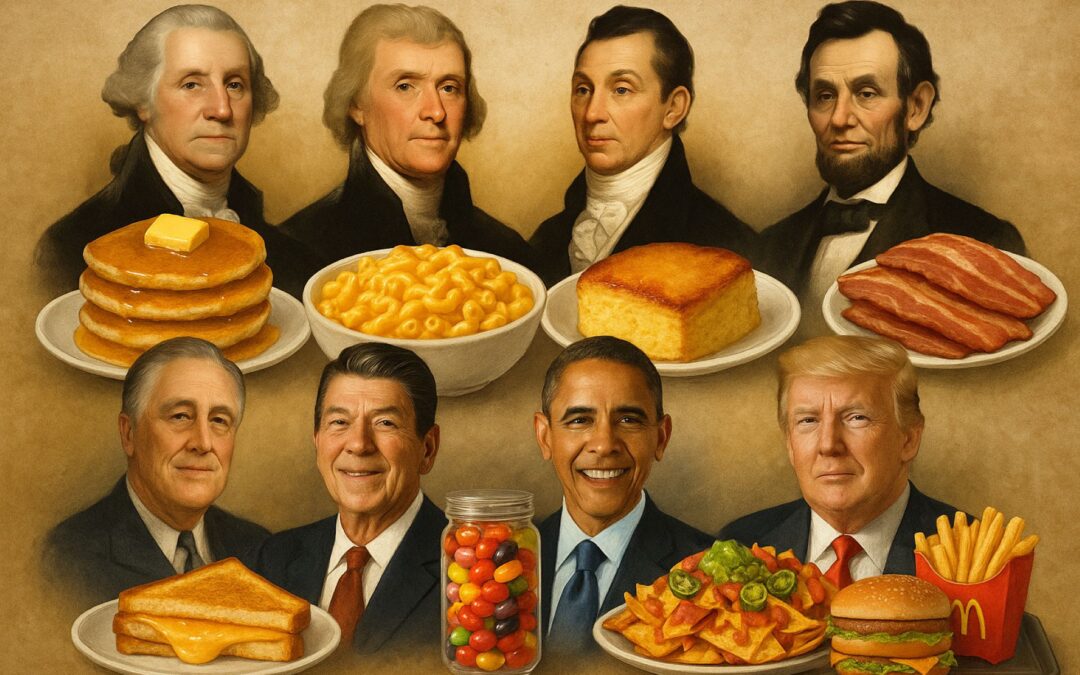
The American presidency is often defined by policy, power, and history-shaping decisions. Yet behind every speech and state dinner lies something far more human: appetite. What a president chooses to eat—whether it’s Lincoln’s bacon, Reagan’s jelly beans, or Obama’s nachos—tells us as much about their character as any campaign slogan. These culinary preferences are snapshots of heritage, personality, and even political strategy. Some dishes reflected frontier toughness, others symbolized refinement, and a few were just plain eccentric. Taken together, they form an edible portrait of America’s leaders, one plate at a time.
George Washington – Hoecakes
Washington began his mornings with a ritual as sturdy as his legacy: hoecakes. These cornmeal pancakes, soaked in butter and honey until dripping, were more than breakfast—they were survival. With rotting teeth and ill-fitting dentures, he needed food that slid down easily. The sweetness disguised the necessity, and the simplicity reflected the practical frontier sensibilities he never quite left behind. At Mount Vernon, his step-granddaughter noted he could eat three in a sitting, each softened until it required little chewing. They weren’t lavish, but they were his anchor, as steady as the man who built a republic.
John Adams – Hard Cider & Apple Pan Dowdy
Adams woke each morning with a tankard of hard cider—a habit common in New England, but one he clung to with Puritan determination. Alcohol wasn’t indulgence; it was safer than water, and cider was practically liquid bread. By evening, his sweet tooth found solace in apple pan dowdy, a baked pudding brimming with molasses and autumn spice. Taken together, his diet turned him into America’s first apple evangelist, a man powered by orchards and harvest traditions. Apples weren’t just food; they were New England itself, fermented in his veins and baked into his legacy.
Thomas Jefferson – Macaroni & Cheese
Jefferson’s sojourn in France gave America one of its most enduring comfort foods. Obsessed with macaroni and parmesan, he returned with a pasta-making machine, eager to replicate the delicacies he’d tasted abroad. In 1802, White House guests were astonished when he served a baked macaroni pie—a precursor to modern mac and cheese. He scribbled recipes for creamy puddings and custards, recording his culinary curiosity in meticulous detail. To his peers, he was a visionary statesman; in the kitchen, he was a proto–food blogger, blending French refinement with American enthusiasm, and leaving behind the blueprint for one of the nation’s most beloved dishes.
James Madison – Ice Cream (via Dolley Madison)
Though Madison’s personal tastes remain shadowed, his wife Dolley transformed dessert culture in Washington. She made ice cream a centerpiece of White House receptions, serving it in fruit flavors like strawberry and apricot, setting a trend that would ripple through American dining rooms. Rumors of oyster ice cream turned out to be exaggerations, but the impact was undeniable. The Madisons even built an ice house on the White House grounds to sustain the craze. Rivals joked that the president was more devoted to Dolley’s frozen confections than to policy, and perhaps they weren’t entirely wrong.
James Monroe – Spoon Bread
Spoon bread, that custardy marriage of cornbread and soufflé, was Monroe’s edible signature. Raised on Virginia soil yet influenced by European tastes, Monroe’s table often featured the dish alongside fried chicken or ham. Its texture—soft enough to scoop yet hearty enough to satisfy—captured the blending of American simplicity with genteel refinement. At his Oak Hill plantation, it was an everyday comfort, as reliable as the rolling fields of corn that sustained the South. For Monroe, spoon bread wasn’t just food; it was continuity, a culinary tether to the homeland he governed from afar.
John Quincy Adams – Fresh Fruit
Where others indulged in meat and pies, John Quincy Adams embraced the orchard. Apples, pears, plums—his diet leaned toward whatever ripened under the sun. He even expanded the White House gardens to ensure a steady supply of fruit, planting trees that blurred the line between politics and personal pleasure. Visitors expecting grand banquets sometimes found their plates filled with little more than seasonal produce. But Adams believed in moderation, and fruit suited both his disciplined temperament and his active lifestyle. In him, the saying “you are what you eat” took literal form: cultivated, simple, and enduring.
Andrew Jackson – Leather Britches
Jackson’s table was as rugged as his reputation. Leather britches—green beans dried in their pods, then stewed slowly with bacon until smoky and chewy—were his favorite. The name itself conjured toughness, echoing Jackson’s own nickname, “Old Hickory.” Alongside hickory nut soup and fried apple pies, the dish represented the raw frontier energy he embodied. It wasn’t delicate cuisine; it was sustenance, seasoned with salt, smoke, and grit. For a president who thrived on combat, political and physical, leather britches were less about taste and more about identity. They were food as fortification.
Martin Van Buren – Oysters
Van Buren’s Dutch heritage and New York upbringing found perfect expression in oysters. In the 19th century, they were abundant and cheap, lining tavern menus and street corners. Van Buren ate them raw, baked, stewed—it hardly mattered, as long as they were fresh and plentiful. At White House dinners, he often ignored cakes and pastries, reaching instead for the shellfish. He even quipped that a meal’s success could be measured by the mountain of shells left behind. For him, oysters weren’t a delicacy; they were nostalgia, connecting him to the Hudson and the bustling oyster markets of his youth.
William Henry Harrison – Squirrel Stew
Harrison’s presidency was brief, but his food choice was memorable: squirrel stew. A frontier staple, it reflected his carefully cultivated log-cabin persona. During his 1840 campaign, supporters ladled out free bowls of the stew with cornbread and cider, binding his candidacy to the rugged common man. The dish itself was earthy and gamey, thickened with root vegetables, tasting faintly nutty. It wasn’t aristocratic fare—it was fuel for farmers, soldiers, and settlers. For Harrison, squirrel stew was more than sustenance; it was political symbolism ladled steaming into the electorate’s bowls.
John Tyler – Indian Pudding
Tyler, father to fifteen children, relied on practicality in the kitchen. Indian pudding—a baked concoction of cornmeal, molasses, and milk spiced with cinnamon and ginger—was cheap, filling, and adaptable. Served hot and comforting, it nourished large households and echoed colonial traditions. For Tyler, it provided more than calories: it was continuity with New England’s early settlers, a culinary bridge from colonial hearths to presidential halls. In its warmth lay the reassurance of abundance, something Tyler surely valued as both patriarch and president.
James K. Polk – Cornbread
Polk’s tastes were spartan, shaped by Southern roots and an austere temperament. Cornbread in its many forms—ash cakes baked directly in embers, pones crisped on griddles, or simple loaves—was his enduring favorite. He wasn’t a man for French sauces or elaborate spreads. Cornbread represented simplicity, humility, and a connection to the soil. It was everyday food, yet to Polk, it was enough. His presidency may have expanded the nation’s borders, but his palate remained firmly rooted in the rustic hearth of the South.
Zachary Taylor – Calas (Creole Rice Fritters)
Years stationed in Louisiana left Taylor enamored with calas—sweet fried rice fritters hawked by vendors in New Orleans. Eaten hot in the mornings with coffee, they were as much a part of the city’s fabric as jazz and parades would later become. Taylor carried that taste to Washington, introducing Creole street food to the White House table. To him, calas were not just sustenance but memory, linking him to the soldiers, merchants, and families of the Crescent City. Their sweetness softened his otherwise hard-edged military persona.
Millard Fillmore – Mock Turtle Soup
Victorian society prized green turtle soup, a delicacy often too costly for common households. The solution? Mock turtle soup, made with calf’s head and seasoned to mimic the prized reptile. Fillmore adored it, enough to have the first stove installed in the White House for better preparation. To modern tastes, it sounds grotesque, but in the 19th century, it was refinement on a budget. Fillmore’s preference highlighted both his social aspirations and his willingness to embrace trends that elevated the presidency into line with European sophistication.
Franklin Pierce – Fried Clams
Pierce’s New England upbringing tied him irrevocably to the sea. Golden fried clams, dredged and crisped until briny sweetness yielded to crunch, were his delight. Paired with clam chowder, they offered him the taste of home—simple yet indulgent. At a time when coastal cuisine was becoming iconic in New England identity, Pierce embodied it, choosing fried clams over fancier dishes. They weren’t a campaign prop or social affectation. They were the food of his childhood, served on paper plates at the seashore, reminding him of the Atlantic’s constancy.
James Buchanan – Cabbage
Buchanan, the only lifelong bachelor to occupy the White House, was surprisingly domestic in his tastes. His true love was cabbage—humble, hearty, and endlessly versatile. He ate it buttered, stewed, fermented into sauerkraut, or shredded into slaw. Friends and staff recalled his plate piled high with leafy greens, the pungent aroma filling the dining room. At a time when refined cuisine was prized, Buchanan’s preference for cabbage felt oddly ascetic, as if he were retreating into the plain comforts of a Pennsylvania farmhouse. For a president often accused of indecision and timidity, his chosen food was fitting: simple, sour, and divisive.
Abraham Lincoln – Bacon
Lincoln’s lifelong companion was bacon. From his log-cabin boyhood to the circuit courts of Illinois, bacon was there—salty, smoky, and durable enough to last long journeys. Even during the Civil War, he joined soldiers at campfires, eating bacon and hardtack shoulder-to-shoulder, dissolving the barrier between commander and common man. In the White House, amidst the weight of the Union’s survival, bacon represented familiarity. It wasn’t luxury, it wasn’t politics—it was nourishment tied to memory. For Lincoln, every slice carried echoes of frontier resilience and the bond of shared struggle.
Andrew Johnson – Hoppin’ John
Johnson leaned heavily on Hoppin’ John, a Southern staple of black-eyed peas, rice, and pork simmered together. Traditionally eaten on New Year’s Day for luck and prosperity, it was symbolic as much as it was nourishing. Johnson, embattled by impeachment and scorn, seemed to need every ounce of luck he could get. His plate of Hoppin’ John reflected both his Tennessee roots and his political precariousness. Though history judged him harshly, the dish itself—humble, filling, and bound up with tradition—stood as a reminder that food can be both sustenance and superstition.
Ulysses S. Grant – Rice Pudding
After years of hard campaigning, battlefield rations, and a stomach worn thin by stress and alcohol, Grant craved simplicity. His comfort was rice pudding, made tender and sweet by his wife Julia. At elaborate dinners, while guests indulged in French delicacies, Grant would often bypass the pomp and head straight for his bowl of pudding. To him, it wasn’t just food—it was refuge. The victorious general who forced Lee’s surrender preferred the quiet sweetness of a homemade dessert over the grandeur of victory banquets. His legacy may be military, but his palate was disarmingly domestic.
Rutherford B. Hayes – Cornmeal Pancakes
For Hayes, Sunday mornings meant cornmeal pancakes, drizzled with molasses until sticky and rich. He longed for them even on Civil War battlefields, writing home about how much he missed their frontier flavor. In the White House, he didn’t replace them with continental crepes or elegant pastries—he kept serving cornmeal pancakes, defying diplomatic expectations. To Hayes, they weren’t just breakfast—they were a declaration of authenticity. The taste of the frontier mattered more than foreign sophistication, and he brought that conviction to the presidential table.
James Garfield – Squirrel Soup
Like Harrison before him, Garfield grew up on Ohio squirrel soup, a dish born of necessity rather than indulgence. Even as president, he kept the tradition alive, enjoying it at his farm with his wife, Lucretia. The broth was hearty, the meat slightly nutty, sustaining farm families through harsh winters. For Garfield, it was the taste of home, unpretentious and grounding. His presidency was tragically short, but squirrel soup endures as a reminder of his rural roots and the modesty of his beginnings.
Chester A. Arthur – Mutton Chops
Arthur’s dining habits matched his appearance. His lavish mutton chop sideburns mirrored his love for mutton chops on the plate. In New York restaurants, waiters hardly asked—they knew “the usual” meant chops with baked potatoes. Though he hosted opulent dinners with fine wines and French dishes, when the crowd dispersed, he returned to his chops. They were his signature, his comfort, his culinary mirror. The president with the most memorable facial hair also became the president most synonymous with meat cut from the sheep’s ribs.
Grover Cleveland – Pickled Herring
Cleveland, a man of sturdy build and working-class sensibilities, found happiness in pickled herring. Salty, vinegary, preserved—this was food that spoke to immigrant tables and tavern benches. He paired it with Swiss cheese and beer, ignoring the elegant offerings placed before him at banquets. His wife admitted he was happiest in the kitchen with his simple spread, far from the glittering receptions. In his taste for herring, Cleveland revealed his disdain for pretense and his comfort in the company of everyday fare.
Benjamin Harrison – Corn in All Forms
Indiana-born, Harrison adored corn in every possible guise: chowder, fritters, pudding, or roasted cobs. Corn wasn’t just food—it was identity. He turned it into centerpiece dishes at state dinners, offering corn chowder as both sustenance and statement. It was Midwestern pride in edible form, transforming the golden kernels of Indiana into a symbol of home, heritage, and political belonging. For Harrison, serving corn was serving his own roots.
William McKinley – Hot Lobster Salad
McKinley and his wife Ida celebrated their 25th wedding anniversary with hot lobster salad, cementing it as a household favorite. The dish, baked with lobster, cream, and a rich sauce, was decadent yet comforting. It became so closely tied to him that restaurants offered “Lobster à la McKinley.” It was celebratory food, romantic and personal, reflecting both his domestic devotion and his taste for something slightly more indulgent than his Midwestern predecessors.
Theodore Roosevelt – Steak & Game Meat
Roosevelt’s table was a hunter’s bounty. Venison, bear, beef—if he could shoot it, he could eat it. French diplomats grumbled that White House meals were too heavy on steak and light on refinement, but Roosevelt cared little. He imposed rules of his own: fried chicken must come with gravy, steaks had to be thick and juicy. He hunted, he grilled, he feasted. To him, food was vitality, as robust as his personality. The dining table was just another frontier to conquer with appetite and bravado.
William Howard Taft – Steak & Potatoes
Taft’s love for food was legendary, his waistline a testament. Breakfast often began with a 12-ounce steak and eggs, sometimes repeated at lunch and dinner. At over 300 pounds, his appetite defined his public image. He even used food as politics, inviting senators to “president’s breakfasts” of steak and eggs to court favor. Eventually, health forced restraint, but Taft’s culinary legacy remains tied to excess—he was the president who truly ate like a king, until the crown grew too heavy.
Woodrow Wilson – Chicken Salad
Wilson, with a sensitive stomach, avoided spice, fat, and heavy meats. His choice was plain chicken salad, often eaten alone at his desk. For him, food was not indulgence but utility, sustenance with minimal effort. “My favorite food,” he once joked, “is whatever requires the least chewing.” His presidency was heavy with war and diplomacy, but his plate remained light, unassuming, almost austere.
Warren G. Harding – Chicken Pot Pie
Harding’s wife Florence became famous for her chicken pot pie, which she served during his “front porch campaign” in Ohio. Supporters arrived in droves, fed both with rhetoric and flaky crusts filled with creamy chicken. Even in Washington, amidst scandal and corruption, Harding clung to the dish. Chicken pot pie became his edible symbol of home, hearth, and nostalgia for simpler times.
Calvin Coolidge – Pork Apple Pie
Silent Cal was never silent about his love for Vermont-style pork apple pie. The dish blended sweet apples with savory salt pork, baked into a pie that was hearty and rustic. He spoke often of his mother’s version, calling it unmatched. He ate it not just for dessert but at breakfast, supper, whenever possible. In Coolidge’s quiet way, pork apple pie was his most expressive indulgence—Vermont heritage sealed in pastry.
Herbert Hoover – Marshmallow Sweet Potatoes
Hoover’s sweet tooth leaned toward baked sweet potatoes topped with gooey marshmallows. During the Depression, the dish became a staple: inexpensive, filling, and dressed with sugar to feel festive. It revealed a softer, more indulgent side of a man often remembered for economic collapse. For Hoover, marshmallow-topped yams were a small comfort in a time of national despair.
Franklin D. Roosevelt – Grilled Cheese
Despite leading the nation through depression and war, FDR loved something almost childlike: grilled cheese sandwiches. Crispy bread, melted cheese, often paired with tomato soup—simple, affordable, and universally beloved. Even when entertaining kings and queens, Roosevelt’s personal plate could hold nothing more glamorous than melted cheddar. It was his tether to ordinary America, reminding him that power did not require pretension.
Harry Truman – Well-Done Steak
Truman believed in cooking steak until no pink remained. “Only coyotes eat raw meat,” he quipped, ensuring his beef was charred through. Always accompanied by a baked potato and a glass of milk, his meals reflected his no-nonsense Midwestern ethos. Food was not about nuance or delicacy—it was about certainty, substance, and tradition.
Dwight D. Eisenhower – Million-Dollar Fudge
Ike’s sweet indulgence was Mamie Eisenhower’s “Million-Dollar Fudge,” a confection of chocolate, marshmallow cream, and walnuts. Mamie’s recipe became a national sensation, printed in newspapers and mailed out on White House cards. For a general who led armies across Europe, it was an unexpectedly sentimental indulgence—sweet, soft, and celebratory. The five-star general relished five-star fudge.
John F. Kennedy – New England Fish Chowder
Kennedy remained loyal to his Massachusetts roots with New England fish chowder. Creamy broth, potatoes, chunks of fish, and milk—he loved it for lunch, and once mailed the recipe to a schoolgirl who asked about his favorite dish. It was homely and approachable, a reminder that beneath the glamorous image, JFK’s heart belonged to Cape Cod kitchens and coastal tradition.
Lyndon B. Johnson – Texas Barbecue & Chili
At his Stonewall ranch, LBJ turned barbecue into diplomacy, feeding foreign leaders brisket and ribs beneath the Texas sun. His chili, fiery and unapologetic, became legend—so much so that Lady Bird Johnson had recipe cards printed and mailed from the White House. Food for LBJ was more than sustenance; it was statecraft. Smoke and spice became the flavors of his presidency.
Richard Nixon – Cottage Cheese with Ketchup
Nixon’s culinary quirk was cottage cheese topped with ketchup—a dish he ate with startling regularity. Breakfast, lunch, late-night—it didn’t matter. Even on his final day in the White House, he sat down to his cottage cheese. It was odd, bland, slightly sour—much like his public reputation in the wake of Watergate. His presidency ended in disgrace, but his chosen food lives on as one of the strangest presidential habits.
Gerald Ford – Pot Roast & Butter Pecan Ice Cream
Ford’s Michigan upbringing made him fond of pot roast—meat and potatoes, slow-cooked until tender. For dessert, he leaned on butter pecan ice cream, a sweet comfort always stocked in the White House freezer. His presidency may have been brief and transitional, but his tastes were steady, rooted in Midwestern family tables.
Jimmy Carter – Cheese Grits with Eggs
Carter ate cheese grits with eggs nearly every morning for decades. A Georgia boy through and through, he adored the dish so much he even named his dog “Grits.” The meal was simple, filling, and deeply Southern—its consistency as unshakable as Carter’s identity. His long life has been a testament to its endurance.
Ronald Reagan – Jelly Beans
Reagan turned jelly beans into a presidential symbol. He kept jars of Jelly Belly beans in cabinet meetings, on Air Force One, and even at press briefings. For his 1981 inauguration, 3.5 tons of red, white, and blue beans were delivered to Washington. More than a snack, they became a prop, a playful emblem of optimism during a serious presidency.
George H. W. Bush – Pork Rinds & Tabasco
Bush Sr. loved pork rinds sprinkled with Tabasco, praising them publicly and even causing a spike in sales. But he also made headlines for the opposite—his open disdain for broccoli. “I’m president of the United States, and I’m not going to eat any more broccoli,” he declared, banishing it from Air Force One. His tastes were unapologetically plain, tied to snack food and defiance.
Bill Clinton – Cheeseburgers
Clinton’s cravings centered on cheeseburgers, particularly jalapeño-topped versions loaded with everything. Secret Service agents became adept at late-night drive-thru runs to satisfy him. After heart surgery, he shifted toward a vegan diet, but admitted he missed burgers most of all. His favorite food was indulgent, messy, and quintessentially American—just like his presidency in the public eye.
George W. Bush – Cheeseburger Pizza
Bush took fusion food to heart with cheeseburger pizza—seasoned beef, onions, pickles, and ketchup-mustard drizzle on a pizza crust. It became a White House favorite for football Sundays, movie nights, and gatherings at Camp David. Playful and unpretentious, it was comfort food designed for sharing, a reflection of his affable persona.
Barack Obama – Nachos
Obama publicly maintained a clean, disciplined diet, but confessed his kryptonite: nachos. He preferred them piled high—cheese, guacamole, salsa, jalapeños. During March Madness, White House watch parties always included heaping trays of nachos, proof that even the most composed leaders have guilty pleasures.
Donald Trump – Fast Food
Trump’s loyalty to fast food was absolute. Big Macs, Quarter Pounders, KFC buckets—he liked their consistency, speed, and reliability. He once served 400 McDonald’s burgers to NCAA champions at the White House, creating a spectacle as bold as his persona. For Trump, fast food symbolized both populism and control—he trusted it more than fine dining, and it fueled him through campaign trails and late nights alike.
Joe Biden – Chocolate Chip Ice Cream
Biden’s devotion to ice cream is no secret. He favors chocolate chip cones, often stopping at parlors mid-campaign or mid-commute. “My name is Joe Biden, and I love ice cream,” he once declared, and his waffle-cone photos quickly became campaign icons. Unlike many presidential foods, Biden’s preference is not obscure or old-fashioned—it’s universal, joyous, and disarmingly relatable. Ice cream isn’t just dessert for him—it’s persona, a sweet constant in the swirl of politics.
Conclusion
From George Washington’s honey-drenched hoecakes to Joe Biden’s beloved chocolate chip ice cream, the presidential palate has been as varied as the republic itself. Food, for these men, was never just sustenance—it was culture, identity, and sometimes even politics. A pot of chili could be diplomacy, a cheeseburger could be comfort, and a bowl of cottage cheese with ketchup could be—well, a mystery. What remains constant is the reminder that even the most powerful figures in history were bound by the same everyday cravings as the rest of us. In the end, the presidency may change the course of nations, but it still pauses for breakfast, lunch, and dinner.