
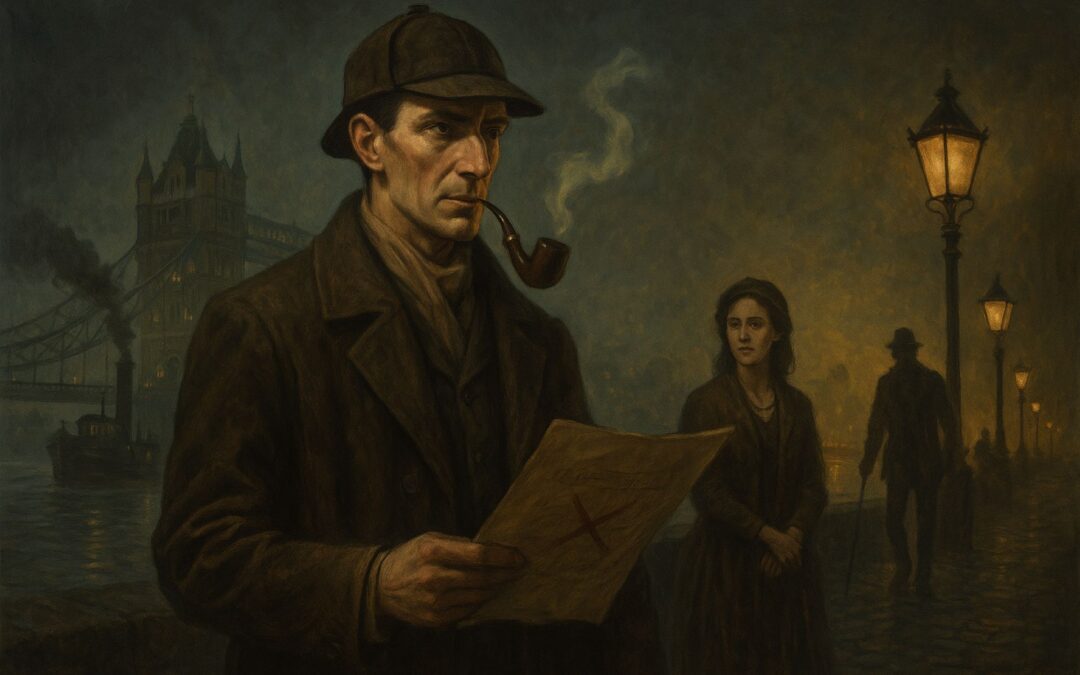
Few literary works capture the atmosphere of Victorian London—the fog, the intrigue, the interplay of wealth and ruin—quite like The Sign of the Four. Published in 1890, it cemented Sherlock Holmes as more than a clever detective; it made him a cultural phenomenon. The novel intertwines mystery with romance, imperial history with moral corruption, and dazzling deductions with moments of deep human frailty.
It is a story not merely of stolen treasure but of obsession, betrayal, and the strange ways fate binds people together. From the shadowed streets of London to the turbulent waters of the Thames, Conan Doyle crafts a tale that shows both the brilliance of Holmes and the vulnerabilities of those around him. At its heart lies a question larger than the mystery itself: what is true wealth, and what price are we willing to pay to possess it?

The Case Begins at Baker Street
London, with its damp fog and restless energy, sets the backdrop for the story’s first moments inside 221B Baker Street. Sherlock Holmes sits in his armchair, listless and unsatisfied, the violin silent at his side. His mind, deprived of complexity, turns toward the syringe—his habitual solution when the world offers no intellectual challenge. He prepares a dose of cocaine with clinical detachment, a ritual that has long disturbed Dr. Watson. Watson, ever the physician and moral counterweight, reproaches Holmes for his dangerous indulgence, reminding him that brilliance cannot excuse self-destruction. Holmes, however, brushes aside the concern. For him, the chemical haze is not vice but temporary reprieve from crushing monotony.
It is in this atmosphere of tension that the doorbell announces Miss Mary Morstan. She enters, composed yet anxious, carrying with her the air of someone bearing secrets long unshared. Her story unfurls slowly but with urgency: her father, Captain Morstan of the British Army, returned from India ten years prior, promising to meet her in London. She waited, but he never arrived. No trace, no farewell, no explanation. For years, this absence gnawed at her quietly until something peculiar began—each year, on the same date, an anonymous sender dispatched a single luminous pearl. No message, no signature, only the gem. Recently, however, the routine shifted. Alongside the pearl came a note summoning her to the Lyceum Theatre that very evening, hinting at revelations.
Holmes listens with rapt intensity, his gray eyes alight at the scent of intrigue. Here, at last, is the puzzle he craves. Watson, in contrast, notices more than the facts. He observes Mary herself—the steadiness in her voice, the quiet dignity with which she recounts her plight, the undercurrent of sadness she carries. Already, a current of admiration pulls him toward her, though he suppresses it beneath the physician’s calm exterior. For Holmes, it is a case; for Watson, it is the beginning of something more. Together, they resolve to accompany Mary to the Lyceum, a decision that will propel them into a labyrinth of treasure, betrayal, and murder.
The Sign of the Four Revealed
As the carriage rattles through London’s crowded streets, Mary produces an artifact that deepens the mystery: a piece of paper, yellowed with age, discovered among her father’s effects. Upon it lies a crude map with a red cross inked boldly at the center. Beneath it, four names are scrawled—Jonathan Small, Muhammad Singh, Abdullah Khan, and Dost Akbar. Beside these names is the phrase The Sign of the Four, enigmatic yet foreboding. Holmes examines it under the dim carriage lamp, his mind parsing symbols, his lips tightening in anticipation. This is no ordinary inheritance or accident of fate—this is conspiracy.
Their journey ends not at the bustling theater doors but in a sudden diversion. A cab whisks them away into quieter quarters until they arrive at the home of Thaddeus Sholto, the son of Major Sholto, a retired officer and former confidant of Captain Morstan. Thaddeus is an odd figure—nervous, almost jittering, with a strange obsession for cleanliness and an unrelenting stream of explanations. His eccentricity might have unnerved another listener, but Holmes absorbs every word, sorting truth from embellishment.
Thaddeus recounts the tale that has long haunted his family. Years earlier, Major Sholto and Captain Morstan had quarreled bitterly over the possession of an Indian treasure—jewels and ornaments of staggering value, collectively known as the Agra wealth. The argument ended suddenly when Captain Morstan, overcome with agitation, collapsed from a heart attack. Major Sholto, panicked, concealed both the death and the treasure’s location, fearful of scandal and retribution. Yet guilt gnawed at him, and on his deathbed he confessed his deception to his sons, instructing them to make restitution by granting Mary Morstan her rightful share. To honor this promise, they began sending her the annual pearls as a gesture of goodwill.
But Thaddeus’s revelations extend further: his brother Bartholomew has recently discovered the long-hidden trove at their family estate, Pondicherry Lodge. The jewels are real, tangible, glittering in their concealment. Thaddeus, believing in fairness, insists that Miss Morstan must finally claim her portion. Holmes listens, his mind sharpening with the realization that this is no mere tale of inheritance—it is the prelude to treachery. Watson, though attentive, finds his gaze wandering again toward Mary, marveling at her composure under the weight of such revelations. The puzzle grows deeper, the danger nearer, and the stage is set for the grim events awaiting them at Pondicherry Lodge.
The Murder at Pondicherry Lodge
The journey to Pondicherry Lodge carries with it an atmosphere of foreboding. Nestled behind high walls and iron gates, the Sholto residence has the aura of a fortress, more prison than home. When Holmes, Watson, and Mary arrive, they are met not by the expected triumph of treasure but by unease. Mrs. Bernstone, the housekeeper, greets them in a state of agitation. Bartholomew Sholto, she explains, has locked himself in his attic laboratory since morning and refuses to answer her calls. His silence, in a house already steeped in secrets, feels ominous.
Holmes wastes no time. With Watson at his side, he inspects the attic door. Finding it bolted from within, he peers through the keyhole and glimpses what at first appears almost grotesque—Bartholomew’s face, fixed in a wide, unnatural grin, the expression of a man whose final moment was marked by shock and agony. They break down the door, only to discover his lifeless body sprawled across the room. The grin is explained by rigor mortis and the effects of poison. On the floor nearby lies a small blowpipe and a dart, its tip dipped in a substance known for its deadly speed.
Holmes’s gaze takes in every detail with cold precision. The chest that was supposed to contain the fabled Agra treasure sits conspicuously empty. A note lies upon the body, bearing the ominous inscription: The Sign of the Four. From the impressions left behind, Holmes deduces that two intruders were present—one a man with a wooden leg, the other a smaller accomplice whose prints are unlike those of any ordinary man. His suspicions crystallize around the name Jonathan Small, already known from the mysterious map Mary presented.
At this moment, Scotland Yard makes its entrance in the form of Inspector Athelney Jones, a man whose confidence far outpaces his competence. Jones is eager to assert control, throwing out questions and theories with little regard for evidence. He assumes authority over the scene, but Holmes is already ten steps ahead, noting clues the inspector barely notices. The tension is palpable: one man driven by method and genius, the other by bluster and bureaucracy. What to Jones seems an impenetrable mystery is, to Holmes, already a trail with clear direction.
The Pursuit Across London
Holmes wastes no time in converting his deductions into pursuit. He orders Watson to fetch Toby, a mongrel dog renowned for its extraordinary sense of smell. At the crime scene, Holmes discovers a vital clue: one of the culprits, the man with the wooden leg, has stepped into creosote, leaving behind a trail invisible to the eye but pungent to Toby’s nose. This single misstep becomes the thread by which Holmes intends to unravel the whole tapestry.
The chase takes them deep into the sprawling maze of London. Toby sniffs eagerly, leading Holmes and Watson across narrow streets, through bustling markets, and past taverns alive with noise. At one point, the trail comically ends at a public-house that stores barrels of creosote, confusing even the faithful hound. Holmes laughs at the irony, for even the keenest tracker can be led astray in the labyrinth of the city. Undeterred, they press on, the dog soon rediscovering the scent and pulling them back on course.
Realizing that the pursuit will stretch beyond simple footwork, Holmes calls upon his youthful allies, the Baker Street Irregulars. These ragged, streetwise boys, armed with little more than sharp eyes and nimble feet, scatter across the docks with instructions to watch for a steam launch named the Aurora. Holmes has learned that the fugitives have secured it from Mordecai Smith, a boat owner along the Thames. Days pass with no success, and impatience gnaws at Holmes. Though his faith in logic never falters, he loathes stagnation.
Determined to seize control, Holmes dons one of his many disguises, transforming himself into a weathered sailor with a convincing stoop and grizzled beard. In this guise, he prowls the riverfront, slipping into taverns and workshops, asking seemingly idle questions. His persistence pays off—he locates the Aurora, hidden in plain sight, prepared for flight.
Returning to Baker Street, Holmes reveals his discovery to a stunned Watson and a visibly chastened Inspector Jones. The detective’s eyes gleam with excitement. The chase has now become a hunt, and the city itself feels like a chessboard, each move bringing hunter and quarry closer to their inevitable confrontation.
Resolution and Aftermath
With Jonathan Small secured, the great drama begins to quiet, though its echoes reverberate through every character involved. Inspector Athelney Jones, never one to miss a chance to parade himself, declares the case a resounding success for Scotland Yard. Yet everyone present knows the truth—that without Holmes’s sharp eye and relentless pursuit, the mystery would have remained unsolved. Jones, humbled but not transformed, thanks Holmes with a mixture of sincerity and bluster, already imagining how he will spin the story to his advantage in the press.
For Holmes, the conclusion brings no triumphal satisfaction. He is a man of method, and once the puzzle is solved, its allure evaporates. The empty treasure chest is, for him, proof of the futility of human avarice. He remarks with his usual cold detachment that love, wealth, and passion all cloud the mind, standing in opposition to the clarity of reason. Watson, however, does not share this view. His attention turns wholly to Miss Mary Morstan, whose quiet grace has accompanied them through danger and disappointment alike. The emptiness of the chest, instead of despair, brings him relief: had Mary inherited great wealth, she might have become untouchable, beyond the reach of a modest army doctor. Instead, fate has leveled the ground between them.
It is in this moment, away from the noise of Scotland Yard and the shadows of crime, that Watson declares his love. Mary accepts, and in their shared embrace lies a resolution deeper than the solving of any mystery. The treasure, cursed in every hand that touched it, is gone; but in its absence, a bond more enduring is forged. While Watson steps forward into a new chapter of companionship and hope, Holmes withdraws. He cannot partake in their joy, for to him emotion is an encumbrance, a fog that obscures truth. As Watson basks in newfound happiness, Holmes returns to his familiar solitude, reaching once more for the vial and syringe that bring him, if not joy, then numbness. Thus, one life blossoms even as another retreats into shadow.
About the Author
The mind that created Holmes was itself a study in contrasts. Sir Arthur Conan Doyle, born in Edinburgh in 1859, was the son of Charles Doyle, an artist plagued by alcoholism and mental illness. Poverty shadowed the family, but Doyle’s determination, aided by the support of wealthier relatives, led him to a good education. He studied medicine at the University of Edinburgh, where he encountered Dr. Joseph Bell, a professor whose uncanny skill in observation and diagnosis became the model for Sherlock Holmes. Bell’s ability to draw sweeping conclusions from minute details left a permanent imprint on Doyle’s imagination.
Though he earned his degree and practiced medicine, Doyle found his true passion in storytelling. As a medical student, he had begun to craft tales of adventure and deduction, and by 1886, he had created Sherlock Holmes. The detective’s debut brought Doyle both fame and financial comfort, but also a peculiar imprisonment. Readers adored Holmes, yet Doyle longed to write in other genres—historical novels, war accounts, and spiritualist tracts. In 1893, weary of his creation, Doyle killed Holmes off at the Reichenbach Falls, only to face such public outrage that he was compelled to resurrect him years later in The Hound of the Baskervilles, the very story that would cement Holmes as a cultural legend.
Beyond literature, Doyle lived a life of restless energy. He wrote prolifically on politics, championed social causes, and served as a war correspondent. His writings on the Boer War earned him a knighthood from King Edward VII. He was also deeply invested in spiritualism, convinced that communication with the dead was possible—a belief that invited both fascination and ridicule. In his personal life, Doyle married twice and fathered five children, though none continued his line.
Today, Doyle’s name is often misremembered as “Conan Doyle,” though “Conan” was in fact his middle name. Regardless, his legacy is unmistakable. Through Sherlock Holmes, he gave the world a figure who embodies logic, observation, and the relentless pursuit of truth—a figure so vivid that, more than a century later, many still think of Holmes as though he were a man who truly walked the foggy streets of London. Doyle himself may have resented the shadow Holmes cast over his other works, but it is that very shadow that secured him a place in literary immortality.
Conclusion
The Sign of the Four endures because it is more than a detective story. It is a meditation on greed, loyalty, and love—forces that drive men to both greatness and ruin. Holmes, with his cold devotion to reason, solves the puzzle but remains detached, returning to the sterile solace of cocaine. Watson, by contrast, finds his treasure not in jewels but in Mary Morstan’s affection, proving that happiness lies beyond material gain.
And Jonathan Small, the man who once held fortune in his hands, discovers too late that riches bring only chains. Doyle leaves readers with a haunting paradox: the jewels vanish into the Thames, but the ripples of their absence shape every life they touched. In the end, it is not the treasure that lingers in memory, but the revelation that some mysteries illuminate more about the human heart than they do about stolen wealth.