
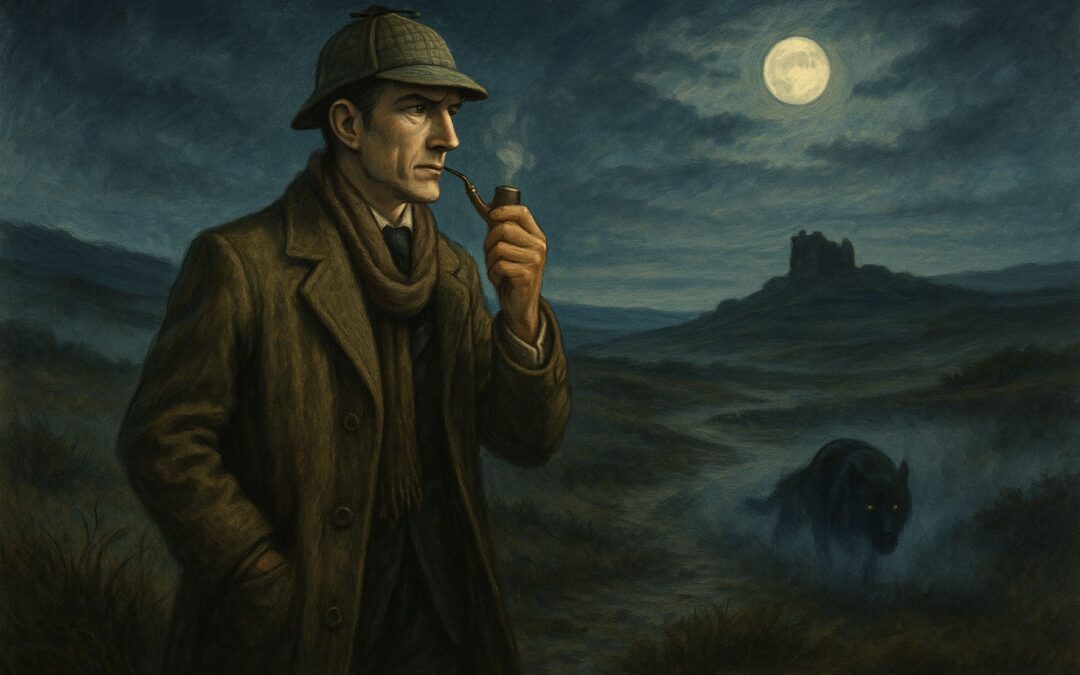
Few detective stories have gripped readers as fiercely as The Hound of the Baskervilles. Sir Arthur Conan Doyle masterfully blends Gothic atmosphere, family legend, and the unerring logic of Sherlock Holmes into a tale that straddles the line between superstition and science. Set against the haunting backdrop of the Devonshire moors, the novel invites us into a world where folklore bleeds into reality, and reason must wrestle with terror. What begins with a forgotten walking stick soon unravels into a centuries-old curse, a monstrous hound, and a plot driven by greed disguised as destiny. More than a mystery, it is a study of fear itself—how myths can enslave the mind, and how clarity of thought can shatter even the darkest illusion.

A Curious Walking Stick
The opening scene places us inside the familiar sitting room of 221B Baker Street, where Holmes’s razor-sharp mind is once again set loose upon an everyday object that transforms into a riddle. A stout, well-used walking stick lies forgotten by a visitor the night before. Its surface is scarred by years of handling, the brass ferrule at its tip dented and worn from countless steps. The inscription engraved on a silver band reads: “To James Mortimer, M.R.C.S., from his friends of the C.C.H.”
To Watson, the stick conjures a dignified image: an elderly country doctor, beloved by his patients, whose cane testifies to long service and countless house calls across muddy lanes. Watson’s reasoning feels plausible—solid, even comforting. Yet Holmes dismantles it with almost playful precision. He reconstructs Dr. James Mortimer not as a venerable elder, but as a young man, unburdened by ambition, who has recently abandoned the bustling world of London medicine for quieter country life. The dog, inferred from the teeth marks near the handle, is larger than a spaniel but smaller than a mastiff—a telling detail Holmes adds almost as an afterthought.
This simple exercise in deduction is not merely intellectual sport. It reminds us, as it reminded Watson, that Holmes’s brilliance lies not in leaps of imagination but in ruthless attention to detail, in peeling back appearances to expose a deeper truth. And soon enough, the truth behind Mortimer’s forgotten cane comes knocking at Baker Street, carrying with it a story woven with folklore, greed, and fear.
The Baskerville Curse
Dr. Mortimer does not arrive merely to reclaim his walking stick. He comes bearing an old manuscript and an even older terror. The document, penned in 1742, recounts the infamous deeds of Hugo Baskerville, whose cruelty and debauchery have become legend. Hugo, consumed by lust for a local farmer’s daughter, imprisoned her within Baskerville Hall. The girl escaped across the moor, but Hugo, frenzied and vowing his soul to the devil, unleashed hounds and horsemen in pursuit.
The chase ended in a nightmare tableau. The young woman lay dead from exhaustion and fear, but Hugo’s fate was even more gruesome—his throat torn open by a hound “larger than any mortal beast,” its eyes glowing with a hellish light. From that moment, the legend of the Hound of the Baskervilles took root in Devonshire soil. Generations whispered that the spectral beast stalked the family’s heirs, hunting them if they dared cross the moors at night.
For Mortimer, the legend is no longer confined to dusty parchment. Sir Charles Baskerville, the latest master of the estate, was found dead near the yew alley of his grounds. Though physicians ruled it a heart attack, Mortimer reveals the detail he concealed from the coroner: enormous paw prints pressed into the earth nearby. To him, the resemblance between the ancient curse and Sir Charles’s death is chilling.
The dilemma grows sharper with the arrival of Sir Henry Baskerville, the last of the line, summoned from America to inherit the hall and its vast fortune. Mortimer fears that the young heir is destined to meet the same fate if he dares to live on the ancestral land. Though trained in science, Mortimer is not immune to dread. He brings the case to Holmes, hoping the great detective might pierce the veil between legend and reality before another Baskerville falls.
Strange Omens in London
Before Sir Henry even sets foot in Baskerville Hall, shadows begin to cluster around him in London. On the very morning of his arrival, a letter arrives at his hotel. Its message is crude yet chilling: a warning to “keep away from the moor if you value your life.” The letter is a patchwork of words clipped from a newspaper, with only a few written by hand to complete the message. To an ordinary man, it might look like a prank; to Holmes, it is an ominous sign. He notes the precision with which the writer disguised their handwriting, the choice of the Times as the source for the clippings, and even the likelihood that the note was written with a hotel pen. These small details hint at sophistication, planning, and above all, fear of detection.
No less disturbing are the peculiar thefts that plague Sir Henry’s luggage. First, one of his new boots disappears, only to be followed days later by an older one. The incidents appear trivial, even laughable, yet Holmes insists that such oddities rarely occur by accident. A pattern, he suggests, lies beneath them—a pattern tied to Sir Henry himself.
Adding to the unease, Sir Henry is trailed through the streets by a mysterious figure with a black beard. Holmes and Watson pursue this lead, discovering that the man hired a cab under the name “Sherlock Holmes.” It is a brazen taunt, meant to obscure his real identity and mock the detective’s pursuit. Though the trail runs cold, Holmes recognizes that the enemy they face is clever, calculating, and willing to strike even in the heart of London.
These omens—the warning letter, the stolen boots, the unseen pursuer—form a sinister overture to the case. They suggest not a random string of events but a deliberate plot. Holmes, sensing the moor’s danger, resolves to send Watson with Sir Henry to Devon. The detective himself remains in London, or so it seems, plotting in secret and allowing the unseen hand behind these warnings to reveal itself further.
Arrival at Baskerville Hall
When Sir Henry and Watson finally travel to Devonshire, the contrast with London could not be sharper. The moorland stretches wide and desolate, a landscape of bogs, tors, and swirling mists that seem to conceal both ancient secrets and present threats. Soldiers patrol the roads with rifles, warning of Selden, a brutal convict who has escaped from nearby Dartmoor Prison and now hides somewhere amidst the treacherous terrain. Even before setting eyes on the hall itself, danger feels omnipresent.
Baskerville Hall rises against this bleak backdrop as a monument to both grandeur and decay. Its Gothic silhouette, heavy with age, carries the weight of the family curse like a physical burden. Inside, high-ceilinged chambers echo with silence, portraits of grim ancestors stare from shadowed walls, and the atmosphere is thick with melancholy. Watson describes it as more sepulchre than home.
The caretakers, Mr. and Mrs. Barrymore, meet them with dutiful politeness, yet an air of secrecy lingers. Their answers to simple questions seem guarded, their eyes evasive. That very night, Watson hears the unmistakable sound of a woman sobbing somewhere within the house, though Barrymore denies it in the morning with stiff formality. Mrs. Barrymore’s swollen eyes, however, betray the truth.
Beyond the walls, the moor itself seems alive with menace. Its vast emptiness becomes a stage for whispered legends and unseen watchers. Sir Henry, though determined to claim his inheritance, finds himself unnerved by its bleak isolation. Watson, loyal as ever, steels himself for the task ahead. The case has left behind the orderly streets of London and entered a world where superstition, fear, and human cunning blur into one. Here, in this desolate setting, the curse of the Baskervilles feels less like a folktale and more like a living presence waiting to strike.
Allies and Intrigue
As Watson acclimates to life on the moor, new faces emerge—each adding both companionship and suspicion. Chief among them is Jack Stapleton, a schoolmaster turned naturalist whose knowledge of plants, insects, and marshes is matched only by his intensity. Outwardly genial, Stapleton reveals a peculiar obsession with the moor, guiding Watson across its treacherous landscape with the pride of a man who feels master of it. His so-called sister, Beryl, stands in sharp contrast: elegant, uneasy, her beauty shadowed by fear. In a rare moment alone, she urgently warns Watson to leave Devon, her terror breaking through the façade of civility. Later, she retracts her words under Stapleton’s stern gaze, leaving Watson with the uncomfortable sense that she is both prisoner and accomplice.
The romantic attention Sir Henry lavishes on Beryl further complicates matters. What begins as a gallant admiration stirs Stapleton to flashes of jealous rage, revealing cracks in his carefully controlled persona. Watson, ever watchful, notes how quickly Stapleton shifts from fury to forced acceptance when pressed, as though playing a role rather than expressing true feeling. Meanwhile, another figure steps into the circle: Laura Lyons, the estranged daughter of a local man, socially disgraced yet aided financially by Sir Charles Baskerville. Questioned about her connection to the night of Sir Charles’s death, she admits she had arranged a meeting with him to request money for a divorce, but insists she never attended. Her evasiveness about who persuaded her to write the letter only deepens the mystery. With every new acquaintance, Watson senses a tightening web in which Sir Henry is the prey.
The Barrymores’ Secret
The servants of Baskerville Hall, Mr. and Mrs. Barrymore, seem cloaked in shadows from the moment Watson and Sir Henry arrive. Their behavior is deferential, yet beneath the surface lies tension, whispered arguments, and veiled emotions. The mystery of the nocturnal sobbing intensifies suspicion. One night, Watson and Sir Henry catch Barrymore signaling from an upper window with a lantern. When confronted, he refuses explanation, his silence heightening the impression of conspiracy.
It is Mrs. Barrymore, pale and anguished, who finally breaks. She confesses that her brother, Selden—the escaped convict hunted across the moor—has been their secret. The signals were meant to guide him to food and clothing left by the loyal couple. Among the garments given were some of Sir Henry’s cast-off clothes, an act of kindness that would later prove deadly. Though the revelation clears the Barrymores of darker suspicions, it thrusts Selden directly into the orbit of the Baskerville curse.
Attempting to capture Selden, Watson and Sir Henry pursue him under moonlight across the vast expanse of the moor. The chase fails; Selden vanishes into the mist, agile and desperate. Yet Watson glimpses something far more haunting—a solitary stranger watching from a ridge, tall and solitary, a silhouette that does not match any of the neighbors he has met. The figure lingers like a phantom, reminding Watson that a larger design is unfolding beyond the Barrymores’ desperate loyalties. The revelation of their secret shifts the focus: the servants are not masterminds of evil, but tragic players in a broader, more sinister scheme.
Holmes in Hiding
The shadowy figure Watson glimpsed on the moor turns out not to be a stranger at all but Sherlock Holmes himself, concealed in one of the ancient stone huts scattered across the landscape. For days, perhaps weeks, he has been there in secrecy, living rough in the wilderness while Watson believed him to be in London. Holmes explains that he chose concealment to gain an unobstructed vantage point, free from the assumptions and politeness that cloud the testimony of locals. From this lonely outpost, he has watched patterns unfold, footsteps traced, and meetings contrived under the veil of night.
Watson’s initial shock quickly transforms into admiration, though not without a sting of wounded pride at having been kept in the dark. Holmes softens this by praising Watson’s reports and keen observations, remarking that his friend’s documentation of daily events at Baskerville Hall has been invaluable in piecing together the truth. Yet Holmes’s own findings go even further. He has uncovered the most devastating revelation of all: Jack Stapleton and Beryl are not siblings but husband and wife. The deception casts every interaction in a new light—Beryl’s fearful warnings, her evident distress, and Jack’s possessive anger.
Holmes connects the dots with ruthless clarity. Stapleton, a man with impeccable knowledge of the moor and its dangers, has manipulated both Laura Lyons and Beryl to further his schemes. He cultivated Laura’s trust, persuading her to lure Sir Charles into the yew alley under the pretense of helping her, all the while planning his death. Holmes’s theory is chilling in its simplicity: Stapleton is a hidden branch of the Baskerville family, motivated by greed, determined to inherit the estate and its fortune by eliminating Sir Henry. His weapon is no phantom, but flesh and blood—a monstrous hound conditioned to terrorize and kill, its jaws smeared with phosphorus to give the appearance of otherworldly fire. What had seemed legend is unmasked as diabolical ingenuity, the curse repurposed into a calculated tool of murder.
Death on the Moor
The sinister machinery of Stapleton’s plan first claims an unintended victim. Selden, the escaped convict, meets his end in place of Sir Henry. The irony is grim: clothed in garments given to him by the Barrymores, including Sir Henry’s cast-off suit, Selden carries the scent that guides the hound. When Holmes and Watson find his lifeless body upon the moor, its twisted form and mauled throat confirm that the beast has struck again. For a dreadful moment, they believe Sir Henry himself has been killed, the heir extinguished in silence. Only upon closer inspection does the truth emerge: the victim is Selden, mistaken for the baronet by scent alone.
Stapleton arrives at the scene with an alacrity that betrays his guilt. His expression, for a fleeting instant, is one of triumph—swiftly replaced by a feigned sorrow when he realizes the wrong man has died. Holmes observes him closely, noting the crack in his composure, the premature satisfaction that has slipped past his mask. Though Stapleton continues to dissemble, his position grows precarious.
This misstep confirms Holmes’s deductions with brutal clarity. The hound is no supernatural apparition but a creature bred and brutalized for murder, unleashed with precision upon its targets. Yet the scheme has not ended. Stapleton’s sights remain fixed on Sir Henry, whose affection for Beryl offers a perfect lure. With Inspector Lestrade summoned from Scotland Yard, Holmes sets the stage for the final confrontation. Sir Henry is instructed to dine with Stapleton, then return home across the moor alone. He is to act as bait, walking deliberately into danger, while Holmes, Watson, and Lestrade prepare to end the reign of the phantom hound once and for all. The moor, ever a stage of terror, now awaits its final act.
The Hound Unleashed
The night of reckoning arrives with a sense of dreadful anticipation. Sir Henry, obedient to Holmes’s instructions though visibly unsettled, dines with Stapleton and then sets off across the moor. Above him the sky is heavy with fog, a suffocating blanket that creeps ever closer, threatening to smother all visibility. Holmes, Watson, and Inspector Lestrade conceal themselves along the path, their nerves stretched taut. Time drags like an eternity, every shifting shadow on the moor a potential omen.
Then it comes—the unearthly sound of padded feet pounding the earth, followed by the ghastly sight of a beast erupting from the mist. Massive in stature, its jaws froth, and its eyes appear aflame. To Watson, it seems as though the legends are true—that hell itself has disgorged its emissary. Sir Henry screams as the monster lunges, its phosphorescent mouth glowing with an infernal light. But Holmes, calm in crisis, raises his revolver and fires, the report shattering the night. The beast stumbles, rises again in fury, then collapses under a hail of bullets. Its dreadful illusion dies with it, leaving only a grotesque hound, its muzzle reeking of phosphorus, its body the tool of a man’s cunning cruelty.
The men rush to Stapleton’s house. Inside they find Beryl, bound and bruised, her spirit crushed by her husband’s tyranny. She reveals that she has long been coerced into his schemes, her earlier warnings to Watson proof of her desperate conscience. Freed at last, she tells of her husband’s violent temper and his insistence on using the family legend to secure fortune through murder. Holmes and Watson pursue Stapleton himself into the fog-drenched mire. There, in the labyrinth of treacherous bogs, his arrogance betrays him. He had always boasted of his knowledge of secret paths, but in his flight he misjudges. The swamp closes around him, devouring him whole. No body is recovered—only the certainty that nature, implacable and merciless, has claimed him as just punishment.
The lair of the beast is later uncovered: a hidden shed on the moor containing Sir Henry’s stolen boot, which Stapleton had used to train the hound to his victim’s scent. Here, too, the hound’s cruel treatment is evident—starvation, confinement, and terror twisted into obedience. What the villagers whispered as a phantom curse is revealed in its rawest form: human greed harnessing brutality, dressed in the trappings of myth.
The Aftermath
With the beast slain and Stapleton vanished into the mire, the moor finally exhales its long-held breath of menace. Sir Henry, though physically unharmed, is deeply shaken. The image of the glowing hound, its slavering jaws inches from his throat, haunts him in the days that follow. He withdraws from Baskerville Hall for a time, his nerves frayed, his body requiring rest and recuperation away from the place of his near-destruction.
Holmes, ever the meticulous mind, reconstructs the chain of events for Watson and Lestrade. The detective explains how Stapleton, a hidden descendant of the Baskerville line, carefully orchestrated each stage of his plan. He manipulated Laura Lyons with false promises of marriage to lure Sir Charles to the yew alley at night. He exploited Sir Henry’s affection for Beryl to set a similar trap. He trained the hound with Sir Henry’s stolen boots to ensure it would recognize the scent. And by painting its muzzle with phosphorus, he turned a trained predator into a devilish apparition capable of terrorizing even the strongest of men. Every step of the plot relied not on the supernatural but on psychology—fear, suggestion, and the weight of an old legend.
The truth dissolves the curse, yet the legacy of the Baskervilles is forever altered. The family, once plagued by whispers of damnation, is shown instead to have been the target of human malice masquerading as myth. For Sir Henry, the inheritance remains, but it comes with scars—an awareness of how close he came to becoming yet another victim of both legend and greed.
As for Holmes and Watson, the case stands among their most famous triumphs. It illustrates not only Holmes’s brilliance in deduction but also the perilous dance between superstition and reason, where folklore can be manipulated into a weapon sharper than steel. The moor falls silent, the hound lies dead, and the name of Stapleton fades into the mire. What endures is the lesson that even the most terrifying legends often have a very human hand behind them.
About the Author
Arthur Conan Doyle’s life mirrored the complexity of his characters—full of contradictions, ambitions, and reinventions. Born in Edinburgh in 1859 to a struggling family, Doyle’s early years were marred by hardship. His father battled alcoholism and mental illness, leaving the household in disarray. Yet his extended family, particularly his uncles, ensured he received a strong education, eventually leading him to study medicine at the University of Edinburgh. It was there, while attending lectures by the brilliant but eccentric Dr. Joseph Bell, that Doyle first encountered the deductive reasoning and forensic attention to detail that would inspire the creation of Sherlock Holmes.
Though trained as a doctor and earning his degree in 1881, Doyle’s medical practice never flourished as much as his imagination. He began writing stories during his medical studies, publishing his first works in modest journals. By 1886, he had fully conceived Sherlock Holmes, debuting him in A Study in Scarlet. The character’s instant popularity brought Doyle both wealth and a trap—Holmes’s fame overshadowed his other literary ambitions, such as historical novels and spiritualist treatises.
By the 1890s, Doyle had grown weary of Holmes, declaring the detective stifled his artistic growth. In 1893, he attempted to rid himself of the character by killing him off in “The Final Problem.” The public outcry was seismic; readers wore black armbands, newspapers protested, and Doyle faced relentless pressure to resurrect his creation. Reluctantly, he brought Holmes back in The Hound of the Baskervilles (1902), though cleverly framed the tale as a case set before Holmes’s supposed death, allowing him to test the waters before a full revival.
Doyle’s life outside literature was equally restless. He campaigned for social reforms, wrote extensively on war and imperial policy, and was knighted in 1902 by King Edward VII for his writings on the Boer War. Later in life, he became deeply invested in spiritualism, writing and lecturing passionately about the afterlife, much to the bewilderment of his more skeptical fans.
On a personal level, Doyle married twice and fathered five children, though none continued his line. He died in 1930, leaving behind not only the world’s most famous detective but also a literary legacy that transcends genre. Today, his name is almost inseparable from Holmes, yet his broader body of work—ranging from historical romances to essays on faith—reveals a man endlessly searching for meaning beyond the printed page.
Conclusion
The Hound of the Baskervilles remains the quintessential Sherlock Holmes story because it distills the essence of Conan Doyle’s genius: the clash between legend and logic, terror and truth. Through fog-shrouded moors, eerie cries in the night, and the looming shadow of a spectral beast, Doyle keeps the reader suspended between belief and skepticism until Holmes unveils the human hand behind the horror. The novel is not simply a tale of crime solved; it is a meditation on how fear magnifies myth, and how greed often masquerades as fate. More than a century later, the hound still prowls in our imagination—not as a phantom, but as a reminder that the most frightening monsters are those created by human ambition.