
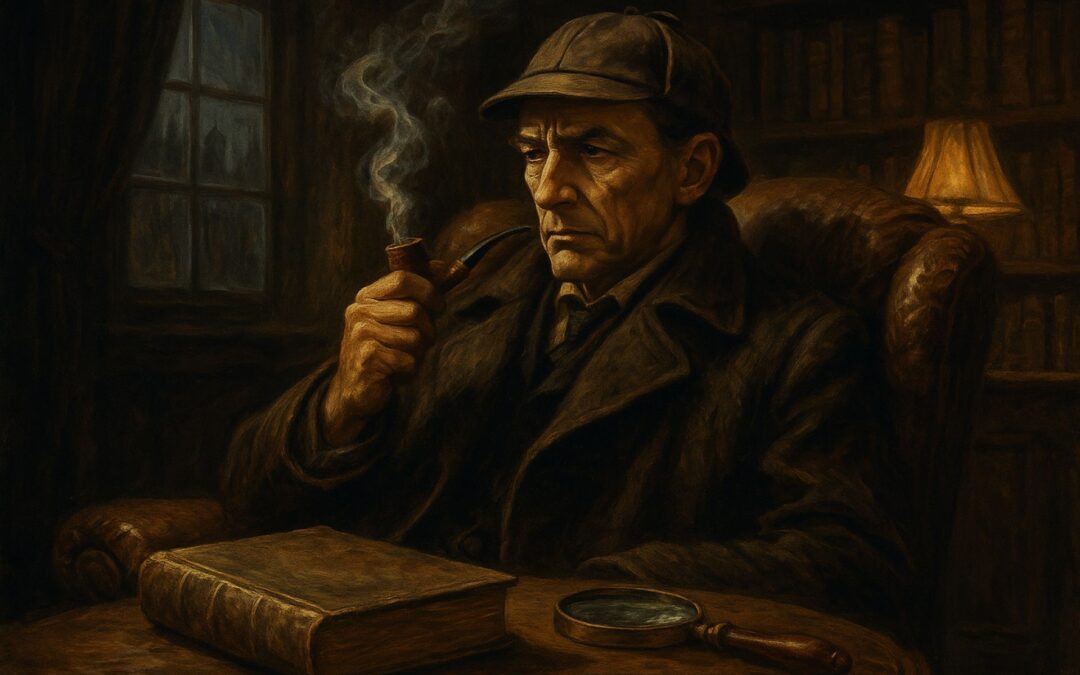
When The Case-Book of Sherlock Holmes appeared in 1927, it marked the final bow of Arthur Conan Doyle’s legendary detective. Unlike earlier collections filled with bustling London intrigues and glittering jewels, these twelve tales carry a darker, more contemplative tone. Holmes, older and more seasoned, navigates a world marked by jealousy, cruelty, obsession, and the limits of human ambition.
The cases often lack the triumphant neatness of his earlier adventures; instead, they reveal the tragic consequences of pride, secrecy, and folly. From aristocrats blinded by love to scientists undone by their own experiments, this final collection shows Holmes not only as a master of deduction but also as a witness to the fragility of human character.

The Adventure of the Illustrious Client
The case begins with Holmes recovering from an illness at 221B Baker Street when Sir James Damery, an intermediary for an unnamed but powerful “illustrious client,” arrives with an urgent matter. The client, a high-ranking aristocrat, seeks Holmes’s discreet intervention to prevent the marriage of Violet de Merville, a young heiress of impeccable reputation, to Baron Adelbert Gruner.
Gruner is a cultured and magnetic Austrian nobleman, outwardly charming but inwardly corrupt. His reputation in Europe is sinister: he has seduced, ruined, and discarded women without remorse. Rumors abound of cruelty, blackmail, and even mysterious deaths in his wake. Yet Violet, blinded by infatuation, defends him passionately and refuses to listen to reason.
Holmes recognizes that only concrete proof will break Gruner’s spell. He learns that the Baron keeps a secret book, a private catalogue of his female conquests, filled with intimate details of their seduction and downfall. If this volume could be obtained and shown to Violet, it would destroy her illusions. But acquiring such a dangerous document is no simple task, for Gruner is not only cunning but also surrounded by loyal servants and underworld allies.
During his inquiries, Holmes is attacked by two thugs outside his lodgings — a clear warning that Gruner is aware of his interference. Holmes narrowly avoids serious injury, thanks to his alertness and cane. The attempt only strengthens his resolve.
The breakthrough comes when Holmes approaches Kitty Winter, a fiery and broken woman who had once been deceived and abandoned by Gruner. Burned by his cruelty and filled with hatred, Kitty agrees to aid Holmes in exposing the Baron. Her testimony alone would not sway Violet, but Kitty knows of the incriminating diary. Holmes devises a plan to infiltrate Gruner’s home under the guise of a collector of Chinese porcelain, exploiting the Baron’s well-known passion for the subject.
The scheme succeeds: Holmes distracts Gruner with talk of ceramics while Kitty seizes the diary. When the Baron realizes the ruse, Kitty takes her revenge. In a fit of righteous fury, she hurls vitriol into his face, blinding and disfiguring him permanently.
With the diary secured, Holmes presents it to Violet de Merville. The grotesque details of Gruner’s past, corroborated by his downfall, shatter her illusions. The marriage is prevented, the client’s honor preserved, and another woman is saved from ruin — though the case ends not with triumph but with a bitter aftertaste.
For Holmes, this adventure highlights the darker side of human passion, where intellect and justice must contend not only with crime, but also with obsession, cruelty, and revenge.
The Adventure of the Blanched Soldier
This tale is distinctive within the Holmes canon because it is narrated not by Dr. Watson but by Holmes himself. Watson is absent, engaged in married life, and Holmes takes up the pen to describe the case as he saw it. The tone is crisp, direct, and less sentimental than Watson’s, offering readers a rare glimpse into Holmes’s own storytelling style.
The story begins when James M. Dodd, a former officer in the Boer War, calls upon Holmes. Dodd is deeply concerned about the fate of his comrade, Godfrey Emsworth. After the war, Godfrey returned to his family estate at Tuxbury Old Park, but since then, all contact has mysteriously ceased. Dodd wrote letters and even visited, only to be met with evasive answers from Colonel Emsworth, Godfrey’s stern father, who insists his son is abroad. Suspicion gnaws at Dodd, for Godfrey was his close companion in battle, and the silence seems unnatural.
Holmes, intrigued, agrees to investigate. Upon arriving at the estate, they encounter hostility from Colonel Emsworth, a man of rigid pride and cold authority. He rebuffs Dodd’s inquiries and tries to dismiss Holmes, but Holmes is not easily deterred. A critical moment occurs when Holmes glimpses a pale, ghostly face at an upstairs window — unmistakably Godfrey. The “blanched soldier” appears gaunt and sickly, confirming that he is being hidden within the house.
Holmes pieces together the puzzle: the Emsworth family fears that Godfrey has contracted leprosy during his service abroad. In Victorian society, leprosy carried immense social stigma — more dreaded than many fatal diseases, not only for its disfigurement but also for the isolation it demanded. Colonel Emsworth, terrified of scandal, has confined his son in secrecy, attended only by a sympathetic family friend, Mr. Kent, who acts as physician and guardian.
Holmes, however, is not satisfied with assumptions. He arranges to meet Godfrey, and the young man confirms the cruel truth: he has been forced into near-solitary confinement, treated as if already lost to the world, despite his protestations of relative health. Holmes arranges for medical experts to examine him, and the final revelation brings relief. Godfrey is not suffering from leprosy at all but from a less severe and non-contagious skin condition, lupus vulgaris. The family’s fears were misplaced, and Godfrey is freed from his living tomb.
Holmes reflects on the needless suffering caused by secrecy, shame, and ignorance. The case demonstrates not only his skill in deduction but also his humanity, for he recognizes the anguish of a soldier unjustly condemned to exile. Unlike cases of jewels, murders, or espionage, this story is one of misplaced fear and the restoration of dignity to a wronged man.
The Adventure of the Mazarin Stone
This story stands apart in style from most of the Holmes canon. It is told in the third person rather than through Watson’s or Holmes’s own voice, because Conan Doyle adapted it directly from his stage play The Crown Diamond. The narrative is theatrical, confined largely to the sitting room of 221B Baker Street, and plays out almost like a drama performed before an audience.
The case revolves around the theft of the Mazarin Stone, a priceless yellow diamond belonging to the Crown. The government is desperate to retrieve it quietly, without scandal. Suspicion falls on Count Negretto Sylvius, a suave but ruthless criminal with a taste for danger and a record of evading justice. Holmes has already deduced Sylvius’s involvement and prepares an elaborate trap to recover the gem.
When the story opens, Holmes seems to be resting in his armchair, reading quietly, while Watson comes and goes. But what appears to be Holmes seated in thought is, in fact, a carefully crafted wax effigy of the detective. The real Holmes is concealed behind a screen in the room, able to observe and overhear everything. This clever decoy serves as both protection — for Sylvius is known to be violent — and bait to lure the criminal into carelessness.
Sylvius arrives at Baker Street accompanied by his brutish accomplice, Sam Merton, a former prizefighter turned thug. They believe they are confronting Holmes in person. Confident and mocking, Sylvius attempts to gauge how much Holmes knows. As the conversation progresses, Holmes’s mastery becomes apparent: he already possesses incriminating knowledge, and his calmness unsettles the criminals. Sylvius unwittingly reveals enough about the gem’s location that Holmes’s hidden trap can be sprung.
At the decisive moment, Holmes reveals himself, stepping out from behind the screen. Scotland Yard officers, whom Holmes had stationed nearby, enter to arrest the pair. The Mazarin Stone is secured, and the Crown is spared embarrassment.
The story’s atmosphere differs from the usual bustle of Holmes’s investigations. Instead of running through foggy London streets, examining clues, or interrogating witnesses, the drama unfolds in a single static set-piece — Holmes’s own chambers. The tension comes not from physical action but from psychological play, theatrical staging, and Holmes’s brilliant use of deception.
Critics have sometimes judged the story weaker than others because of its origin as a play, but it nonetheless shows Holmes as a master of stagecraft, intellect, and timing. His ability to anticipate danger and manipulate appearances allows him to triumph without ever leaving his room. It also underscores one of Doyle’s recurring themes: that intellect, patience, and psychological mastery can be more powerful than brute strength or reckless daring.
The Adventure of the Three Gables
The story begins when Holmes and Watson are visited by Steve Dixie, a hulking ex-prizefighter. Dixie attempts to intimidate Holmes, warning him to stay away from a case involving a house called The Three Gables. But Holmes, unimpressed, quickly deduces Dixie’s background — his profession, his associations, and even the fact that he has been sent by others rather than acting on his own. Shamed and astonished, Dixie retreats, and Holmes turns his attention to the real matter at hand.
Shortly thereafter, Mrs. Maberley, a respectable widow, consults Holmes. She tells him she has recently been approached by agents who offered to buy her house, The Three Gables, at an exorbitant price, insisting that every item within must be included in the sale. When she refused, she was harassed and threatened. Mrs. Maberley’s concern is heightened because she has only recently moved in, and the unusual offer suggests hidden motives.
Holmes investigates and discovers the source of the intrigue: Mrs. Maberley’s late son, Douglas, had a scandalous affair with a married woman. After the relationship ended, he wrote a novel based on their liaison. The woman’s vengeful husband and his associates seek to suppress the manuscript at all costs, fearing public disgrace. The plot to buy the house is merely a cover to seize and destroy the work.
Holmes retrieves the manuscript, confirming that the entire affair is driven by jealousy and reputation rather than crime of profit. While he sympathizes with Mrs. Maberley’s distress, he also acknowledges the bitterness of the situation — her son’s work, his one true achievement, will never be seen by the public. In the end, the villains are thwarted, but the resolution carries melancholy rather than triumph.
This case illustrates Holmes’s breadth of work: not every client comes with a murder or jewel theft. Sometimes the crimes involve reputation, secrecy, and the destructive power of resentment. It also shows Conan Doyle weaving social commentary into detective fiction, portraying the ruthless lengths to which people will go to guard appearances.
The Adventure of the Sussex Vampire
Holmes receives a peculiar letter from Robert Ferguson, a wealthy man who writes with a tone of both desperation and embarrassment. The letter hints at a situation so bizarre that Ferguson scarcely dares describe it directly: he suspects that his young Peruvian wife is a vampire who has attacked their infant son. The case is made stranger by Ferguson’s past — he has a teenage son from a previous marriage, Jack, who is crippled and withdrawn, and a new infant son with his second wife.
Holmes, ever skeptical of the supernatural, takes the case not because he believes in vampirism but precisely because he does not. “We are bound to exhaust the natural explanations before falling back upon the supernatural,” he remarks. He and Watson travel to Sussex, where they find the Ferguson household heavy with tension and suspicion.
Ferguson recounts two disturbing incidents: once, his wife was discovered with blood on her lips, standing over the baby’s cradle; another time, a nurse caught her in the act of drawing blood from the child’s neck. Convinced she is harming the infant, Ferguson has grown cold toward her, while she remains silent and aloof, refusing to defend herself.
Holmes observes the dynamics carefully. He notes that the wife shows tenderness toward the baby, but she is also fearful and restrained in her behavior. Holmes also studies Jack, the elder son, who resents the attention showered on the baby and whose jealousy is palpable.
The truth emerges with Holmes’s characteristic clarity: it is not the mother but Jack who has attempted to harm the child, driven by bitterness and a sense of exclusion. The mother, discovering Jack’s attempts, acted not with cruelty but with protection — she had been sucking poison from the wounds left by Jack’s bites in a desperate effort to save the baby, concealing the truth to protect Ferguson’s relationship with his son.
Holmes exposes the situation gently but firmly. Ferguson realizes his terrible mistake and reconciles with his wife. Jack’s act, though grave, is treated with compassion, as Holmes suggests it stems from his physical disability and emotional turmoil rather than malice.
This story exemplifies Conan Doyle’s talent for using sensational premises — in this case, vampirism — only to resolve them with rational explanations rooted in psychology and family tension. It is less about crime and more about misunderstanding, jealousy, and the fragility of domestic harmony.
The Adventure of the Three Garridebs
The case opens with the visit of John Garrideb, an American adventurer who spins an extraordinary tale for Holmes and Watson. He explains that a wealthy eccentric named Alexander Garrideb has left a vast fortune to anyone who can prove the existence of three men bearing the surname “Garrideb.” John claims to be one, and he has found a second — Nathan Garrideb, a lonely collector living in London. All they need now is a third to secure the inheritance.
Nathan, an odd yet harmless man obsessed with curios and antiquities, has been lured by the prospect of riches and is eager to cooperate. John encourages Nathan to leave his home for a supposed search of this mythical third Garrideb, insisting that they must travel together. But Holmes, skeptical of the tale, begins to see through the deception.
Holmes quickly notices inconsistencies in John’s story, his over-eagerness, and his failure to provide verifiable details about the supposed will. Further inquiries reveal John’s true identity: he is none other than “Killer” Evans, a notorious American criminal wanted for murder and fraud. His scheme is simple but cunning: Nathan’s house, cluttered with antiques, sits atop a hidden strongroom that once belonged to a counterfeiter. Evans’s real aim is to get Nathan out of the way long enough to break into the vault and retrieve concealed printing plates for counterfeit currency.
Holmes devises a plan to expose Evans. He and Watson remain in Nathan’s house when Evans makes his move. As Evans attempts to force entry into the strongroom, Holmes confronts him. A struggle ensues, during which Watson is grazed by a bullet. Holmes, visibly shaken, shows uncharacteristic emotion. He grips Evans by the throat and declares with cold fury that had Watson been seriously harmed, Evans would not have left the room alive.
This poignant moment highlights the depth of Holmes’s affection for Watson, a rare crack in his usual facade of logic and detachment. For Nathan Garrideb, however, the aftermath is bitter. The dream of fortune evaporates, leaving him crushed and broken, wandering aimlessly among his curiosities.
The story is remembered not only for its clever unraveling of a fraud but also for that single, moving glimpse into the bond between Holmes and Watson — one of the most human and heartfelt moments in the entire canon.
The Problem of Thor Bridge
The story begins when Neil Gibson, a wealthy and domineering American often referred to as the “Gold King,” seeks Holmes’s help. Gibson’s wife, Maria, has been found shot dead near Thor Bridge, a stone structure spanning the lake on his English estate. Suspicion has fallen on Grace Dunbar, the governess of Gibson’s children, with whom he is deeply infatuated. Dunbar had quarreled with Maria and was the last person seen with her. The police are convinced of her guilt, and Gibson, while admitting his attraction to Dunbar, insists she is innocent.
Holmes and Watson travel to the estate. They find Grace Dunbar to be intelligent, calm, and noble, even in the face of scandal. She maintains her innocence with quiet dignity, which only strengthens Holmes’s resolve to clear her name.
The physical evidence seems damning. The revolver from which the fatal shot was fired belongs to Neil Gibson. It was discovered near the body, lying on the ground. A letter from Grace, requesting that Maria meet her at Thor Bridge, is also found in Maria’s possession, pointing to a confrontation.
Holmes, however, notices subtleties that others miss. The most puzzling clue is the revolver itself. It shows no trace of having been dropped, nor is it positioned naturally — it seems placed rather than discarded. More importantly, Holmes notes a chip on the stonework of the bridge’s parapet near where Maria fell.
Through careful reconstruction, Holmes demonstrates that Maria Gibson orchestrated her own death as an act of jealous revenge. Consumed by resentment toward Grace, Maria sought to frame her rival for murder. She tied the revolver to a heavy stone using string, placed it against her temple, and pulled the trigger. The recoil snapped the string, causing the revolver to be flung into the water. But by chance, the gun struck the bridge’s stonework, breaking free of the string and landing beside her body — the very inconsistency that drew Holmes’s attention.
Holmes explains the method to the astonished police and secures Grace Dunbar’s freedom. Neil Gibson, though cleared of complicity, is left humbled by his own destructive passions. The case is closed not with the capture of a criminal but with the revelation of tragic self-destruction and the cruelty of jealousy.
“The Problem of Thor Bridge” is one of Conan Doyle’s most ingenious “locked-room” style puzzles, its solution hinging on physics, observation, and Holmes’s refusal to accept surface appearances. It also highlights Doyle’s recurring theme: that love, jealousy, and pride can drive people to acts as calculated as any criminal’s scheme.
The Adventure of the Creeping Man
The story begins when Holmes is consulted by Trevor Bennett, the devoted secretary of Professor Presbury, an elderly but respected academic at Cambridge. Presbury, though advanced in years, has recently become engaged to a much younger woman, a match that has raised eyebrows. Since returning from a mysterious trip abroad, however, his behavior has grown increasingly bizarre and alarming.
Bennett reports that Presbury receives secretive letters from a man in Prague, keeps a locked box hidden from everyone, and exhibits strange nocturnal wanderings. More disturbing still, the professor has developed grotesque, animal-like habits: crouching, bounding on all fours, and once even attempting to scale the wall outside his home like a monkey. His faithful dog, once devoted, now growls and snaps at him with inexplicable hostility.
Holmes and Watson travel to Cambridge to investigate. They find Bennett deeply worried, and the professor’s household on edge. Holmes carefully studies the dog’s reaction to Presbury, interpreting it as an instinctive response to something unnatural in the man’s scent or movements. The pieces begin to fit together: the locked box, the foreign correspondence, and the disturbing change in behavior.
Late one night, the truth emerges. The professor, under the influence of a secret experimental serum, is observed creeping around the garden on all fours, moving with the uncanny agility of an ape. Holmes and Watson, hidden nearby, witness the horrifying spectacle as Presbury claws and scrambles at the walls in a fevered attempt to climb, his humanity almost obliterated by the transformation.
Holmes later explains his deductions. Presbury, terrified of losing the vitality needed to marry a much younger woman, had sought out a foreign quack who supplied him with an “elixir of youth” derived from monkeys. The injections had indeed granted bursts of strength and agility, but at a terrible price: the professor’s body and mind had begun to mimic simian behavior. The hostility of the dog was thus perfectly rational — animals instinctively sensed the corruption in his altered nature.
The case closes grimly. Presbury, disgraced and broken, must live with the consequences of tampering with forces beyond human control. Holmes, in his usual detached way, reflects on the folly of man’s desire to defy natural limits, particularly when driven by vanity or desire.
“The Creeping Man” is one of Doyle’s most Gothic and unsettling stories. Unlike the rational exposures of superstition in earlier adventures, this tale deals with degeneration and the horror of a human being reduced to an animal state — a parable of scientific hubris as much as a detective case.
The Adventure of the Lion’s Mane
This is one of the very few Holmes cases narrated not by Dr. Watson but by Holmes himself, set during his retirement on the Sussex coast. It offers a quieter yet eerie backdrop: instead of London’s bustle, the setting is the seaside, where Holmes lives in relative solitude with his beehives.
The case begins when Holmes encounters Harold Stackhurst, the headmaster of a nearby preparatory school, who rushes toward him in panic. With him is Fitzroy McPherson, a young science teacher, staggering and in agony. Moments later, McPherson collapses and dies at Holmes’s feet, gasping out the words “Lion’s Mane” as his final clue.
The scene is strange and horrific. McPherson’s body bears livid, whip-like red streaks across his torso, as if scourged by an invisible hand. At first glance, suspicion falls on Ian Murdoch, another teacher at the school, known for his quick temper and past quarrels with McPherson. There is also speculation about romantic jealousy, since McPherson had been courting Maud Bellamy, a local beauty admired by many men, including Murdoch.
Holmes begins his inquiry by ruling out human agency. The marks on McPherson’s body do not match blows from a whip or strikes from a weapon. They are too irregular, too cruelly inflamed. Moreover, no sign of poison or struggle is evident. The dying clue — “Lion’s Mane” — puzzles Holmes deeply. At first, he wonders whether it refers metaphorically to some rival or enemy.
The breakthrough comes when Holmes revisits the shore where McPherson collapsed. There, near the shallows, Holmes discovers the true culprit: a deadly sea creature known as the lion’s mane jellyfish (Cyanea capillata). Its long, nearly invisible tentacles carry a venomous sting that lashes its victims with burning, whip-like stripes. The unfortunate McPherson, swimming alone, had encountered the creature and suffered fatal shock and paralysis. His dying words were not symbolic but literal.
Holmes explains his findings to Stackhurst and Murdoch, exonerating the latter and closing the case. The solution underscores Holmes’s methodical refusal to settle for the obvious suspect. Even in retirement, he applies logic, observation, and natural science to penetrate mysteries.
This story stands out for its atmosphere — a blend of isolation, natural danger, and Holmes’s reflective voice. It reminds readers that mysteries are not always born of human malice; sometimes, nature itself, with its hidden terrors, provides the deadliest of enigmas.
The Adventure of the Veiled Lodger
The case begins in a somber and almost confessional tone. Mrs. Hudson, Holmes’s landlady, tells him about a mysterious tenant — a veiled woman lodging in her house. This woman, Mrs. Ronder, has lived in near-total seclusion for years, her face always covered, her demeanor weighed down by grief. Eventually, she gathers the courage to approach Holmes, not with a request for his professional services, but with the need to unburden her tragic story to someone she trusts will listen without judgment.
Mrs. Ronder had once been part of a circus troupe, married to Mr. Ronder, a brutish and cruel man. Together, they performed a sensational act involving wild animals, including a lion. Behind the scenes, however, Mrs. Ronder endured relentless abuse at her husband’s hands. Her life was one of submission, humiliation, and fear, hidden beneath the glamorous exterior of circus fame.
One night, her husband’s brutality culminated in a horrific act. In a calculated bid to kill his wife and make her death appear accidental, Ronder released a lion into her path during a performance. The beast mauled her savagely, leaving her face disfigured beyond recognition. But fate turned against him: while she survived, scarred and broken, he was killed in the attack.
Scarred both physically and emotionally, Mrs. Ronder withdrew from the world, hiding behind her veil. Her confession to Holmes is less about seeking justice — the villain is already dead — and more about unburdening her soul. She admits to long years of despair, to considering suicide, and to carrying the crushing weight of her suffering in silence.
Holmes listens with rare tenderness. For perhaps one of the few times in the canon, he offers no deduction, no pursuit of a culprit, and no dramatic solution. Instead, he offers compassion, urging her not to succumb to despair. His role here is less detective than confessor, giving a tormented soul the dignity of being heard and consoled.
This tale is striking within The Case-Book for its lack of traditional detective work. There is no crime to solve, no criminal to apprehend. Instead, it is a meditation on human cruelty, endurance, and the scars — both visible and invisible — that suffering leaves behind. It reminds readers that Holmes, though celebrated for his intellect, could also extend deep empathy when faced with human tragedy.
The Adventure of Shoscombe Old Place
Holmes is approached with a curious problem concerning Shoscombe Old Place, an ancient estate renowned for its racing stables. The estate is owned by Lady Beatrice Falder, though her brother, Sir Robert Norberton, effectively runs it. Sir Robert is a fiery, impulsive man, notorious for his gambling and reckless temper, yet admired for his daring horsemanship. With the prestigious Shoscombe Cup approaching, the atmosphere around the stables is tense, for Sir Robert’s future — both financially and socially — hinges on the outcome.
Strange events at the estate arouse suspicion. The head trainer reports that Sir Robert’s behavior has grown erratic: he has dismissed long-standing servants without explanation, is frequently seen visiting the local crypt at night, and has forbidden anyone from approaching Lady Beatrice’s quarters, even though she had once been a familiar presence. Moreover, her beloved dog, which was always inseparable from her, is now inexplicably devoted to Sir Robert. Whispers spread that something sinister may have happened to the lady of the house.
Holmes and Watson visit the area and conduct quiet inquiries. They note Sir Robert’s constant tension and the unnatural silence surrounding Lady Beatrice’s wing. The most telling clue comes from the dog’s sudden change of loyalty — an animal’s instincts rarely lie. Holmes suspects that Lady Beatrice is no longer alive and that her death is being deliberately concealed.
His suspicions are confirmed during a nighttime observation. Holmes sees Sir Robert and an accomplice removing a body from the crypt and preparing to burn it in the furnace used for the stables. When confronted, Sir Robert confesses. Lady Beatrice, terminally ill, had recently died. But because she held the estate in her name, her death would mean the immediate transfer of property, leaving Sir Robert ruined before he could compete in the Shoscombe Cup. In desperation, he concealed her death and attempted to dispose of her remains secretly, hoping to buy time to secure his finances through the race.
Holmes, though stern, understands the man’s motive was driven less by malice than by desperation and pride. Still, the concealment of death and desecration of remains cannot go unpunished, and Sir Robert’s fate is sealed.
The story closes with a tone of grim inevitability. Unlike cases where Holmes saves innocents or exposes hidden villains, here he uncovers the tragedy of a man undone by his own recklessness, gambling, and flawed sense of honor. Shoscombe Old Place reflects Conan Doyle’s late-career interest in tales of moral ambiguity, where the boundary between crime and human weakness is blurred.
The Adventure of the Retired Colourman
The story begins when Josiah Amberley, a recently retired art dealer and former “colourman” (a seller of artists’ supplies), visits Baker Street. He is a fretful, suspicious, and miserly man, and he pours out his grievances to Holmes and Watson. His much younger wife has disappeared, apparently eloping with Dr. Ray Ernest, a local physician and family friend. Amberley claims they have also robbed him, taking with them cash and securities. His request to Holmes is simple: find his wife and bring her back — or at the very least, track down the missing money.
Holmes, noting Amberley’s anxious and controlling nature, sends Watson to accompany him on an inspection of Amberley’s suburban home. The house is gloomy and oppressive, its windows barred like a prison. Amberley complains endlessly of betrayal, yet his manner suggests more possessiveness than love. Watson is struck by the stifling atmosphere, as though the house itself mirrors its owner’s mean spirit.
Holmes, though apparently occupied with another case, quietly continues his investigation in the background. He instructs Watson to observe Amberley closely, especially his movements around the strongroom — a fortified chamber where he kept his money and valuables. Amberley insists the elopers must have taken refuge abroad, but Holmes’s instinct points to something darker.
The truth emerges with devastating clarity. Far from being a victim, Amberley is the perpetrator. Enraged by jealousy and driven by pathological possessiveness, he lured his wife and her lover into the strongroom under false pretenses, locked them inside, and asphyxiated them with gas. He then fabricated the story of elopement to cover his tracks and play the role of the wronged husband.
Holmes reveals the crime with cold precision, dismantling Amberley’s lies. The irony is cruel: Amberley’s greed to retrieve his supposed losses led him straight into Holmes’s net. Scotland Yard takes him into custody, and his attempt to portray himself as a pitiable victim collapses under the weight of his monstrous deed.
The story ends on a grim note. Unlike some earlier Holmes adventures where justice feels triumphant, here there is no satisfaction, only the bleak exposure of a man’s pettiness curdled into murder. Amberley is a portrait of jealousy, miserliness, and cruelty, a reminder that evil need not be grand to be horrifying — it can grow from the narrowest and meanest of human hearts.
Conclusion
The Case-Book of Sherlock Holmes closes the canon with a mix of puzzles, tragedies, and meditations on the human condition. The collection showcases Doyle’s willingness to experiment with narration, tone, and subject matter — from the Gothic horror of The Creeping Man to the quiet compassion of The Veiled Lodger.
Holmes is no longer merely the brilliant logician of Baker Street; he emerges as a figure confronting the twilight of his career and the complexities of human suffering. These final stories may lack the sparkle of his earliest triumphs, but they offer something rarer: a detective who sees beyond crime into the very soul of humanity. In them, Sherlock Holmes does not simply solve mysteries — he reveals the costs of being human.