
Few literary figures have captivated the imagination quite like Sherlock Holmes, the master detective created by Arthur Conan Doyle. A Study in Scarlet, the novel that introduced Holmes and his loyal companion Dr. John Watson, is far more than a conventional murder mystery. It is a richly layered narrative weaving together forensic science, psychological insight, and a haunting tale of love and vengeance.
Set against the backdrop of Victorian London and the rugged American West, this story marks the genesis of modern detective fiction. Delving into its intricate plot reveals not only Holmes’s unparalleled deductive prowess but also profound themes of justice, obsession, and redemption. This article unravels the intricate tapestry of A Study in Scarlet, examining the pivotal moments and characters that have made it a timeless classic.

Introduction to the Story and Characters
Dr. John H. Watson’s reentry into civilian life is far from triumphant. Scarred both physically and mentally by the brutalities of the Second Afghan War, he returns to London carrying invisible wounds as heavy as those on his body. His convalescence abroad has left him not only injured but also adrift in a city that offers little solace. He lodges in a dingy hotel, his days marked by a relentless monotony that threatens to erode his very sense of purpose. The grand metropolis, with its sprawling streets and teeming crowds, only accentuates his isolation — a man surrounded by millions yet profoundly alone.
Watson’s circumstances are emblematic of a broader malaise afflicting many veterans: the struggle to reintegrate into a society that has moved on without them. His finances are depleted, and prospects seem bleak. The familiar sense of comradeship and mission he once found in military service is absent, replaced by the hollow echoes of a purposeless existence.
Into this desolation steps Stamford, a former colleague from his medical days, whose reappearance is both a welcome surprise and a harbinger of change. Stamford shares with Watson a pressing dilemma — his acquaintance Sherlock Holmes seeks a roommate. Holmes is described as a man of peculiar habits and unsettling idiosyncrasies, someone whose interests diverge wildly from the norm. Stamford’s warning about Holmes’s eccentricities and disregard for conventional scientific pursuits primes Watson for an encounter unlike any he has known.
Their meeting is steeped in understated tension and curiosity. Holmes’s demeanor is aloof yet magnetic, his piercing gaze hinting at a mind that observes with unerring precision. Despite the warnings, Watson’s practical needs and latent desire for companionship compel him to accept the offer. Their decision to cohabit at 221B Baker Street is the genesis of one of literature’s most legendary partnerships — a confluence of contrasting personalities that will redefine detective fiction. The modest flat, with its narrow stairway and cluttered rooms, becomes a crucible for groundbreaking inquiry and intellectual camaraderie.
The Unveiling of Sherlock Holmes’s Methods
The early days of shared residence reveal the contours of Holmes’s enigmatic character. His habits confound Watson: intense bouts of scientific experimentation sit alongside long stretches of apparent idleness. Holmes’s expertise is laser-focused — he commands an encyclopedic knowledge of chemistry, anatomy, British law, and even obscure poisons, yet remains remarkably ignorant of subjects like literature, art, and astronomy. This selective erudition puzzles Watson and hints at a mind trained exclusively on the mechanics of human behavior and forensic science.
Watson’s attempts to discern Holmes’s occupation lead to speculation and confusion until Holmes decisively unveils his true calling: Consulting Detective. This title is revolutionary, signaling a profession that straddles the border between the official and the unconventional. Unlike ordinary detectives bound by procedural constraints, Holmes operates as a private investigator specializing in the application of logical deduction and scientific principles to solve crimes.
Holmes elaborates on his philosophy: observation is not mere seeing but an active, analytical process. He explains that every individual leaves an invisible trail — a constellation of clues in appearance, mannerisms, and possessions that reveal their history and occupation. His claim that he can read a person’s entire biography from a glance is met with skepticism by Watson, yet Holmes’s confidence is unshakable.
The arrival of a Scotland Yard messenger serves as an impromptu demonstration of Holmes’s method. Without prior knowledge, Holmes accurately deduces the man’s former rank, regiment, and recent postings. Watson is stunned — this moment crystallizes Holmes’s genius and reveals the extraordinary deductive prowess that will become the cornerstone of their future cases.
The Murder Case That Brings Them Together
The fragile calm of their domestic arrangement shatters with the arrival of a plea for assistance from Tobias Gregson of Scotland Yard. The department is grappling with a perplexing homicide — the mysterious death of Enoch Drebber, an American found lifeless in a vacant London house.
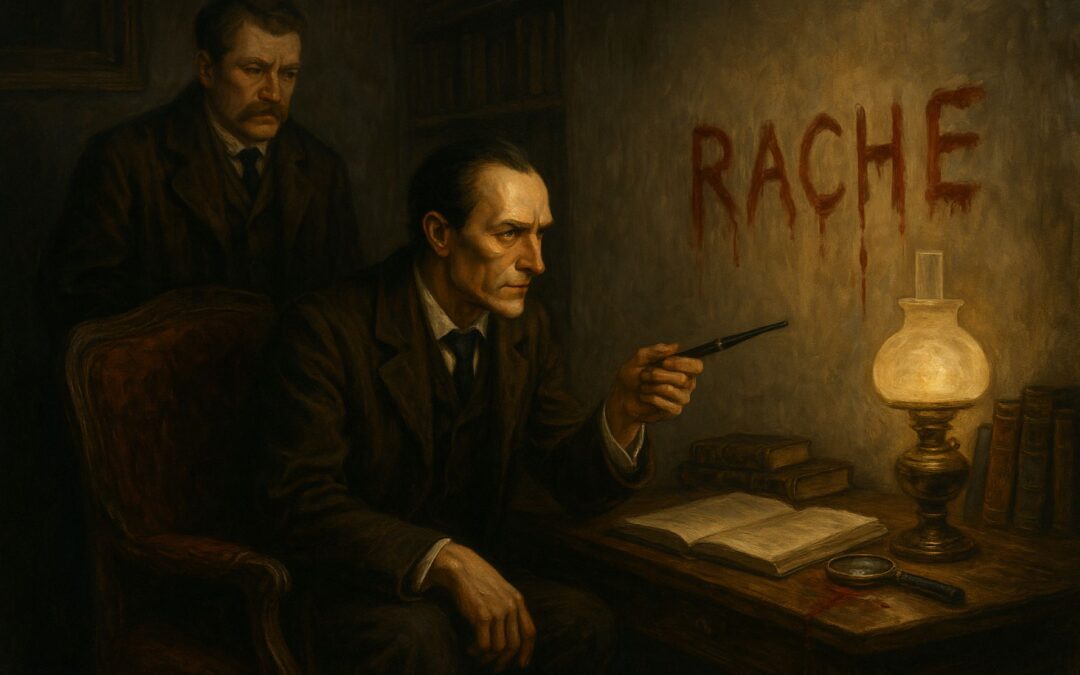
Holmes and Watson are drawn to the scene on Brixton Road, where the air is thick with enigma. The crime scene presents baffling contradictions: the victim’s body is marred by no obvious wounds, yet scattered droplets of blood trace an arc across the floor. The chilling message “RACHE,” written in what appears to be blood on the wall, deepens the mystery. The police speculate clumsily, suggesting the killer intended to write “Rachel,” perhaps a person connected to the victim, but was interrupted mid-act.
Holmes’s intervention is both immediate and authoritative. His knowledge of German enables him to read “RACHE” correctly as “revenge,” signaling an intentional misdirection designed to confuse the investigation. This revelation not only discredits the official theory but also underscores Holmes’s linguistic acumen and his capacity to pierce through deception.
His methodical examination of the crime scene goes beyond superficial inspection. Holmes measures the room with exactitude, notes the spatial relations, and interrogates every incongruity. He is unimpressed by the simplistic assumptions of Gregson and Lestrade, whose investigative methods rely heavily on conjecture rather than empirical evidence.
This episode exemplifies Holmes’s radical approach: a commitment to rigorous logic, forensic science, and an unwavering refusal to be swayed by appearances. It is here that the foundations of the case are laid, setting Holmes on a collision course with London’s entrenched police bureaucracy and ushering in a new era of detective work grounded in science and deduction.
Holmes’s Deductive Profile of the Killer
Sherlock Holmes’s ability to reconstruct the identity of a criminal from mere traces left behind is nothing short of astonishing. Without ever encountering the suspect in person, Holmes assembles an intricate portrait, pieced together with forensic precision and psychological insight. His description is rich in detail: the killer is a man of roughly six feet in height, possessing small feet encased in square-toed boots — a subtle clue to his socioeconomic background and perhaps the geographical origin of his footwear.
Holmes further notes the suspect’s florid, or “flowery,” complexion, suggesting a man who spends significant time outdoors or is perhaps of a particular temperament, possibly prone to emotional volatility. The presence of long fingernails on the right hand is peculiar — it hints at someone who avoids manual labor but maintains an appearance that may serve a particular purpose, perhaps to project refinement or to disguise true nature.
Adding to this, Holmes identifies the killer’s smoking preference: a triopoly cigar. This detail, seemingly minor, offers insight into the suspect’s habits, social standing, and even geographic associations, as triopoly cigars were a specific variety known in certain circles.
Holmes’s deduction about the arrival vehicle is equally meticulous. The killer traveled in a taxi drawn by a horse shod with three old horseshoes and one new one — an irregular pattern that serves as a unique identifier. The new horseshoe is likely a replacement, indicating recent injury or maintenance, and the asymmetry helps track the horse and, by extension, the taxi driver.
Further, Holmes’s conclusion that the victim was poisoned, despite the absence of visible wounds, demonstrates his adeptness at interpreting subtle physiological signs. Blood droplets near the body but no external injuries suggest internal trauma or poisoning, a detail overlooked by conventional investigators.
This profile is the product of Holmes’s unparalleled observational skills combined with his encyclopedic knowledge of human behavior, chemistry, and the minutiae of London’s streets. It starkly contrasts with the superficial assumptions of the official detectives and underscores the revolutionary nature of Holmes’s investigative methodology.
The Capture of the Murderer and Unraveling the Mystery
Holmes’s pursuit of justice moves beyond deduction into active investigation. His first tactical move involves confronting John Rance, the policeman who discovered the victim’s body. Rance’s initial reluctance to divulge information reflects a theme pervasive in the narrative: the inadequacies and complacencies within the official police force. Holmes’s willingness to bribe Rance is pragmatic, reflecting his flexible moral code when the pursuit of truth demands unconventional measures.
From Rance, Holmes learns of a lone figure seen near the crime scene — a man staggering as if drunk. Holmes quickly hypothesizes that this drunkenness is a deliberate disguise, a cunning ploy by the killer to evade suspicion. This insight exemplifies Holmes’s capacity to see beyond appearances, recognizing deception where others see only happenstance.
The lost ring, a seemingly trivial detail, becomes central to Holmes’s strategy. By placing an advertisement claiming that Watson has found the ring and will return it to its rightful owner, Holmes creates a bait to lure the murderer out of hiding. This psychological trap leverages the killer’s pride and need for possession, using human nature against itself.
The plot thickens when an old woman appears at 221B Baker Street to reclaim the ring. Holmes’s suspicions are aroused, and he covertly follows her only to discover she is a man in disguise, likely an accomplice or a decoy. This revelation adds layers of intrigue, highlighting the killer’s network and the lengths to which they will go to obfuscate the truth.
Meanwhile, police officers arrest Arthur Charpentier based on circumstantial evidence — his altercation with Drebber and his suspicious absence at the time of the murder. However, this arrest is premature and misguided, as evidenced by the emergence of a second murder: the stabbing of Stangerson, Drebber’s servant. The recurrence of the cryptic word “RACHE” at this new crime scene confirms a connected vendetta rather than isolated incidents.
Holmes’s breakthrough arrives with the discovery of a pillbox containing two pills: one harmless, one deadly. Testing these on a dog reveals the lethal nature of one pill, confirming poison as the murder weapon. This scientific confirmation enables Holmes to identify the true killer — Jefferson Hope — a man who had concealed his identity and motive beneath the guise of a taxi driver. Holmes’s handcuffing of the taxi driver is the culmination of his methodical investigation, transforming theory into tangible justice.
The Backstory: Vengeance in the American West
The narrative’s second part unfolds as a vivid and tragic tableau set against the harsh landscapes of the American West in 1847. John Ferrier and Lucy, his adopted daughter, stand on the brink of death, victims of the merciless desert and the brutal realities of pioneer life. Their salvation comes from an unexpected source: a Mormon wagon train led by Brigham Young, who offers them refuge on one condition — conversion to Mormonism and integration into the nascent community at Salt Lake City.
Lucy’s upbringing within this austere and rigid society shapes her into a strong yet constrained young woman. Her love for Jefferson Hope, an outsider and gentile prospector, challenges the strictures imposed by the Mormon elders. This forbidden romance ignites conflict, as the elders, particularly Enoch Drebber and Joseph Stangerson, demand Lucy’s marriage to one of their own — a blatant assertion of control and religious orthodoxy.
John Ferrier, vehemently opposed to Mormon polygamy and the forced subjugation of his daughter, becomes a tragic figure of resistance. His defiance provokes threats and ominous warnings, symbolized by a countdown of days displayed in their home, signaling Lucy’s impending forced marriage.
Hope’s return to assist in their escape signals a desperate hope for freedom. Yet, the plan unravels tragically: Ferrier is murdered, Lucy is coerced into a loveless marriage with Drebber, and succumbs soon after, her death steeped in sorrow and heartbreak. The community’s cold indifference to her demise — especially from Drebber, who sought her father’s wealth rather than her heart — underscores the moral decay beneath the veneer of religious authority.
Hope’s transformation from lover to avenger is fueled by this profound injustice. His vendetta transcends personal grief; it becomes a relentless crusade against those who destroyed his chance at happiness. His stalking of Drebber and Stangerson across states and continents epitomizes an obsessive quest for retribution, setting the stage for the climactic confrontations in London decades later.
The Final Confrontation and Justice Served
Jefferson Hope’s relentless pursuit of vengeance carries him from the vast, unforgiving deserts of the American West to the fog-shrouded streets of Victorian London. His transformation from a grieving lover to a calculating avenger is marked by patience, cunning, and a single-minded focus on his ultimate goal: retribution against Enoch Drebber and Joseph Stangerson. Disguised as a humble taxi driver, Hope infiltrates the very fabric of the city, shadowing his targets with the vigilance of a predator stalking its prey.
The methodical nature of Hope’s revenge is chilling. He forces Drebber to ingest one of two pills contained in a pillbox — a lethal test of fate. Hope himself takes the other pill, trusting the outcome to divine justice. This macabre gamble reveals a man who believes in cosmic balance, using his own life as a wager to ensure that punishment is meted out fairly. When Drebber dies, Hope leaves the cryptic message “RACHE” written in blood at the crime scene — a calculated misdirection to confound the authorities.
Hope’s confrontation with Stangerson is more violent and immediate. Unlike Drebber, Stangerson resists Hope’s attempt to repeat the deadly pill test. The struggle escalates to a fatal stabbing, with Hope forced to kill in self-defense. Despite the gravity of his actions, Hope does not view himself as a mere murderer; rather, he sees himself as an executor of justice for the wrongs inflicted upon his loved ones.
Hope’s health deteriorates during this period due to a congenital aortic aneurysm — a ticking time bomb threatening his life. His confession to the police is given calmly, even joyfully, as though unburdened by guilt. He openly recounts the narrative of love, loss, and vengeance that propelled his actions, framing his killings as moral imperatives rather than crimes. This complex portrayal blurs the lines between justice and revenge, raising profound questions about the nature of morality and retribution.
Aftermath and Holmes’s Revelation
Following Hope’s capture, Sherlock Holmes offers Watson an illuminating account of the detective work that led to the unraveling of the case. Holmes details his use of a network of street children — the Baker Street Irregulars, led by the resourceful Wiggins — whose keen eyes and nimble feet were instrumental in tracking down Hope’s movements across London. This unorthodox intelligence-gathering technique highlights Holmes’s ingenuity and his willingness to exploit all available resources in the pursuit of truth.
Holmes explains how minute observations, such as the pattern of the horseshoes on the taxi’s horse and the peculiarities of the poison pills, provided crucial leads. His scientific approach to deduction, combining chemical analysis with psychological insight, exposed the flawed assumptions of the official detectives and pierced the veil of deception surrounding the murders.
Despite his pivotal role, Holmes exhibits a degree of modesty, attributing the official resolution of the case to Scotland Yard detectives Gregson and Lestrade. This deference reflects Holmes’s complex relationship with the police — a mix of rivalry, collaboration, and mutual respect.
Watson, deeply impressed and inspired by Holmes’s brilliance, commits to chronicling their adventures. This decision marks the birth of a literary legacy that will immortalize Holmes’s methods and character, setting the standard for detective fiction.
About the Author, Arthur Conan Doyle
Arthur Conan Doyle’s journey from modest beginnings to literary prominence is as compelling as the mysteries he crafted. Born into a troubled household plagued by his father’s alcoholism and mental illness, Doyle’s early life was fraught with instability. Yet, through the support of extended family, he accessed quality education, eventually pursuing medical studies and earning a doctorate in medicine.
Doyle’s medical career provided both livelihood and inspiration. While practicing medicine, he nurtured a passion for writing, experimenting with various genres before creating Sherlock Holmes in 1886. Holmes’s character was revolutionary — a synthesis of Doyle’s scientific knowledge and his fascination with logic and human psychology.
The immediate popularity of Sherlock Holmes brought Doyle fame and fortune but also personal conflict. He felt constrained by his creation, fearing it pigeonholed him and overshadowed his other literary and intellectual pursuits, including his interest in spiritualism and historical fiction. His attempt to kill Holmes off in 1893 elicited public outrage so intense that Doyle was compelled to resurrect the detective in subsequent works.
Beyond literature, Doyle was a multifaceted figure: an active participant in politics, a spiritualist advocate, and a family man with two wives and five children. His knighthood from King Edward VII recognized not just his literary achievements but his broader contributions to society.
Despite common misconceptions, “Conan Doyle” is not a compound surname but a middle and last name; Arthur preferred to be addressed simply as Doyle. His legacy endures not only through the iconic detective he created but also through his diverse engagements and lasting impact on popular culture.
Conclusion
A Study in Scarlet stands as a testament to Arthur Conan Doyle’s genius in marrying gripping storytelling with pioneering detective methodology. Through the vivid characterizations of Holmes and Watson, the suspenseful murder investigation, and the poignant backstory of love and revenge, the novel transcends genre conventions to explore deeper human truths. It is a story of intellect clashing with emotion, order confronting chaos, and justice wrestling with morality.
More than a detective tale, it is a profound exploration of the human condition that continues to resonate with readers more than a century after its publication. The enduring legacy of A Study in Scarlet lies not only in the birth of Sherlock Holmes but in its masterful fusion of mystery, science, and storytelling artistry.