
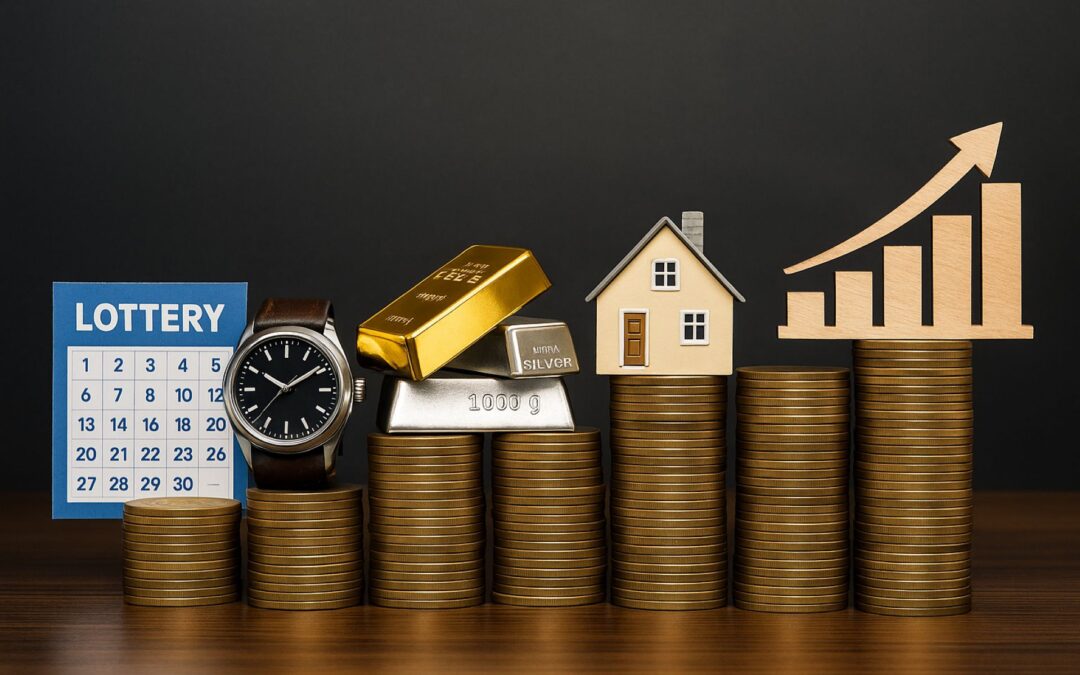
Not all assets are created equal. Some masquerade as wealth builders while quietly draining your bank account, while others—often overlooked—silently compound into fortunes. Understanding the difference isn’t just academic; it’s the dividing line between financial frustration and lasting freedom. Put $100,000 into the wrong place, and it evaporates. Put it into the right one, and it multiplies across decades into generational wealth.
This ranking strips away the illusions. From the seductive traps of F-tier to the crown jewels of S-tier, each category reveals what truly builds wealth and what only pretends to. It’s not about hype or fad—it’s about risk, returns, durability, and scalability. By the end, you’ll see clearly where money stagnates, where it grows, and where it explodes.
F-Tier Assets: The Financial Traps
F-tier assets are not just poor investments—they are financial illusions dressed up as wealth strategies. They lure people in with excitement, glamour, or the faint possibility of “striking it rich,” but in reality, they dismantle capital, leaving only regret behind. They appeal to emotion, not logic. They feed status cravings, not balance sheets. And worst of all, they trick people into believing they’re investing when they’re actually consuming.
Take the lottery. It’s marketed as a golden ticket to freedom, but the math tells a different story. Americans spend over $100 billion annually on lottery tickets—more than they spend on books, movies, sports tickets, and video games combined. The average adult burns through $1,000 a year chasing jackpots they’ll never win. The odds of landing the Mega Millions jackpot? Roughly 1 in 300 million. You’re more likely to be killed by a vending machine, struck by lightning multiple times, or become president of the United States than to hit that jackpot. Put $100,000 into tickets, and you’re essentially feeding a shredder. Gambling in casinos or sports betting follows the same formula. These games are designed for the house to win, and over time, the odds grind away at every dollar.
Then there’s the glittering trap of luxury goods. The sports car, the diamond watch, the high-fashion handbag—status wrapped in leather, steel, or silk. They feel like assets because you can hold them, flaunt them, and even resell them. But they are depreciating liabilities. A brand-new Porsche can lose 20–30% of its value the moment it leaves the dealership, and half within five years. Watches and jewelry are no better—unless you’re buying museum-grade pieces with insider expertise, their resale value is a fraction of the purchase price. Even smartphones, when financed on debt, belong here. That shiny $1,200 phone loses 50% of its value the moment the next model is announced. Warren Buffett’s warning resonates here: cars and status goods aren’t investments—they’re money pits.
Collectibles deserve their own cautionary tale. Every generation has its speculative frenzy. The 1990s had Beanie Babies, touted as “retirement nest eggs.” The early 2000s had baseball cards and comic books. The 2020s saw NFTs explode in value, with digital art flipping for millions—until the bubble popped and most collapsed into worthlessness. Even in legitimate collectible markets—fine art, vintage cars, rare coins—there’s a catch: liquidity. A Picasso painting may be appraised at $10 million, but unless a buyer is willing to pay that amount, it’s just framed wealth stuck on a wall. The average person lacks the networks, expertise, and patience to make these plays profitable. Instead, they end up stuck with illiquid assets that drain cash rather than produce it.
What unites all F-tier assets is the fatal confusion between consumption and investment. Consumption feels good—it’s emotional, immediate, and gratifying. Investment, by contrast, is slow, rational, and often boring. Real assets either generate cash flow or appreciate in value over time. F-tier assets do neither. They drain you while disguising themselves as “investments.”
Imagine putting $100,000 into this tier. In the lottery, it vanishes instantly. In luxury goods, it withers to $50,000 in five years while costing you insurance, maintenance, and financing fees along the way. In speculative collectibles, it sits in limbo, waiting for a buyer who may never arrive. That money doesn’t compound into financial freedom—it gets eaten alive by depreciation, bad odds, and false promises.
F-tier assets are not harmless indulgences. They’re traps. They exploit human psychology—greed, vanity, impatience—and disguise spending as investing. For anyone serious about wealth, the first rule is simple: don’t get stuck in the bottom tier.
D-Tier Assets: Fragile and Unforgiving
D-tier assets sit just above the realm of outright financial traps, but only barely. They carry enough credibility to be called investments, yet in practice they are fragile—overly dependent on timing, luck, or flawless execution. For every story of success, there are countless examples of disappointment. They can preserve wealth in certain conditions, but they rarely create it.
Commodities: Gold, Silver, and the Mirage of Safety
Commodities like gold and silver are often marketed as safe havens, the ultimate stores of value in turbulent times. And in moments of panic, they perform admirably. When the 2008 financial crisis rocked global markets, gold soared more than 25% in a single year. Investors fleeing collapsing banks and volatile stocks found comfort in metal they could touch, weigh, and lock in a vault.
But zoom out, and the picture changes. Over the past 50 years, gold’s long-term annualized return hovers around 7–8%. Respectable? Yes. But when compared to equities—especially broad stock indexes averaging 10%—gold underperforms significantly. Worse, commodities generate no cash flow. They don’t pay dividends. They don’t compound. They simply sit there, waiting for market perception to lift their value.
And that’s the real problem. Gold, silver, or oil prices are dictated by macro forces far outside an individual’s control: central bank policies, inflation fears, geopolitical crises. You might get lucky and buy at a bottom before a surge, but without that timing, commodities stagnate. They protect purchasing power but rarely multiply it. A $100,000 allocation here simply holds ground—it doesn’t climb the mountain of wealth.
The Myth of the “Easy Rental”
The next fragile category is single rental properties. On paper, the model is seductive: buy a home, lease it out, collect rent, let the tenants pay off your mortgage. Real estate agents make it sound like an autopilot path to passive income. But in practice, single-property landlords face a minefield of risks.
First, vacancies. A month without a tenant means a month of mortgage, tax, and insurance payments with zero offsetting income. If that vacancy stretches into several months, the supposed “asset” quickly turns into a financial anchor. Second, maintenance. Roof repairs, plumbing emergencies, appliance replacements—all eat directly into returns. A single unexpected expense can wipe out an entire year’s profits. Third, interest rates. When rates rise, as they did aggressively in 2022–2023, mortgage payments swell, rental yields shrink, and property values wobble.
Data from the U.S. Census Bureau confirms the fragility: “mom-and-pop” landlords with just one property are far more likely to default than landlords with multiple units. Why? Because they lack diversification. If their one tenant leaves, their entire “business” collapses. Scale brings stability; isolation breeds risk.
Fragility: The Common Thread
What unites D-tier assets is fragility. They can function in ideal circumstances, but they lack durability. Gold works brilliantly in a crisis, but outside of crisis, it stagnates. A single rental pays well when tenants are consistent, costs are low, and rates are steady—but the moment one variable slips, the math falls apart.
This fragility means they are poor foundations for wealth. Imagine parking $100,000 here. In commodities, it just sits—maybe worth slightly more in 20 years, maybe not. In a single rental, it might grow modestly during stable times, but one lawsuit, one vacancy, or one bad tenant could flip it into a loss. Unlike higher-tier assets, they do not operate as systems that smooth out risk over time. They’re binary—either everything goes right, or it all unravels.
The False Comfort of D-Tier
D-tier assets seduce with their narratives. Gold feels “timeless.” Real estate feels “safe because it’s tangible.” Yet history shows otherwise. Both have bankrupted the overconfident. They don’t annihilate wealth instantly like F-tier traps, but they suffocate it slowly, often leaving investors stuck for decades with little to show.
For anyone serious about building wealth, D-tier is a warning: don’t mistake fragility for strength. If your future depends on luck, timing, or flawless conditions, it’s not investing—it’s gambling in disguise.
C-Tier Assets: Safe but Stagnant
C-tier assets are where safety meets mediocrity. They’re not catastrophic like F-tier traps, nor brittle like D-tier fragility. They preserve wealth reasonably well, sometimes even provide steady returns, but they rarely accelerate anyone toward financial independence. If investing were a car race, C-tier assets are the vehicles that never leave the middle lane—steady, predictable, but incapable of overtaking.
Bonds: The Illusion of Stability
Bonds are the clearest example of this category. Governments and corporations issue them, promising fixed interest payments in exchange for your loaned capital. U.S. Treasury bonds in particular are lauded as “risk-free,” backed by the full faith and credit of the government. And indeed, they’ve served as a safe haven for centuries.
But safety has a price: stagnation. Over the past 30 years, 10-year Treasury bonds have delivered average returns of 4–5% annually. Compare that to the S&P 500’s 10% return, and the difference is striking. Over three decades, $100,000 in stocks compounds to over $1.7 million. In bonds, that same sum struggles to break $400,000. Bonds protect against volatility, yes, but they don’t generate transformative wealth. They’re the financial equivalent of parking your money in a garage—safe from storms, but going nowhere.
Corporate bonds can pay more, but with added risk. High-yield “junk” bonds sometimes return 7–8%, yet default risk looms large. One economic downturn, and entire portfolios can collapse under bankruptcies. For conservative investors, bonds are fine. For wealth builders, they’re dead weight.
REITs: Real Estate Without the Roof Leaks
Real Estate Investment Trusts (REITs) often sound like the perfect compromise: exposure to property markets without the hassle of fixing toilets, chasing tenants, or paying property taxes directly. They pool capital from thousands of investors to own and manage portfolios of commercial buildings, apartments, or retail spaces. Many REITs pay juicy dividends, sometimes 4–6%, making them attractive to income-focused investors.
But here’s the catch: they’re extremely sensitive to interest rates. When borrowing costs rise, property values fall, and REITs take a beating. In 2022, when the Federal Reserve aggressively hiked rates, the FTSE NAREIT All Equity Index plummeted more than 25%. Over the long run, REITs tend to underperform broad stock indexes while being more volatile. Yes, they offer diversification. Yes, they produce income. But compared to equities, their growth ceiling is capped.
Collectibles With Expertise: Wealth for the Well-Connected
Collectibles make a second appearance in this tier, but with a crucial difference: expertise. Unlike F-tier fads—Beanie Babies or NFTs—established markets like fine art, rare watches, or vintage cars can hold and even grow in value. Ultra-high-net-worth individuals often allocate 5% of their portfolios to art, according to Deloitte’s 2023 Art & Finance Report. For them, it’s both a store of wealth and a social signal of refinement.
The problem, however, is liquidity. Selling a Picasso, a Rolex Daytona, or a Ferrari 250 GTO isn’t like unloading shares of Apple stock. Finding the right buyer at the right price can take months, even years. Auction houses take their cut. And the market itself is opaque, often driven by fashion, trends, or the whims of billionaires. For insiders with networks and patience, fortunes can be made. For outsiders, collectibles often sit idle—symbols of status rather than engines of wealth.
The Role of C-Tier Assets in Portfolios
C-tier assets share one defining trait: they’re fine. They won’t ruin you, but they won’t make you rich either. Their best use lies in diversification. Bonds stabilize a portfolio during stock market downturns. REITs add income streams without direct landlord headaches. Art or collectibles can hedge against inflation while providing status and aesthetic value. But none of these, on their own, can form the backbone of wealth creation.
A $100,000 allocation here will likely preserve value, inch forward with modest returns, and keep pace with inflation. But it won’t build life-changing wealth. C-tier assets are guardians of capital, not growers of it. They belong in a portfolio as insurance, not as the main engine of financial progress.
B-Tier Assets: Reliable Compounding
B-tier assets are where wealth building truly begins to feel tangible. Unlike the traps of F-tier or the fragility of D-tier, these are durable, proven, and repeatable paths to financial independence. They don’t require insider knowledge or enormous starting capital. They’re not flashy, but they are dependable. And dependability, over decades, is what creates millionaires.
Index Funds: The Everyman’s Wealth Engine
Few financial inventions have democratized wealth like the index fund. Instead of gambling on individual stocks, index funds allow investors to buy tiny slices of hundreds of companies at once, mirroring the performance of the entire market. The S&P 500 index fund is the quintessential example—tracking the 500 largest U.S. companies.
Since inception, it has returned about 10% annually. That might sound modest, but compounding turns it into a fortune. Consider this: $10,000 invested in 1980 would now be worth over $900,000. And that’s without stock-picking, market timing, or hedge fund fees. All it requires is patience.
John “Jack” Bogle, the founder of Vanguard, championed this approach by reminding investors that markets tend to rise over the long term, but humans sabotage themselves by trying to outguess them. Index funds eliminate the guesswork. They are cheap, liquid, and virtually maintenance-free. For the average investor, there is no cleaner, more efficient wealth-building tool.
Dividend Stocks: Paid to Wait
Dividend-paying stocks are the quiet compounding machines of the market. Companies like Coca-Cola, Johnson & Johnson, and Procter & Gamble have paid dividends consistently for decades, often raising payouts year after year. These firms belong to the “Dividend Aristocrats” index—a collection of companies that have increased dividends for 25+ consecutive years.
The appeal is simple: you get paid just for owning the stock. It feels like rent from a property, except without the tenants or the maintenance. A portfolio of dividend stocks can generate 3–5% in annual income while still appreciating in value. Historically, dividend payers have outperformed non-dividend payers, offering both growth and stability.
The trade-off is speed. High dividend payers often grow more slowly than reinvestment-heavy giants like Amazon or Google. A dividend investor might not see explosive growth, but they will see reliable cash flow and lower volatility—two qualities that keep people invested through market storms. And staying invested is the ultimate advantage.
Real Estate at Scale: From Fragile to Systematic
A single rental property is fragile. One bad tenant or a vacancy can sink the investment. But scale changes everything. Once a landlord owns five, ten, or twenty units, risk spreads out. Vacancies in one unit are balanced by income from others. Maintenance costs are averaged across the portfolio. Even property management becomes more efficient at scale, with firms offering bulk services for multi-unit landlords.
According to U.S. Census data, about 70% of rental properties are owned by individuals. But only those with multiple units consistently see long-term stability and profitability. With scale, real estate shifts from speculation to system. Rental income flows steadily, property values appreciate over decades, and the owner gains leverage—literally—by financing multiple properties with borrowed money.
Real estate portfolios also offer a unique advantage: the combination of cash flow and appreciation. While stocks may rise or fall, tenants still pay rent. While properties may depreciate physically, land in desirable locations typically gains value. With proper management, scaled real estate can rival index funds in consistency while offering greater tax benefits.
The Common Thread: Repeatability
The beauty of B-tier assets is that they don’t depend on luck, insider access, or perfect timing. They work for anyone willing to commit capital and wait. They are boring, yes—but boring is the point. Markets punish impulsive traders and reward patient compounding.
Imagine allocating $100,000 here. In index funds, it compounds quietly into $1 million over 30–35 years. In dividend stocks, it provides $3,000–$5,000 in annual income while still growing in value. In real estate, it can be leveraged into multiple units that generate steady monthly rent. The returns aren’t overnight fireworks—they’re a slow, steady march toward financial independence.
B-tier assets are the middle class’s secret weapon. They don’t require genius, they don’t require insider connections, and they don’t require luck. They require time, discipline, and consistency. And those three ingredients are enough to turn ordinary savings into extraordinary wealth.
A-Tier Assets: Demanding but Dominant
A-tier assets are where the wealth game changes gears. Unlike B-tier, which thrives on accessibility and consistency, A-tier is about scale, exclusivity, and leverage. These assets can generate serious, life-changing wealth—but only if you can overcome the high barriers to entry. They demand capital, specialized knowledge, or strategic patience. They are not for beginners, but for those who can play, they deliver far more than the “safe and steady” paths.
Private Equity and Venture Capital: Outsized Returns, Insider Access
Private equity and venture capital funds sit firmly in the A-tier because they consistently beat public markets—when done right. A Bain & Company 2023 report showed that top-tier private equity funds return 12–15% annually, even after fees. Venture capital, meanwhile, has minted fortunes for those who backed companies like Google, Uber, or Airbnb in their early days.
The catch? Access. These funds are closed doors for most people. Minimum investments often start at $250,000, and your capital can be locked up for 7–10 years. You also need the right networks just to hear about these deals—most aren’t advertised. The wealthiest families, institutions, and ultra-connected investors dominate this space because they can wait out illiquidity and stomach the risk of total losses.
Another problem: dispersion of returns. In private equity and venture capital, the best firms and funds consistently outperform, while average ones barely beat the stock market. Unless you’re plugged into the very top tier of managers, your results may not justify the risks. This is why, for most, it remains aspirational rather than practical. But for those who can play in this arena, the rewards far outpace anything available in public markets.
Franchises: Plug-and-Play Businesses With a Price Tag
Franchises are another A-tier asset because they let you buy into a proven model. Instead of building a business from scratch, you step into a system with brand recognition, marketing machinery, and a customer base already waiting. Top franchises like McDonald’s, Chick-fil-A, or Domino’s often produce six figures in annual profits per location. According to Franchise Business Review, the average franchise operator nets between $80,000 and $100,000 per year.
The beauty of the model is repeatability. A successful operator can open multiple locations, stacking income streams. Franchises provide a structure that reduces uncertainty—proven menus, supplier networks, marketing campaigns—but still allow for entrepreneurial upside.
The downside is cost. Opening a franchise often requires between $500,000 and $1 million in startup capital, sometimes more. Beyond that, approval isn’t guaranteed. Corporate franchisors carefully vet applicants, rejecting many who don’t meet their standards. And even with approval, profitability depends heavily on execution and location. A great site in a bustling city can thrive; a poor one in a declining area can languish.
Franchises work best for those with managerial skill, patience, and enough capital to scale beyond one store. They are powerful, but the gatekeeping is intense.
Commercial Real Estate: Scale Over Shelter
While single-family rentals wobble with vacancies and repairs, commercial real estate operates on a different plane. Multi-family apartment complexes, office buildings, shopping centers, or industrial warehouses scale income far beyond what one rental ever could. Instead of relying on one tenant to pay the bills, you rely on dozens—or even hundreds. The result is more stable income and the potential for significantly larger profits.
Commercial real estate has averaged around 9% annual returns over the past 25 years, according to CBRE. But the numbers don’t tell the full story. Investors use leverage—borrowing against properties—to amplify gains. A modest 5% rise in property value can translate into much larger returns if debt is structured correctly. Tax advantages also play a massive role: depreciation deductions, 1031 exchanges, and favorable financing terms make commercial real estate a favorite of wealthy families and institutions.
The barrier, however, is size. Even a small apartment complex might cost $1–5 million, with banks requiring hefty equity up front. Managing commercial properties also demands professional expertise—leasing offices, managing tenants, and negotiating contracts. It’s a business, not a hobby.
The Pattern of A-Tier Assets
What ties A-tier assets together is the mix of proven performance and steep barriers. They work. They build fortunes. But they aren’t accessible to everyone. A $100,000 investment here is rarely enough to secure a meaningful position. It might cover franchise fees but not build-out. It might serve as a down payment on a modest property, but lenders will demand far more equity. In private equity, it might buy a tiny slice of a deal—if you even get access.
A-tier teaches an important lesson: capital itself is a gatekeeper. The opportunities are there, the systems are proven, but wealth often begins to accelerate only once you’ve already built a foundation strong enough to afford entry.
S-Tier Assets: The Wealth Machines
At the very top of the hierarchy are the S-tier assets—the crown jewels of wealth creation. Unlike the slow plod of C-tier or the steady compounding of B-tier, these assets offer asymmetry: the potential to turn modest investments into fortunes by harnessing scale, leverage, and systems. They are not merely wealth preservers or incremental growers; they are multipliers. They build empires, legacies, and dynasties. But they come with one caveat: they demand more than just money. They require vision, execution, and, at times, audacity.
Owning a Business: Cash Flow and Exit Multiples
Entrepreneurship is the undisputed king of wealth creation. According to U.S. Census Bureau data, over 70% of millionaires are entrepreneurs. Why? Because a business pays twice. First, it generates consistent cash flow through operations—sales, services, subscriptions, royalties, or fees. Second, it delivers a massive payday upon exit. A business producing $500,000 in annual profit can sell for two, three, even five times that number, depending on its growth prospects and industry.
No other asset class offers that kind of leverage. Stocks grow at 8–10% per year; a well-run business can grow profits by 50% annually. And when sold, the valuation “multiple” amplifies that growth further. A software company, for example, might sell for 8–12 times earnings because of scalability and recurring revenue models. That means every $1 in profit could translate into $10 in sale value.
The downside is obvious: starting and scaling a business is grueling. Most fail. It demands grit, creativity, leadership, and an appetite for risk. Yet for those who succeed, entrepreneurship isn’t just an asset—it’s a wealth machine that outpaces everything else.
Equity in High-Growth Companies: Betting on Rockets
If owning your own business is the surest path to wealth, owning a piece of someone else’s rocket ship runs a close second. Early equity in companies like Amazon, Tesla, or Apple has turned modest sums into fortunes. A $10,000 investment in Amazon’s 1997 IPO is now worth over $1.6 million. Nvidia, the AI hardware juggernaut, has created similar generational wealth for early believers.
The dynamic here is simple but powerful: asymmetric upside. You can only lose what you put in, but gains can be exponential. Venture capitalists, angel investors, and early employees who receive stock options are the ones who typically benefit from this path. For most people, access is limited, but it’s not impossible. Platforms now exist that allow accredited investors to buy into startups. The risk is sky-high—most startups fail—but when they succeed, the payoff eclipses nearly every other asset class.
Scalable Digital Assets: Infinite Leverage in the Internet Age
The digital era has birthed a new breed of S-tier asset: scalable digital properties. Think YouTube channels, subscription apps, online courses, SaaS (software as a service), or e-commerce brands. Unlike physical businesses, digital assets scale with near-zero marginal cost. Once the infrastructure is built—whether a video, a piece of code, or a digital product—it can be distributed to millions of people without added expense.
This scalability is what makes digital assets rival traditional businesses. A YouTube creator can earn advertising revenue, sponsorship deals, and merchandise sales from the same piece of content viewed globally. A SaaS founder can build software once and sell it to thousands of companies. The creator economy alone was valued at over $100 billion in 2022, with top creators earning millions annually.
Importantly, digital assets often combine multiple income streams—ad revenue, subscriptions, affiliate sales, brand deals—creating resilience. They also allow individuals to compete with corporations in ways that were unthinkable 20 years ago. A single person with a laptop and internet connection can create something with global reach and profitability.
The Common Thread: Leverage
What ties S-tier assets together is leverage. In B-tier, your capital works for you slowly. In A-tier, your capital and connections unlock larger systems. In S-tier, money, technology, people, and networks combine to multiply output exponentially. These assets don’t rely on your individual labor; they rely on systems that keep producing while you sleep.
- A business leverages customers, employees, and processes.
- High-growth equity leverages the innovation and ambition of others.
- Digital assets leverage the reach of the internet, scaling infinitely without proportional costs.
The Power of a $100,000 Allocation
Now imagine placing $100,000 here. In a traditional business, it might fund a startup that generates $500,000 a year in profit, later sold for millions. In high-growth equity, it might seed an early-stage investment in the next breakout company, potentially multiplying into millions. In digital assets, it might bankroll a YouTube channel, an app, or an e-commerce brand that scales into a global income stream.
Unlike lower tiers, the upside is not capped. These assets don’t crawl—they leap. They don’t simply preserve or grow—they multiply. They create not just wealth, but freedom, influence, and legacy.
Conclusion
Wealth isn’t built by chasing the loudest promises. It’s built by placing capital where it can compound, scale, and outlast. F-tier and D-tier assets lure with flash but crumble under scrutiny. C-tier offers safety but stalls growth. B-tier provides the reliable foundation—steady compounding for those willing to wait. A-tier demands capital and access, rewarding those who can cross the threshold. And S-tier, the pinnacle, belongs to those who create or own systems powerful enough to scale beyond themselves.
The lesson is simple: wealth flows to durability, repeatability, and leverage. Avoid the traps, embrace the steady growers, and—if you have the skill and vision—step into the machines that redefine what money can do. The tiers aren’t just a ranking—they’re a roadmap. The question is: which lane will you choose to build your fortune?