
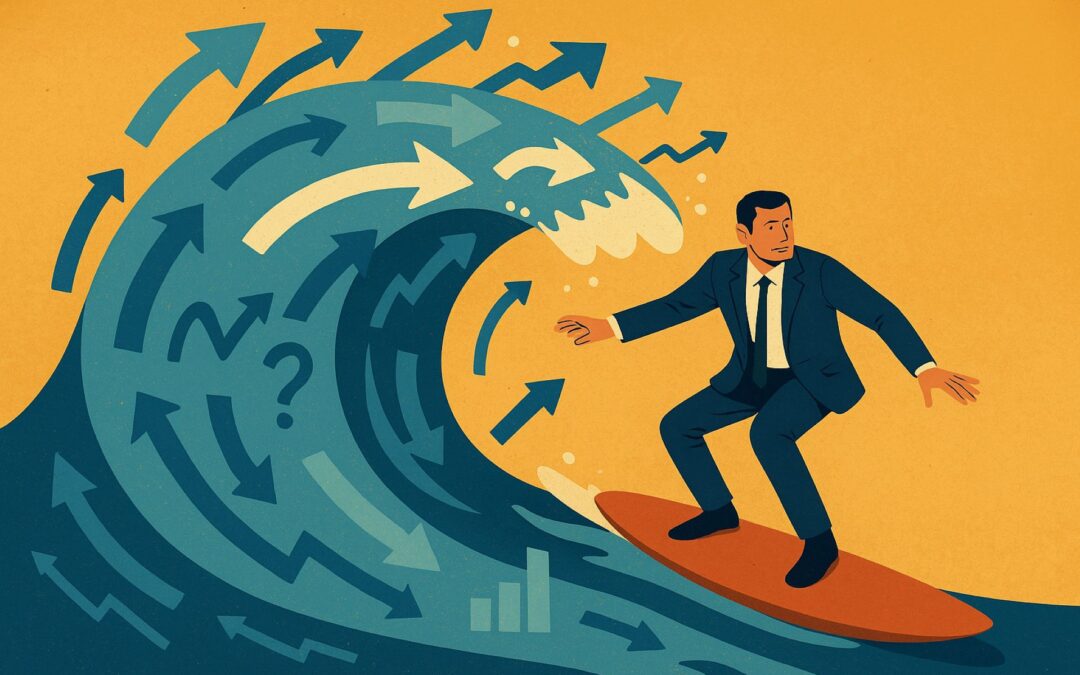
Business, at its core, is a paradox. You’re told to plan obsessively, yet be ready to throw that plan out the window. To commit wholeheartedly, yet remain flexible enough to pivot at a moment’s notice. To chase your vision relentlessly, yet let go when the world tells you it’s time to evolve.
That’s the game Gary Vaynerchuk has mastered—and the one most entrepreneurs never do. Because building a business isn’t about stubbornly sticking to your blueprint. It’s about reacting to reality. It’s about reading the room, the culture, and the consumer with such agility that you move in rhythm with them.
The concept is simple but deeply uncomfortable: reactionary business. The art of adapting fast, embracing uncertainty, and transforming challenges into opportunities. The entrepreneurs who understand this don’t just survive the chaos of the market—they turn it into momentum. The ones who don’t? They get left behind, still clinging to yesterday’s version of success.
This is how you roll with it.
Be Ready to Adapt
Adaptability isn’t just a business advantage—it’s a survival instinct. In the entrepreneurial world, markets shift overnight, algorithms change without warning, and audiences evolve faster than trends can be named. Yet, astonishingly, most entrepreneurs treat their original plan like sacred scripture. They cling to it even as the world around them transforms. That’s the beginning of the end.
The biggest myth in business is that success belongs to those who are the most stubborn about their vision. In truth, it belongs to those who can bend without breaking. The entrepreneurs who make it big are not the ones who predict every move correctly; they’re the ones who adjust the fastest when things go wrong—or when they go right in ways they didn’t expect.
Gary Vaynerchuk has seen this pattern play out countless times. Ambitious creators start with a clear direction—laser-focused on a niche, a product, or an audience—and then, when opportunity comes knocking from an unexpected direction, they freeze. They refuse to deviate from their plan. They protect their initial identity rather than expand it. And in doing so, they smother their own potential.
Take, for example, a woman Gary once advised who ran a food blog dedicated to creative, kid-friendly sandwiches. Her vision was charming: whimsical lunches shaped like animals, bright colors, and easy recipes for parents. Her brand was growing steadily—until her analytics revealed something strange. Her audience wasn’t mostly moms. It was largely adult men—beer-loving sports fans who found her style entertaining and her sandwich ideas oddly perfect for game-day gatherings.
That revelation should’ve been a gift. An open door to an entirely new, profitable audience segment. But instead of walking through it, she ignored it. She insisted her content was “for kids,” not tailgate parties. The opportunity passed her by. Sure, she continued to grow modestly, but she never broke through. She was too attached to her original idea to see that her market had chosen her for something else.
Adaptation isn’t betrayal—it’s evolution. The best entrepreneurs don’t resist when the current shifts—they pivot their sails and use the wind to their advantage. The world doesn’t reward purity of intention; it rewards flexibility of execution.
Look at the story of Cristal Champagne. In the late 1990s, Cristal wasn’t just a premium drink—it was a cultural symbol. Hip-hop artists like Jay-Z, Diddy, and Nas were showcasing it in music videos, lyrics, and VIP lounges. They had made Cristal cool. But instead of recognizing this as a golden opportunity to expand its market and cement its relevance with a powerful cultural movement, the brand’s managing director publicly distanced himself. In an interview with The Economist, he dismissed the association, implying discomfort with the brand’s newfound popularity among rappers and their fans.
That statement detonated a bomb under Cristal’s reputation. The hip-hop community, feeling disrespected, turned away. Jay-Z didn’t just boycott Cristal—he replaced it with his own brand, Armand de Brignac (Ace of Spades), which exploded into one of the most recognized luxury champagnes in the world. In trying to preserve its old identity, Cristal lost its future.
That’s what happens when brands forget that they don’t control culture—culture controls them.
Being ready to adapt means staying humble enough to admit when the world is telling you something new about your business. It’s about listening to your customers instead of lecturing them. It’s about seeing opportunity where others see distraction.
Adaptation doesn’t mean you abandon your vision. It means you evolve it. You let your brand breathe, grow, and respond to reality instead of clinging to fantasy.
Every major success story—whether it’s Netflix, Apple, or Nike—is built on this principle. Netflix started as a DVD rental company. Apple nearly died before reinventing itself as a lifestyle technology brand. Nike pivoted from performance gear to cultural storytelling. Each one thrived because they didn’t worship the plan—they worshiped the process.
Entrepreneurs who understand this never panic when the landscape changes. They read the signs, make the adjustments, and move forward. They understand that the goal isn’t to control the market—it’s to dance with it.
Adaptability isn’t about luck or genius. It’s about awareness, humility, and courage—the willingness to change course while staying true to your destination. The market will always evolve. The question is: will you evolve with it?
Put Out Fires
No matter how smart you are, how perfect your product seems, or how beloved your brand becomes, something will go wrong. It’s not a question of if—it’s when. A careless tweet, a bad review, an unflattering video, a public misunderstanding—it only takes one spark for a reputation to catch fire. And in today’s hyperconnected world, that fire spreads at the speed of Wi-Fi.
Reactionary business means you don’t wait for the fire department—you grab the hose yourself.
Gary Vaynerchuk learned this firsthand during the NFL Draft, when cameras caught him apparently booing the New York Jets’ selection of Mark Sanchez. Overnight, ESPN and sports blogs lit up with commentary: Gary Vee, lifelong Jets superfan, was mocking the team’s new quarterback. But the reality was far more nuanced. He wasn’t booing Sanchez at all—he was frustrated because he thought the Jets had given up too much to trade up in the draft.
By the time the clip made its rounds, context was gone and outrage had taken over. Years ago, this kind of misunderstanding could have wrecked a personal brand. You’d have to beg a journalist to correct the record or wait weeks for the story to die down. But Gary didn’t have to wait. The next day, he addressed it directly on his show, Wine Library TV, speaking candidly to his audience about what had really happened. No publicist. No spin. Just speed, sincerity, and transparency. The issue evaporated overnight.
That’s the power of reactionary business—it lets you turn crisis into connection.
The same principle played out on a far bigger stage with Domino’s Pizza. In 2009, two rogue employees uploaded a horrifying YouTube video showing themselves tampering with food before serving it. The clip spread like wildfire, triggering disgust, outrage, and fear across the country. The internet, of course, declared the brand dead.
But instead of hiding behind lawyers or issuing sterile press statements, Domino’s fought back using the very weapon that had been used against it—social media. Within 48 hours, CEO Patrick Doyle appeared in a YouTube video of his own. His tone was serious, his message direct: this behavior was unacceptable, those employees were fired, and steps were being taken immediately to ensure it would never happen again.
It wasn’t glamorous PR—it was human. And that’s why it worked.
The move didn’t just save Domino’s reputation; it became a case study in crisis management. Doyle didn’t sugarcoat or deflect—he confronted the problem head-on, and the public respected that. The company’s response was so swift and open that it actually strengthened brand trust instead of destroying it.
That’s what reactionary business looks like in practice. You meet problems where they arise, on the same platforms and in the same tone as your audience.
Gary often pushes this idea further. He’s said that if he were running a fast-food chain, he’d install live cameras in every kitchen so customers could see their food being made in real time. Total transparency. Why? Because sunlight kills rumor. Once people can see the truth for themselves, misinformation loses its power.
That’s what modern consumers crave—not perfection, but honesty. They don’t expect you to be flawless; they expect you to be real. When you screw up, own it. When something goes wrong, say so. The faster you respond, the faster you regain control of the story.
Reactionary business thrives on three principles: speed, honesty, and empathy. Speed buys time. Honesty earns respect. Empathy builds loyalty. Combine those, and you don’t just put out fires—you prevent them from spreading in the first place.
Shape Your Story
In the old world, brands controlled their narrative. They decided what to say, how to say it, and when. Consumers listened. The media amplified. And that was that.
That world is gone.
Social media didn’t just democratize communication—it detonated it. Today, your story will be told whether you participate or not. The public will shape your brand’s reputation in real time, through tweets, videos, comments, reviews, and memes. You can’t stop it—but you can steer it. That’s the new game.
Gary Vaynerchuk believes that trying to suppress or sanitize your brand’s story is the fastest way to destroy it. He’s watched countless companies pour millions into PR agencies that promise “damage control,” only to end up sounding robotic and out of touch. The truth is, people don’t want polished—they want participation.
He argues that every employee, from the CEO to the intern, should be part of the storytelling ecosystem. Give them permission to talk about their work, their ideas, even their frustrations. When employees speak freely about the company, they humanize it. They give it a pulse. Yes, it’s risky—someone might say something negative—but it’s far riskier to pretend everything’s perfect while resentment festers behind closed doors.
Think of it like this: every team member is an antenna, picking up signals from your customers and your culture. If you let them broadcast what they feel, you get raw, unfiltered insight into the health of your organization. If you silence them, you blind yourself.
And the same goes for customers. When people talk about your brand online—positively or negatively—they’re giving you a map. Every compliment tells you what to double down on. Every complaint tells you what to fix. Every confusion tells you where to clarify.
In the past, brands had to beg for media coverage to share their perspective. Now, you can do it yourself. Facebook Live, LinkedIn, X (Twitter), Instagram, YouTube, and Twitch have turned every founder and executive into their own media company. You don’t need a press conference to address your audience—you can go live, right now, from your phone.
That’s the real gift of social media: it hands you the microphone.
Gary has always said that authenticity scales faster than any ad campaign. The unfiltered message—spoken directly, from human to human—is the new marketing. When you show up online as yourself, people believe you. When you hide behind corporate copy, they don’t.
Of course, transparency doesn’t mean chaos. You still guide the narrative; you just do it through openness instead of control. Encourage dialogue. Respond to feedback. Correct misinformation when it appears. Thank your champions publicly. Let your critics see you listening.
Because shaping your story isn’t about defending your reputation—it’s about building it, one interaction at a time.
When done right, this approach transforms your brand from a faceless entity into a living, breathing presence in people’s lives. You’re no longer shouting at your audience; you’re talking with them.
And that’s the difference between being followed and being believed.
Trendspotting
Every entrepreneur dreams of discovering the next big thing. But most of them go looking for it in the wrong places—by copying what’s already hot instead of noticing what’s quietly emerging. The real art lies not in creating trends from nothing, but in recognizing them early enough to ride the wave before everyone else sees it coming. That’s what Gary Vaynerchuk calls the essence of reactionary business—being alert, curious, and fast.
Some people have a natural radar for cultural undercurrents. Gary’s one of them. From the moment he was a teenager, he had a knack for spotting where people’s attention was going before the market caught up. He sensed it in baseball cards during the late ’80s when the hobby exploded into a billion-dollar industry. He saw it again with e-commerce, turning his father’s liquor store into one of the first successful online wine retailers. He jumped on YouTube when most people still thought video blogs were a fad. Every one of those moves wasn’t luck—it was instinct built on awareness.
Trendspotting is less about prediction and more about observation. You watch people, not data. You look for behaviors that don’t yet have words. When Gary noticed kids doodling fake tattoos on their arms with markers, he didn’t dismiss it as childish play. He saw a cultural clue—a hunger for personalization and self-expression. It was small, almost invisible, but it said something big: identity was becoming customizable. If he were in the ink business, he said, he’d create a skin-safe, non-toxic, kid-friendly tattoo ink. A simple tweak to an old product could have captured an entirely new market.
That’s what trendspotting is: the ability to extract opportunity from cultural noise.
The same logic applies to technology. When Gary started hearing people say, “I canceled my cable,” his entrepreneurial radar went off. Five years earlier, no one would’ve dared. Cable was a household necessity. But now, people were replacing it with Netflix, YouTube, and Hulu. That was the signal. The way people consumed entertainment was fundamentally changing.
He saw that the future wasn’t about channels—it was about choice. People no longer wanted to be told what to watch. They wanted to curate their own experience. That shift—from passive consumption to active selection—was the birth of the streaming revolution.
Imagine what that means for creators and entrepreneurs. The teenager running a small graffiti art vlog on YouTube today might be tomorrow’s equivalent of a TV network. When television and internet fully converge—and they will—the line between mainstream and niche will vanish. The audience will be in charge. You’ll type in “body graffiti” or “tattoo art,” and you’ll have instant access to hundreds of creators who were once invisible.
That’s why reactionary entrepreneurs don’t chase fads—they track behavior. They notice when language changes, when habits evolve, when new rituals form. They ask: What does this mean? Where is attention shifting? How can I be there before everyone else?
Trendspotting is also about empathy. You don’t just see what people are doing—you feel why they’re doing it. You connect dots that others miss. When kids doodle on their skin, you see creativity and rebellion. When people ditch cable, you see autonomy. When users flock to short-form video, you see a shrinking attention span and a craving for quick dopamine. The trends tell a story about humanity. Your job is to read it early and act fast.
In a world where technology and culture evolve by the month, this skill isn’t optional—it’s oxygen. The entrepreneurs who master it don’t just adapt to the future; they build it.
The Art of Reactionary Business
At its core, reactionary business is about balance—the delicate equilibrium between obsession and openness, conviction and flexibility. It’s knowing when to hold your ground and when to pivot. Too much rigidity, and you break. Too much fluidity, and you lose direction. The magic happens in the tension between the two.
Gary Vaynerchuk lives in that tension. He’s fanatically passionate about his mission—to help people monetize their passions and embrace their authenticity—but he’s never married to the how. He reinvents his strategy as fast as the platforms evolve. When Twitter exploded, he doubled down on conversation. When Instagram rose, he leaned into visuals. When TikTok began taking over, he was among the first entrepreneurs his age to truly understand its potential. He doesn’t resist change—he courts it.
Reactionary business is not about chaos; it’s controlled agility. It’s strategic improvisation. Think of a jazz musician—every note is planned enough to sound intentional, but flexible enough to riff when the rhythm shifts. That’s how great entrepreneurs operate. They don’t rewrite their purpose; they rewrite their approach.
This mindset demands humility. You have to be willing to say, “I was wrong.” You have to treat feedback like a compass, not a critique. You have to look at failure not as punishment but as market data. The faster you accept what reality is showing you, the faster you can adapt.
Look at history’s most transformative companies. Netflix started mailing DVDs. When the internet matured, they pivoted to streaming. Then, they doubled down again—creating original content, becoming both platform and producer. That’s three reinventions in two decades. Each pivot looked risky in the moment. Each one was necessary for survival.
Apple did the same. It began as a computer company. Then it became a design company. Then a lifestyle brand. The iPod, iPhone, and App Store weren’t random hits—they were reactions to cultural shifts. Apple sensed the public’s hunger for simplicity, beauty, and connection—and adjusted its sails before anyone else did.
That’s the essence of reactionary business: you read the winds, not the waves.
Gary often says that passion without adaptability is obsession, and obsession without awareness is delusion. Entrepreneurs who refuse to adapt often disguise it as loyalty to their vision. But vision isn’t about clinging—it’s about guiding. You keep your North Star fixed, but you’re willing to change your path to get there.
Reactionary business is also a philosophy of speed. The window between a trend’s birth and its saturation is shrinking every year. What used to take five years now takes five months. You can’t afford to deliberate endlessly. The winners are those who act before they’re ready and refine as they go.
Ultimately, this mindset isn’t limited to social media or digital platforms. It’s a worldview—a way of thinking that keeps you relevant no matter what era you’re in. Whether you’re running a bakery, a software startup, or a global brand, the principle remains: stay alert, stay humble, stay fast.
Because the truth is, business—like life—will never go exactly as planned. But if you can roll with it, you can turn every surprise into strategy. Reactionary business doesn’t just keep you afloat—it turns the tide in your favor.
Conclusion
Adaptability isn’t weakness—it’s wisdom. The world rewards those who can evolve while staying anchored to what matters most. Reactionary business isn’t about abandoning your goals or constantly reinventing yourself to chase trends. It’s about staying awake—alert to shifts, aware of timing, attuned to truth.
Gary Vaynerchuk’s philosophy reminds us that business is less about control and more about choreography. You can’t dictate the rhythm of the market, but you can learn to move with it. That’s how you turn obstacles into pivots, mistakes into strategy, and chaos into clarity.
In the end, success doesn’t come from predicting every outcome. It comes from being ready when the unexpected arrives—from rolling with it, not resisting it. Because the entrepreneurs who roll with the punches are the ones still standing when everyone else is scrambling for balance.