
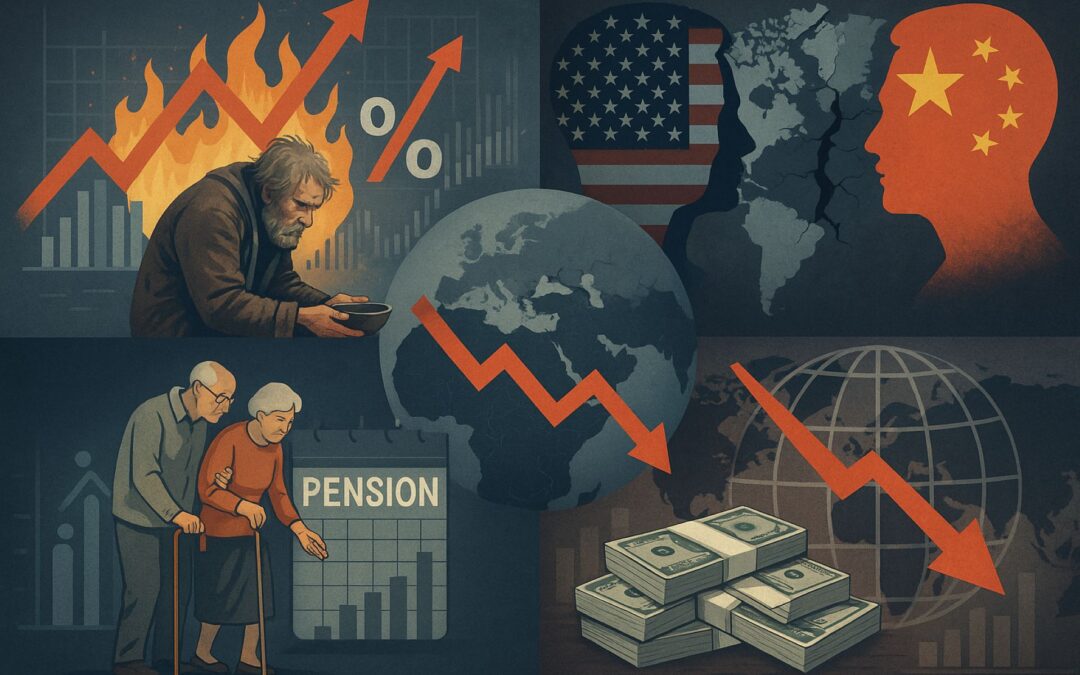
A century from now, historians may look back at the 2020s as the decade when the global economy reached a breaking point. Inflation eroded living standards, while wealth concentrated at the top, and millions fell deeper into poverty, straining the balance between generations in aging societies. Debt ballooned to levels that threatened to drown governments, companies, and households alike.
And just as the world needed cooperation most, geopolitics splintered into rival camps. These are not abstract theories; they are lived realities reshaping everyday decisions—from whether families can heat their homes to whether nations can feed their people. To understand our present and prepare for our future, we must confront the five defining economic problems of our age.
Inflation and the Cost of Living Crisis
Inflation is often described as a “silent thief,” but in reality, it’s more like a relentless tide—it rises slowly, sometimes imperceptibly. Before you realize it, the ground beneath you has shifted. What it really means is that the value of your money is shrinking over time. A loaf of bread that cost $1 last year might cost $1.10 this year, not because the bread has changed, but because the currency in your hand has lost purchasing power. Over the years, that erosion compounds into something devastating: salaries stagnate, savings diminish, and entire lifestyles must be recalibrated.
For decades, economists saw a controlled level of inflation as a necessary lubricant for the machinery of growth. A rate of around 2% per year was considered healthy. It encouraged spending, investing, and innovation, ensuring that money continued to circulate instead of being hoarded under mattresses. But inflation is like fire—manageable in a fireplace, destructive when it spreads unchecked. In the aftermath of the 2008 financial crisis, central banks doused economies with cheap money to prevent collapse. Interest rates plunged, quantitative easing expanded balance sheets, and liquidity flooded the system. The fire burned quietly for years, until the pandemic poured fuel onto it.
When COVID-19 hit, demand collapsed almost overnight. People stopped traveling, dining out, shopping, and commuting. Governments stepped in with unprecedented stimulus—printing and distributing trillions of dollars, offering near-zero borrowing costs, and even providing outright grants to keep households afloat. In the short term, it worked. Economies didn’t implode. But when restrictions lifted, the world found itself awash with money, and supply chains—crippled by factory closures, shipping delays, and labor shortages—couldn’t keep up. Too much money chasing too few goods is the perfect recipe for runaway prices.
By 2022, inflation in the U.S. and Europe had surged to nearly 10% annually. That figure sounds abstract until you break it down. A family accustomed to spending $500 a month on groceries suddenly faced bills of $550, then $600, with no corresponding rise in income. Renters found landlords hiking prices by double digits. Electricity bills doubled or tripled in some regions. In the developing world, where margins of survival are razor-thin, inflation became a matter of life and death. Staples like rice, wheat, and cooking oil have skyrocketed in price, pushing millions below the poverty line.
And the pain wasn’t confined to numbers on receipts. In the U.K., surveys revealed parents skipping meals so their children—or even their pets—could eat. Across Europe, elderly couples often kept their homes unheated through the winter to save money for medicine. In parts of Africa and Asia, food riots erupted as basic commodities became unaffordable. Inflation is not just an economic metric; it is a force that reshapes societies, rewriting daily rituals, family priorities, and political landscapes.
Even now, as central banks raise interest rates and inflation appears to “cool,” the reality is harsher. A slowdown in inflation does not mean prices fall—it means they rise more slowly. The new baseline remains elevated. Gasoline that once cost $3 per gallon and now costs $5 is unlikely to return to $3 again. This “ratchet effect” ensures that living standards, once eroded, rarely snap back to their previous levels. Young people, especially, often feel locked out of milestones—such as homeownership, financial independence, and starting a family—because wages have not kept pace with rising costs.
Central banks are caught in a precarious balancing act. Raise interest rates too aggressively and economies risk spiraling into recession: businesses cut investment, consumers slash spending, and unemployment rises. Raise them too timidly and inflation rebounds, entrenching itself into contracts, wages, and expectations. Economists refer to this as the “inflationary spiral,” where prices chase wages and wages chase prices in a self-perpetuating cycle.
What makes this crisis particularly unnerving is its fragility. Stability, if regained, could be shattered in an instant by external shocks, such as a new war, another pandemic, or a disruption in vital supply chains like those for semiconductors or energy. Inflation is no longer just a technical issue for economists—it is a lived reality, a pressure cooker affecting how billions of people make choices each day.
At its core, the inflation story is about vulnerability. It reminds us how delicate the balance of modern prosperity truly is—how quickly abundance can curdle into scarcity, and how entire generations can feel the tremors of policies made decades earlier.
Rising Global Inequality
Inequality today is not just wide—it is staggering, bordering on surreal. While economies on paper appear to be growing, the reality is that prosperity is not shared evenly. Since 2020, the richest 1% of people have captured nearly two-thirds of all new wealth created worldwide. That translates into $26 trillion flowing to a tiny fraction of humanity, while the remaining 99% of people split just $16 trillion among billions of people. The imbalance becomes even starker when measured individually: for every single dollar gained by someone in the bottom 90%, a billionaire gained $1.7 million.
The Mechanics of Concentration
How did the scales tilt so dramatically? The answer lies in the structure of modern capitalism itself. Inflation, while eroding wages, inflates asset prices—stocks, real estate, and commodities. Those who already hold assets see their wealth multiply effortlessly, while those without ownership are left behind. Add to this tax codes that favor capital gains, deregulation, weakened worker protections, and a globalized system that rewards corporations shifting production to the cheapest labor markets, and the result is predictable: wealth flows upward.
Technology intensifies the problem. A handful of companies dominate entire sectors, creating winner-takes-all economies where profits are funneled to executives and shareholders, rather than the workers who build the products. Globalization, while lifting millions out of poverty in developing countries, has simultaneously hollowed out industries in developed ones, leaving working classes displaced and resentful.
The Human Face of Inequality
Statistics only tell part of the story. Behind them lies a daily struggle. In developing countries, 700 million people still live on less than $2.15 a day, unable to afford even the most basic needs. In developed nations, middle-class families face stagnant wages, while the costs of housing, healthcare, and education continue to spiral upward. Parents skip meals so children can eat. Students graduate with crushing debt. Meanwhile, billionaires host opulent parties in rented-out cities and buy super yachts that eclipse small villages in cost.
This contrast erodes not just financial stability but also social cohesion. When one group enjoys near-limitless luxury while another can’t afford to survive, the social contract itself begins to fray. People lose faith in the idea that hard work can change their circumstances. Anger and distrust take root.
The Economic and Political Consequences
Inequality is not only unjust, but also inefficient. Economies grow fastest when prosperity is distributed broadly. Concentrated wealth reduces overall demand—when only a few can afford to buy, entire markets shrink. History shows what happens when inequality spirals unchecked: revolutions, populist uprisings, and political instability. The French Revolution, the Russian Revolution, and even the rise of radical movements in the 20th century all share inequality as a common trigger.
In modern times, inequality fuels populist politics and nationalism. It creates fertile ground for leaders who promise to upend “rigged systems” and restore dignity to the masses. While the wealthy protect their empires, societies grow increasingly polarized, with trust in institutions evaporating.
Paths Toward Balance
Some societies have found ways to temper inequality. Progressive taxation ensures that the ultra-wealthy contribute a greater share of their wealth. Strong investments in education and healthcare lift the base of society and create opportunities for upward mobility. Worker protections and fair labor laws safeguard against exploitation. The Nordic countries, with their balance of market freedom and robust social systems, offer an example of how prosperity can be shared without stifling economic growth.
But implementing such reforms is politically fraught. The wealthy wield disproportionate influence, and policies that challenge concentrated power often meet fierce resistance. Without intervention, inequality is likely to continue its upward trend, deepening divides and sowing unrest.
At its heart, inequality is not just about money. It is about dignity, opportunity, and the sense that society values all its members. Without balance, even the strongest economies risk hollowing out from within.
Aging Populations
One of the most profound economic shifts of the 21st century isn’t technological or financial—it’s demographic. The global population is getting older, faster than at any point in history. By 2030, one in six people will be 60 years old or older. By 2050, that figure doubles. Entire societies are moving into uncharted territory, where seniors outnumber children, and the traditional balance between workers and retirees is collapsing.
The Demographic Transition
Historically, families were large because survival was uncertain. Children were insurance against high infant mortality and provided labor in agrarian economies. As societies grew wealthier and more urbanized, family sizes shrank. Education became more costly, healthcare improved, and women entered the workforce in greater numbers. The outcome was a plummeting birthrate, often well below the replacement rate of 2.1 children per woman.
At the same time, medical advances have dramatically extended life expectancy. In the early 1900s, global average life expectancy hovered around 30–40 years. Today, it exceeds 72, and in developed countries it pushes into the 80s. This dual trend—fewer births, longer lives—creates the “inverted pyramid”: a growing elderly population supported by a shrinking base of young workers.
Economic Consequences
An aging society is costly. Seniors require pensions, healthcare, housing, and social services; yet, many are retired and no longer contributing to the workforce. In countries with generous pension systems, the financial strain is immense. For example, Japan already spends more than a quarter of its budget on pensions and elder care, with similar pressures mounting across Europe. In the U.S., Social Security faces insolvency without reforms.
Younger generations shoulder the burden. Workers pay higher taxes to support retirees while also navigating stagnant wages, soaring housing costs, and personal debts. The intergenerational contract—the promise that each generation supports the one before it—is under severe stress.
Social and Cultural Shifts
Aging isn’t just an economic issue; it reshapes societies. Elderly populations vote in higher numbers, influencing politics toward policies that protect pensions but often resist reforms. Cultural attitudes toward aging vary—Asian societies have traditionally emphasized filial piety, with families providing direct support to their elders, while Western societies rely heavily on state systems. As the numbers swell, even these cultural frameworks strain.
There’s also a shift in the workforce itself. Older workers, healthier than previous generations, are staying employed into their 60s and 70s. Sometimes it’s by choice—extending careers, sharing expertise, maintaining purpose. Other times it’s a necessity, as savings prove insufficient. Retirement as a leisurely phase of life is becoming less attainable for millions.
Strategies for Adaptation
Governments are experimenting with solutions, none of which are without controversy. Raising retirement ages is one approach, though it often sparks protests. Encouraging immigration brings younger workers into the labor force, but raises political and cultural debates. Automation and robotics offer another path—Japan already deploys robots in elder care, blending technology with necessity. Pro-natalist policies, like financial incentives for families to have more children, have been tried in places like South Korea and Hungary, but results remain modest.
The underlying challenge is that aging is predictable but difficult to reverse. Unlike crises, demographic changes occur slowly, giving governments time to adapt—but also tempting them to delay painful reforms. Every year of delay compounds the eventual cost.
A Future Shaped by Longevity
What emerges is a paradox. Longer lives are one of humanity’s greatest achievements, proof of medical progress and prosperity. Yet without structural reforms, this triumph risks becoming a burden. Aging populations will redefine labor markets, reshape healthcare systems, and test the resilience of welfare states. Whether this shift becomes a golden era of longevity or a slow-motion economic crisis depends on choices made today.
Debt Spirals: Governments, Companies, and Households
Debt is the oxygen of the modern economy—it fuels growth, enables governments to invest, and provides families with access to homes and education. But like oxygen, too much of it can suffocate. As of 2023, global debt stands at over $300 trillion, more than triple the size of the entire world economy. This staggering figure spans governments, corporations, and households, binding them all in a delicate chain of obligations.
Government Debt: The Sovereign Burden
Governments borrow to fund infrastructure, healthcare, defense, and welfare. The tool of choice is government bonds, essentially IOUs sold to investors with the promise of repayment plus interest. In moderation, this creates stability. In excess, it becomes crippling.
The United States, for instance, projects interest payments exceeding $1.2 trillion by 2025—around 17% of total federal spending. That means nearly one out of every five tax dollars will go toward debt service rather than schools, roads, or innovation. Poorer nations face harsher realities. Over 100 countries have already slashed budgets for essentials like healthcare and education just to keep creditors at bay. Sri Lanka’s 2022 default, which triggered fuel shortages and mass protests, revealed how quickly debt crises can spiral into political collapse.
The World Bank now estimates that about 60% of low-income countries hover on the brink of default. Sovereign debt has become less about progress and more about survival.
Corporate Debt: Growth on Borrowed Time
Companies also lean heavily on borrowing. Debt finances expansions, acquisitions, and innovation. But when revenues decline or interest rates spike, repayment becomes untenable. Corporate defaults can trigger domino effects: employees lose their jobs, suppliers go unpaid, and investors retreat.
Consider the phenomenon of “zombie companies”—businesses kept alive by cheap credit but unable to cover even their interest payments. These firms drag down productivity and distort markets. When central banks raise rates, zombies stumble, and the fallout ripples through entire economies.
Household Debt: Families Under Pressure
For households, debt is both an enabler and a trap. Mortgages make homeownership possible, but in times of high inflation and variable interest rates, monthly payments can suddenly double. Credit cards, often used to bridge income gaps, now carry interest rates above 20%, creating vicious cycles where families pay only the minimum and watch balances balloon.
In the U.S. alone, credit card debt has crossed $1 trillion. Student loans add another layer of crushing debt, delaying milestones such as buying a home, starting a family, or saving for retirement. In many developing nations, informal lending chains saddle families with usurious interest, locking them into generational cycles of poverty.
The Double-Edged Sword
Debt is paradoxical. Too little borrowing and economies stagnate—innovation slows, opportunities vanish, growth withers. Too much, and the weight of repayment drags societies into crises. Debt allows one generation to build for the next, but reckless accumulation ensures that the future is mortgaged before it arrives.
The danger today is not just the sheer volume of debt but its interconnection. When a household defaults, it affects banks. When banks falter, governments intervene. When governments overspend, global markets tremble. Each sector is tied to the other in a precarious web, amplifying risks.
The Generational Shadow
The gravest consequence of the debt spiral is its long-term nature. Debt rarely vanishes; it compounds. Decisions made by one generation bind the hands of the next. Today’s borrowing binge could mean tomorrow’s austerity, higher taxes, or reduced public services for children yet to be born.
Debt is not inherently evil—it is a tool. But it is a tool that demands discipline. Without it, nations, corporations, and families risk drowning in the very resource they rely on to survive.
Geopolitical Fragmentation
Globalization once promised a seamless world. Goods flowed across borders, supply chains spanned continents, and ideas spread with ease. For decades, the logic was clear: the more nations traded and collaborated, the less incentive there would be for conflict. But in the 2020s, this vision is unraveling. Instead of a single integrated marketplace, the world is fragmenting into rival blocs.
From Global Village to Rival Camps
The early 21st century was defined by interdependence. Cheap manufacturing from China fueled Western consumption; Russian gas kept European lights on; American technology connected billions. That interdependence, however, became a vulnerability. The pandemic exposed fragile supply chains. The invasion of Ukraine severed energy lifelines. Rising tensions between the U.S. and China fractured technological ecosystems.
Today, trade is being weaponized. The U.S. has restricted China’s access to cutting-edge semiconductors, while Beijing hoards rare earth minerals, which are critical for electronics and green energy. Russia, cut off from Western finance, retaliated by cutting gas exports, plunging Europe into an energy crisis. Even Brexit, though less dramatic, signaled a similar pullback—nations reclaiming sovereignty at the expense of shared prosperity.
The Economic Price Tag
Fragmentation is expensive. The International Monetary Fund estimates that deep global decoupling could erase up to 7% of global GDP—roughly $7 trillion, equivalent to the combined economies of Germany and France. Developing countries are likely to suffer the most. Many depend on open markets to export goods and attract investment. Forced to pick sides between rival blocs, they risk losing access to vital trade routes and financial flows.
For ordinary people, the consequences are tangible. Energy bills soared across Europe after Russia cut its supplies. Grain shortages rippled from Ukraine into Africa and the Middle East, driving food insecurity. Technology has also splintered, with different standards for 5G, internet governance, and AI development now dividing East and West. What once was a global commons is becoming a set of walled gardens.
Social and Scientific Fallout
Fragmentation isn’t confined to trade. Scientific collaboration has slowed, with researchers in rival blocs cut off from joint projects. Student exchange programs and cultural ties have weakened, narrowing perspectives. Even travel and tourism are increasingly politicized, with visas harder to obtain and air routes disrupted. Instead of building trust, walls—both literal and figurative—are rising.
Lessons from History
This is not the first time the world has fractured. The Cold War created two competing systems, each with its own rules, alliances, and ideological battles. Yet the current moment is different: the global economy today is far more intertwined, making separation more disruptive. The shift away from globalization risks undoing decades of progress that lifted billions out of poverty.
The Human Choice Ahead
Unlike aging populations or natural disasters, fragmentation is not inevitable—it is man-made. Politics, nationalism, and mistrust drive it. Which means it is also reversible, if nations can summon the will to cooperate. The stakes are high: a world divided grows poorer, smaller, and more suspicious, while a world connected grows wealthier, more innovative, and—though never free of conflict—less prone to collapse.
Geopolitical fragmentation is the most dangerous kind of problem: one born of fear but sustained by choice. Whether it defines the century depends on whether nations see beyond rivalry to the larger truth—that in a fragile, interconnected world, division is a luxury humanity cannot afford.
Conclusion
Every era has its challenges, but ours feels uniquely compounded. Inflation is still eroding household security. Inequality becomes increasingly pronounced with each passing year. Populations are graying faster than social systems can adapt. Debt burdens weigh on the future like an anchor, and geopolitical fragmentation threatens to undo decades of global progress. None of these problems is isolated; each feeds into the others, creating a web of strain that touches every corner of life.
Yet while the scale is daunting, the outcome is not fixed. These crises are not immutable laws of nature but consequences of human decisions—political, economic, and social. Which means they can also be shaped, mitigated, and, in some cases, solved. The question is not whether these problems exist, but how we choose to respond to them. The future will belong not to those who fear uncertainty, but to those who adapt, innovate, and refuse to surrender their agency. In a volatile world, the greatest asset any of us can cultivate is resilience—and the wisdom to act before the tide overwhelms us.