
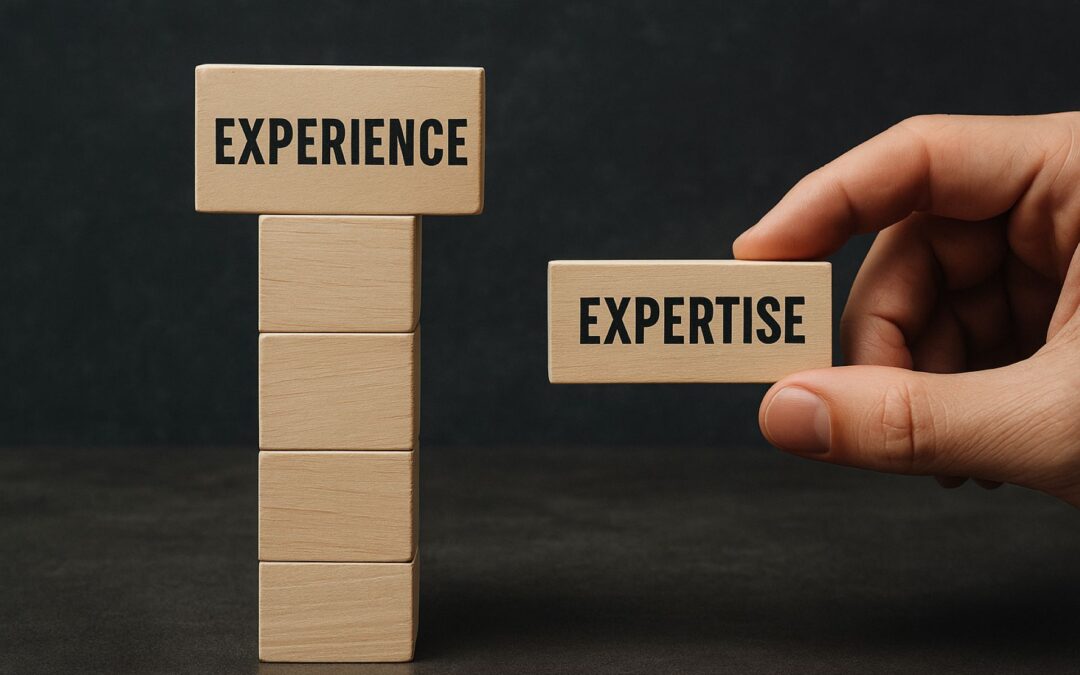
In the world of professional growth and career advancement, “experience” is often treated like a golden ticket—something that guarantees success and competence. From job applications to performance reviews, experience is frequently touted as a crucial qualification. But is experience truly the key to excellence, or is it just a comforting illusion of competency? In reality, the importance of experience is often overrated.
What truly sets individuals apart in today’s fast-changing world is not the number of years they’ve spent doing something, but their ability to develop expertise. Expertise, built through deliberate practice and a commitment to continuous learning, is what enables professionals to adapt, innovate, and thrive in an ever-evolving landscape. Let’s explore why experience is not the ultimate determinant of success and why expertise should be the real focus for growth and achievement.
Debunking the Myth of Experience
When people talk about experience in the workplace, it’s often treated as the ultimate qualification. Companies post job listings demanding “X years of experience,” and job seekers flood the market with resumes that boast their accumulated time in roles. But what if the importance of experience is a myth? What if the emphasis on years spent doing something is ultimately irrelevant to true competence?
At first glance, experience seems like an undeniable asset. It suggests familiarity, which translates to comfort in handling familiar tasks. Imagine you’re tasked with something you’ve done many times—whether it’s managing a client project, negotiating a deal, or simply attending meetings. You know exactly what to expect. You know when a conversation will take a certain turn, when a project will hit a snag, or when a decision will need to be made. This sense of control is comforting. It allows you to perform tasks with a sense of ease, making the process seem effortless. It’s like driving a well-known route every day: you don’t have to think much about the path, and you’ve seen every turn so many times that it feels automatic. You’re comfortable in that predictability.
But what happens when the familiar changes? The road you’ve always driven on suddenly gets a detour, or an unforeseen challenge arises. The comfort that once came from experience quickly dissolves. Why? While experience may grant you the ability to anticipate patterns and handle routine situations with confidence, it doesn’t necessarily prepare you for new challenges. It’s the same thing that happens in the workplace—when companies ask for experience, they are asking for comfort in handling predictable, known scenarios. But what they’re overlooking is that the world doesn’t operate in neatly predictable patterns anymore. Especially in today’s rapidly evolving markets, industries, and technologies, that same comfort can become a trap.
The problem is, we often mistake familiarity for mastery. Familiarity allows you to get by—sometimes even well—but mastery requires something more. Experience doesn’t guarantee that someone is pushing the boundaries, improving, or innovating. In fact, relying solely on experience can foster complacency. After all, if you’ve been doing the same thing for years, why bother challenging the way you do it? This is why a high level of experience doesn’t always correlate with success or breakthrough innovation.
Experience vs. Expertise: A Crucial Distinction
The key to understanding why experience is overrated is recognizing the distinction between experience and expertise. While these two concepts are often conflated, they represent entirely different approaches to skill development and performance.
Experience is often about the quantity of time spent in a particular field or role. If someone has been in a profession for years, they’ve likely encountered the same tasks, challenges, and scenarios over time. Experience is the result of repetition—doing the same things again and again until you are comfortable with them. But this kind of experience doesn’t inherently mean that someone has developed a deeper understanding or a higher level of skill. It simply means they’ve spent time in the field. They have become adept at handling the familiar, but that doesn’t equate to expertise.
Expertise, on the other hand, is about depth and mastery. It’s the ability to not only perform a task but to understand it at a profound level, innovate upon it, and apply it in new, effective ways. Expertise is about continuously pushing boundaries, learning, and improving. It’s an active pursuit, not a passive one. It requires deliberate effort and a mindset that focuses on growth, adaptation, and challenge. For instance, think about a doctor. A doctor with 20 years of experience might have seen a variety of cases and treated many patients. But if that doctor hasn’t kept up with new medical research, tried new techniques, or sought to improve their approach, their experience may have plateaued. A doctor who actively seeks out the latest treatments, attends medical seminars, and challenges their own methods will likely offer more value to their patients than one who simply rests on their years of practice.
The crux of the matter is that while experience provides a broad sense of comfort and predictability, it does not require improvement. You can go through the motions year after year, facing the same problems, and still not grow as an expert. Expertise, however, is about continuous learning, adaptation, and improvement, which cannot happen by simply repeating the same tasks over time. An expert doesn’t just react to problems—they anticipate, solve, and often innovate new ways to address them.
For example, imagine two chefs: one who has been making the same dish for 10 years and another who experiments with new techniques, tries new recipes, and learns from feedback. The first chef may be very skilled at preparing the dish—but they’re only doing so out of habit, not a deep understanding of the nuances involved. The second chef is not just skilled but is pushing the boundaries of culinary expertise, applying their knowledge in innovative ways to create something new. The second chef’s depth of knowledge and ability to innovate make them the true expert, even if they’ve had fewer years in the kitchen.
Thus, when companies demand experience, what they’re often really asking for is expertise. The issue is that they may not fully understand the distinction between the two. Experience is simply the result of time and repetition; expertise is the result of deliberate practice and continuous improvement. This is why it’s possible to become an expert faster than you can accumulate years of experience—provided you are focused on intentional growth and the development of your skills.
The Role of Time in Gaining Experience
Time is often viewed as a crucial factor in accumulating experience, but it’s essential to understand that time spent in a role or industry doesn’t automatically translate to mastery or the highest level of skill. The notion that more years equate to more knowledge is widespread in the corporate world and beyond, but it oversimplifies the process of professional and personal development.
Consider the example of a teacher with 20 years of experience. At first glance, their resume seems impressive. They have witnessed a range of student behaviors, handled countless classroom challenges, and presumably developed an intuitive sense of what works. However, what if that teacher has been using the same teaching methods for the last decade, refusing to adapt to modern tools, or never seeking out new pedagogical strategies? Their 20 years of teaching could simply represent 20 years of doing the same things, not necessarily 20 years of growth and improvement. While they’ve had the chance to face a variety of situations, if their focus has been on managing routine challenges rather than enhancing their craft, their experience is limited to repetition, not refinement.
The same can be said for someone in any profession. A carpenter who has been crafting furniture for decades might have honed a certain set of skills, but if their tools and techniques haven’t evolved over time, their craft may remain stagnant. This is a common trap people fall into—assuming that the passage of time in a role is sufficient to develop expertise. But just because you’ve been on the job for years doesn’t mean you’ve continuously sought to improve or innovate.
Time spent in a job does allow for familiarity with the job’s typical rhythms, challenges, and environments. It helps you become attuned to what’s coming next, which can reduce stress and decision-making time. But familiarity and routine should not be mistaken for expertise. This distinction is particularly important in industries where change is constant. For example, in technology, what worked five years ago may be outdated today, and someone who hasn’t kept up with these shifts, despite being in the industry for a long time, is at risk of becoming obsolete.
Moreover, time doesn’t automatically bring new perspectives. People may grow comfortable with their approach, feeling confident in their established methods. Yet, true progress in any field comes from challenging these methods, trying new approaches, and learning from both successes and failures. Expertise isn’t about sitting in one place for years; it’s about constantly moving forward, adjusting, and adapting to the new demands of the job.
This is why focusing solely on the duration of time in a role as a measure of competence is flawed. Time spent in a role does not guarantee a deeper understanding or greater skills. Instead, the emphasis should be on the intensity of the effort within that time—whether the person actively sought to expand their knowledge, improve their methods, and take on new challenges. A person who has spent five years actively learning, experimenting, and growing may have more expertise than someone with 20 years who has grown complacent.
Expertise: The Power of Deliberate Practice
Deliberate practice is the cornerstone of expertise. This concept goes beyond merely performing tasks over and over—it involves a focused, conscious effort to improve one’s skills and understanding. Deliberate practice is characterized by clear goals, ongoing feedback, and continuous refinement, all of which differentiate it from simply repeating a task out of habit.
The idea behind deliberate practice is simple: to master a skill, you must continually push the boundaries of your ability. It’s about intentionally stepping out of your comfort zone and confronting tasks that challenge you. This approach requires an awareness of your weaknesses and a willingness to address them, rather than continuing to do things that are already within your capability. For instance, a musician who is committed to deliberate practice may choose to work on a challenging new piece of music rather than simply playing their favorite, familiar tunes. They focus on improving their technique, learning new scales, and pushing themselves to master new rhythms or styles. This is far different from someone who has played the same set of songs for years but never ventured beyond that repertoire.
Deliberate practice can be applied across all fields. For example, consider a graphic designer. A designer who focuses on deliberate practice might take the time to learn new design tools, study emerging trends, and experiment with new techniques that push the boundaries of their current work. Instead of sticking to the same designs they’re comfortable with, they actively seek ways to innovate and improve their craft. They might take on challenging design projects, ask for feedback from peers or mentors, and practice creating designs outside their comfort zone to expand their skill set.
One of the key components of deliberate practice is feedback. Simply doing something repeatedly doesn’t guarantee improvement. To truly develop expertise, you need feedback to understand what you’re doing right and where you can improve. For example, a writer might submit their work to peers for critique, take constructive criticism, and revise their work based on that feedback. This process helps refine the skill and accelerates progress. Without this type of reflection and input, you may not be able to see your blind spots or areas where your practice could be more focused.
Another hallmark of deliberate practice is its focus on pushing through discomfort. Expertise requires more than just performing familiar tasks; it’s about identifying areas where you’re weak or unsure and working intentionally to improve them. This can be uncomfortable at times—whether it’s learning a new software, attempting a new technique, or tackling complex problems—but it’s this discomfort that leads to growth. The person who thrives in deliberate practice embraces this discomfort as a necessary part of the process.
Perhaps most importantly, deliberate practice is iterative. It involves constant iteration: practice, assess, refine, repeat. This ongoing cycle of improvement helps an individual move from novice to expert. In contrast, someone relying solely on experience might continue to repeat the same processes without actively working to get better. This is why deliberate practice is often seen as the key to rapidly developing expertise. It’s not about the time spent in the field—it’s about how focused and intentional that time is.
For example, in fields such as sports, the concept of deliberate practice is essential. A basketball player who spends hours practicing shots will improve, but a player who practices specific techniques, focuses on their weaknesses, and works with a coach to receive feedback will improve much faster. The same principle applies to virtually any field, from software development to public speaking. The key to expertise is not simply doing something for a long time, but doing it with the intention of getting better and actively seeking opportunities to refine your skills.
Why Experience Isn’t Always the Answer
Experience is often touted as a guarantee of competence, but in many cases, this assumption doesn’t hold true. The belief that experience automatically equates to superior performance is a common misconception, and it’s one that limits the potential of both individuals and organizations. There’s an inherent flaw in the idea that the more years you spend in a role, the better you become at it. This oversimplified perspective fails to account for the nuances of skill development, the need for continual learning, and the changing dynamics of today’s fast-paced world.
The first problem with the experience-over-expertise mentality is that it doesn’t consider the fact that experience can breed complacency. Over time, individuals may become comfortable in their routines, relying on the same methods that worked in the past. For instance, a manager with 15 years of experience might rely on traditional approaches to problem-solving without ever challenging their methods or considering new ways to tackle issues. The longer someone stays in a role, the more entrenched they become in their habits, and the less likely they are to seek out innovative solutions. In this case, experience may actually hinder growth and limit their ability to adapt to new challenges.
This is especially dangerous in industries where change is constant. Take the tech industry, for example. Technologies evolve rapidly, and relying solely on years of experience with outdated software or tools can leave individuals lagging behind. A person who has spent 10 years working with a particular set of tools might have deep knowledge of that system, but if they haven’t kept up with new developments, they may find themselves at a disadvantage when the market shifts. In contrast, someone with less experience but more up-to-date knowledge of the latest technologies can leap ahead quickly, using their fresh perspective and adaptability to thrive in new environments.
Moreover, experience doesn’t necessarily indicate the highest quality of work. Just because someone has spent years in a position doesn’t mean they are the best at what they do. Experience can sometimes be an illusion of competence. For example, someone who has been in sales for a decade might have a good grasp of the basic techniques but may not be excelling at closing deals or maintaining long-term client relationships. They’ve been in the job long enough to develop a sense of what works, but they might not have refined their skills or developed new strategies that could significantly improve their results. This is why simply asking for more experience is an unreliable metric for hiring or promotion decisions.
Experience also leads to the false assumption that it’s always safer to hire someone with years on the job. Companies often gravitate toward candidates with lengthy resumes, thinking they’re taking fewer risks. However, this approach overlooks the value of fresh talent. Someone with fewer years of experience might bring new insights, ideas, and energy to the table—qualities that someone with years of experience may have lost along the way. The assumption that experience automatically means success can prevent businesses from tapping into new and innovative ways of thinking.
In short, the idea that experience is always the answer leads to a narrow view of what makes someone qualified. It disregards the importance of continuous learning, adaptation, and the willingness to evolve. While experience can be useful, it should not be the sole criteria for success or hiring decisions. Instead, organizations and individuals should focus on active skill development, innovation, and expertise, which are far more valuable in today’s fast-changing world.
The New Paradigm: Proof of Ability Over Experience
As the world becomes more fast-paced and dynamic, the traditional reliance on experience as the gold standard is rapidly becoming outdated. Instead, the focus should shift to proof of ability. Proof of ability refers to concrete evidence of what a person can do, not just claims about how long they’ve been doing it. This approach bypasses the subjective nature of experience and gives employers, clients, and colleagues a clear and tangible understanding of someone’s capabilities.
Proof of ability can take many forms depending on the field. For example, a designer’s proof of ability might be a portfolio showcasing their best work—creative designs that demonstrate not only skill but also innovation and adaptability. A software developer might have a GitHub profile filled with successful coding projects, each demonstrating their proficiency with different languages, tools, and problem-solving techniques. In contrast to experience, which can be vague and heavily dependent on time spent in a job, proof of ability offers clear, verifiable evidence of someone’s capabilities.
The beauty of proof of ability is that it transcends time and role-specific experience. Rather than being confined to a job title or the number of years spent in a field, proof of ability is dynamic and adaptable. It reflects a person’s current level of expertise and skill, irrespective of how long they’ve been working. This makes it particularly useful in industries that evolve rapidly, where the ability to stay relevant and continually improve is far more important than merely clocking in time. For example, in the digital marketing world, someone who can show a track record of successful campaigns, high engagement rates, or measurable ROI is proving their value far more effectively than someone who has merely been in the field for years without achieving meaningful results.
Moreover, proof of ability is within your control. Unlike experience, which is tied to the passage of time and external factors like job opportunities, proof of ability is something you can actively create and improve. You can build your portfolio, start side projects, contribute to open-source software, write articles, or showcase your skills in any number of ways. This allows you to demonstrate your value to potential employers or clients without waiting for permission or relying on traditional experience-based credentials. The more proof of ability you have, the more difficult it becomes for anyone to dismiss your qualifications based on time alone.
This new paradigm shifts the focus from experience as a qualifier to skills and results as the determining factors. In fields like graphic design, writing, software development, and marketing, results speak louder than years spent in the industry. A person with fewer years of experience but a proven track record of successful projects or outcomes can often outperform someone with more years but no tangible evidence of their success.
Proof of ability is also much more up-to-date. Experience often lags behind current trends and innovations, while proof of ability reflects real-world, current skills. For example, a social media strategist who’s built successful campaigns recently can demonstrate their ability to navigate the most up-to-date platforms, trends, and strategies. Someone who’s been in the role for years may not have adapted to the latest algorithms or content marketing techniques, making their years of experience less relevant.
By focusing on proof of ability, you move away from relying on experience as the sole indicator of competence. This approach fosters a more meritocratic environment where people are valued for their actual contributions and results, not just their time in a position. Whether you’re a job seeker, freelancer, or entrepreneur, showcasing proof of ability allows you to demonstrate your value and stand out in a crowded field. Instead of waiting for years of experience to accumulate, you can focus on producing work that speaks for itself and proves your capabilities in real, actionable ways.
The Value of Expertise in a Rapidly Changing World
In today’s fast-paced and ever-evolving world, expertise is becoming more valuable than experience. This is especially true in industries that are driven by technological advancements and constantly shifting trends. Expertise isn’t about accumulating years of experience; it’s about possessing the knowledge, skills, and adaptability required to stay ahead of the curve. As industries evolve, the ability to continuously innovate, problem-solve, and apply deep knowledge is what sets the leaders apart from the followers.
In fields like technology, finance, healthcare, and marketing, change is the only constant. Technologies evolve rapidly, consumer preferences shift, and market demands fluctuate. Someone with decades of experience may have a deep understanding of the way things worked in the past, but if they haven’t adapted to the present and anticipated future developments, they will quickly find themselves left behind. In contrast, an expert who is constantly learning, challenging themselves, and staying on top of emerging trends will not only remain relevant but also thrive.
For example, in the world of software development, a developer who focuses on acquiring deep expertise in the latest programming languages and frameworks will have a distinct advantage over someone who relies on older technologies they have worked with for years. While the latter may have significant experience with legacy systems, they are less likely to thrive in a landscape where companies are rapidly adopting cutting-edge tools. Conversely, the developer who has specialized expertise in new technologies can bring fresh, valuable insights to projects and drive innovation.
This focus on expertise rather than mere experience is essential in industries where innovation is key. Consider the world of artificial intelligence (AI) and machine learning. These fields have seen incredible advancements over the past decade, with new algorithms, tools, and techniques constantly being developed. Professionals in these fields must stay up to date with the latest research and innovations to remain competitive. Experience alone isn’t enough to ensure success. In fact, relying solely on past knowledge may hinder progress, as experts in AI must constantly adapt to new findings and leverage their expertise to solve novel problems.
Expertise also enables individuals to push boundaries and explore uncharted territory. Those with a deep understanding of their field don’t just rely on established practices—they innovate, experiment, and test new approaches. They lead the charge, setting trends rather than following them. In contrast, those who only rely on experience may become bogged down by routine and comfort, failing to explore new possibilities or consider alternative perspectives.
In a rapidly changing world, expertise isn’t just an asset—it’s a necessity. As industries continue to evolve, individuals who are experts in their fields are the ones who will shape the future. They are the ones who can navigate the complexities of the modern world, adapt to new technologies, and drive innovation. It’s not about how long you’ve been doing something; it’s about how well you can apply your knowledge and skills to solve today’s problems and anticipate tomorrow’s challenges.
Shifting the Focus: Experience Isn’t the Endgame
The future of work and personal development lies in a shift from valuing experience to valuing expertise. While experience certainly has its merits, it is expertise that drives true growth, innovation, and success. In many industries, experience can only get you so far—what matters more is how much effort you put into mastering your craft and continuously improving.
In many cases, experience can become a limitation rather than an advantage. When someone has spent years in a role without actively seeking to expand their knowledge or skills, they may become entrenched in their methods, limiting their potential for growth. Experience can create a false sense of security, where individuals become comfortable with their existing knowledge and fail to push themselves to learn new things. Over time, this comfort can result in stagnation, as those individuals are not actively challenging themselves or evolving their skill set.
This is why focusing on expertise—defined by deliberate practice, continuous learning, and intentional skill-building—becomes a far more valuable approach. Expertise allows individuals to stay adaptable and agile, able to pivot quickly when new opportunities or challenges arise. This mindset of constant improvement, innovation, and mastery enables individuals to remain competitive and relevant, even in fields where change is frequent and rapid.
For example, in the realm of digital marketing, the tools and strategies that worked five years ago may no longer be effective. Social media algorithms change, search engine optimization (SEO) techniques evolve, and new platforms emerge. A marketer with years of experience might know the ins and outs of older techniques, but someone with expertise in the latest trends and strategies will be better equipped to drive results. The expert understands the importance of continuous learning and adapts to new challenges, while the experienced professional may find themselves struggling to keep up.
The value of expertise extends beyond the individual level. Organizations that prioritize expertise over experience are better positioned to innovate and lead in their industries. By fostering a culture of continuous learning and development, companies can ensure that their teams stay ahead of the curve and are able to tackle the challenges of the modern world. This approach encourages employees to grow and evolve, allowing them to take on new roles and responsibilities, drive innovation, and bring fresh perspectives to the table.
Moreover, shifting the focus from experience to expertise opens up opportunities for people who may not have had traditional career paths or long years of experience but have demonstrated the ability to excel in specific areas. This is especially relevant in today’s gig economy, where individuals are often hired based on their skills and results rather than the number of years they’ve spent in a particular role. Professionals who can showcase their expertise through portfolios, projects, and tangible outcomes are more likely to stand out than those who rely solely on a lengthy resume.
As industries continue to change and evolve, the value of experience will become less relevant. What will matter more is the ability to demonstrate expertise, innovation, and adaptability. By focusing on developing expertise through continuous learning, deliberate practice, and a commitment to mastering your craft—you can position yourself as a leader in your field, regardless of how much time you’ve spent in the industry. Expertise is not just about knowledge; it’s about applying that knowledge in meaningful ways to solve problems, drive innovation, and lead others toward success.
Conclusion
While experience can undoubtedly offer comfort and familiarity, it’s expertise that drives true mastery. In today’s rapidly evolving world, where innovation and adaptability are paramount, relying solely on years of experience may leave you stuck in the past. Expertise—achieved through deliberate practice, continuous learning, and applying deep knowledge—provides the tools needed to tackle new challenges and push the boundaries of what’s possible.
As industries shift, the professionals who lead the charge are those who prioritize expertise over experience, focusing on developing their skills and adapting to new opportunities. So, whether you’re building your career or leading a team, remember: experience may get you started, but it’s expertise that will help you succeed in the long run.