
We live in an era that prizes information over experience. We chase certificates, collect advice, and stockpile knowledge, yet remain curiously untransformed by it. Knowing has become a performance; doing, an afterthought. But the truth of mastery has never changed — it lives in the body, not the book.
To truly understand something, you must touch it, test it, and let it resist you. Learning by doing is the oldest form of intelligence we possess, the kind that shapes both hand and mind together. It requires patience, humility, and a tolerance for imperfection — the quiet virtues of anyone who has ever built something real.
Daily Law: The brain is designed to learn through constant repetition and active, hands-on involvement. Through such practice and persistence, any skill can be mastered. Pick a skill to acquire and begin to practice.
Robert Greene, “Five Key Elements for a New Model of Apprenticeship,” The New York Times, February 26, 2013
The Trap of Passive Learning
Our modern systems of education have trained us to be receivers of knowledge rather than participants in it. From childhood, we are rewarded for listening quietly, memorizing efficiently, and reproducing information accurately. Success is measured by recall, not by insight. The result is a kind of intellectual passivity — a mind that knows about things but does not know through them.
This creates an illusion of competence. You read about business strategy and feel ready to start a company. You study philosophy and believe you understand life’s complexities. But when reality intervenes — when a product fails, when a belief is tested — that borrowed confidence collapses. Theoretical knowledge, untested by experience, is like a map of a city you’ve never walked through. You may know every street name, but you can’t feel the terrain beneath your feet.
True learning, by contrast, happens when thought meets friction. The mind sharpens only against resistance. To move from knowing to understanding, you must act — make the decision, write the paragraph, assemble the piece of furniture, ruin it, start again. That is how ideas solidify into intuition. Every mistake becomes a data point your brain encodes in a way no lecture could ever replicate.
Formal education has its value — it gives language, frameworks, and starting points — but it often neglects the one form of learning the brain evolved for: embodied trial and error. We are wired to interact, to tinker, to adjust. When you use your hands, when you physically engage with a problem, your understanding becomes three-dimensional. You stop reciting information and start internalizing it.
Books can inspire you, teachers can point the way, but mastery demands your own fingerprints on the process. Theories are meant to be tested, not worshipped. Until you apply what you’ve learned in the real world, knowledge remains fragile — a collection of borrowed insights untested by consequence.
The truth is simple but uncomfortable: most people would rather feel smart than become capable. Real learning requires discomfort, repetition, and risk — the willingness to stumble. But in that awkward space, something miraculous happens. The mind, engaged and alert, begins to grow. It replaces abstract knowing with embodied wisdom. It stops asking “What do I know?” and starts asking “What can I do?”
The Apprenticeship of Observation
Before mastery comes imitation. Before imitation comes attention. The greatest learners are often not the ones who speak the most, but the ones who watch with disciplined silence.
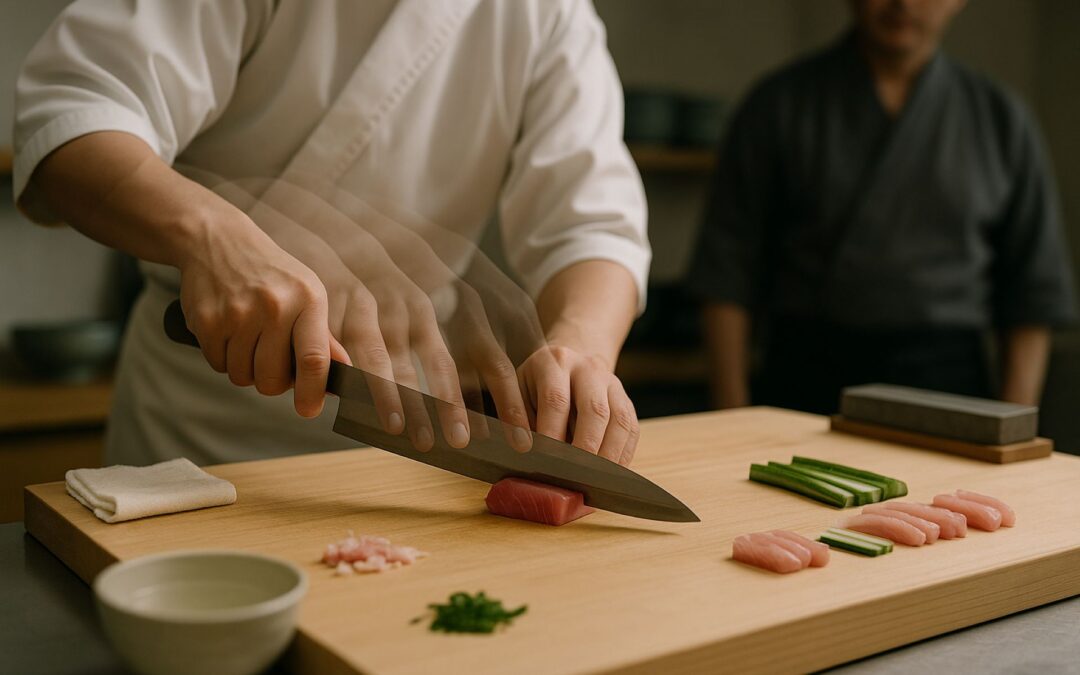
Eiji Ichimura’s story captures this perfectly. As a young dishwasher in Tokyo, his dream was to become a sushi chef. Yet in that tightly guarded culinary world, recipes and techniques were secrets passed only to a chosen few. No one instructed him, no one offered shortcuts. The kitchen hierarchy demanded obedience, not curiosity. So he learned the only way he could — by observing.
Day after day, Ichimura watched the masters at work. He noticed how they held the knife, how their breathing matched the rhythm of their cuts, how every motion — from slicing fish to shaping rice — flowed with ritual precision. He memorized gestures, angles, and timing without uttering a word. Each detail was a clue, each movement a lesson in efficiency and grace.
Then, when the kitchen fell silent at night, he would practice alone. He repeated the motions endlessly, cutting vegetables into invisible sushi, refining the same stroke until it felt effortless. He learned not from instruction but from absorption — from the slow conversion of observation into muscle memory. Years later, his movements would bear the unmistakable stillness of mastery, the kind that can only come from years of devotion rather than direct teaching.
Ichimura’s path mirrors that of countless masters before him — from sculptors and calligraphers to athletes and musicians. They begin not with a manual but with imitation. Watching, absorbing, and repeating are not signs of limitation but of respect for the craft. In a culture obsessed with originality, we forget that all innovation begins with replication. You must copy before you can create.
The apprenticeship of observation demands humility. It asks you to be a beginner again, to surrender the ego’s hunger for speed and visibility. But in doing so, it grants you something greater — the foundation of intuition. Observation teaches patience, attention, and reverence for detail. It forces you to slow down enough to notice what others overlook: the tiny refinements, the invisible disciplines, the quiet rituals that separate competence from art.
When you study closely, the world begins to reveal its hidden grammar. Patterns emerge. Movements acquire meaning. And through steady practice, imitation transforms into originality — not through rebellion, but through mastery.
The Rhythm of Repetition
Repetition is the invisible architecture of mastery — the quiet rhythm beneath every skill, every art form, every act of excellence. Yet our culture, obsessed with instant progress, often mistakes repetition for stagnation. We crave variety, speed, and shortcuts. But the truth is, the human brain doesn’t evolve through novelty — it evolves through refinement. Each repetition is not a copy of the last but a microscopic evolution of it, a new iteration in the ongoing dialogue between body and mind.
In the beginning, repetition feels dull. It grates against our need for stimulation. You practice the same piano scale, write the same opening paragraph, swing the same hammer, again and again. But underneath the monotony, your nervous system is quietly transforming. Neurons fire in tighter synchrony, connections strengthen, movements become more precise. The conscious strain that once accompanied every step starts to fade. What began as mechanical labor becomes a kind of moving meditation.
This is how true fluency emerges — not from bursts of inspiration but from the accumulation of thousands of disciplined repetitions. The athlete, the craftsman, the writer, the dancer — all are united by this invisible ritual. Repetition doesn’t merely improve performance; it changes identity. Through it, the act becomes part of you. You no longer do the skill; you embody it.
It is also through repetition that you learn endurance — the art of staying when others quit. The discipline to repeat when progress feels imperceptible is what separates the amateur from the master. Each repetition is an act of faith, a declaration that improvement will come, even if it can’t yet be seen. And with time, something shifts. The dull repetition that once felt burdensome begins to feel rhythmic, almost musical. The motion becomes natural, then graceful. Eventually, it becomes art.
Every great craftsperson understands this paradox: mastery hides inside boredom. When others flee from monotony, the master stays. The sculptor sanding stone for the thousandth time, the coder debugging yet another line, the violinist tuning to the same note — they all know that perfection is not a single act but a sequence of devoted returns. Each repetition builds on the last, stacking invisible layers of understanding until one day, the work speaks with a life of its own.
Repetition, then, is not the enemy of creativity — it is its foundation. It teaches patience, hones instinct, and strips away distraction. When practiced with awareness, repetition becomes revelation. It’s the slow, deliberate rhythm through which ordinary movement turns into timeless skill.
The Maker’s Mindset
The maker’s mindset begins where repetition leaves off — in the realization that mastery is not a destination but a continuous state of engagement. It is the quiet acceptance that there will always be another layer to refine, another nuance to uncover, another weakness to strengthen. To think like a maker is to approach learning not as a race but as a lifelong conversation with your craft.
At its heart, this mindset is built on humility. The maker does not demand immediate results; they trust the process. They know that excellence cannot be forced or rushed. It emerges naturally when effort becomes ritual and patience becomes instinct. This patience is not passive — it’s active, grounded in the discipline of showing up even when the spark of motivation has long faded.
The maker also learns to see mistakes differently. Failure is no longer a verdict but a form of feedback — an essential component of progress. Every imperfection points to a deeper truth about the material, the method, or the self. To the untrained eye, a failed attempt looks like waste; to the maker, it is raw data. It’s how you adjust, evolve, and refine.
Over time, this relationship with failure breeds resilience. The maker learns to endure the unseen seasons — the long stretches of invisibility where effort seems unrewarded. They understand that mastery unfolds in solitude, far from applause. The satisfaction lies not in external validation but in the subtle internal shift when a motion feels smoother, when the work resists less, when intuition quietly takes over.
The maker’s mindset also redefines success. It’s not about finishing quickly or dazzling others but about deepening one’s relationship with the craft itself. A potter shaping clay, a writer revising a paragraph, a carpenter aligning a joint — each gesture is both work and meditation. The act itself becomes meaningful, regardless of the outcome.
To live as a maker is to find beauty in process, not perfection. You begin to measure progress not by leaps but by layers — each session adding invisible depth to your competence and character. The maker trusts that even small, unseen efforts accumulate into something lasting. They understand that mastery is not built in grand gestures but in quiet repetition, humble patience, and the persistent will to return to the work — again and again.
The maker’s mindset, in the end, is not about control but surrender — surrendering to the slow tempo of true growth, to the rhythm of imperfection and refinement. It’s the posture of one who understands that creation, like character, is shaped through time, friction, and faithful attention.
Conclusion
The path of mastery is not lined with revelation but with repetition. You learn by engaging, failing, and refining — by returning to the work again and again until thought and action are indistinguishable. In the end, learning by doing is less about acquiring skill and more about transforming character. Each attempt teaches not only technique but temperament.
You grow steadier, more observant, more attuned to the subtle rhythms of progress. What begins as effort becomes instinct; what feels like struggle becomes grace. And through this ongoing conversation between mind, material, and motion, you discover the quiet truth that every master eventually learns — that practice is not the means to mastery; it is mastery.
This article is part of The Daily Laws Series based on Robert Greene’s book.