
“One repays a teacher badly if one remains only a pupil.”
— Friedrich Nietzsche
Every apprenticeship begins in the shadow of someone else’s mastery. You enter that world small, uncertain, grateful for any fragment of guidance. At first, the mentor’s voice becomes your compass, their methods your map, their approval your measure of worth. But as your abilities sharpen and your perception deepens, a quiet tension begins to form. The very person who once opened the door now occupies the space you must eventually walk into. This is not conflict — it is the natural geometry of growth.
The journey toward mastery is not defined only by devotion but by divergence. To honor the master fully, you must one day step beyond them. And in the ancient rhythm of mentorship, this moment is symbolized by a simple, unsettling idea: to the master goes the knife. A metaphorical cut — not of harm, but of separation — marking the instant you become responsible for your own path.
This article explores that moment. The tension, the rebellion, the discernment, and the lineage it creates. Because no matter your field, mastery demands that you eventually stand alone.
Daily Law: Internalize the important and relevant parts of the Master’s knowledge. Apply the knife to everything else.
— Mastery, III: Absorb the Master’s Power — The Mentor Dynamic
The Moment of the Cut
In the quiet architecture of every apprenticeship, there exists an invisible threshold. You cross it not with celebration but with a subtle shift in posture — a moment when your hands no longer tremble as they once did, and the master’s movements no longer appear supernatural. What once felt unreachable begins to feel familiar. What once intimidated now invites examination.
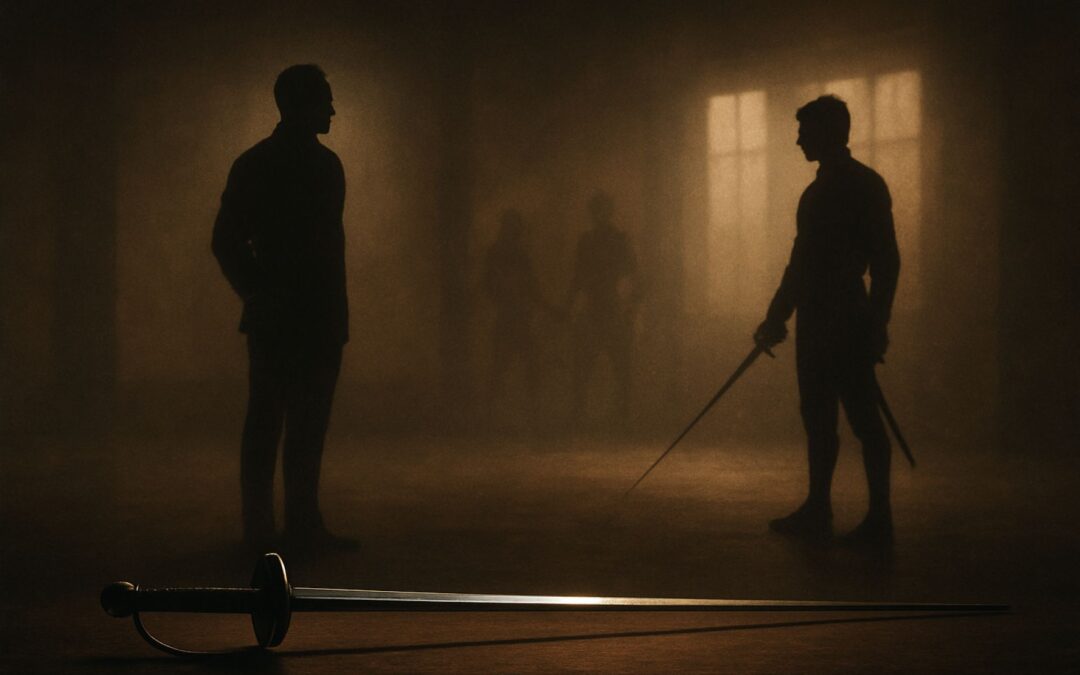
This is the moment embodied in the old Spanish fencing expression al maestro cuchillada — “to the Master goes the knife.” The phrase is unsettling, violent at first glance, but its true meaning lies in the delicate, almost sacred transition it describes. The “knife” is not a literal blade. It is competence, confidence, and clarity. To cut the master is not to harm him — it is to show him that his teaching has taken root.
Every true teacher knows this moment must come. Apprenticeship is never meant to be an eternal arrangement. It is a bridge, not a home. The master is there to be absorbed, studied, replicated, and eventually transcended. Mastery demands this sequence; growth requires this severance.
But the cut is not a clean or simple act. Emotion complicates the process. Reverence makes you hesitate. Gratitude slows your hand. You remember the early days — when the master corrected your errors, when they tolerated your blunders, when they shaped your rawness into something usable. There is a debt there, an unspoken bond that seems to forbid any impulse of distance.
Yet distance is inevitable.
As your skill grows, so does your autonomy. As your eye sharpens, so does your judgment. You begin to discern where the master’s strengths end and where their blind spots begin. You see their limitations — not with arrogance, but with clarity. Every human being, no matter how wise, leaves certain stones unturned.
Eventually, you realize the apprenticeship can give you no more. Remaining a pupil becomes a slow erosion of potential. The knife must descend — not out of malice, but out of necessity. It is the only way the apprentice becomes an equal. It is the only way the master’s lineage continues.
This moment, though painful, is the silent heartbeat of all progress.
The Nature of Rebellion
Modern culture romanticizes rebellion. We turn the rebel into an icon, imagining that greatness springs from defiance alone. The lone dissenter, the bold disruptor, the one who rejects tradition without hesitation — this archetype fascinates us. But most rebellion today is hollow performance. It is opposition for the sake of visibility, not transformation.
Real rebellion is quieter. It is rooted in long study, deep understanding, and a profound respect for what came before. Rebellion without foundation has no weight; rebellion attached to knowledge carries the force of revolution.
The apprentice who picks up the knife without first absorbing the master’s depth is merely a vandal. The apprentice who learns thoroughly, listens carefully, imitates patiently — and only then diverges — is the one who creates something lasting.
This kind of rebellion is not emotional but evolutionary.
When you begin your apprenticeship, you stand far from the mentor. Their competence overwhelms you, their experience dwarfs yours. But as months or years pass, the distance narrows. You begin to see that mastery is not a mystical quality, but a skill acquired through repetition, discipline, and clarity of purpose.
The more you learn, the less you mythologize your teacher. The pedestal shrinks. You see the human behind the legend — flawed, brilliant, contradictory, and incomplete. And then the internal friction begins: the mind that once obeyed starts to question. The hands that once followed start to adapt. The voice that once stayed silent begins to disagree.
Rebellion begins not with anger but with recognition.
You realize you can see angles the master cannot. You perceive opportunities they overlook. You feel impulses they have grown too comfortable to chase. The roles invert — subtly, gradually — until your viewpoint becomes sharper than theirs in certain domains.
This is the natural rhythm of all creative, intellectual, and technical growth. Every field advances by this slow friction between generations.
The painter surpasses the one who taught him to hold a brush. The mathematician extends the work of his predecessor. The musician evolves the tradition into something unrecognizable but resonant. The student becomes the challenger, not because rebellion is fashionable, but because rebellion is the mechanism through which knowledge renews itself.
Rebellion is not a rejection of the master; it is the fulfillment of the master’s purpose.
The Mentor as Mirror and Limit
When you first enter a mentor’s orbit, they feel like a living map. They know the terrain, the pitfalls, the blind alleys, the shortcuts. Their presence lifts your vision above the ground where you usually stumble. They help you see what is possible — which is the first gift of any teacher.
But the second gift is more subtle: they show you your limits.
A mentor exposes your weaknesses, corrects your errors, and challenges your assumptions. They force you to confront the parts of yourself you’d prefer to ignore. But over time, something else happens. Through the intensity of close observation, you also begin to see their limits.
This is an uncomfortable realization. The master you admired so unconditionally is not infinite. They have boundaries. They have beliefs that no longer evolve. They have techniques rooted in a different era. They have habits that served them once but may not serve you.
And most importantly: they have a perspective shaped by their journey, not yours.
A mentor’s path is not a universal road — it is a single trail carved through a singular life. To walk it forever would be to surrender your own unfolding. Apprenticeship is temporary precisely because its shape is borrowed, not born.
The master’s strengths guide you; their limits define your need to depart.
This duality — the mentor as both mirror and limit — is the silent architecture of all learning. You imitate the master so deeply that the imitation eventually suffocates. You absorb so much that absorption becomes confinement.
When that moment comes, you must step outside their shadow. Not out of disrespect, but out of self-preservation.
To stay beneath a mentor for too long is to distort the original purpose of the relationship. The master is there to render himself obsolete. The pupil is there to transcend.
The mentor cannot carry you into your own mastery. They can only equip you for the journey.
The Knife as Discernment
The knife is most misunderstood when taken literally. In the context of mentorship, it is not a weapon — it is a tool of refinement. It symbolizes the ability to separate what is essential from what is unnecessary. It represents the shift from obedience to judgment.
At the beginning of an apprenticeship, you lack the perspective to distinguish between brilliance and bias. Everything the master does feels sacred. Their preferences become your preferences. Their style becomes your style. Their way becomes the way.
But as your vision clears, you start to notice patterns. You see what is timeless in their approach — the principles that ground their mastery. You also see what is accidental — personal quirks, outdated conventions, moments where their habits outweigh their insight.
This is where the knife must be used.
To evolve, you must cut away what does not belong to you. You must remove inherited assumptions that conflict with your own nature. You must discard methods that no longer serve the era you live in. You must strip away rituals that stifle innovation.
The knife is an instrument of identity.
Every cut you make reveals more of who you actually are. Every separation allows your own voice, style, and logic to surface. True mastery is not additive — it is subtractive. It is the removal of everything that obscures your individuality.
This process requires courage. You fear disappointing the master. You fear misjudging what deserves to stay. You fear the loneliness that comes with self-direction. But discernment is the essence of adulthood, both intellectually and spiritually.
It is the moment you stop inheriting and start originating.
The Lineage of Mastery
Mastery is not a straight line — it is a lineage, a chain of minds influencing one another across time. Each link begins as a pupil, evolves through imitation, and ultimately breaks away to create something new. This cycle is not betrayal; it is tradition.
Every master you admire has once stood where you now stand — looking at their mentor with a mixture of reverence and restlessness. They too felt the tension between loyalty and liberation. They too sensed the moment when admiration became limitation. And they too had to choose the difficult path of independence.
This is why the best mentors expect — even welcome — the knife. They understand the rhythm of the craft. They know that the student who never surpasses the teacher dishonors the lineage. They know stagnation is the real betrayal.
In time, you will stand on the other side of this equation. You will teach someone. You will guide them, shape them, invest in them. And if you teach well, they will outgrow you. They will challenge your assumptions. They will extend your ideas. They will see what you could not.
When their knife descends, let it land gracefully.
It is the clearest sign that you have done your job. It is the final gesture of respect — to be surpassed. It means your knowledge has lived long enough to evolve. It means your influence has taken on a life of its own. It means you have become part of the lineage.
Conclusion
Every master you admire once faced the same choice you face now — remain in comfort or step into independence. They, too, learned from someone who shaped them, challenged them, and eventually limited them. The knife they lifted was not an act of betrayal but a declaration of readiness. A quiet vow to carry the lineage forward without becoming trapped inside it.
In your own path, the moment of the cut will come. It may feel disloyal. It may feel premature. But growth does not wait for permission, and authenticity cannot flourish in perpetual imitation. You honor your mentor not by remaining in their shadow, but by becoming the evidence that their guidance worked.
Mastery is a relay, not a monument. You receive the torch, refine it, and pass it on. And in that chain — of learning, rebelling, separating, and teaching — the world renews itself.
This article is part of The Daily Laws Series based on Robert Greene’s book.