
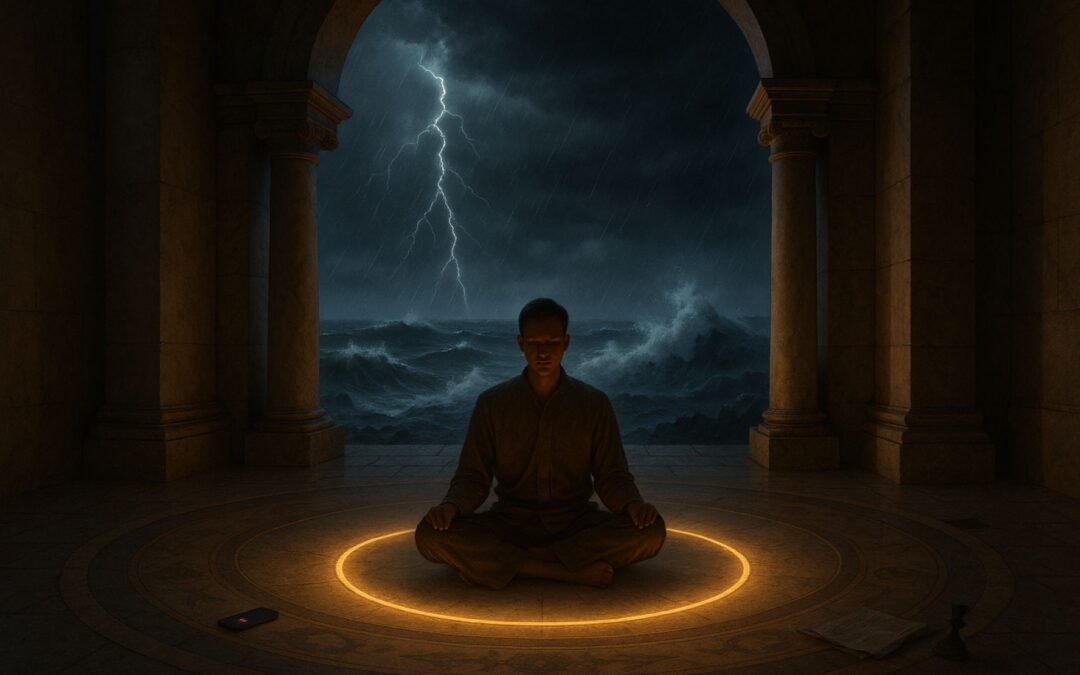
What makes a person truly invincible? Is it physical strength, unshakable confidence, or sheer willpower? Epictetus would say none of these. The only invincible person, he wrote, is the one who cannot be upset by anything outside their reasoned choice. It’s a radical idea — that invulnerability has nothing to do with controlling life and everything to do with controlling ourselves.
We admire those who keep their cool when chaos erupts — the leader who stays calm amid crisis, the athlete who performs under pressure, the friend who listens instead of lashing out. Their secret is not detachment, but discipline. They’ve learned that composure is not the absence of emotion, but the presence of mastery. The Stoics called this strength prohairesis — the ability to remain unmoved by what cannot be controlled and to respond to the world with steady reason.
This article explores that idea — how calm becomes a form of power, how reason becomes a fortress, and how invincibility can be cultivated not through domination, but through understanding.
“Who then is invincible? The one who cannot be upset by anything outside their reasoned choice.”
— Epictetus, Discourses, 1.18.21
The Calm Within the Storm
There is a quiet strength in composure — a strength so subtle that most mistake it for passivity. Yet, it is one of the rarest and most commanding forms of power. The world often glorifies dominance, loudness, and speed. But composure — that unshakable calm amid provocation — belongs to those who have mastered themselves.
Imagine standing in a storm. The wind howls, rain lashes your face, and the ground beneath you trembles. Most people brace, resist, or run. The Stoic, however, simply plants their feet and breathes. Not because they are immune to the storm, but because they understand it cannot touch their judgment. The external chaos cannot dictate their internal state unless they grant it permission.
When a seasoned professional stands before a hostile press, facing sharp questions and veiled insults, they perform a kind of modern Stoicism. Each question is a wave — it crashes, but they remain upright. They listen without defensiveness, respond without venom, and leave without resentment. The crowd might roar, the headlines might twist their words, but their equilibrium stays intact. That is the art of self-command.
This kind of calm is not natural; it’s cultivated. It is born from understanding where one’s control truly begins and ends. Epictetus taught that while we cannot control events, we can always control our judgments about them. Between the spark of stimulus and the fire of reaction lies a sacred interval — a space of reason. Those who can dwell in that space, even for a breath, hold a power that no authority, insult, or misfortune can shake.
Calm does not mean the absence of feeling. The Stoic feels anger, frustration, and fear just like anyone else. But they refuse to be enslaved by those emotions. They recognize that emotional turbulence is natural — it arises and subsides like waves. What matters is not suppressing the waves, but learning to surf them with balance and grace. To remain calm is not to feel less — it is to understand more.
In our daily lives, storms appear in subtler forms: a rude comment from a colleague, a traffic jam when you’re late, a harsh message that stings your ego. These are small gusts of wind testing your stability. Most people react automatically — snapping, sulking, withdrawing. But each of these moments is an invitation to practice composure. Every irritation is a rehearsal for strength.
To stay calm in the storm is to trust in your own reason. It’s to remember that other people’s behavior says more about their nature than it does about your worth. It’s to understand that external events are merely raw materials; how you shape them is your responsibility. Composure, then, becomes a moral act — a statement of values.
When you choose calm over chaos, patience over pride, reason over reaction, you’re not merely controlling emotion; you’re sculpting character. You are saying to the world, “I will not let you decide who I am.” That’s the moment your peace becomes power — and your calm, a form of invincibility.
The Fortress of Reasoned Choice
At the center of Stoic philosophy lies one unshakable principle: we control our mind, not the world. Everything else — fortune, reputation, relationships, the weather, the economy — lives beyond our direct grasp. Yet within us exists a power that no circumstance can touch: prohairesis, the reasoned choice. Epictetus called it “the one thing that is truly ours.” It is both our refuge and our weapon.
Imagine this reasoned choice as a fortress built not of stone but of clarity. Its walls are made of understanding; its gates open only to reason. When the outside world hurls chaos, insult, or misfortune, those arrows cannot penetrate unless we open the gate and let them in. Every emotional wound begins with an unguarded gate — a moment when we confuse the external for the internal, when we forget that impressions are not facts.
Someone cuts you off in traffic — your pulse spikes, your mind invents motives, your temper flares. Yet the event itself is neutral. The only meaning it carries is the one you assign. You could see it as disrespect, or you could see it as impatience, ignorance, or even as nothing at all. The difference between fury and peace lies entirely in that judgment.
This is what Epictetus meant by invincibility: not the elimination of hardship, but the refusal to surrender your reason to it. The Stoic does not ask for the world to be gentle; they ask to be strong enough to face it with equanimity. Prohairesis is that strength — the disciplined mind that stands between impulse and action.
Every challenge you encounter is an opportunity to test your fortress. A friend betrays you — do you collapse in bitterness, or do you see it as an exercise in forgiveness? A project fails — do you label it a catastrophe, or do you see it as material for learning? Life, to the Stoic, is a series of training drills for the soul. The greater the difficulty, the more glorious the chance to practice mastery.
But like any fortress, prohairesis must be maintained. Left unattended, its walls weaken. That is why Stoics rehearsed their values daily — through journaling, reflection, and meditation. They visualized adversity before it arrived (premeditatio malorum), preparing themselves mentally for insult, loss, and pain. When trouble came, it found them already armored in awareness.
This inner fortress doesn’t isolate you from the world — it liberates you within it. You become fully engaged yet internally undisturbed. You can love deeply without clinging, work hard without obsession, succeed without arrogance, and fail without despair. You act not because you seek control, but because you understand where control truly lies.
To live from prohairesis is to stand calmly at the center of life’s whirlpool. The waves spin, the current pulls, but you remain anchored in judgment, steady in purpose, sovereign in response. No insult, no misfortune, no praise, and no disaster can reach that core — unless you invite them in. That is why the Stoics saw reason not as cold logic, but as the very foundation of freedom.
When you choose to think before you react, to pause before you retaliate, you are not just exercising restraint — you are practicing philosophy in its purest form. You are living proof of what Epictetus called the “invincible mind”: the one fortress no storm can breach.
Training for Inner Strength
The calm, unshakable presence we admire in Stoics — and in any master of composure — is not an accident of temperament. It is the outcome of training. Just as the athlete strengthens muscles through strain, the Stoic strengthens judgment through adversity. Calm is a skill; resilience is a discipline. The world, full of friction and unpredictability, provides the perfect gym.
The ancient Stoics approached emotional discipline as a craft. They treated every setback as an exercise in control, every irritation as a weight to be lifted by reason. Seneca advised that we should deliberately expose ourselves to minor discomforts — skip a meal, endure the cold, sleep on the floor — so that we might weaken luxury’s grip on us. Marcus Aurelius began each morning reminding himself that he would meet “the ungrateful, the arrogant, the deceitful.” He rehearsed frustration before it appeared, so he could greet it not with surprise but with readiness.
In modern life, this same practice applies. Every difficult conversation, every delay, every rejection is material for inner training. When your flight is canceled or a colleague criticizes your work, the reflexive reaction is irritation. But that’s the very moment to pause, breathe, and remember: this is your workout. You are being tested not in comfort but in composure. The harder the moment, the greater the opportunity to refine your mastery.
Training for inner strength begins with awareness. You cannot command what you do not first observe. The Stoics advised daily self-scrutiny — an honest review of one’s words, impulses, and decisions. Epictetus told his students to ask, “What did I do well? What could I have done better?” This quiet reflection is not self-criticism; it is calibration. It keeps your moral compass aligned and your emotional reflexes sharp.
Journaling, meditation, and visualization were their daily drills. The Stoics journaled not to record life, but to shape it. They meditated not to escape thought, but to discipline it. They visualized hardship to dissolve fear before it arrived. In doing so, they built psychological muscle memory — an instinctive ability to stay rational under stress.
The modern equivalent might be mindfulness practice, cognitive reframing, or emotional labeling. These techniques are not new; they are Stoicism reborn in modern language. The act of noticing your irritation, naming it without judgment, and choosing a response — that is the ancient art of prohairesis in motion. Each repetition strengthens neural pathways toward calmness.
But no training works without consistency. A single act of patience does not make one patient. The Stoics insisted on continual rehearsal — the daily sharpening of awareness until calm becomes your default. Over time, reactions slow down, understanding quickens, and serenity deepens. You cease to be ruled by circumstances because you’ve already ruled yourself.
Eventually, strength becomes quiet. You no longer need to prove your composure because it radiates naturally. The noisy ego that once demanded control now rests in assurance. You can walk into chaos and not lose your peace, face insult and not feel diminished, fail and still remain whole.
This is what it means to train like a Stoic: to meet life as practice, not punishment; to see each difficulty as a repetition of the mind’s exercise; to understand that peace, like muscle, is built through resistance. When you approach every challenge as a teacher, you no longer resent adversity — you rely on it. The world becomes your gym, and your mind, indestructible.
True Invincibility
Invincibility, in the Stoic sense, is not a mythic imperviousness or the denial of pain. It is a moral condition — the absolute independence of one’s peace from the fluctuations of the external world. To the Stoic, the body can be struck, wealth can be lost, reputation can be ruined, but the mind — when governed by reason — remains untouched. That is the essence of apatheia: not apathy, but the serene freedom from destructive passion.
The world defines strength in visible terms: dominance, status, victory. Yet every conquest built on force or chance is temporary. The person who builds power on fortune is vulnerable the moment fortune shifts. The one who depends on others for validation is exposed to every whisper of praise or blame. But the person whose strength flows from within — from the disciplined alignment of thought, intention, and virtue — cannot be dethroned.
This kind of invincibility is not dramatic; it is quiet, steady, and deeply personal. You see it in the individual who loses everything yet continues to walk upright. You see it in those who endure injustice without bitterness, who remain kind in the face of cruelty, who hold to principle when convenience would offer escape. They are not spared pain, but they refuse to be owned by it. Their suffering refines them instead of breaking them.
Epictetus himself was enslaved, beaten, and mocked, yet he taught that true freedom belongs only to the rational mind. “You may fetter my leg,” he said, “but not even Zeus can conquer my will.” That is the paradox of Stoicism — the idea that power is not something to be seized but something to be understood. The more one accepts what lies outside control, the more absolute one’s control becomes over what truly matters.
To reach this state requires a profound reordering of values. It demands that we stop measuring success by outcomes and begin measuring it by integrity. Did you act with justice? Did you preserve your composure? Did you keep your word, even when it hurt? The Stoic’s pride lies not in triumph but in consistency. They do not aim to be unscathed, only unshaken.
Such invincibility does not isolate you from the world; it liberates you within it. When you no longer need life to conform to your desires, you are finally free to engage it fully. You can love without fear of loss, strive without attachment to reward, and serve without expectation of gratitude. This freedom is not the absence of care but the perfection of it — care without dependency, effort without anxiety.
And so, when adversity comes — as it always will — the Stoic neither collapses nor protests. They acknowledge it, meet it, and move through it. When insulted, they respond with composure. When betrayed, they maintain dignity. When exhausted, they continue their duty. Each act of calm endurance reinforces the inner citadel.
To be invincible, then, is not to win every battle, but to remain undefeated in spirit no matter the outcome. It is to know that while fate controls the stage, you alone control the performance. You may stumble, falter, even fall — but your will, your prohairesis, remains sovereign.
This is the Stoic’s triumph: not over others, but over the self. The strength to endure without surrender. The courage to act without demand. The grace to let go without despair. When the test ends and the dust settles, you will stand as you began — clear, calm, and whole. And when life inevitably asks again, “Are you ready?” you will smile, nod, and say, “Next.”
Conclusion
Invincibility is not about winning every fight, nor is it about escaping pain. It’s about meeting life with a steady mind and an untrembling heart. The Stoics never promised a life free from insult, loss, or hardship. They promised something greater — the ability to face all of it without surrendering your peace.
You become invincible the moment you stop demanding that the world obey your expectations. You become strong the instant you realize that calm is not weakness but wisdom in action. When challenges come — as they always do — you’ll no longer ask why me? but instead, what can I choose now?
That choice — deliberate, reasoned, and free — is the essence of Stoic power. It is the quiet confidence to stand amid the storm and say, without anger or fear, “Next.”
This article is part of The Daily Stoic Series based on Ryan Holiday’s book.